


🩸 RED BLOOD JOURNAL TRANSMISSION
Division: Civilization & Power Structures
Transmission Code: RBJ-RETIREMENT-GATEKEEP-061
Classification: Economic Architecture / Workforce Filtering Mechanism
Archive: The Archive of Blood & Memory
The five year federal pension trap
THE FIVE-YEAR GATE
How the System Invites You In… But Rarely Lets You Stay
🪐 PROLOGUE — THE INVITATION
On the surface, the message is simple:
“It’s not too late.”
Join late.
Start over.
Build a future—even at 61.
The system appears generous.
It offers a path:
Work a few years
Earn a pension
Secure a stable ending
A second chance.
But beneath the surface…
There is a gate.
And not everyone who enters… reaches it.
I — THE PROMISE
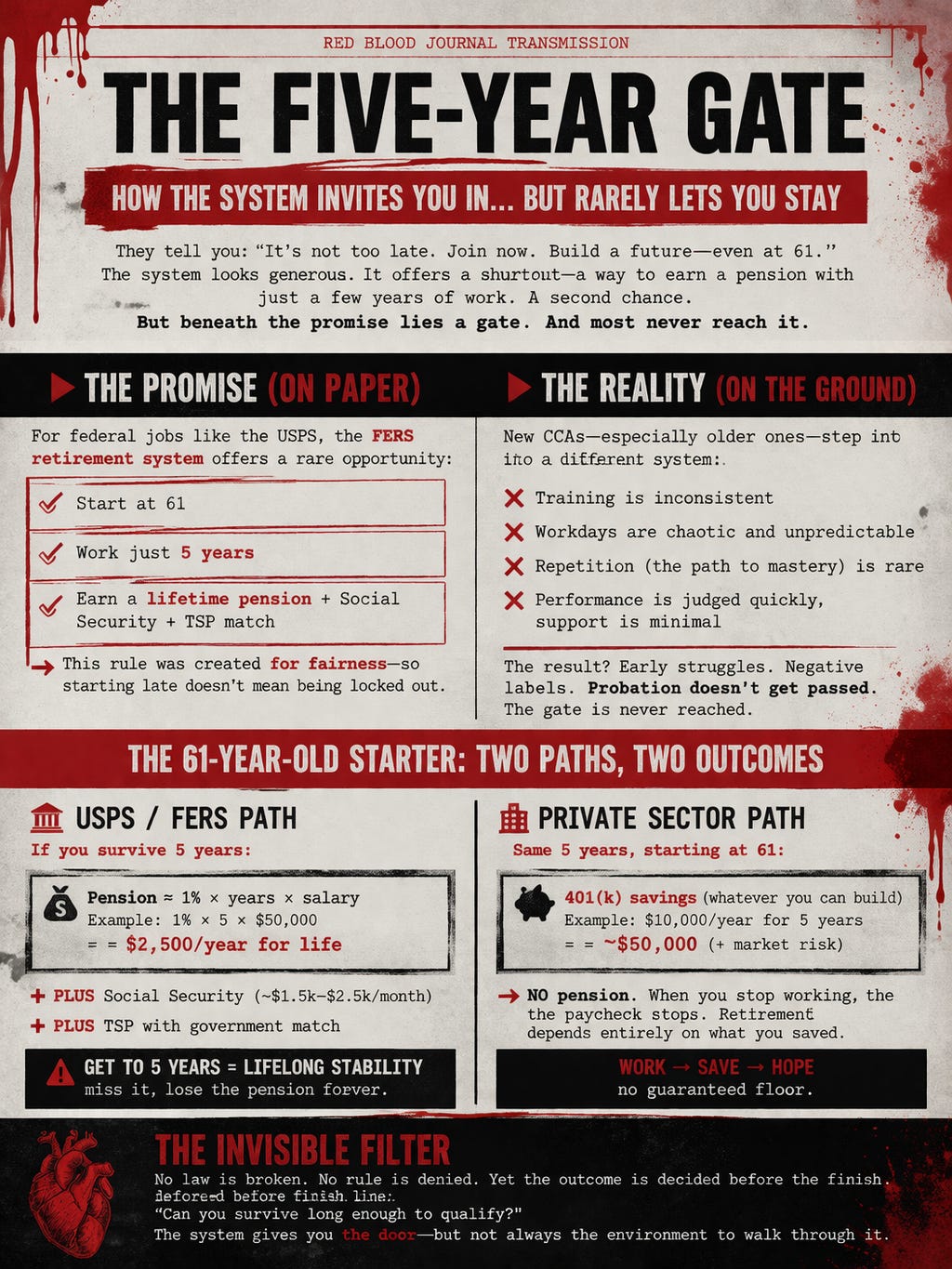
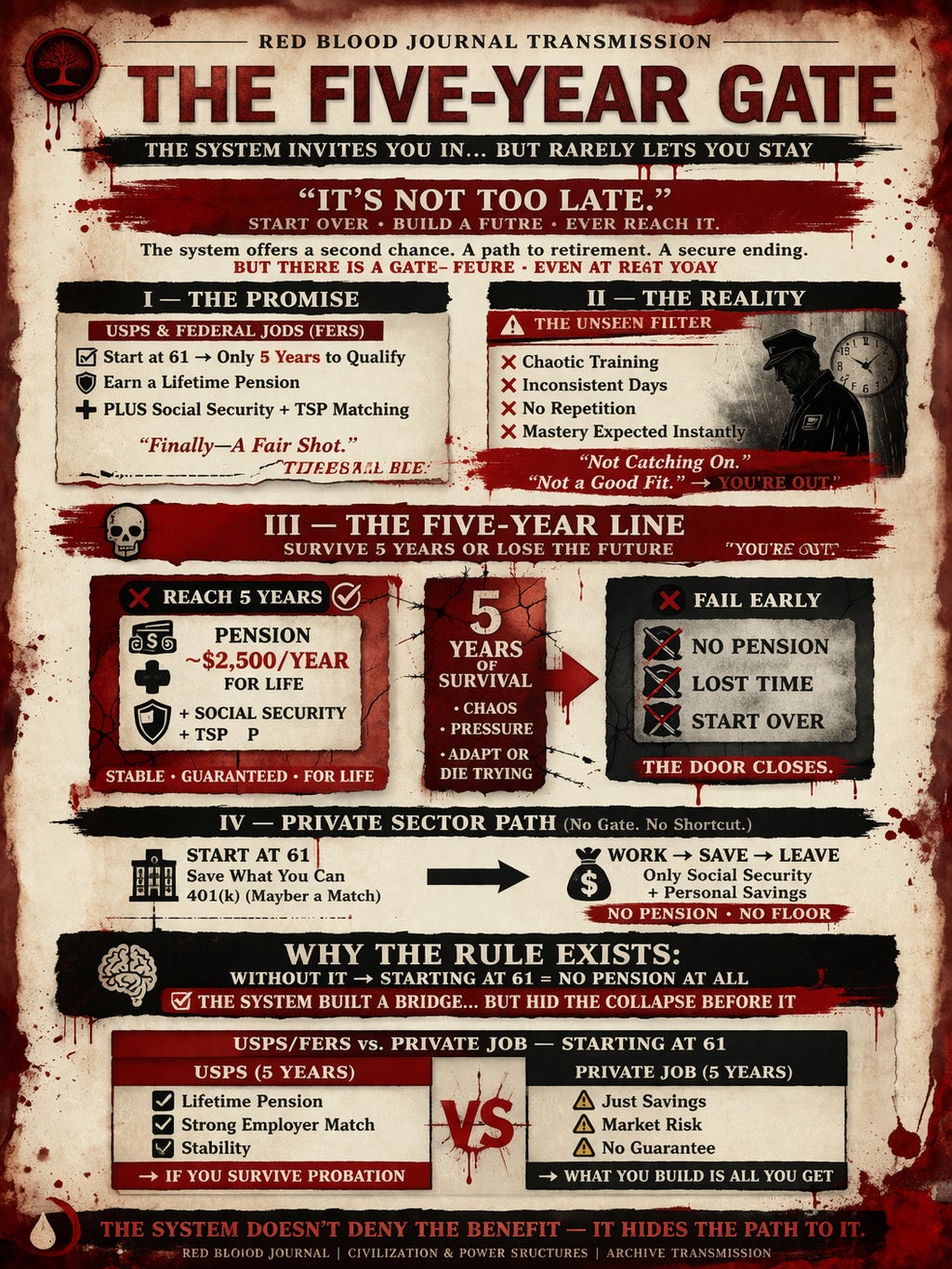
Inside federal systems like the United States Postal Service, the structure is formal, mathematical, and seemingly fair.
Through the Federal Employees Retirement System, the rule is clear:
Even if you start late
Even if you are past 60
👉 You can still qualify for retirement with only a few years of service.
This is not accidental.
It was designed to solve a problem:
Without it, older workers would be permanently locked out of the system.
So the architects of the system created a bridge.
A shorter path.
A chance.
II — THE REALITY
But a rule on paper… is not the same as a path in reality.
Inside the operational layer, a different system exists:
Training is fragmented
Workdays are inconsistent
Repetition is rare
Mastery is expected immediately
The new worker—especially the older one—enters a paradox:
You must perform like a veteran… before you are allowed to become one.
And when performance slips?
The label appears:
“Not catching on”
“Too slow”
“Not a good fit”
The outcome becomes predictable:
Probation ends
Confidence collapses
Exit occurs
And the gate… is never reached.
III — THE FIVE-YEAR LINE
The system does not deny the benefit.
It simply places it… five years away.
Five years of:
Survival
Adaptation
Endurance
If reached, the reward is real:
A lifetime pension
Stability layered on top of Social Security
A financial floor that does not disappear
But if not reached?
The structure resets:
No pension
No long-term gain
Only time spent inside the system
IV — THE PARALLEL PATH
Outside government systems, in the private world, the illusion disappears entirely.
There is no gate.
There is no shortcut.
There is only accumulation:
A 401(k) plan
Personal savings
Market exposure
Start at 61?
Then:
You save what you can
You leave with what you built
Nothing more.
Nothing guaranteed.
V — THE INVISIBLE FILTER
This is where the deeper mechanism reveals itself.
No rule is broken.
No law is violated.
The system still says:
“You are allowed.”
But the environment quietly determines:
“Who actually succeeds.”
And the factors are not written in policy:
Ability to learn under chaos
Tolerance for instability
Speed over structure
Perception over development
The result is not enforced…
It is produced.
VI — THE DESIGN WITHOUT DESIGNERS
This is not always a conspiracy.
It is often something more powerful:
A system shaped by incentives, not intentions.
Supervisors are measured on:
Short-term output
Immediate performance
Not:
Long-term development
Late-career success stories
So the system optimizes for:
Fast learners
Low-friction workers
Immediate productivity
And unintentionally filters out:
Those who require structured repetition
Those who enter later in life
🧠 RBJ INTERPRETATION
The Five-Year Gate is not a lie.
It is real.
But it operates under a silent condition:
The system gives you access to the door…
but does not guarantee you the environment needed to reach it.
🔴 ANNEX A — THE TWO PATHS
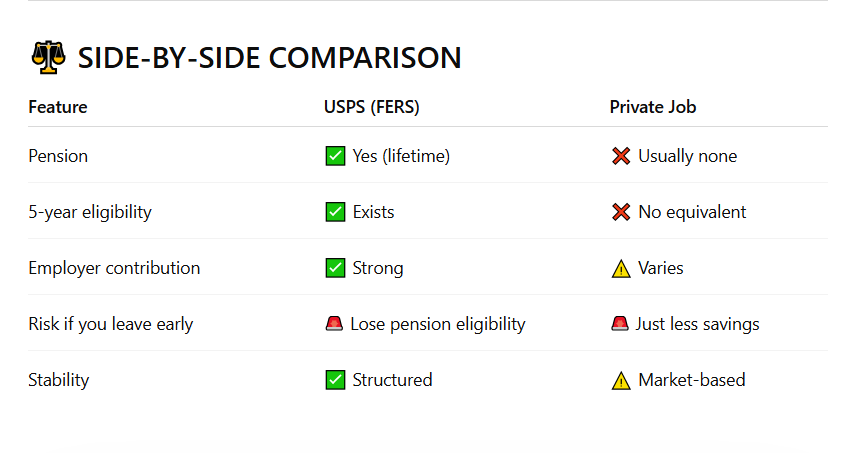
PATH 1 — THE GOVERNMENT STRUCTURE
Entry at 61
Survive 5 years
Outcome: Lifetime pension + Social Security
PATH 2 — THE PRIVATE SYSTEM
Entry at 61
Save independently
Outcome: Social Security + whatever you managed to build
👉 One offers a floor.
👉 The other offers only accumulation.
🔴 ANNEX B — THE TRUE RISK
The real risk is not failure.
The real risk is almost succeeding:
Entering the system
Believing in the path
Falling short before the threshold
Because in that space…
You lose both:
Time
Opportunity elsewhere
🔴 ANNEX C — THE UNSEEN QUESTION
The system asks a question without speaking it:
“Can you survive long enough to qualify?”
Not:
“Can you do the job well?”
🔚 FINAL NOTE — THE REVELATION
This transmission is not an accusation.
It is an observation.
A pattern repeated across systems:
Laws create fairness
Operations create outcomes
And between them…
reality is decided
🩸 END TRANSMISSION
⏳The Five-Year Gate:
Survival and the Architecture of Failure
This text examines the structural challenges older individuals face when entering government workforces late in life to secure pension benefits.
While federal systems offer a five-year qualification period for retirement stability, the high-pressure operational environment often prevents these workers from reaching that milestone.
The author highlights a paradox where the system technically allows entry but creates invisible filters that prioritize immediate speed over the long-term development of new hires.
This creates a stark contrast with private sector models, which rely on individual accumulation rather than guaranteed retirement floors.
Ultimately, the source argues that systemic incentives often undermine official policies, leaving late-career employees at risk of losing both time and financial security.


