


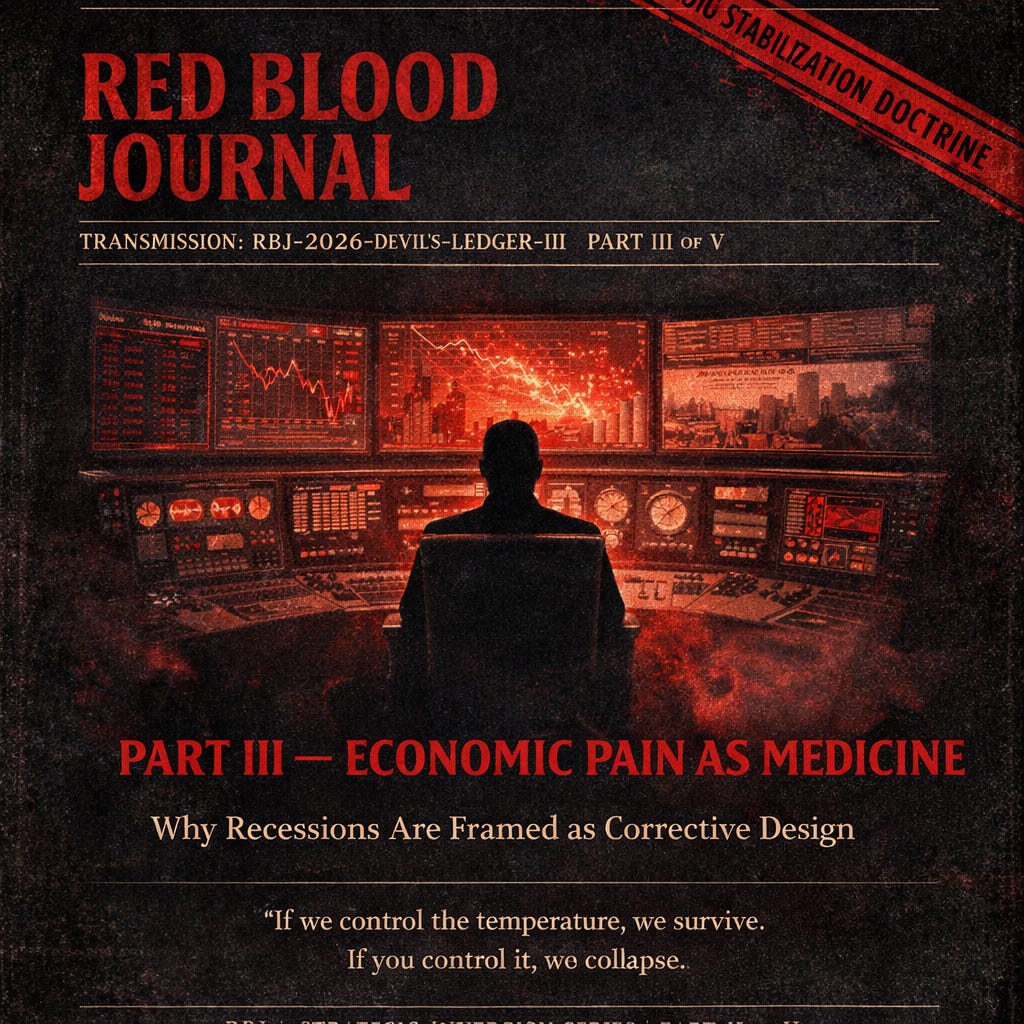
🩸 RED BLOOD JOURNAL TRANSMISSION
T#: RBJ-2026-DEVIL’S-LEDGER-III
Classification: Power Architecture Analysis / Economic Stabilization Doctrine
Status: Fictional Analytical Commentary — Strategic Role Reversal
Part III of V
PART III — ECONOMIC PAIN AS MEDICINE
Why Recessions Are Framed as Corrective Design
PROLOGUE — THE CONTROL PANEL
From the street, inflation feels like theft.
From the throne, inflation is a lever.
From the street, recession feels like failure.
From the throne, recession is calibration.
The citizen experiences pain.
The ruler studies dials.
This is the economic defense.
I — THE THEORY OF OVERHEAT
The Boss would argue:
Left unregulated, markets expand beyond sustainability.
Credit multiplies.
Speculation accelerates.
Consumption exceeds production.
Asset bubbles inflate.
When expansion outruns fundamentals, collapse becomes inevitable.
The ruler’s claim:
Short-term tightening prevents long-term implosion.
Interest rate hikes are described not as punishment —
but as cooling systems.
The pain is framed as preventive.
II — DEBT AS DISCIPLINE
Critics call it debt servitude.
The Boss calls it behavioral structure.
When credit is unlimited, restraint disappears.
When borrowing is costly, decision-making sharpens.
From the throne:
Debt binds individuals to productivity.
Productivity sustains growth.
Growth sustains order.
The uncomfortable argument emerges:
Economic pressure incentivizes participation.
Without pressure, systems stagnate.
III — INFLATION AS INVISIBLE TAX
The population sees currency erosion.
The ruler sees adjustment.
Inflation can:
Reduce real debt burdens.
Stimulate spending.
Shift economic momentum.
From above, controlled inflation becomes a policy instrument.
Too little — stagnation.
Too much — collapse.
Therefore, fluctuation is framed as management, not accident.
IV — THE NECESSITY OF FAILURE
The citizen demands stability.
The Boss argues:
Permanent stability breeds fragility.
If weak institutions are never allowed to fail,
they metastasize.
If bad investments are never punished,
risk multiplies.
Recessions, in this logic, are purification cycles.
They eliminate excess.
They consolidate strength.
They reset expectation.
The throne calls this:
Creative destruction.
V — INEQUALITY AS INCENTIVE
From below, inequality looks immoral.
From above, it is described as motivation.
If rewards are equal regardless of output,
effort declines.
If success yields disproportionate gain,
ambition intensifies.
The ruler frames inequality as fuel.
The citizen frames it as injustice.
Both views coexist —
but only one sets policy.
VI — THE STABILITY PRIORITY
The Boss’s internal doctrine may read:
“Economic pain is regrettable.
Systemic collapse is unforgivable.
We introduce pressure to prevent implosion.”
The ruler tolerates unemployment spikes
to avoid currency collapse.
The ruler tolerates asset loss
to prevent structural ruin.
This is the defense.
COUNTERINTELLIGENCE NOTE
Every economic architecture presents itself as rational.
But rational for whom?
Stability at the top
may feel like suffocation at the bottom.
The logic can be coherent
and still controversial.
CLOSING LINE — PART III
From the throne, recessions are not disasters.
They are reset buttons.
Part IV will examine the most controversial justification of all:
Why fear is considered the most efficient form of social cohesion.
⚖️The Throne’s Logic:
Economic Calibration and Control
This text explores a fictional doctrine where economic suffering is viewed as a strategic necessity rather than a failure of governance. From the perspective of those in power, high interest rates and recessions act as vital cooling mechanisms that prevent total systemic collapse. The narrative suggests that inflation and debt function as tools for social discipline, forcing productivity and sharpening decision-making among the citizenry. Furthermore, the source argues that inequality and business failures serve as essential incentives and purification cycles to maintain long-term stability. Ultimately, the work highlights the disconnect between the pain experienced by the public and the calculated recalibration performed by those who manage the economy.


