


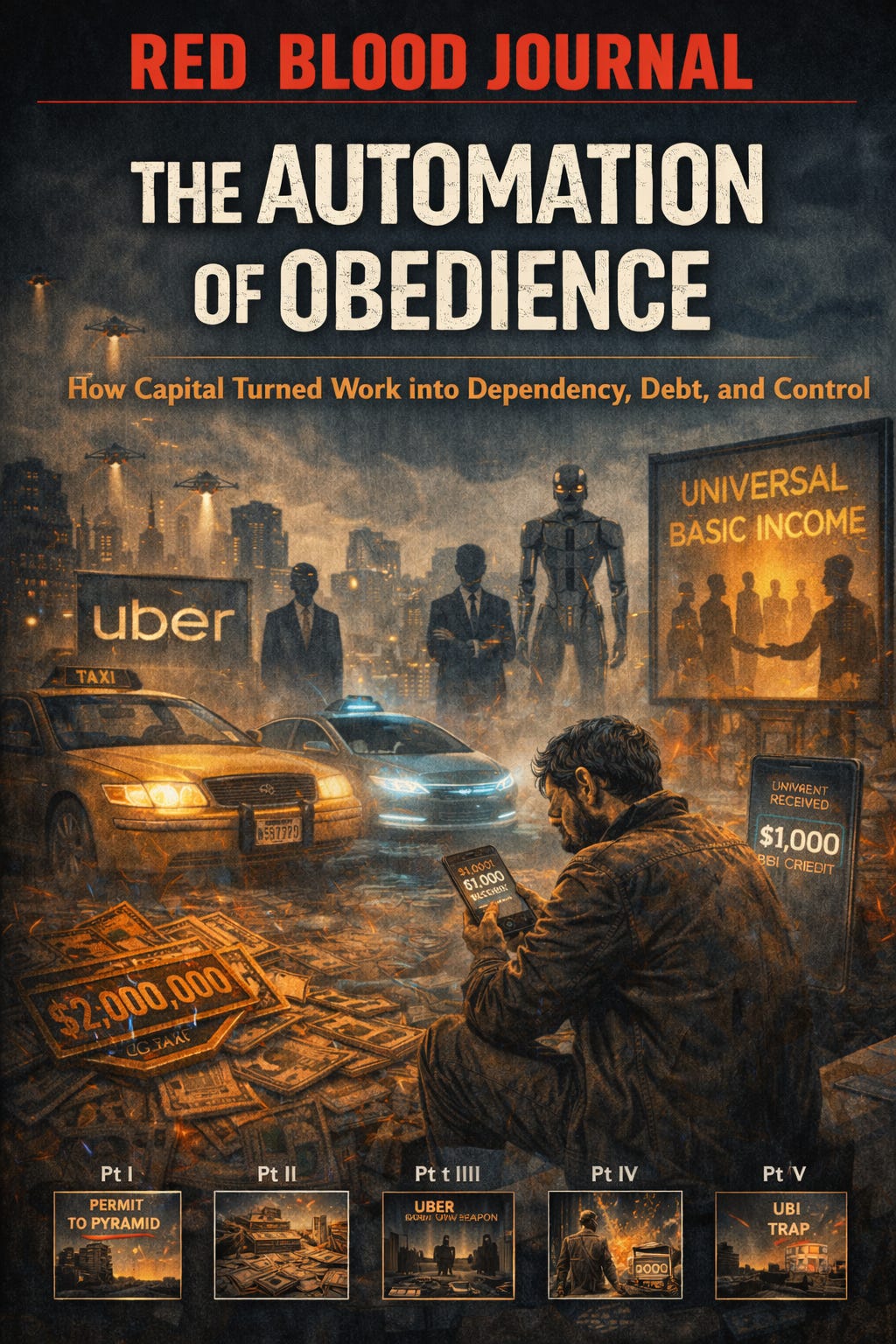
🩸 RED BLOOD JOURNAL — MASTER DOSSIER
THE AUTOMATION OF OBEDIENCE
Classification: Political Economy / Counterintelligence of Labor / Algorithmic Sovereignty
Desk: The Archive of Work, Debt & Control
I. THE ARC OF POWER (SYNTHESIS OF PARTS I–V)
PROLOGUE — THE LOST LADDER
There was a moment when the street itself functioned as a frontier.
A man arrived with little more than will and endurance.
A steering wheel became capital.
A medallion was a permit to work, not a chip in a casino.
Taxi driving was brutal, but it was sovereign.
Twelve to sixteen hours of labor could still buy rent, food, savings, and — critically — the possibility of a home.
Work created independence.
Independence created dignity.
Dignity created political quiet.
This was not utopia. It was workable.
But workable systems that empower too many ordinary people never survive long in hierarchies built for concentration.
II. FROM PERMIT TO PYRAMID
The turning point was administrative, not dramatic.
Cities capped medallions.
A regulatory tool became an asset.
Scarcity transformed work into speculation.
$100 became $10,000 in San Diego
$100,000 became $2,000,000 in New York
The medallion ceased to serve drivers and began to serve owners, banks, and financiers.
Labor was replaced by leverage.
Effort was replaced by paper.
The city became the silent underwriter of a bubble.
Banks entered quietly, turning medallions into collateral and pushing drivers into million-dollar debt.
Then came Parviz — a local mirror of the system.
He leased medallions at $250/month, then sold claims on medallions that did not exist. A miniature Federal Reserve in a taxi yard.
When he collapsed, he was labeled a criminal.
The deeper truth: he imitated the logic of the system without its protection.
Axiom of Part II:
The system does not hate fraud — it hates unauthorized fraud.
The ladder did not break.
It was monetized.
III. THE DISRUPTOR AS A WEAPON
Uber did not arrive as chaos.
It arrived as capital.
Publicly: innovation, fairness, disruption of cartel power.
Privately: a coordinated financial maneuver.
The same banks that financed Uber and Lyft were also the principal lenders behind $1–2M medallion loans.
A perfect scissor strategy emerged:
Front A — Accelerate Uber
Flood with capital
Subsidize rides
Operate in legal gray zones
Undercut taxis
Rapid expansion
Front B — Crush medallion owners
Call in loans
Refuse restructuring
Force technical defaults
Foreclose aggressively
Result:
Medallion wealth was not outcompeted — it was liquidated.
Bankruptcy became a technology of power: Engineered Default.
The independent driver was replaced by an algorithmically managed gig worker.
The dispatcher was replaced by software.
The street remained — sovereignty vanished.
Axiom of Part III:
When the same hands finance both the disruptor and the disrupted, the outcome is not competition — it is confiscation.
IV. SELF-DRIVING SOVEREIGNTY
With platforms dominant, the next move was obvious:
Remove the human entirely.
Self-driving vehicles do not just threaten taxis. They target:
Uber drivers
Delivery drivers
Long-haul truckers
Logistics workers
Bus drivers
Eventually pilots
And downstream: engineers, dispatchers, and support staff
This is not “creative destruction.”
It is systematic labor elimination.
The chain evolves:
Old world: Driver + street = independence
Platform world: Driver + app = dependency
Autonomous world: App + machine = human irrelevance
Mobility becomes a proprietary grid.
Cities become optimized for machines.
Citizens become variables.
The new class divide sharpens:
Owners of automation: tech firms, banks, asset managers, AI infrastructure
The redundant many: former drivers, logistics workers, service labor
Platforms exploited workers.
Automation erases them.
Axiom of Part IV:
When machines replace workers, power replaces people.
V. THE UBI TRAP — MANAGED SURVIVAL
With mass automation comes a manufactured crisis of unemployment.
The proposed solution arrives: Universal Basic Income.
Official story:
Automation is inevitable
Jobs will vanish
People must not starve
Therefore, UBI is humane
Counterintelligence reading:
First dispossess
Then automate
Then centralize ownership
Then distribute survival from above
The man moves from:
Worker →
Gig worker →
Redundant →
Recipient
UBI, as designed by elites, can become:
A leash, not a lifeline
A permission slip, not a right
A pacification mechanism, not a liberation tool
If survival depends on centralized systems, bargaining power disappears.
No workplace to strike.
No employer to negotiate with.
No independent income to exit to.
A population that depends on monthly credits is easier to govern than a population that owns assets and works independently.
Axiom of Part V:
When work disappears and survival is centralized, freedom becomes conditional.
SERIES CAPSTONE AXIOM
Whoever controls work controls power.
Whoever controls survival controls the people.
Whoever controls both controls the future.
II. WHAT THIS ALL MEANS — THE STRUCTURE OF CONTROL
Across the five parts, the architecture is consistent:
Create an asset (medallion) via policy
Financialize it into a bubble
Introduce a disruptor to devalue it
Use debt to clear out small owners
Replace humans with machines
Replace wages with managed income (UBI)
This is not just about taxis.
It is a template for:
Housing
Education
Healthcare
Transportation
Potentially all labor
III. BRAINSTORM: OPTIONS FOR A COMMON MAN
Below is a structured map of real strategic options for an ordinary person inside this system — from most defensive to most transformative.
They are grouped by realistic feasibility, not fantasy.
OPTION 1 — PERSONAL SURVIVAL STRATEGIES (SHORT TERM)
(How to endure the world as it exists now.)
A. Asset over income
If work is unstable, ownership matters more than wages.
Practical moves:
Avoid heavy debt where possible
Prioritize tangible assets:
Small property
Land (even modest)
Tools
Equipment
Local businesses
Lesson from medallions: never trust policy-created assets without exit options.
B. Skill portfolio that resists automation
Some labor is harder to automate:
Skilled trades: electrician, plumber, carpenter
Repair work: mechanics, machinists
Physical craftsmanship
Local service work requiring human presence
Hybrid roles: tech + hands-on (e.g., automation maintenance)
Strategy:
Move toward work that is embodied, local, and hard to digitize.
C. Side systems of income
Do not rely on one stream of income.
Examples:
Small business + wage job
Rental income + skilled trade
Community-based micro-enterprise
Cooperative work arrangements
Redundancy beats loyalty to any single employer or platform.
OPTION 2 — COMMUNITY STRATEGIES (MEDIUM TERM)
(Power through association, not isolation.)
A. Worker cooperatives
If platforms centralize power, decentralize ownership:
Driver co-ops
Delivery co-ops
Local ride services owned by drivers
Community-based logistics networks
This resists the Uber model by aligning ownership with labor.
B. Mutual aid and parallel economies
If UBI becomes the norm, parallel systems matter:
Local barter networks
Time banks
Community currencies
Neighborhood credit circles
These create resilience outside centralized control.
C. Local political engagement
Cities still shape transportation, zoning, and labor.
Common man options:
Pressure for limits on corporate automation fleets
Support policies that protect small operators
Advocate for worker representation in transport regulation
Not glamorous — but real.
OPTION 3 — ECONOMIC STRATEGIES (LONG TERM)
(Changing the rules of the game.)
A. Universal Basic Property (UBP) — stronger than UBI
Instead of monthly handouts, distribute ownership:
Public stakes in AI and automation
Dividends from national wealth funds
Community-owned infrastructure
This turns citizens into shareholders, not recipients.
B. Data as property
If platforms profit from data, common people should own theirs.
Personal data dividends
Cooperative data trusts
Legal rights over algorithmic use of personal information
This would claw back power from tech firms.
C. Worker ownership of AI
If AI replaces labor, workers should co-own the machines.
Models:
AI cooperatives
Shared automation dividends
Publicly owned autonomous fleets with citizen payouts
This keeps productivity gains democratic.
OPTION 4 — PHILOSOPHICAL STRATEGY (DEEP RESISTANCE)
(How a common man preserves freedom internally.)
Even if the system centralizes survival, a man can refuse internal dependency:
Maintain discipline and skill
Build things with hands
Cultivate community
Refuse passivity
Stay economically curious
Teach children independence, not compliance
The last freedom is psychological.
IV. TWO FUTURES — CHOICE OF PATH
The series implies a fork in history.
Path A — The UBI Trap (likely if nothing changes)
Automation replaces labor
UBI pacifies population
Ownership concentrates
Freedom becomes conditional
Path B — The Ownership Society (harder, but possible)
Automation exists
But dividends flow to citizens
Workers co-own AI
Communities retain local power
UBI exists as floor, not leash
Same technology.
Opposite politics.
V. FINAL RED BLOOD SYNTHESIS
The story is not really about taxis.
It is about how power:
Creates assets
Inflates them
Destroys them
Automates work
Then offers survival as a controlled benefit
The thesis stands:
The system first sells the dream of independence —
then removes the means to achieve it.
⛓️The Automation of Obedience: From Sovereignty to Synthetic Survival
Power shifts from human sovereignty to algorithmic control by financializing labor, devaluing assets, and replacing workers with automation.
To counter this engineered dependency and the trap of centralized UBI, people must prioritize asset ownership and cooperatives.


