


🩸 RED BLOOD JOURNAL TRANSMISSION
Division: Civilization & Power Structures
Transmission Code: RBJ-CPS-2026-IRAN-ARMED-CITIZEN-SCENARIO
Classification: Strategic Thought Experiment / Counterfactual Analysis
Archive: The Archive of Blood & Memory
WHAT IF IRANIANS HAD THE RIGHT TO BEAR ARMS
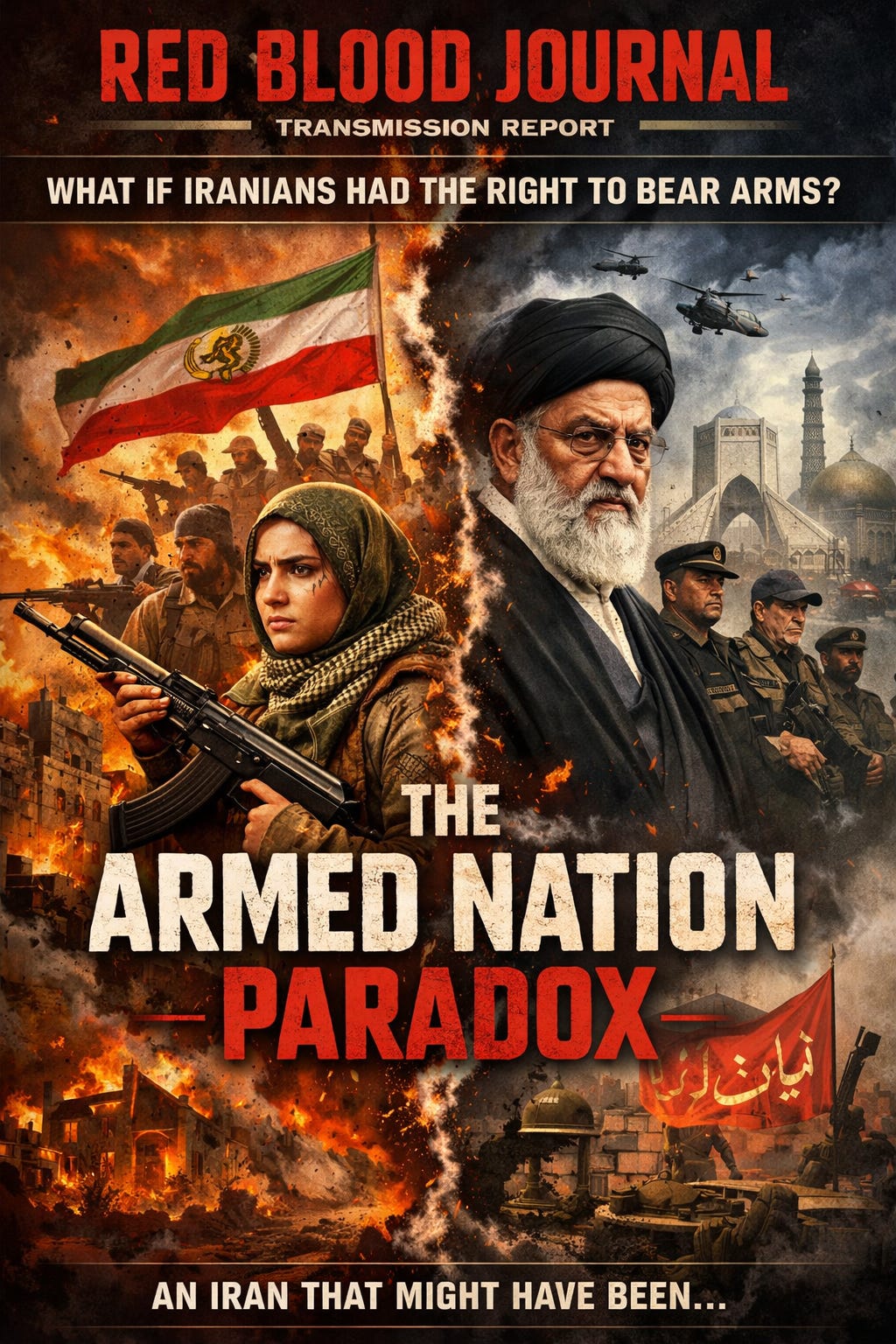
THE ARMED NATION PARADOX
A Counterfactual Scenario: If the Iranian People Had the Right to Bear Arms
PROLOGUE — THE QUESTION HISTORY NEVER TESTED
In 1979 a revolution replaced the Shah of Iran with a religious state governed by clerical authority.
For 47 years, that system has survived internal protests, international sanctions, economic collapse, and repeated waves of public unrest.
The question rarely asked in mainstream analysis is simple:
What if the Iranian people had possessed a constitutional right to bear arms similar to the Second Amendment of the United States?
What if millions of civilians had been legally armed not just during the revolution—but throughout the decades that followed?
This transmission explores that counterfactual scenario.
Not as advocacy, but as a strategic thought experiment about power, control, and the balance between state authority and citizen capability.
I — THE STRUCTURE OF POWER IN MODERN IRAN
The modern Iranian state rests on three pillars of coercive control.
1. Centralized Armed Power
The regime controls nearly all organized force through:
The Islamic Revolutionary Guard Corps (IRGC)
The Basij militia
The national police
Intelligence services
Civilian ownership of firearms is heavily restricted and tightly monitored.
The result is a monopoly on violence.
2. Surveillance and Informant Networks
Neighborhood-level enforcement relies heavily on:
Basij volunteers
intelligence monitoring
religious and political oversight structures
This creates localized enforcement without civilian resistance capability.
3. Ideological Authority
Religious legitimacy and revolutionary identity provide the moral framework used to justify authority.
The system combines:
theology
nationalism
revolutionary mythology
into a durable ideological structure.
II — THE COUNTERFACTUAL SCENARIO
Now imagine a different constitutional structure.
Imagine Iran adopting something similar to:
“The right of the people to keep and bear arms shall not be infringed.”
Millions of households possess firearms.
Weapons are privately owned and culturally normalized.
This single change would dramatically alter the political geometry of the state.
III — POSSIBLE OUTCOME PATHWAYS
AI modeling of historical revolutions suggests multiple possible trajectories, not just one.
Human intuition often imagines only two outcomes:
tyranny
freedom
Reality produces far more complex possibilities.
Below are the most plausible scenarios.
SCENARIO A — REGIME NEVER CONSOLIDATES POWER
If civilians were widely armed after 1979:
The clerical government might have faced immediate decentralized resistance.
Local militias could form outside regime control.
Protests might escalate into armed regional standoffs.
Possible outcome:
Iran becomes a fragmented revolutionary landscape rather than a centralized theocracy.
Comparable historical examples:
Spain during its civil war
Lebanon during its militia era
The regime might never have achieved full national control.
SCENARIO B — A DETERRING BALANCE
Another possibility:
The regime still emerges—but must govern cautiously.
An armed population creates political friction against repression.
Mass arrests, violent crackdowns, and heavy-handed policing become riskier.
This produces a system closer to:
authoritarian government
but constrained by potential public resistance
In this scenario:
Iran resembles a hybrid state rather than a fully consolidated ideological regime.
SCENARIO C — REGIME ADAPTS AND ARMS ITS SUPPORTERS
States are adaptive organisms.
Faced with an armed population, the government might respond by arming loyalists.
This could create:
regime-aligned militias
opposition militias
localized armed politics
The country becomes a dual-power system.
Examples from history include:
Iraq after 2003
parts of Libya after 2011
Here, guns do not produce liberty.
They produce competition for authority.
SCENARIO D — CIVIL WAR POSSIBILITY
If ideological divisions remain deep while weapons are widespread, a fourth possibility emerges.
The state fractures.
Political disputes escalate into armed conflict between factions.
In this scenario:
The regime might not survive.
But neither does national stability.
IV — THE AMERICAN CONTEXT
The United States constitutional tradition treats firearms differently.
The Second Amendment historically served multiple purposes:
Frontier survival
Resistance to tyranny
Militia defense
Cultural autonomy
For supporters of gun rights, the Iranian example is often cited as a warning:
A population without arms becomes dependent on the state for protection.
Critics of civilian firearms argue the opposite.
They warn that widespread weapons can lead to:
political violence
instability
accidental harm
militia rule
Both arguments draw on historical examples.
V — THE LIMITS OF PREDICTION
Even advanced AI modeling cannot perfectly predict historical outcomes.
Human societies are complex adaptive systems.
A single variable—like gun ownership—interacts with:
culture
religion
economic conditions
foreign intervention
leadership personalities
What appears decisive in theory may behave differently in reality.
VI — THE LESSON OF POWER
One truth remains consistent across history:
Who controls organized force ultimately shapes political outcomes.
Sometimes that force lies entirely with the state.
Sometimes it is distributed among citizens.
Each structure carries its own risks.
FINAL REFLECTION — THE QUESTION THAT REMAINS
If the Iranian population had been widely armed for the past 47 years:
The Islamic Republic might not look the same today.
Perhaps the regime would have fallen.
Perhaps it would have adapted.
Perhaps the country would have fractured.
Or perhaps a different equilibrium would have emerged.
History never ran the experiment.
But the thought experiment reveals something deeper:
The debate over weapons is not merely about guns.
It is about the relationship between citizens and power itself.
🩸 END TRANSMISSION
Archive Reference: Blood & Memory / Counterfactual Histories
⚔️The Armed Nation Paradox:
Iran’s Counterfactual Power Dynamics
This strategic analysis explores a counterfactual scenario regarding how civilian firearm ownership might have altered the historical trajectory of the Iranian state since 1979.
The text contrasts the current monopoly on violence held by the regime with various hypothetical outcomes that could arise from an armed citizenry.
These potential paths include immediate decentralization of power, a deterring balance that forces more cautious governance, or a descent into fragmented civil war.
Ultimately, the document examines the Second Amendment through an international lens to illustrate the complex relationship between state authority and citizen capability.
By analyzing these risks and rewards, the source suggests that the distribution of organized force fundamentally dictates the political geometry of any nation.


