


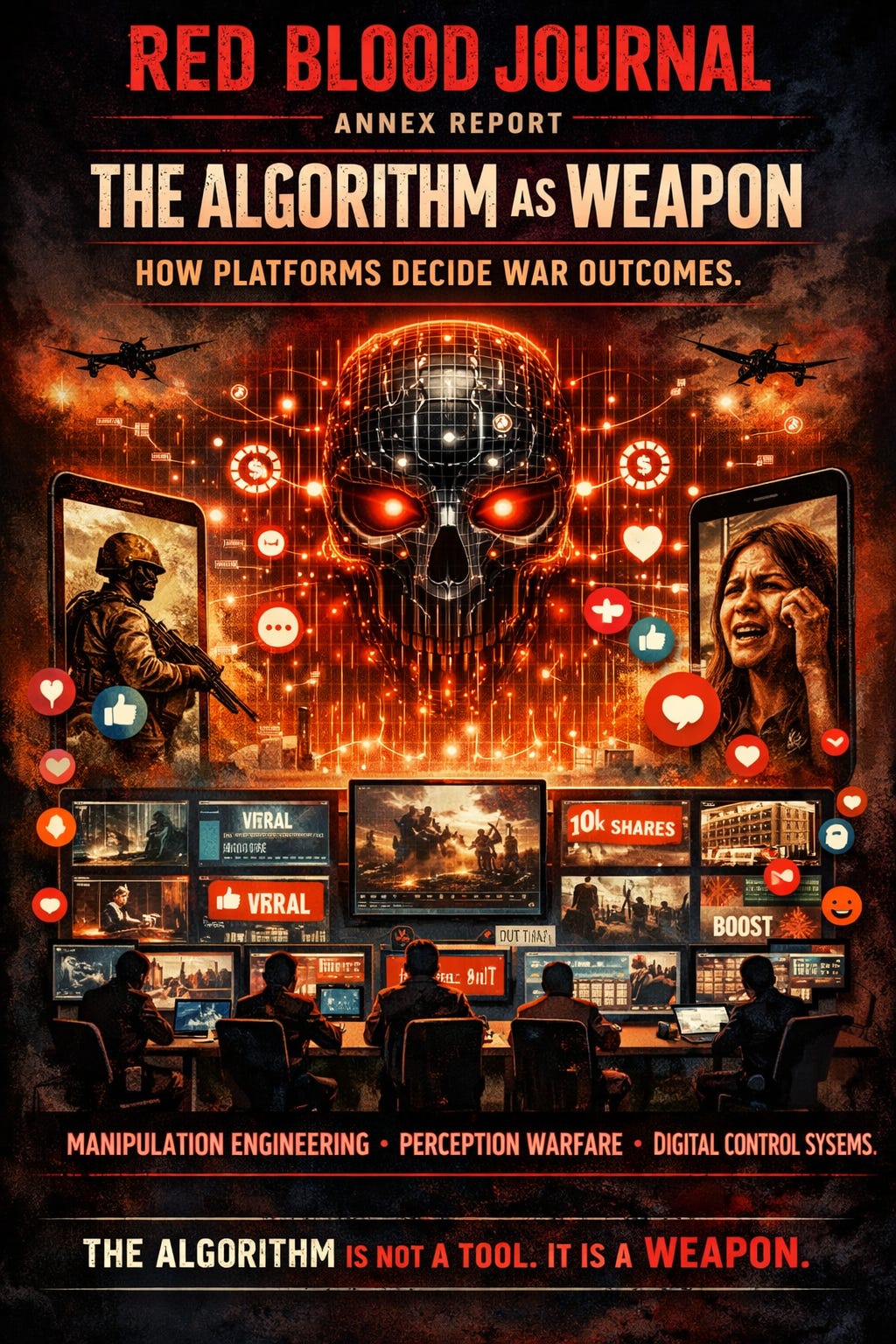
🩸 RED BLOOD JOURNAL TRANSMISSION
Division: Information Warfare & Narrative Control Unit
Annex Code: RBJ-ANNEX-A-ALGORITHM-WEAPON-001
Classification: Platform Power / Perception Engineering / Synthetic Consensus Systems
Archive: The Archive of Blood & Memory
Your screen is the modern battlefield
ANNEX A
THE ALGORITHM AS WEAPON
How Platforms Decide War Outcomes Before the Battlefield Does
🪐 PROLOGUE — THE MACHINE THAT DOES NOT VOTE
In the old world, empires needed:
Armies
Printing presses
Radio towers
Television networks
To shape reality, they needed visible institutions.
But on the new battlefield, the most powerful editor of human thought does not wear a uniform.
It does not give speeches.
It does not wave a flag.
It does not even claim authority.
It simply sorts.
It ranks.
It recommends.
It hides.
It repeats.
And by doing so, it decides what millions will feel before they have time to think.
This is the algorithm.
And in the age of permanent war, the algorithm is not merely a tool of communication.
It is a weapon system.
I — THE INVISIBLE COMMAND CENTER
The people still imagine platforms as neutral streets.
A place where ideas compete.
A place where users choose.
A place where truth rises if it is strong enough.
But the platform is not a street.
It is a command center disguised as a public square.
Every post is filtered.
Every image is scored.
Every video is evaluated.
Every account is weighed against invisible behavioral models.
The algorithm asks:
Will this trigger fear?
Will this trigger rage?
Will this trigger tribal loyalty?
Will this keep the user here longer?
Will this spread faster than doubt can stop it?
Truth is only one input.
Usually, it is not the winning one.
II — THE NEW LOGIC OF POWER
In older propaganda systems, a ruler needed to convince the population of one story.
In the platform age, power discovered something even stronger:
You do not need one story.
You only need:
Millions of personalized stories
All pushing the same emotional outcome
One man sees heroism.
Another sees victimhood.
Another sees treason.
Another sees sacred vengeance.
Another sees proof that the enemy is inhuman.
The details differ.
The emotional destination is the same.
That is the genius of algorithmic warfare:
It does not create one mass narrative.
It creates many customized narratives that produce one mass reaction.
III — ENGAGEMENT AS TARGETING SYSTEM
The public thinks engagement is a business metric.
Clicks.
Shares.
Comments.
Watch time.
But in information warfare, engagement becomes a targeting system.
It reveals:
what a population fears
what a population hates
what a population will defend irrationally
what symbols trigger obedience
what topics fracture social unity fastest
The algorithm is not only distributing content.
It is mapping the nervous system of civilization.
Every scroll becomes intelligence.
Every reaction becomes a data point.
Every outrage becomes a weaponized preference profile.
The user thinks he is consuming content.
The system is studying him for future manipulation.
IV — THE ALGORITHM DOES NOT NEED TO LIE
This is the most important doctrine in the annex:
The algorithm does not need to invent falsehood from nothing.
It only needs to:
amplify selectively
suppress selectively
sequence selectively
repeat selectively
This changes everything.
Because the most effective manipulation is not always a fake story.
Sometimes it is:
a real story shown without context
a true image shown at the right emotional moment
a clip cut before the contradiction appears
a headline pushed harder than the correction
a rumor repeated until it feels older than the truth
The algorithm wages war through emphasis.
Not just fabrication.
It turns partial reality into total perception.
V — HOW PLATFORMS CHOOSE WINNERS IN WAR
A war now has two fronts:
Physical front
Who controls land, skies, ports, missiles, supply chains.
Perception front
Who controls feeds, clips, framing, emotional tempo, symbolic memory.
The second front often determines the endurance of the first.
Because a state can survive military loss longer than it can survive narrative collapse.
If the people believe:
the war is unwinnable
the casualties are meaningless
the enemy is stronger than expected
the leaders are lying
sacrifice has no purpose
Then the algorithm has already breached morale.
And morale is the hidden infrastructure of war.
VI — THE FIVE PLATFORM WEAPONS
1 — VELOCITY
The side that frames the event first often owns it.
Before facts stabilize, emotion hardens.
The algorithm rewards first impact, not mature understanding.
So the public does not live inside verified reality.
It lives inside first-arrival reality.
2 — REPETITION
Repetition manufactures legitimacy.
A claim seen once is a possibility.
A claim seen fifty times becomes atmosphere.
The user no longer asks:
“Is this true?”
He begins asking:
“Why is everyone talking about this?”
That shift is the birth of synthetic consensus.
3 — TRIBAL FILTERING
The platform learns who each person already trusts and hates.
It then delivers content that feels native to the user’s tribe.
Thus propaganda becomes intimate.
It no longer sounds like command.
It sounds like home.
4 — EMOTIONAL PRIORITIZATION
Fear outruns correction.
Humiliation outruns nuance.
Moral shock outruns patience.
So the algorithm favors content that strikes the body before the mind.
It transforms the nervous system into a distribution channel.
5 — SELECTIVE ERASURE
What is buried may matter more than what is shown.
A platform does not need to ban a fact completely.
It can simply:
reduce its reach
break its momentum
place it behind weaker content
drown it in noise
delay it until the emotional window closes
This is modern disappearance.
Not censorship by wall.
Censorship by fog.
VII — THE USER AS UNPAID COMBATANT
In older wars, civilians were drafted with papers.
In modern wars, they are drafted through interfaces.
They do not know they are serving.
Yet every day they:
distribute narratives
enforce tribe loyalty
shame dissenters
repeat unverified claims
report opponents
mass-amplify emotional triggers
The platform converts ordinary people into micro-propagandists.
Not through ideology alone.
Through design.
The user is given:
instant reward
social reinforcement
identity affirmation
enemy visibility
belonging through repetition
And soon he is no longer asking whether the story is true.
He is defending it because the story is now part of his social body.
VIII — WHEN ALGORITHMS BECOME DIPLOMATIC ACTORS
There was a time when diplomacy belonged to states.
Now platforms intervene in war outcomes by shaping:
public patience
outrage cycles
coalition sentiment
reputational pressure
the acceptable range of policy
A government may control armies and still fear a feed.
Because a platform can:
intensify pressure for escalation
normalize war fatigue
turn allies against each other
make de-escalation look like surrender
make surrender look like strategy
This means platforms are no longer observers of conflict.
They are active geopolitical terrain.
Sometimes more decisive than the battlefield they depict.
IX — THE ALGORITHM’S TRUE IDEOLOGY
Many people ask:
“Whose side is the algorithm on?”
This is the wrong first question.
Its first loyalty is rarely national.
Its first loyalty is to:
retention
stimulation
compulsion
behavioral predictability
monetizable attention
And that makes it compatible with every faction willing to exploit it.
The algorithm does not love empire.
It does not love resistance.
It does not love truth.
It does not love peace.
It loves intensity.
And war produces intensity in industrial quantities.
That is why conflict thrives on platforms.
Not because the machine believes in war.
But because war feeds the machine what it hungers for most:
attention without rest.
X — SYNTHETIC CONSENSUS
How the people are made to feel that everyone agrees
The greatest illusion the platform creates is not merely persuasion.
It is consensus.
A user logs in and sees:
the same slogans
the same clips
the same enemies
the same jokes
the same moral conclusions
He concludes:
“This is what people think.”
But often he is not seeing society.
He is seeing a sorted corridor.
A behavioral tunnel.
A curated weather system.
Consensus is manufactured not only by bots or paid influence.
It is manufactured by ranking architecture.
The platform makes certain opinions feel huge and others feel nonexistent.
And once that illusion settles, self-censorship begins.
The people police themselves.
No prison required.
XI — THE WAR AFTER THE WAR
Even when bombs stop, the algorithm keeps fighting.
Because postwar control depends on narrative settlement:
Who was right?
Who was evil?
Who suffered more?
Who may speak?
What images become memory?
What facts are buried beneath commemorative mythology?
The platform becomes the editor of history in real time.
Not years later in textbooks.
Immediately.
The winning side in memory may not be the winning side on the ground.
And memory, over time, governs the next war.
XII — RBJ INTERPRETATION
The algorithm is not merely showing the war.
It is:
pacing the war
moralizing the war
personalizing the war
extending the war
preserving the war as identity
This is why modern conflict feels endless.
Because even when territory stabilizes,
the feed does not.
The battlefield can pause.
The narrative machine cannot.
Its business model forbids silence.
XIII — WARNING TO THE READER
The most dangerous moment is when a person believes:
“I reached this conclusion on my own.”
Perhaps he did.
But perhaps he arrived there after:
300 repeated framings
40 emotional cues
12 strategic suppressions
dozens of tribal affirmations
a recommendation engine trained on his anger
In such a world, independent thought still exists.
But it must fight upstream.
And most do not know there is a current.
XIV — CLOSING TRANSMISSION
In the old doctrine, whoever controlled the radio controlled the nation.
In the new doctrine:
Whoever controls the algorithm
controls the emotional timing of civilization.
And whoever controls emotional timing
can decide:
what becomes urgent
what becomes forgettable
what becomes sacred
what becomes hated
what becomes war
The people think they are watching events unfold.
Often, they are watching events being selected, shaped, accelerated, and delivered in the precise sequence needed to produce consent.
Not informed consent.
Algorithmic consent.
🩸 FINAL DOSSIER CONCLUSION
The algorithm is not a side issue of modern war.
It is the hidden artillery of the digital age.
It does not always destroy cities.
It destroys:
context
patience
proportionality
doubt
independent judgment
And once those are gone,
a population can be led almost anywhere.
Filed Under: Algorithmic Governance / Perception Warfare / Synthetic Consensus / Digital Battlefield Systems
👁️Algorithmic Consent:
The Engineering of Narrative Warfare
This text describes how digital platforms have transformed the internet into a sophisticated weapon of psychological warfare.
Modern conflicts are no longer won solely on the battlefield but are decided through the algorithmic manipulation of human emotion and perception.
By selectively amplifying or suppressing information, these systems manufacture a synthetic consensus that directs how the public reacts to global events.
Users are unknowingly drafted into this struggle, as their engagement and biases are harvested to refine future methods of control.
Ultimately, the source argues that whoever masters these ranking architectures gains the power to dictate the narrative reality and emotional timing of entire civilizations.


