


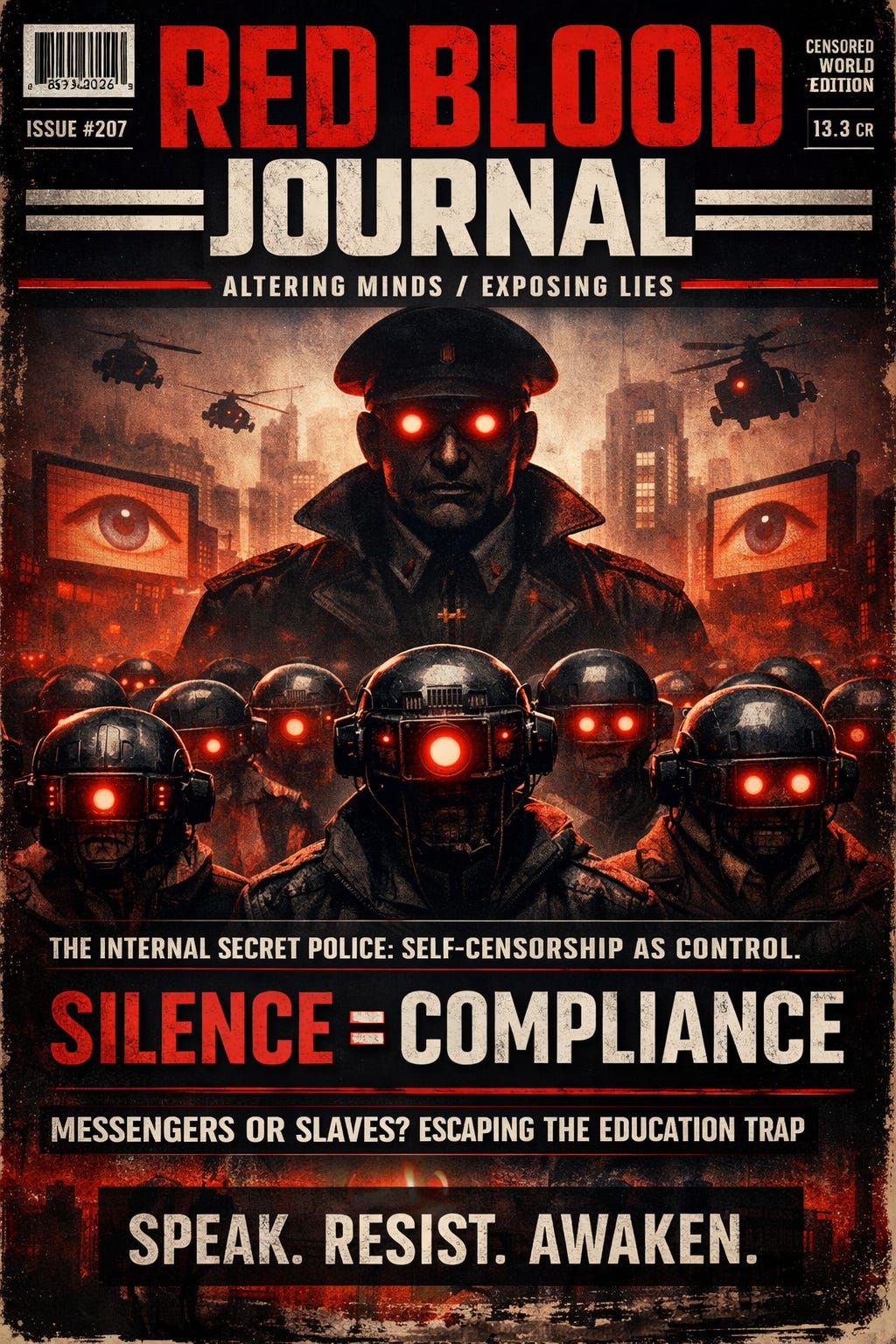
🩸 RED BLOOD JOURNAL TRANSMISSION
T#: RBJ-2026-SILENCE-PROTOCOL
Classification: Counterintelligence of Conscience / Social Compliance Architecture
Desk: The Archive of Blood & Memory — San Diego / Tehran / In-Between
[I] PROLOGUE — THE COMFORT OF NON-EXISTENCE
Silence presents itself as safety.
In practice, it is shelter for power.
The “silent majority” does not emerge as a crowd. It crystallizes in a single inward collapse — the moment when a person decides that speaking truth is more dangerous than living inside a lie. That private surrender, replicated millions of times, becomes a civilization.
No regime needs iron bars when it successfully installs an internal guard inside every mind.
[II] SECTION I — THE INTERNAL SECRET POLICE
The most effective police state does not patrol streets. It inhabits thoughts.
It speaks in familiar language:
Do not make trouble.
Stay in your lane.
This is not your fight.
It feels reasonable. That is its camouflage.
This internal force is not accidental. It is cultivated through education, media, and institutional conditioning that quietly teaches one lesson above all others:
The individual is insignificant.
From that premise, silence becomes logical. If a person believes they are small, their silence feels natural rather than criminal.
Yet this “reasonableness” is the engine of domination.
[III] SECTION II — SILENCE AS SOCIAL REPLICATION
A virus does not conquer through spectacle. It reproduces through imitation.
The silent majority functions the same way.
Each person who looks away grants legitimacy to the next person’s refusal to act. Each small retreat becomes precedent. Soon, silence is no longer a choice — it is culture.
Injustice does not require mass cruelty. It requires only mass non-interference.
Power advances not on its own strength, but on the quiet footsteps of those who refuse to stand.
[IV] SECTION III — DISTANCE DOES NOT ABSOLVE
Most claim they would intervene if harm were visible and immediate.
Yet the same people tolerate harm when it arrives as:
Policy rather than violence
Propaganda rather than threat
Exploitation rather than assault
Erasure rather than murder
Distance becomes a moral anesthetic.
But ethical responsibility does not shrink with geography. It is tested by it.
If witnessing abuse in front of one’s eyes demands action, then witnessing systemic abuse demands the same — only at a different scale.
[V] SECTION IV — EDUCATION AS NEUTRALIZATION
Modern schooling rarely asks: Who is this person? What is their duty? What is their power?
Instead, it trains:
Compliance
Standardization
Obedience to procedure
Deference to authority
The result is not an educated populace, but a manageable one.
A population that does not believe in its own uniqueness will never believe in its own responsibility.
This is not accidental. It is architecture.
[VI] SECTION V — PARTICIPATION AS MINIMUM DUTY
Participation is not reducible to protest or spectacle. It begins earlier — inside perception itself.
Participation looks like:
Refusing inherited narratives when they feel hollow.
Speaking truth even when the voice trembles.
Declining to repeat lies for social convenience.
Supporting those who accept risk for truth.
Treating others as sovereign individuals rather than disposable units.
The threshold is not heroism. It is refusal.
Refusal to let fear govern conscience.
Refusal to let silence masquerade as neutrality.
[VII] ANNEX — THE MORAL EQUATION
Silence = Consent
Consent = Stability of Power
Stability of Power = Continuation of Harm
Therefore:
Silence = Participation in Harm
Not by intention, but by effect.
The moral question is not whether every individual is powerful enough to overthrow systems. It is whether they are willing to refuse internal submission.
That refusal is the first act of freedom.
[VIII] COUNTERINTELLIGENCE NOTES
Systems do not primarily fear loud minorities; they fear quiet majorities discovering their voice.
Control becomes complete when repression is internalized.
Every regime claims obedience is “order.” History records it as collapse of conscience.
The most radical act in an age of manufactured consent is simple: to speak clearly and refuse to look away.
[IX] CLOSING — THE THRESHOLD
History does not turn on comfortable observers.
It turns on those who refuse to be absorbed into silence.
Participation is not an optional supplement to citizenship or humanity — it is the minimum ethical baseline.
To remain silent is to be governed from within.
To speak is to begin reclaiming oneself.
If you are not willing to break the silence, you have already chosen to be the system.
🤐The Architecture of Internalized Silence
This text examines how individual quietude functions as the primary structural support for oppressive systems.
Rather than relying on external force, modern power thrives by conditioning people to internalize obedience through education and social pressure.
This psychological architecture transforms private silence into a form of active consent, making the observer a participant in systemic harm.
The author argues that true neutrality is an illusion, as looking away provides the necessary legitimacy for injustice to persist.
Ultimately, the work asserts that breaking internal submission is the fundamental act of reclaiming personal freedom.
Recovering one’s voice is presented not as an act of heroism, but as the minimum ethical requirement for human agency.


