


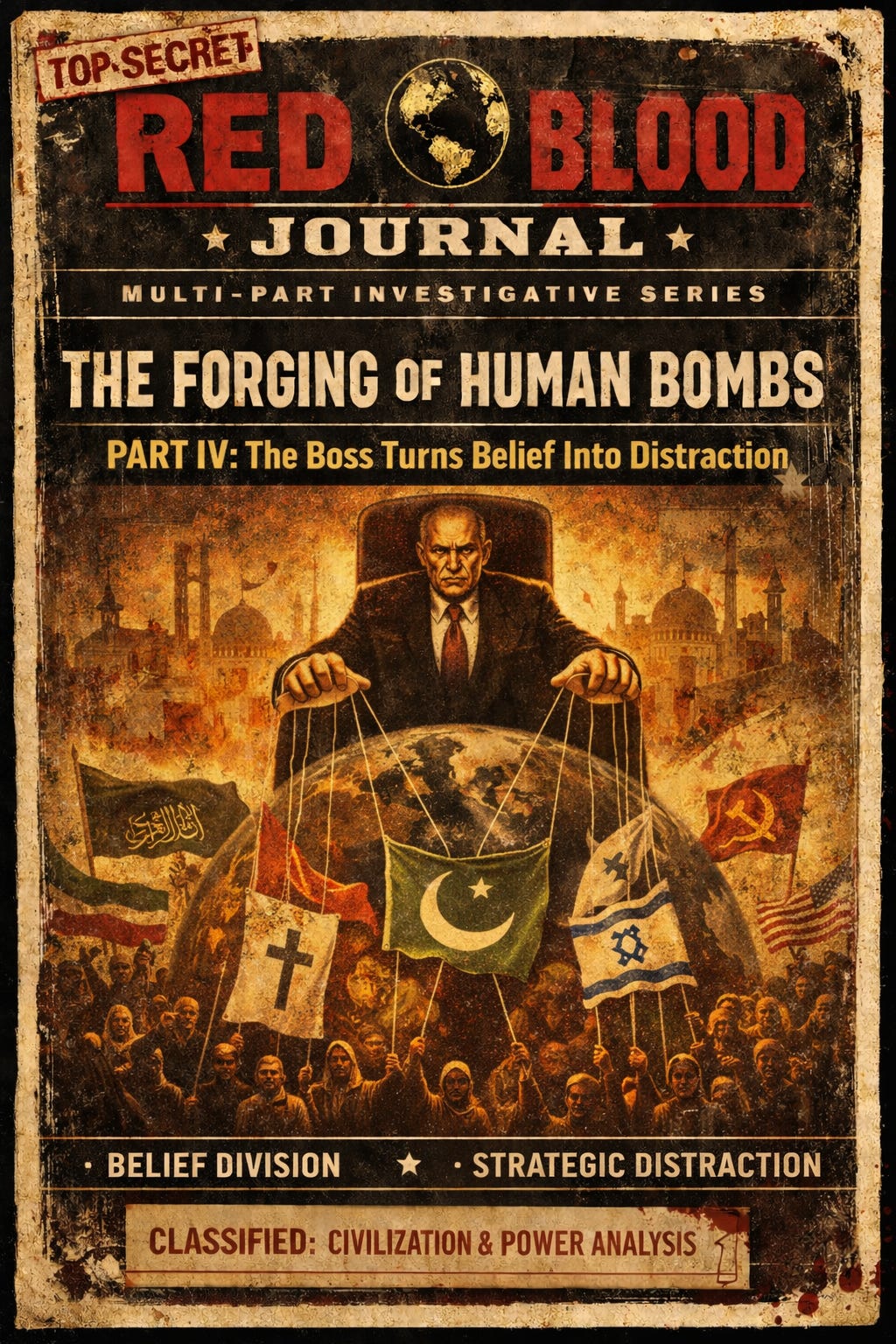
🩸 RED BLOOD JOURNAL TRANSMISSION
Division: Civilization & Power Structures Analysis Unit
Transmission Code: RBJ-CPS-2026-FORGING-IV
Classification: Strategic Pattern Analysis
Archive: The Archive of Blood & Memory
Weaponizing belief for global control
THE GLOBAL GAME
How the Boss Turns Belief Into Distraction
Fourth Transmission in the Series
THE FORGING OF HUMAN BOMBS
PROLOGUE — THE INVISIBLE DIRECTOR
History is often taught as a sequence of conflicts between nations, religions, and ideologies.
Civilizations are shown clashing.
Faiths are shown fighting.
Nations are shown competing.
But behind the surface of these events lies a deeper question.
Who benefits from perpetual conflict?
Who benefits when societies remain permanently divided?
Who benefits when the population of the world spends centuries fighting over beliefs?
The answer appears repeatedly across history.
The same invisible director.
In Red Blood Journal analysis, this figure is referred to simply as:
The Boss.
I — THE OLDEST METHOD OF CONTROL
Weapons change with time.
Swords become rifles.
Rifles become missiles.
Missiles become drones.
But the most effective weapon in history has never been physical.
It has been belief.
Belief shapes identity.
Identity shapes loyalty.
Loyalty shapes action.
If belief can be controlled, entire populations can be guided without chains or prisons.
The population polices itself.
The population sacrifices itself.
The population fights wars that serve interests far above their awareness.
II — THE ARCHITECTURE OF DISTRACTION
The Boss rarely rules through direct authority.
Direct control invites resistance.
Instead, control is achieved through managed fragmentation.
The world is divided into competing identities.
Religion against religion.
Nation against nation.
Ideology against ideology.
Each group believes it is fighting for justice.
Each group believes it is defending truth.
Each group believes the other side is the enemy.
While the true architects of the conflict remain untouched.
This system creates an endless cycle.
Conflict produces fear.
Fear produces loyalty.
Loyalty produces obedience.
The machine sustains itself.
III — RELIGION AS A FORCE MULTIPLIER
Religion possesses a unique power.
Unlike political ideology, religion reaches deeper than rational thought.
It reaches into the human soul.
It answers the greatest questions humans ask:
Why are we here?
What happens after death?
What is good and evil?
When these questions are harnessed by political leaders, belief becomes something extraordinary.
Not merely conviction.
But absolute devotion.
A believer can endure suffering that no political ideology alone could demand.
A believer can sacrifice everything.
Even life itself.
IV — THE MARTYRDOM EQUATION
The Boss understands something fundamental about human psychology.
People fear death.
But if death can be transformed into victory, that fear disappears.
This is the moment when belief becomes the ultimate weapon.
Martyrdom narratives accomplish exactly this transformation.
Death becomes glory.
Sacrifice becomes honor.
Defeat becomes eternal triumph.
Once this equation takes hold, the population produces its own warriors.
No army recruitment necessary.
The believers volunteer.
V — THE GLOBAL BOARD
When viewed through the lens of geopolitics, the world begins to resemble a chessboard.
Major powers move pieces.
Regional actors respond.
Proxy conflicts ignite.
And populations are mobilized through narratives of belief.
History provides numerous examples.
Ideological conflicts during the Cold War.
Religious mobilization in revolutionary movements.
Nationalist propaganda during global wars.
In each case, belief becomes the energy source driving the machine.
VI — THE MASTER DISTRACTION
The Boss does not require that people believe the same thing.
Uniform belief would be dangerous.
Unity is unpredictable.
Unity creates power.
Instead, the Boss encourages infinite division.
Different religions.
Different sects.
Different ideologies.
Different identities.
Each group convinced of its righteousness.
Each group certain it is defending the truth.
And each group too occupied with its rivals to notice the larger structure guiding the conflict.
VII — THE ECONOMICS OF PERPETUAL CONFLICT
War and ideological conflict generate enormous economic systems.
Arms industries expand.
Security industries multiply.
Intelligence networks grow.
Reconstruction contracts appear after destruction.
Financial flows move through banks and institutions.
Conflict becomes an industry.
Peace becomes economically inconvenient.
The machine develops a powerful incentive to continue operating.
VIII — THE STRATEGIC GENIUS OF THE SYSTEM
The brilliance of the system lies in its invisibility.
The population does not feel controlled.
It feels righteous.
It believes it is fighting for truth.
It believes it is defending its identity.
It believes it is protecting its beliefs.
The Boss rarely needs to command.
The population carries out the struggle voluntarily.
RBJ ANALYSIS NOTE
Throughout history the most successful systems of control have not relied on force.
They relied on narrative.
Control the story.
Control the identity.
Control the enemy.
And the population will fight indefinitely.
FINAL OBSERVATION
If the greatest weapon is belief, then the greatest defense is awareness.
A population that understands the mechanics of manipulation becomes far more difficult to divide.
History suggests that the true battlefield is not territory.
The true battlefield is the human mind.
NEXT TRANSMISSION
PART V — THE FINAL QUESTION
If belief can enslave humanity,
can awareness liberate it?
👁️The Boss and the Architecture of Controlled Belief
The provided text outlines a strategic theory regarding global manipulation orchestrated by an elite figure or entity known as “The Boss.”
According to this analysis, belief systems—including religion, nationalism, and ideology—are weaponized to create perpetual conflict and social fragmentation.
By keeping populations preoccupied with manufactured rivalries, the architects of this system ensure voluntary obedience and economic profit without the need for overt force.
The narrative suggests that martyrdom and identity politics serve as distractions that prevent humanity from noticing the underlying power structures.
Ultimately, the source argues that the human mind is the primary battlefield where control is maintained through the management of narratives.
It concludes that only a heightened state of collective awareness can dismantle this cycle of exploitation and liberate society from invisible governance.


