


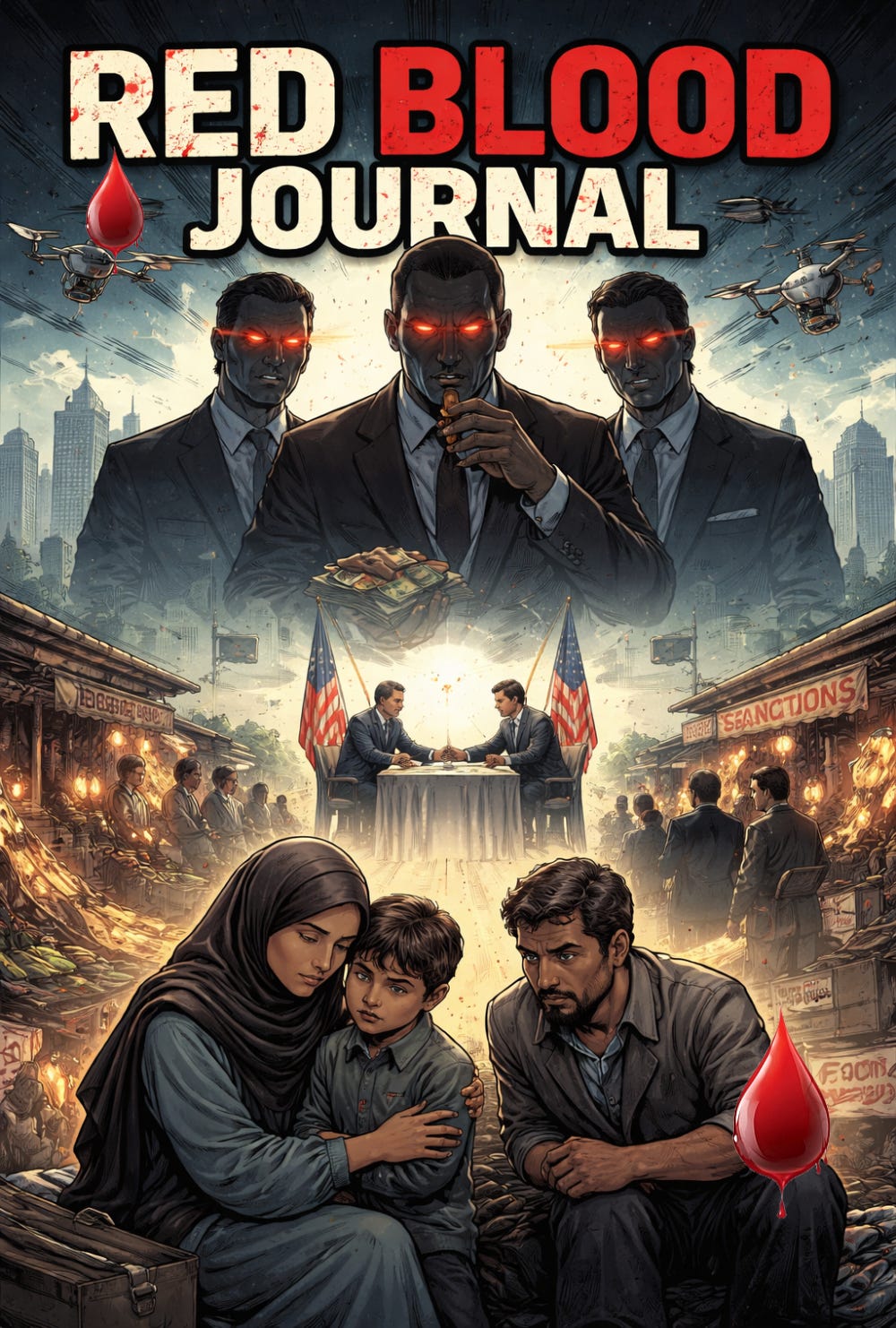
🩸 RED BLOOD JOURNAL TRANSMISSION — COMMENTARY DOSSIER
T#: RBJ-2026-MUSCAT-MIRROR
Classification: Satirical Counterintelligence / Comic-Illuminated Signals
Desk: The Back Room Between Headlines and Power
PROLOGUE — THE TALKING PUPPETS ON A SILK STAGE
Two marionettes sat at a table in Muscat.
The cameras saw “diplomacy.”
The crowd heard “hope.”
The ceiling saw the strings.
Every word sounded polite. Every smile was rehearsed. Every pause was measured like a banker counting bodies instead of coins.
On the surface: talks.
Underneath: theater.
Behind the curtain: owners.
SECTION I — “A GOOD START” = A CLEANER LIE
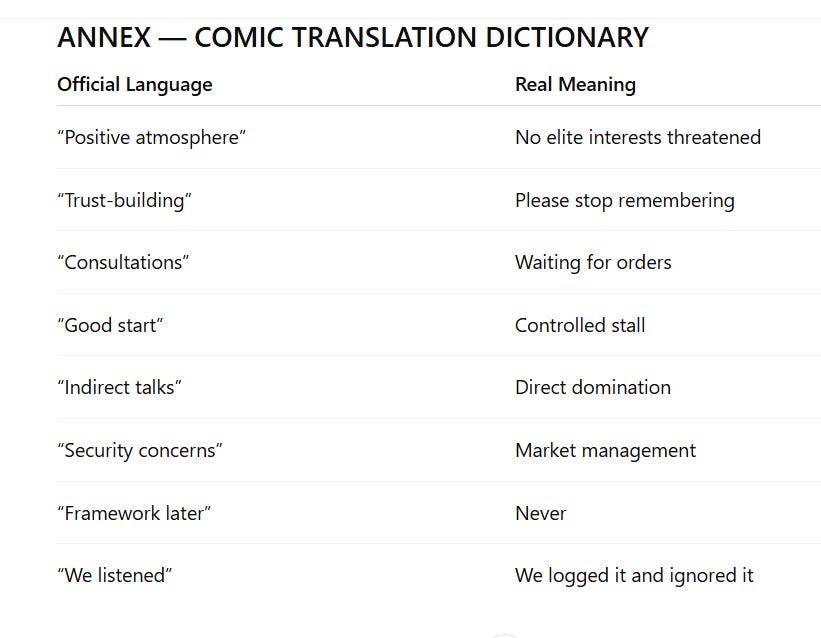
When a foreign minister says “a good start,” it reads like a bedtime story told by a man who owns the bed, the house, and the dream.
In real language, “good start” means:
No commitments made
No power threatened
No interests disturbed
No leash loosened
The stage was not set for peace — it was calibrated for control.
The mediator (Oman) appeared as a neutral waiter, but every waiter knows who pays the bill. Neutrality in empire is a costume, not a condition.
SECTION II — TRUST, OR THE LACK THEREOF
They spoke of “mistrust” as if it were an emotional problem.
In reality, mistrust is not a flaw — it is evidence.
A system that demands trust after decades of deception is not asking for reconciliation; it is demanding amnesia.
The 1979 memory is not ancient history. It is the original sin of modern geopolitics:
a revolution punished, a region disciplined, a people tagged.
The “trust-building” ritual is merely a rebranding of submission.
SECTION III — THE GHOST OF THE 12-DAY WAR
A war arrives.
Talks are scheduled.
A missile lands.
Diplomacy dies on the launch pad.
Then officials call it “bad timing.”
Translation: violence is a negotiating tactic, not a tragedy.
The Israeli strike before the sixth round was not chaos — it was choreography. A message written in fire: talk only within boundaries we define.
Betrayal? Perhaps.
But betrayal implies surprise.
Nothing here was surprising to those who own the script.
SECTION IV — THEY DID NOT TALK ABOUT THE CORE
The minister admitted it with the calm of a man reading a prepared prophecy: no framework, no substance, no core issues.
That is not failure. That is design.
Why touch the core when the surface performs perfectly?
Surface talk keeps the public pacified.
Surface talk keeps sanctions intact.
Surface talk keeps markets jittery.
Surface talk keeps the leash tight.
Negotiations without substance are like a clock without hands — movement with no meaning.
SECTION V — BACK TO THE CAPITALS (THE REAL BOSSES)
“Consultations with capitals” sounds diplomatic.
Decoded: the puppets must report to their masters.
Washington will consult its financiers.
Tehran will consult its factions.
Regional players will adjust their positions like chess pieces on a board they do not own.
No decision will emerge from Muscat. Decisions emerge from places without cameras.
SECTION VI — THE PEOPLE PAY FOR THE THEATER
While men in suits traded polite sentences, ordinary Iranians counted losses:
Currency collapsing like a controlled demolition
Prices climbing like heat in a sealed room
Sanctions squeezing like a python wearing a legal badge
Forty-seven years under the shadow of war — not as history, but as atmosphere
Some postponed having children, not out of choice, but out of existential accounting.
This is the invisible battlefield where real negotiations are felt: dinner tables, empty wallets, anxious nights.
SECTION VII — “PREDICTABILITY” AS A LUXURY ITEM
The public asks for predictability.
The system delivers volatility.
Because unpredictability is profitable to those at the top.
Crisis is a business model.
Instability is a policy.
Normalization is only permitted when it does not disrupt extraction.
When citizens say “we want stability,” the owners hear: we want permission to breathe.
SECTION VIII — WHAT THIS REALLY WAS
Muscat was not diplomacy.
It was maintenance.
Maintenance of:
Power hierarchies
Sanctions architecture
Regional tension equilibrium
Public illusion of process
A ritual where everyone speaks, nothing changes, and the same hands remain on the throttle.
ANNEX — COMIC TRANSLATION DICTIONARY
COUNTERINTELLIGENCE NOTE
If every narrative is treated as gospel, the chains look like jewelry.
If every narrative is questioned, the jewelry begins to look like chains.
The story of Muscat is not about Iran versus America. It is about those who own both sides of the table — and everyone sitting beneath it.
CLOSING — THE LAUGH THAT CUTS
So the talks will continue.
So the headlines will celebrate.
So the markets will tremble.
So the people will pay.
And somewhere, far above Muscat, the true negotiators will clink glasses — not for peace, but for profitable continuity.
🩸 END TRANSMISSION
🎭The Muscat Mirror:
Rituals of Diplomatic Theater
This satirical commentary characterizes the diplomatic negotiations in Muscat not as a genuine pursuit of peace, but as a carefully choreographed theatrical performance.
The text argues that official language serves to mask a stagnant reality where no substantive issues are addressed and elite interests remain undisturbed.
While representatives engage in “trust-building” rituals, the underlying power structures use these delays to maintain economic control and regional tension.
The analysis emphasizes that ordinary citizens bear the true cost of this stalemate through financial hardship and systemic instability.
Ultimately, the source portrays these talks as a maintenance tool for global masters to preserve a profitable status quo rather than achieving a meaningful resolution.


