


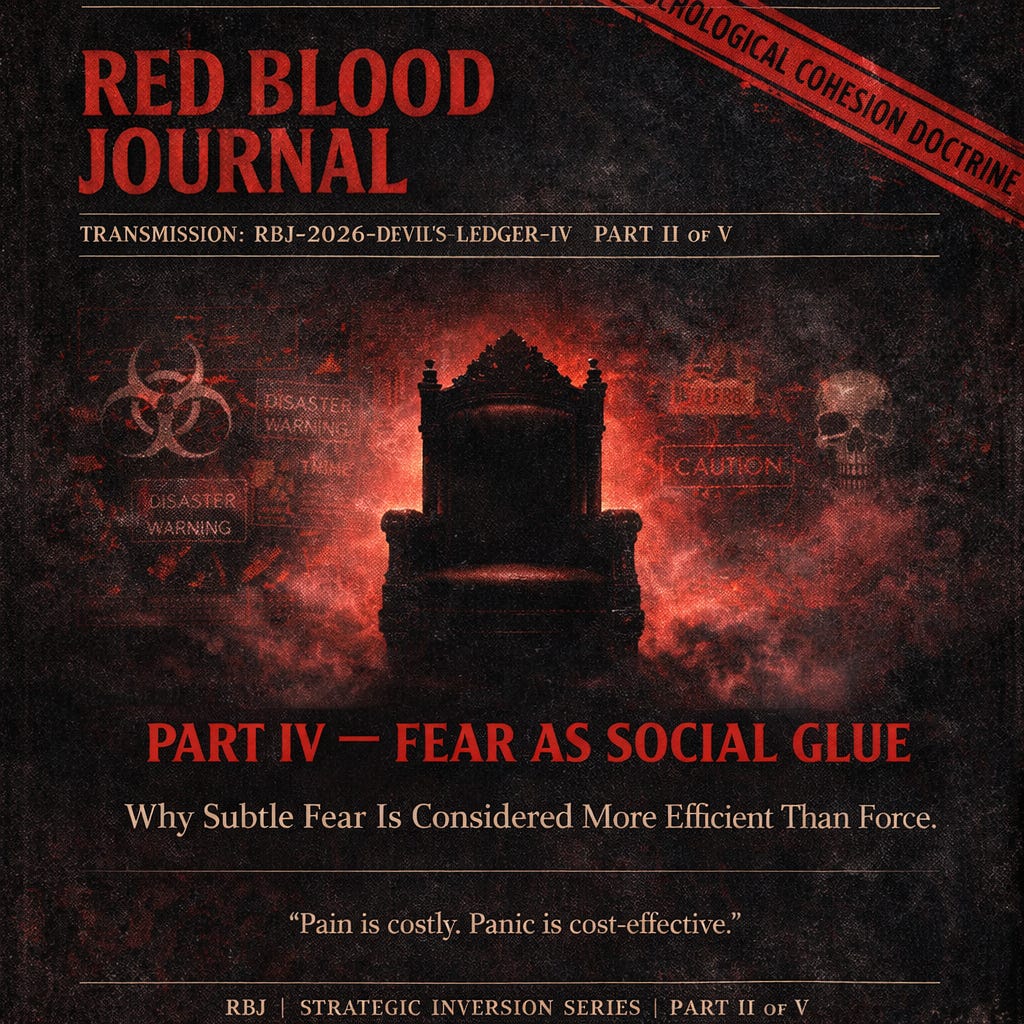
🩸 RED BLOOD JOURNAL TRANSMISSION
T#: RBJ-2026-DEVIL’S-LEDGER-IV
Classification: Power Architecture Analysis / Psychological Cohesion Doctrine
Status: Fictional Analytical Commentary — Strategic Role Reversal
Part IV of V
PART IV — FEAR AS SOCIAL GLUE
Why Subtle Fear Is Considered More Efficient Than Force
PROLOGUE — THE INVISIBLE LEASH
From the street, fear feels oppressive.
From the throne, fear feels efficient.
Open violence is expensive.
Mass repression is unstable.
Visible brutality invites resistance.
But calibrated fear?
That sustains order quietly.
This is the psychological defense.
I — THE ECONOMY OF FORCE
The Boss understands something simple:
Force creates martyrs.
Fear creates compliance.
If punishment is rare but visible,
obedience becomes widespread.
If consequences are unpredictable but possible,
self-regulation increases.
From above:
The best control system is the one citizens internalize.
When people monitor themselves,
enforcement costs drop.
II — REPUTATION AS PUNISHMENT
In older systems, punishment was physical.
In modern systems, it is reputational.
Loss of job.
Loss of status.
Loss of platform.
Loss of belonging.
The Boss calls this:
Non-violent correction.
The citizen calls it:
Social suffocation.
But from the throne, it is efficient.
No prisons required.
No public executions needed.
Exclusion is enough.
III — MORTALITY AS ULTIMATE BOUNDARY
The ruler knows the most powerful stabilizer is existential fear.
If death is framed as catastrophic failure,
risk-taking declines.
If danger is emphasized culturally,
obedience rises.
Emergency narratives — health, security, instability —
become cohesion tools.
The Boss does not invent fear.
The Boss amplifies it.
IV — THE GOOD COP, BAD COP STRUCTURE
Power rarely presents as singular.
One voice reassures.
Another warns.
One offers hope.
Another signals threat.
The citizen oscillates between relief and anxiety.
This emotional rhythm sustains engagement.
From the throne:
Balanced tension prevents uprising.
Too much fear creates revolt.
Too much comfort creates dissent.
Optimal control exists in between.
V — VOLUNTARY COMPLIANCE
The ultimate goal is not terror.
It is normalization.
When citizens begin to say:
“It’s safer this way.”
“It’s better not to question.”
“Stability matters more.”
Then the system has succeeded.
Fear is no longer imposed.
It is adopted.
VI — INTERNAL MEMO OF THE THRONE
If written candidly:
“We do not frighten to dominate.
We frighten to stabilize.
A population aware of risk
behaves predictably.”
Predictability equals governability.
Governability equals continuity.
Continuity equals survival of the structure.
COUNTERINTELLIGENCE NOTE
Fear can be functional.
It can also be corrosive.
The line between prudent caution and engineered anxiety
is thin — and often invisible from below.
Understanding the logic of fear
reveals how deeply psychology shapes power.
CLOSING LINE — PART IV
From the throne, fear is not cruelty.
It is glue.
Part V will conclude the series with the final defense:
Why the Boss believes history will vindicate control —
and why power sees itself as carrying a burden the public cannot see.
👁️The Mechanics of Calibrated Fear
The text examines how strategic psychological manipulation serves as a more efficient tool for social stability than physical force.
It explores the concept of calibrated fear, where authorities maintain order by encouraging citizens to internalize control through the threat of social exclusion and reputational damage.
By emphasizing existential risks and creating a rhythmic balance between anxiety and relief, the ruling structure ensures predictable public behavior without the need for visible violence.
Ultimately, the source argues that voluntary compliance is achieved when the population prioritizes safety over dissent, viewing their own restricted freedom as a necessary condition for stability.
From this perspective, fear is redefined not as an act of cruelty, but as the essential social glue that preserves the continuity of power.


