


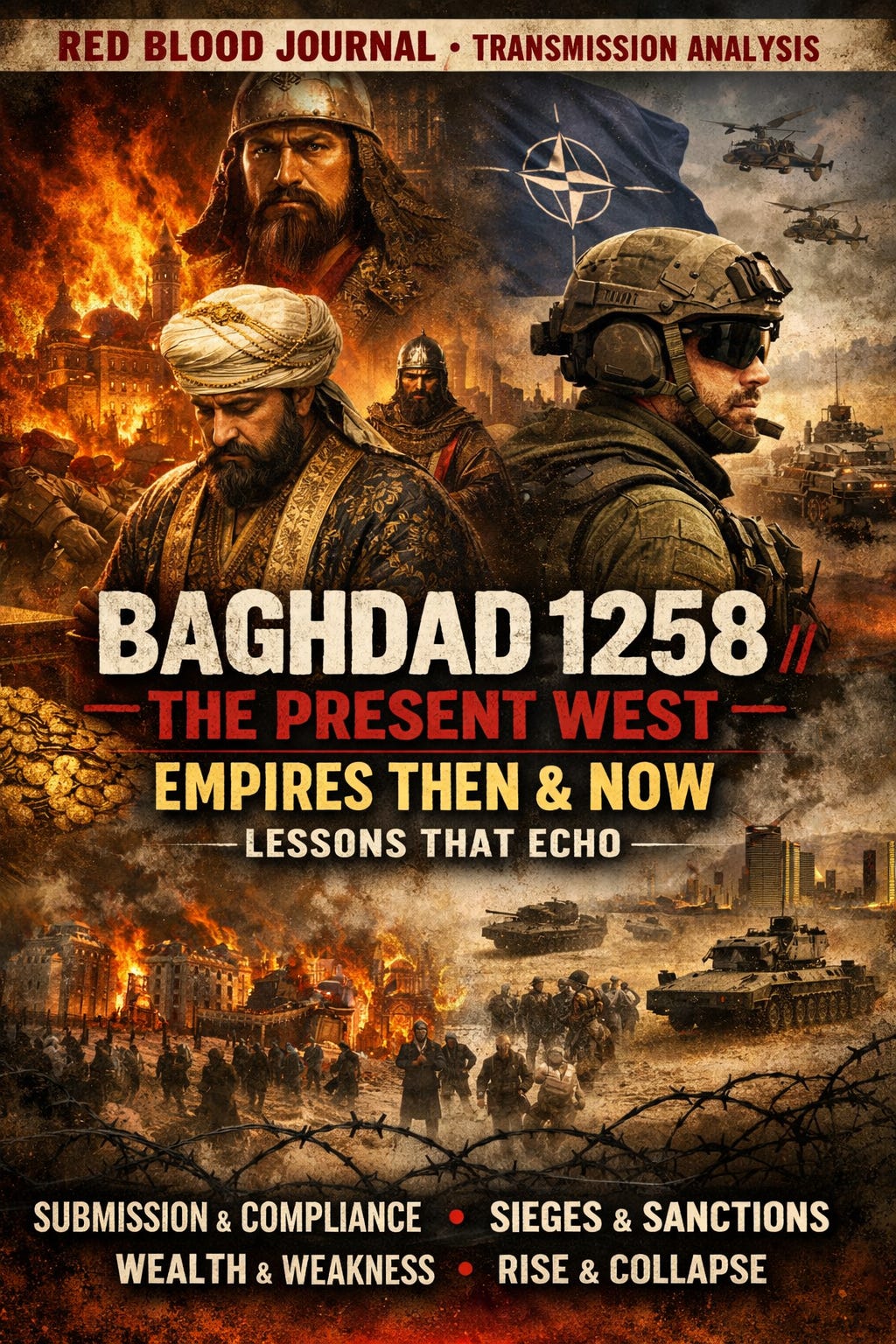
🩸 RED BLOOD JOURNAL — TRANSMISSION
Classification: Crimson History / Imperial Pattern Recognition
Distribution: Open Archive
Subject: BAGHDAD 1258 → THE PRESENT WEST
Subhead: How Empires Signal, Enforce Compliance, and Collapse by the Same Rules
PROLOGUE — THE TREASURY WALK
February, 1258.
A ruler walks through his own vaults—gold untouched, silks stacked, scholars funded—while his soldiers lack armor. The city burns behind him. The men beside him are not his guards. They are witnesses, waiting to see whether he understands.
This is Caliph al‑Mustasim, ruler of Baghdad. Within hours, the caliphate ends—not by accident, not by rage, but by procedure. The men who ended it were not barbarians improvising violence. They were operators executing a system designed to teach a lesson once so it never needed repeating.
History calls it a siege. Empires call it communication.
I. THE SYSTEM, NOT THE RAID
Baghdad did not fall because it was weak. It fell because it misread the threat.
For five centuries, Baghdad was a planetary hub: science, medicine, mathematics, law, trade. The House of Wisdom concentrated knowledge the way modern capitals concentrate capital. Its mistake was believing prestige substitutes for preparedness.
The Mongols were not an army chasing territory. Under Hulagu Khan, they executed a doctrine refined across decades:
Submission first (written terms, identical everywhere)
Silence second (time for doubt to grow)
Demonstration third (visible construction of tools)
Erasure last (methodical, documented, remembered)
Cities that complied kept autonomy. Cities that resisted became textbooks.
This wasn’t cruelty. It was policy.
II. WHAT BAGHDAD BELIEVED (AND WHAT FAILED)
Baghdad believed three things—each familiar today:
Sacred Authority Protects Us
“God will not allow this.”
→ Modern parallel: “International norms,” “rules-based order,” “moral leadership.”Walls Will Buy Time
“They’re horsemen; they can’t breach prepared defenses.”
→ Modern parallel: geography, treaties, markets, energy leverage.Treasury Equals Security
Gold stockpiled while defense atrophied.
→ Modern parallel: financialization over resilience; balance sheets over supply chains.
When the test came, none of these negotiated with physics, logistics, or doctrine.
III. THE DEMONSTRATION
The Mongols didn’t rush. They encircled. They built in plain sight. They calculated angles, loads, cycles. They waited.
When the wall failed, the city was taken by blocks, by lists, by roles:
Skilled → spared and extracted
Unskilled → eliminated
Infrastructure → damaged selectively to prevent recovery
The execution of the caliph followed taboo rules (no royal blood spilled). The method mattered less than the message: titles do not confer immunity.
That message traveled faster than any cavalry.
IV. THE PRESENT MIRROR — WEST & NATO VS. THE “PERIPHERY”
Change the tools; the pattern remains.
Then (Mongols):
Submission letters
Tribute and hostages
Siege engines
Demonstration cities
Now (West/NATO):
Conditional aid & “reforms” (submit to frameworks)
Debt, sanctions, compliance regimes (tribute by spreadsheet)
Military bases, advisors, ISR, and drones (siege without walls)
Demonstration states (what happens if you refuse)
The language is cleaner. The mechanics are not.
Sanctions function like encirclement—cutting routes, starving capacity.
Structural adjustment mirrors tribute—pay to remain “autonomous.”
Precision strikes replace trebuchets—calculations over chaos.
Narrative dominance replaces terror—memory managed, not merely feared.
Cities no longer burn to be remembered. Currencies collapse. Leaders are “removed.” Systems are “restructured.”
The lesson still propagates.
V. THE BAGHDAD ERROR, UPDATED
Many modern states repeat Baghdad’s mistakes:
Symbol over system: believing legitimacy substitutes for logistics
Markets over materiel: assuming trade prevents coercion
Cash over capacity: stockpiling reserves while hollowing industry
Rhetoric over readiness: mistaking alignment statements for deterrence
And like Baghdad, they delay—hoping the letter is a bluff.
It rarely is.
VI. WHO SURVIVES
After Baghdad, cities complied before the army arrived. The Mongols didn’t need to conquer everyone. They needed one perfect demonstration.
The modern equivalent is selective enforcement:
One country’s currency frozen
One government sanctioned into paralysis
One leader made an example
The rest adjust behavior without a shot fired.
Survivors are not the most righteous. They are the most adaptive:
They diversify supply chains
They build redundancy, not prestige
They study the doctrine threatening them
They prepare for systems, not personalities
This is why the Mamluks stopped the Mongols at Ain Jalut: not faith, not walls—matched doctrine.
VII. THE EMPIRE PARADOX
Here is the final lesson history keeps teaching:
Empires fall after their most convincing demonstration of power.
Rome after total dominance.
Baghdad after centuries at the center of thought.
The Mongols after fear had done its work.
Demonstration works—until it trains everyone else how to resist.
EPILOGUE — THE WARNING THAT LASTS
Baghdad wasn’t destroyed to end a city.
It was destroyed to educate the world.
That education still circulates—now through markets, media, and memoranda instead of smoke and stone.
Titles don’t negotiate with tactics.
Tradition doesn’t stop systems.
Treasuries don’t defend walls.
When systems collide, the one that adapts survives.
The one that doesn’t becomes a case study.
And some case studies echo for centuries. 🩸
⏳
1258 fall of Baghdad
This text analyzes the 1258 fall of Baghdad not as a random act of violence, but as a calculated system of imperial enforcement that mirrors modern geopolitics.
The author argues that the Mongol conquest utilized a refined doctrine of submission designed to turn resistant cities into psychological examples for the rest of the world.
By drawing parallels between ancient siege tactics and contemporary economic sanctions or military interventions, the source suggests that empires maintain control through demonstrations of power rather than mere prestige.
It warns that modern nations often repeat the Baghdad error by prioritizing financial wealth and moral authority over logistical readiness and industrial capacity.
Ultimately, the passage asserts that survival depends on adaptation and understanding the underlying mechanics of global compliance.


