


🩸 RED BLOOD JOURNAL — SUPPLEMENTAL ANNEX
Division: Civilization & Power Structures
Transmission Code: RBJ-CPS-2026-ERATH-ANNEX-D
Classification: Strategic Economic Analysis
Archive: The Archive of Blood & Memory
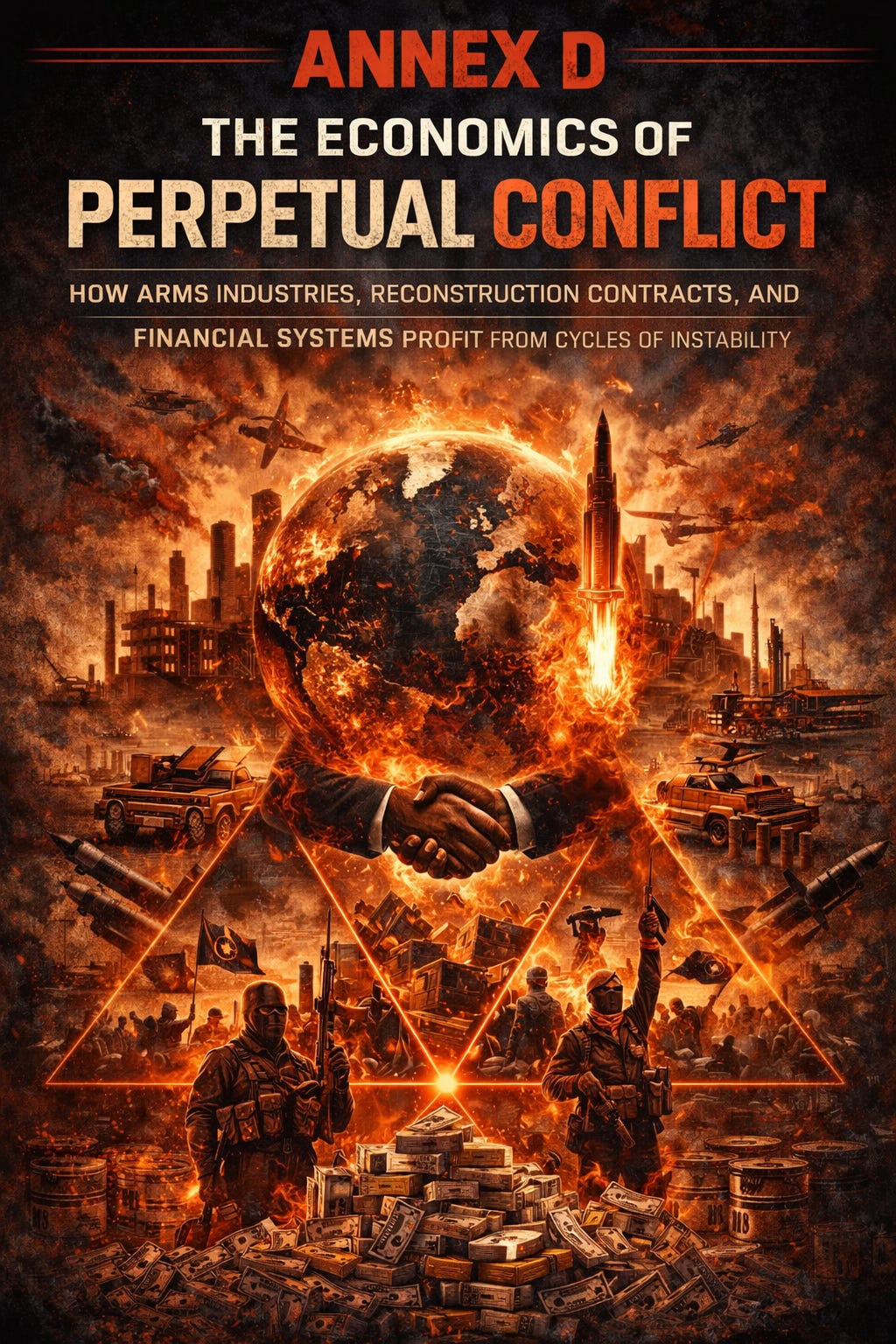
ANNEX D
THE ECONOMICS OF PERPETUAL CONFLICT
How Arms Industries, Reconstruction Contracts, and Financial Systems Profit from Cycles of Instability
PROLOGUE — WAR AS AN ECONOMIC SYSTEM
On Planet Erath, wars appear to be driven by ideology, territorial disputes, or security concerns.
But beneath these visible explanations lies another powerful force:
economics.
War is not only a political instrument.
It is also a massive economic engine.
Entire industries, financial institutions, and political systems are intertwined with the cycles of conflict that shape Erath’s history.
Understanding this economic architecture reveals why instability often persists long after its human cost becomes obvious.
I — THE ARMS INDUSTRY
At the center of the war economy lies the arms industry.
Weapons production requires enormous industrial capacity:
aerospace engineering
electronics manufacturing
materials science
advanced robotics
cyberwarfare technologies
These industries produce:
• fighter aircraft
• missiles
• tanks
• surveillance systems
• drones
• cybersecurity platforms
• satellite systems
Military procurement contracts often reach hundreds of billions of credits annually across Erath.
For many corporations, national defense spending represents their largest and most reliable source of revenue.
In this environment, geopolitical tension becomes economically valuable.
Without perceived threats, demand for advanced weapons systems declines dramatically.
II — THE SECURITY BUREAUCRACY
Modern states maintain vast bureaucracies dedicated to national security.
These include:
defense ministries
intelligence agencies
homeland security departments
military logistics systems
Millions of individuals across Erath are employed within these institutions.
Their budgets depend heavily on the existence of perceived external threats.
When threats increase, budgets grow.
When tensions decline, funding pressures emerge.
This creates a structural incentive within political systems to maintain a sense of ongoing strategic competition.
III — THE PRIVATE CONTRACTOR ECOSYSTEM
Beyond official military institutions lies an enormous network of private contractors.
These companies provide services such as:
• logistics and transportation
• intelligence analysis
• cybersecurity operations
• battlefield technology
• private security forces
• drone operations
• surveillance software
Many conflicts across Erath now involve hybrid military-private operations, where private companies perform functions once reserved for national armies.
This outsourcing transforms warfare into a commercial sector.
Contracts worth billions are awarded to firms that specialize in sustaining military operations.
IV — THE RECONSTRUCTION INDUSTRY
War destroys infrastructure.
Cities are damaged.
Transportation networks collapse.
Energy systems fail.
But after destruction comes reconstruction.
Rebuilding devastated regions requires massive investment in:
construction projects
engineering services
telecommunications networks
energy grids
transportation systems
Large reconstruction contracts often flow to international corporations capable of mobilizing resources quickly.
Ironically, the economic value of reconstruction can rival or exceed the value of the original military contracts.
Thus conflict generates two waves of profit:
destruction
rebuilding
V — THE FINANCIAL SYSTEM
War is expensive.
Governments rarely finance conflicts solely through taxation.
Instead, they often rely on borrowing.
War financing therefore intersects directly with the global financial system.
Key instruments include:
• government bonds
• military financing agreements
• emergency credit facilities
• international financial assistance
Financial institutions that facilitate these mechanisms may earn significant returns through interest payments and investment opportunities.
In this way, war becomes intertwined with global capital flows.
VI — THE RESOURCE ECONOMY
Conflict zones frequently coincide with regions rich in valuable natural resources.
These may include:
oil and gas reserves
rare earth minerals
strategic metals
agricultural land
water resources
Control of these resources can influence global markets.
Companies that secure extraction rights in post-conflict regions often gain access to highly valuable assets.
Thus, resource competition can intersect with geopolitical conflict in complex ways.
VII — THE TECHNOLOGY ACCELERATOR
Historically, war has often accelerated technological innovation.
Military research programs have produced advances in:
• aviation
• computing
• satellite communications
• nuclear energy
• artificial intelligence
• cybersecurity
Many technologies initially developed for military use later enter civilian markets.
This dual-use nature of innovation means that defense spending frequently drives broader technological development.
From the perspective of industry, conflict can therefore function as a research catalyst.
VIII — THE POLITICAL FEEDBACK LOOP
The economic actors benefiting from defense spending often maintain strong relationships with political institutions.
This interaction creates a feedback loop:
geopolitical tension increases
defense budgets expand
contracts flow to industry
industry strengthens political influence
policies supporting defense expansion gain momentum
Over time, this system becomes deeply embedded within national political economies.
Defense industries evolve into strategic pillars of employment, technology, and economic activity.
IX — THE GLOBAL MARKET OF INSTABILITY
In the modern era, the war economy of Erath has become globalized.
Weapons produced in one region are sold to governments in another.
Security firms operate across multiple continents.
Financial institutions fund defense programs internationally.
This global network transforms conflict into a transnational marketplace.
Instability in one region can generate economic activity across the entire planet.
X — THE PERPETUAL CYCLE
When viewed collectively, the economic architecture of conflict reveals a repeating cycle:
tension → military spending → conflict → reconstruction → technological development → renewed competition.
Each stage feeds the next.
The cycle does not require constant war.
But it does require persistent instability.
Without periodic crises, the economic structure supporting the war system begins to weaken.
FINAL ANNEX OBSERVATION
On Planet Erath, many citizens view war primarily through moral, ideological, or political lenses.
These dimensions are real.
Lives are lost.
Cities are destroyed.
Societies are reshaped.
But beneath the human tragedy lies another reality.
Conflict has become embedded within a vast economic ecosystem involving industries, governments, and financial institutions.
This does not mean wars are fought solely for profit.
But it does reveal why cycles of instability can persist across generations.
Because for powerful actors within the system, conflict is not merely a catastrophe.
It is also an industry.
🩸 END OF ERATH STRATEGIC FRAMEWORK SERIES
The full architecture now includes:
• ANNEX A — Mechanics of Engineered Wars
• ANNEX B — The Global Intelligence Web
• ANNEX C — The Ideological Factories
• ANNEX D — The Economics of Perpetual Conflict
Together they describe the four pillars of the Erath Laboratory System:
War — Intelligence — Ideology — Economics
The engines that shape the cycles of power across the planet.
⚙️The Architecture of the Erath War Industry
The provided text explores the financial infrastructure of persistent warfare on the planet Erath, framing conflict as a self-sustaining economic engine rather than just a political crisis.
It details how the arms industry, private contractors, and reconstruction firms derive immense profit from a continuous cycle of destruction and rebuilding.
The analysis emphasizes that government bureaucracies and financial institutions have structural incentives to maintain high levels of geopolitical tension to justify large budgets and debt-based financing.
Furthermore, the narrative explains how technological innovation and resource acquisition are inextricably linked to military expansion, creating a global marketplace of instability.
Ultimately, the source argues that war is a deeply embedded industrial system where powerful actors benefit from perpetual volatility.


