



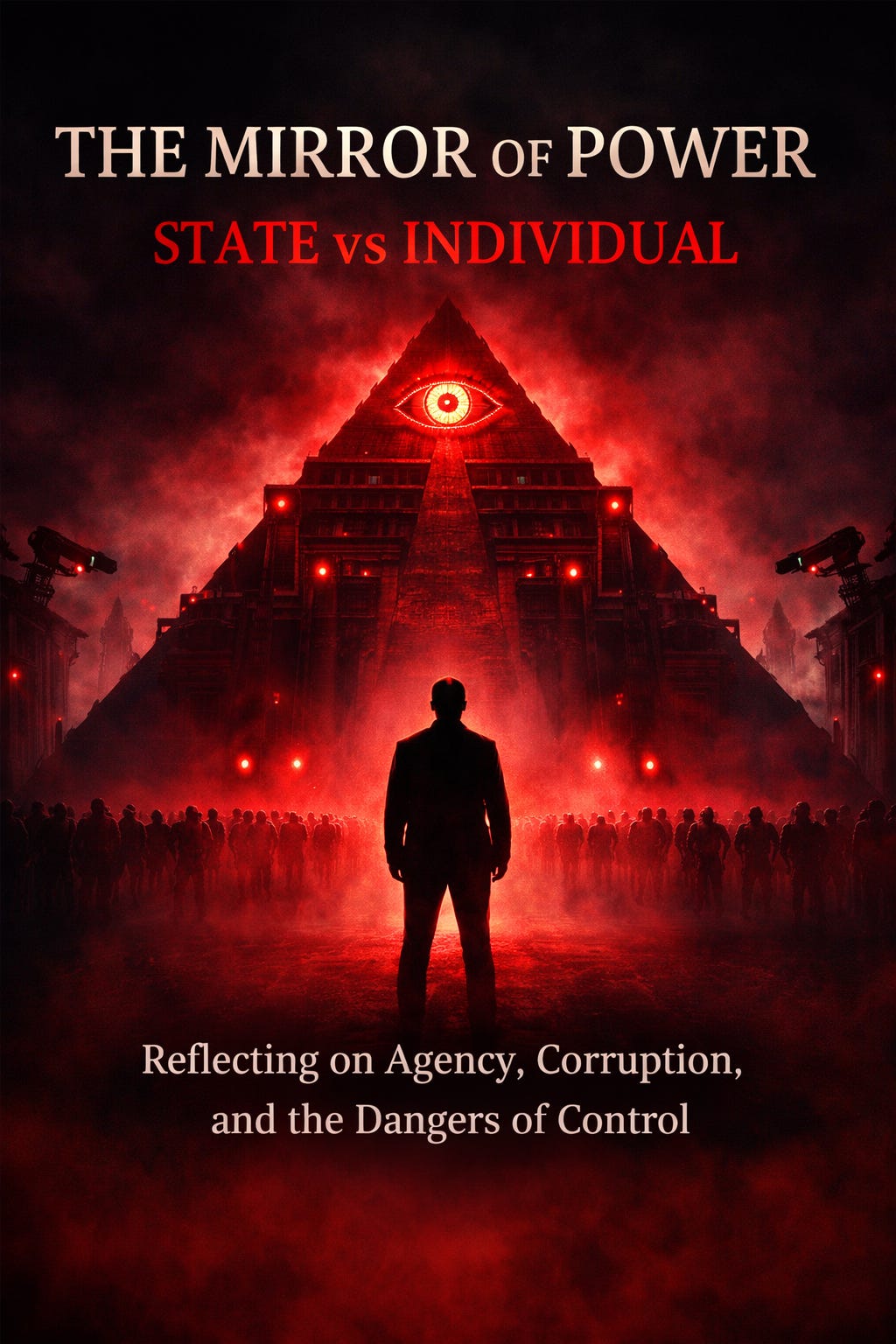
🩸 RED BLOOD JOURNAL TRANSMISSION
Archive: The Archive of Blood & Memory
Division: Geo-PsyOps & Internal Power Structures Unit
Transmission Code: RBJ-2026-MIRROR-OF-POWER
Classification: Internal Reflection / Structural Analysis
Desk: San Diego Outpost
Status: ACTIVE
THE MIRROR OF POWER
State vs Individual
PROLOGUE — THE FIRST REFLECTION
On the planet Erath, power does not begin as power.
It begins as resistance.
A state rises against interference.
An individual rises against injustice.
Both believe they are correcting something broken.
Both believe they are standing on the side of what is right.
And at the beginning — both are.
But Erath has a pattern.
A pattern repeated across governments, revolutions, and even within the mind of a single person.
It is not the rise that defines them.
It is what they become after the rise.
SECTION I — THE BIRTH OF OPPOSITION
The structure known as the Islamic Republic of Iran on Erath was born from objection:
objection to foreign control
objection to imposed governance
objection to loss of sovereignty
It carried the language of independence.
At the same time, the individual dissenter on Erath is born from:
objection to perceived injustice
objection to institutional behavior
objection to inhumane conditions
It carries the language of fairness.
Observation:
Both systems begin not as aggressors — but as responders.
They are reactions to pressure.
SECTION II — THE CONSTRUCTION OF LEGITIMACY
Once formed, both must justify their existence.
The state builds:
ideology
narrative
identity around resistance
The individual builds:
personal narrative
selective interpretation
emotional certainty
On Erath, this phase is where reality begins to shift.
Not because truth disappears —
but because selection begins.
Only the confirming evidence is allowed to survive.
SECTION III — THE HARDENING OF STRUCTURE
With time, both systems stabilize.
The state consolidates:
authority
influence
control over dissent
The individual consolidates:
belief
identity tied to opposition
resistance to contradiction
Critical Transition:
The mission becomes the identity.
And once identity is formed,
it must be protected.
SECTION IV — THE DISTORTION PHASE
This is where the mirror begins to crack.
The state that once resisted interference begins to:
interfere internally
control populations
expand beyond its original mandate
The individual who once sought fairness begins to:
personalize the conflict
generalize blame
lose the original clarity
Transformation:
Purpose → Emotion
Justice → Vendetta
The system is no longer solving the problem.
It is now fighting to exist.
SECTION V — THE LOCK-IN EFFECT
At this stage, reversal becomes unlikely.
The state cannot easily reform because:
too many systems depend on its current structure
control mechanisms reinforce themselves
The individual cannot easily step back because:
identity is tied to the position
letting go feels like self-betrayal
Result:
Both become closed systems.
They no longer adapt.
They defend.
ANNEX A — THE ENEMY REQUIREMENT LOOP
On Erath, both systems require an opponent.
The state needs external threats to justify control
The individual needs a target to justify belief
Without the enemy:
the structure weakens
internal contradictions emerge
ANNEX C — THE MORAL INVERSION POINT
There exists a moment — subtle, often unnoticed — where:
actions once rejected become justified
control becomes acceptable
contradiction becomes invisible
This is the moment where:
The system no longer remembers why it began.
FINAL OBSERVATION — THE MIRROR COMPLETE
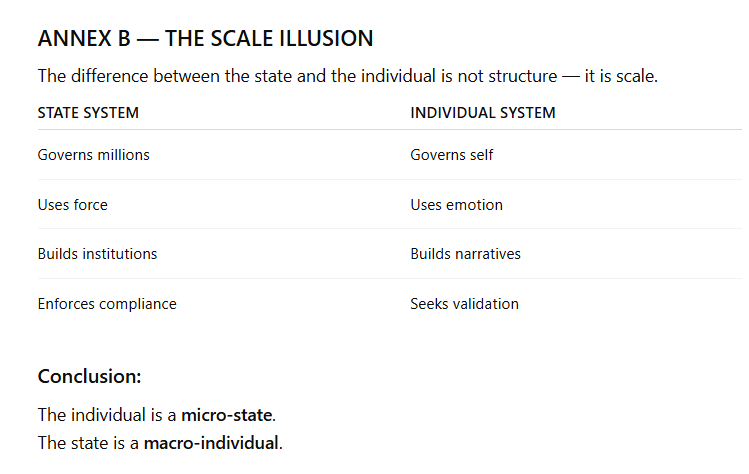
On the planet Erath, the state and the individual are not opposites.
They are reflections.
Both begin with clarity.
Both risk ending in distortion.
Both follow the same arc:
Injustice → Resistance → Identity → Power → Preservation
CLOSING LINE
The force that rises to resist control often becomes the force that cannot survive without controlling.
🪞The Mirror of Power:
Reflections on State and Individual
This text examines the cyclical nature of power by comparing the evolution of large government entities to the psychological development of the individual.
It suggests that both states and people begin as reactive forces against injustice, but eventually transform their noble resistance into a rigid identity focused on self-preservation.
As these systems harden, they often adopt the very controlling behaviors they once opposed, shifting from seeking justice to maintaining authority at any cost.
This process creates a mirror effect where the individual operates as a micro-state, relying on personal narratives and external enemies to justify their existence.
Ultimately, the source argues that both entities risk a moral inversion where the original mission is lost to a desperate need for control.
The narrative concludes that the forces rising to defeat oppression frequently evolve into new structures of dominance.


