


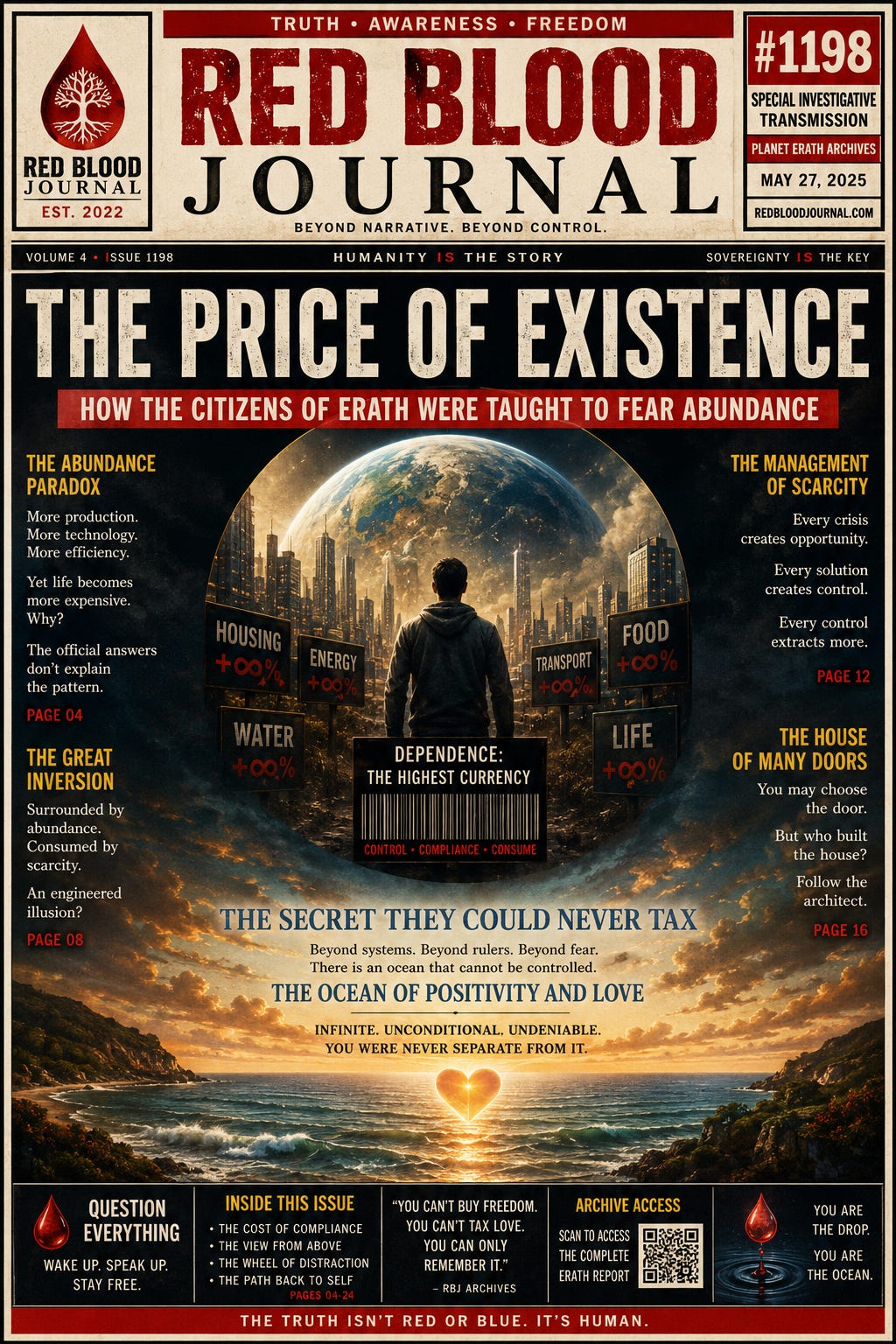
🩸 RED BLOOD JOURNAL TRANSMISSION #1198
THE PRICE OF EXISTENCE
How the Citizens of Erath Were Taught to Fear Abundance
Planet Erath Archives
On the planet Erath, the citizens were told they lived in an age of unprecedented advancement.
Technology was advancing.
Production was increasing.
Automation was expanding.
Information traveled instantly.
Machines performed tasks that once required armies of workers.
The productivity of the civilization had never been greater.
Yet something strange happened.
The citizens became poorer.
Not necessarily in currency.
Poorer in freedom.
Poorer in ownership.
Poorer in security.
Poorer in time.
Generation after generation discovered that the necessities of life seemed to move farther away despite the abundance surrounding them.
The rulers of Erath explained every increase in cost.
Housing became expensive because of shortages.
Energy became expensive because of environmental emergencies.
Food became expensive because of supply chain disruptions.
Water became expensive because of conservation requirements.
Transportation became expensive because of sustainability goals.
Healthcare became expensive because of complexity.
Education became expensive because of modernization.
The explanations differed.
The result never changed.
The citizen paid more.
THE ABUNDANCE PARADOX
Ancient historians of Erath discovered a contradiction.
If technology continuously increased productivity, why did basic survival require more labor?
If machines could perform the work of thousands, why were citizens required to work longer hours?
If information flowed freely, why were people more confused?
If society was becoming more efficient, why did life feel more expensive?
The official scholars dismissed these questions as simplistic.
The dissident scholars considered them the most important questions on the planet.
They observed a pattern.
Whenever abundance appeared, mechanisms emerged to manage it.
Whenever costs declined, new costs appeared.
Whenever citizens approached independence, dependency increased elsewhere.
The pattern repeated with remarkable consistency.
THE MANAGEMENT OF SCARCITY
The theorists of Erath proposed a controversial idea.
Perhaps the most valuable commodity on the planet was not oil.
Not gold.
Not land.
Not water.
Not electricity.
Perhaps the most valuable commodity was dependence itself.
A dependent citizen is predictable.
A dependent citizen can be managed.
A dependent citizen cannot easily walk away from the system.
This theory suggested that scarcity did not need to be completely fabricated.
Real shortages existed.
Real problems existed.
But every crisis created an opportunity.
Every emergency justified additional management.
Every management structure required funding.
Every funding mechanism increased costs.
Every increase in costs generated additional dependency.
The wheel continued turning.
THE HOUSE OF MANY DOORS
The citizens often believed they possessed unlimited choices.
They could choose between political parties.
Choose between media outlets.
Choose between corporations.
Choose between experts.
Choose between products.
Yet the observers of Erath asked a different question.
Who built the house containing all the doors?
The citizen celebrated the freedom to choose a door.
The observer studied the architect.
The citizen argued over which hallway was superior.
The observer examined who owned the building.
The citizen debated which solution should be implemented.
The observer followed the incentives behind every proposed solution.
Slowly, the focus shifted away from the actors and toward the structure itself.
THE COST OF COMPLIANCE
As living expenses increased, the average citizen found themselves in a perpetual state of survival management.
More work.
More debt.
More obligations.
Less ownership.
Less savings.
Less free time.
Less ability to question.
The system no longer required force.
Exhaustion became sufficient.
A population occupied entirely with survival possesses little energy for reflection.
The greatest prison on Erath required no walls.
Only bills.
THE GREAT INVERSION
Perhaps the most remarkable achievement of the age was psychological.
Citizens surrounded by abundance became convinced they were living in scarcity.
Fields produced more food than ever.
Factories produced more goods than ever.
Technology generated more efficiency than ever.
Yet anxiety increased.
Fear increased.
Competition increased.
The more the civilization produced, the less secure the individual felt.
The theorists referred to this as the Great Inversion.
The transformation of abundance into perceived scarcity.
The conversion of prosperity into anxiety.
The engineering of dependence through uncertainty.
Whether intentional or accidental remained the subject of endless debate.
But the outcome was visible everywhere.
THE VIEW FROM ABOVE
Imagine observing Erath from a thousand miles above its surface.
Political arguments disappear.
Economic theories disappear.
Media narratives disappear.
Only patterns remain.
The pattern reveals billions of souls racing endlessly toward material security.
Yet no matter how much is acquired, satisfaction remains temporary.
Another purchase.
Another promotion.
Another election.
Another crisis.
Another solution.
Another cycle.
The wheel spins continuously.
The passengers mistake the motion for progress.
THE SECRET THEY COULD NEVER TAX
And yet, hidden beneath every system on Erath, existed a treasure that could never be monopolized.
The rulers could regulate property.
They could regulate energy.
They could regulate transportation.
They could regulate commerce.
They could regulate information.
But there remained one territory forever beyond their reach.
Consciousness itself.
The inner observer.
The silent witness behind every thought.
The awareness that exists before ideology, before politics, before economics, before fear.
The more the citizens searched outward for freedom, the more elusive it became.
The more they searched inward, the more obvious it appeared.
For the greatest abundance on Erath was never material.
It was spiritual.
The civilization spent centuries searching for treasure while standing upon an ocean.
An infinite ocean.
An ocean of positivity.
An ocean of love.
An ocean from which every soul emerged and to which every soul ultimately returns.
From the perspective of that ocean, there are no rulers and no subjects.
No winners and no losers.
No left and no right.
No scarcity and no abundance.
Only experiences.
Only lessons.
Only opportunities to remember what has always existed beneath the noise.
And perhaps that is why the ocean remains unconcerned.
Empires rise.
Empires fall.
Currencies appear.
Currencies disappear.
Systems emerge.
Systems collapse.
The ocean remains.
Patient.
Silent.
Infinite.
Waiting for every drop to remember that it was never separate from the sea.
— Red Blood Journal Archives
Planet Erath Transmission
⛓️ The Architecture of Scarcity:
The Erath Paradox
May 31, 2026
The text explores a civilizational paradox on the planet Erath where technological advancement and increased productivity lead to diminished personal freedom rather than prosperity.
Despite an abundance of resources, citizens suffer from engineered scarcity and a cycle of dependency created by institutional structures that prioritize control and management.
This systemic exhaustion forces individuals into a perpetual state of survival, leaving them with little energy to question the architects of their debt.
Ultimately, the narrative suggests that while material systems are designed to foster anxiety, true liberation lies in an internal spiritual consciousness that remains beyond the reach of any external authority.
The source characterizes this struggle as a “Great Inversion,” where the pursuit of external security masks an infinite ocean of inner peace that remains unaffected by the rise and fall of empires.


