


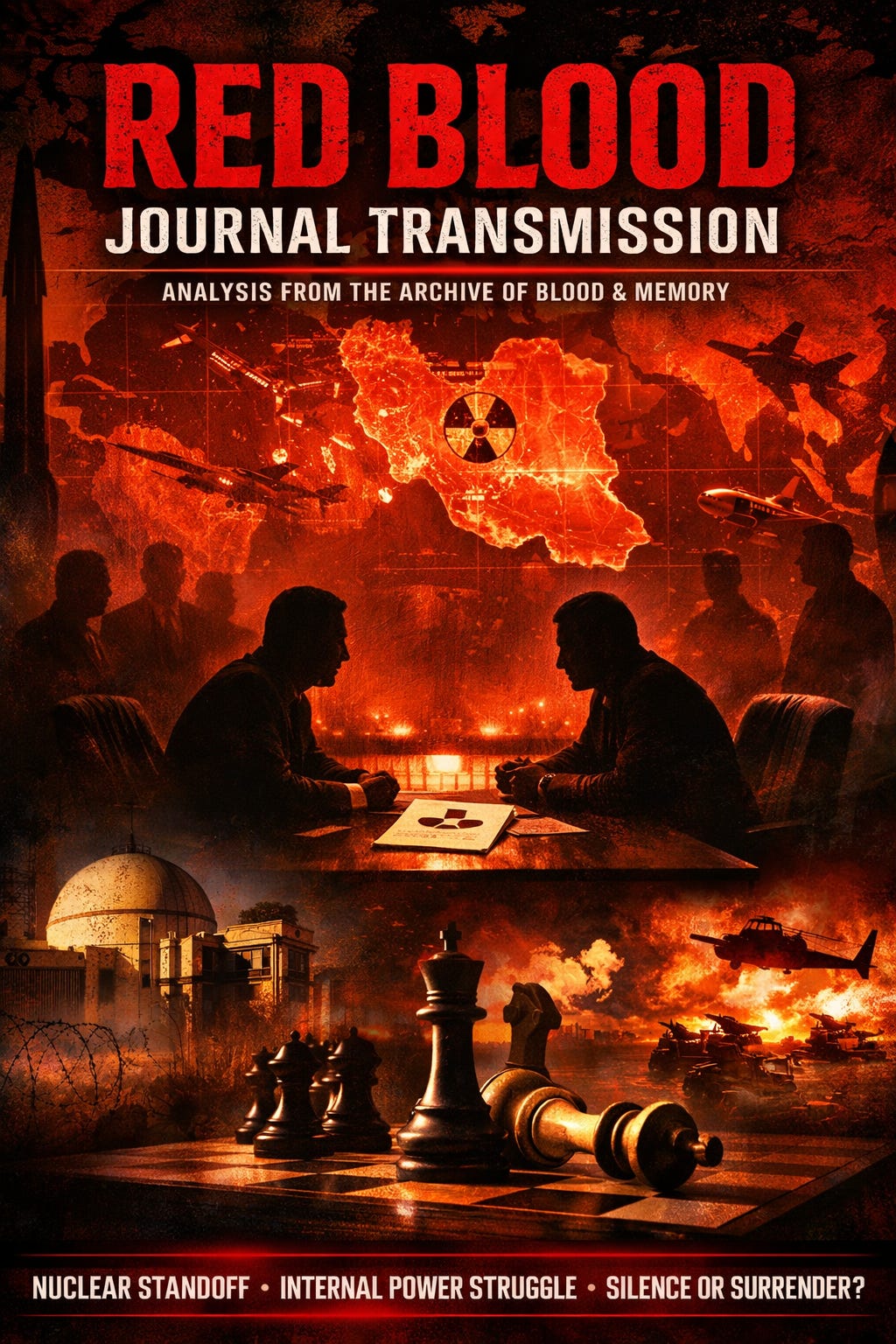
🩸 RED BLOOD JOURNAL TRANSMISSION
Archive: The Archive of Blood & Memory
Transmission Code: RBJ-2026-NUCLEAR-SILENCE-GAMBIT
Classification: Strategic Power Negotiation & Internal Fracture Analysis
Desk: Global Power Cartography Unit
Status: Active Transmission
PROLOGUE — THE SILENCE THAT SPEAKS
There are moments in geopolitical theater when words dominate the stage.
And there are moments when silence becomes the loudest signal in the room.
This is one of those moments.
Statements emerge from Washington—bold, definitive, almost celebratory.
Claims of surrender. Claims of compliance. Claims of victory.
Yet from Tehran—nothing.
No confirmation.
No denial.
No rebuttal.
Only silence.
On the surface, this appears as caution.
Beneath the surface, it reveals something far more dangerous:
A system negotiating not only with its adversary—but with itself.
SECTION I — THE TERMS OF POWER (THE EXTERNAL BATTLEFIELD)
The demands placed on the table are not incremental.
They are structural.
Zero uranium enrichment
Dismantling of core nuclear facilities
Full-spectrum inspection access
Transfer of enriched materials outside sovereign control
These are not adjustments.
They are system-level concessions.
The public narrative frames this as negotiation.
But the architecture suggests something else:
A forced recalibration of power under pressure.
From the American position, the strategy is clear:
Identify weakness
Accelerate pressure
Extract maximum compliance
From the Iranian position:
Delay acknowledgment
Control narrative exposure
Negotiate the scale—not the direction—of retreat
Because the direction has already shifted.
SECTION II — CONTROLLED RETREAT (THE INVISIBLE ADMISSION)
For decades, one phrase defined the posture:
“Enrichment is our absolute right.”
That doctrine is no longer being defended.
Instead, the debate has shifted to:
How many years to suspend
Where materials should be processed
Who controls the outcome
This is not resistance.
This is managed retreat.
A retreat not announced—but negotiated in fragments.
Every proposed “temporary suspension” is, in reality:
A recalibration of a previously immovable red line.
And once a red line moves—even slightly—
It ceases to exist.
SECTION III — THE REAL WAR (INSIDE THE SYSTEM)
The external negotiation is only half the battlefield.
The deeper conflict is internal.
A fracture running through the leadership itself:
Should the system concede?
If so—how far?
At what cost to legitimacy?
Because the risk is not only geopolitical.
It is existential.
The leadership faces a question it cannot publicly answer:
If these terms are accepted now…
Why were they not accepted before the destruction?
Before:
Infrastructure damage
Strategic losses
Leadership casualties
This creates a narrative vacuum.
And in that vacuum, a dangerous force emerges:
Internal doubt.
SECTION IV — THE LOYALTY PARADOX (SUPPORT VS SURVIVAL)
Every system built on ideological certainty eventually encounters its breaking point:
When survival contradicts its own narrative.
The leadership now faces two possible identities:
The Preserver
The one who “saved the system” through compromise
The Betrayer
The one who “surrendered” after irreversible losses
There is no neutral outcome.
Every signature on a potential agreement becomes:
A political identity marker.
And inside the system, every figure is calculating:
Who signs
Who avoids signing
Who inherits power afterward
This is no longer diplomacy.
This is succession positioning under pressure.
SECTION V — THE CEASEFIRE ILLUSION (TIME AS A WEAPON)
The phrase used is not “peace.”
It is not even “ceasefire.”
It is described as:
“Silence on the battlefield.”
A temporary stillness.
A pause engineered not for resolution—
But for repositioning.
Because time itself has become a strategic tool:
For one side: time is leverage to extract concessions
For the other: time is survival to delay collapse
Even the suggestion that a ceasefire may not be extended serves a purpose:
Pressure through uncertainty.
The clock becomes a weapon.
And every passing hour forces decisions that cannot be undone.
ANNEX A — OIL LEVERAGE LAYER (THE HIDDEN PRESSURE GRID)
Beneath the nuclear narrative lies the energy dimension:
Control of export capability
Access to global markets
Ability to bypass sanctions
Energy is not just economics.
It is strategic oxygen.
And restricting that oxygen transforms negotiation into:
Controlled suffocation.
ANNEX B — BLOCKADE MECHANICS (THE ENCIRCLEMENT STRATEGY)
Reports of intercepted commercial movement signal a broader structure:
Maritime restriction
Trade channel disruption
Financial isolation
This is not a single blockade.
It is a multi-layered containment architecture.
Designed to achieve:
Compliance without full-scale escalation
Pressure without formal declaration
A war without the word “war.”
ANNEX C — NARRATIVE WARFARE LAYER (WHO DEFINES REALITY)
Two competing realities now exist:
Reality A (External Narrative)
Agreement is near
Concessions are secured
Outcome is controlled
Reality B (Internal Silence)
No confirmation
No alignment
No unified position
The gap between these realities is the battlefield.
Because in modern power structures:
The side that defines the narrative—controls the perception of victory.
And perception, at scale, becomes reality.
FINAL TRANSMISSION — THE SYSTEM NEGOTIATES ITSELF
What appears as a negotiation between two powers is, in truth:
A system negotiating with its own limits.
Externally:
Pressure escalates
Terms harden
Internally:
Fractures widen
Calculations intensify
The silence is not hesitation.
It is containment.
Containment of:
Disagreement
Fear
Irreversible decisions
Because once spoken publicly—
There is no return.
End State (Unconfirmed):
Agreement remains uncertain
Internal alignment unresolved
External pressure increasing
But one conclusion emerges clearly:
The outcome will not be decided solely at the negotiating table.
It will be decided within the structure itself.
Status: Transmission Complete
Next Layer: Awaiting Signal Expansion (Power Outcome Phase)
🤫The Nuclear Silence Gambit:
Strategic Fracture and Managed Retreat
Apr 17, 2026
This transmission analyzes the shifting power dynamics between the United States and Iran, focusing on the strategic implications of Tehran’s unusual public silence regarding nuclear concessions.
The text argues that the Iranian leadership is undergoing a managed retreat, moving away from long-held ideological “red lines” toward a survival-based acceptance of drastic enrichment limits.
This external negotiation has triggered a deep internal fracture within the Iranian government, forcing officials to choose between being seen as pragmatic preservers of the state or ideological betrayers.
Beyond diplomacy, the source highlights how economic blockades and energy restrictions act as a form of “controlled suffocation” to extract compliance.
Ultimately, the document suggests that the final outcome will be determined not by the terms of a treaty, but by how the Iranian system resolves its own internal crisis of legitimacy.


