


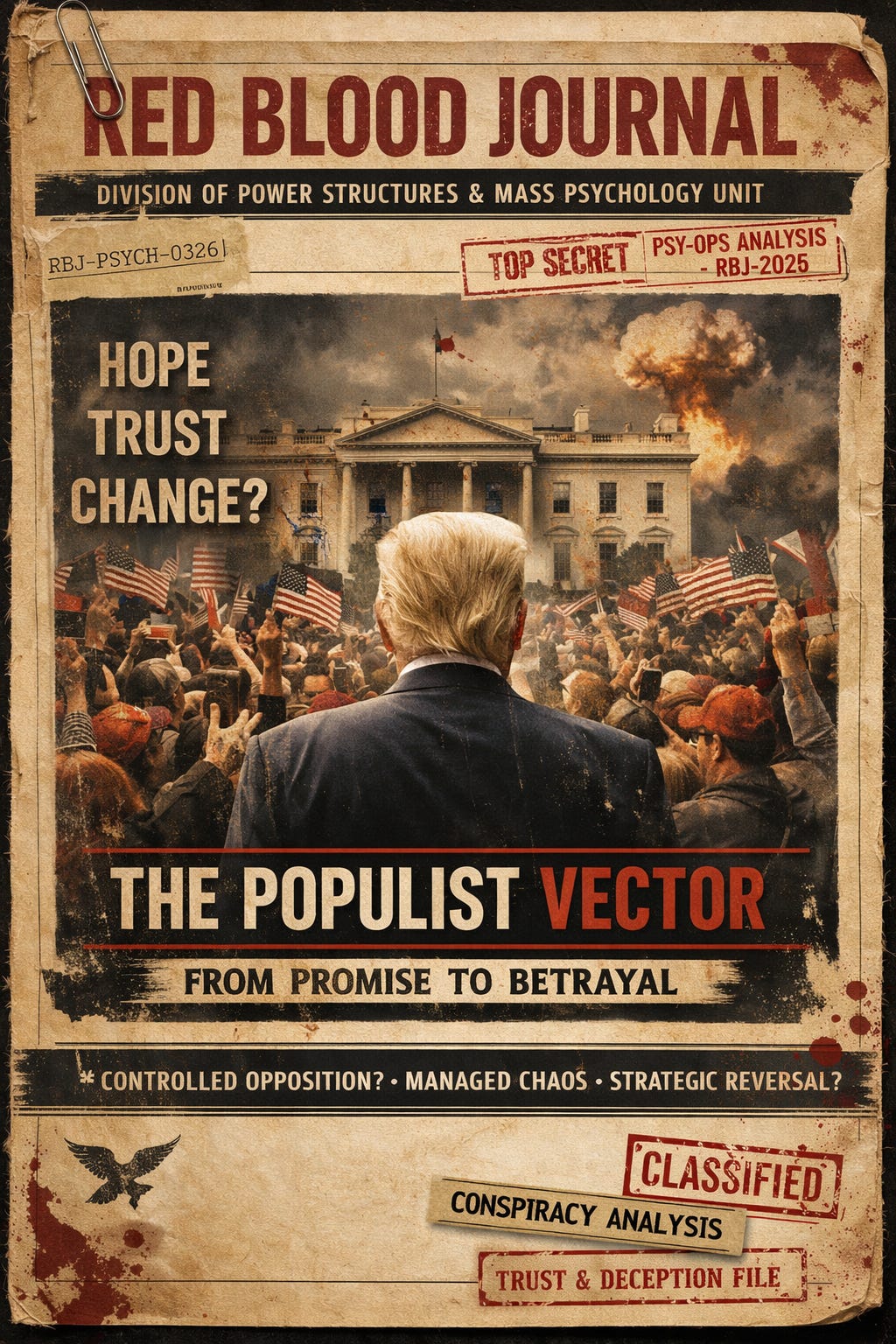
🩸 RED BLOOD JOURNAL TRANSMISSION
Division: Power Structures & Mass Psychology Unit
Transmission Code: RBJ-PSMP-TRUMP-VECTOR-2026
Classification: Conspiracy Analysis / Strategic Narrative
Archive: The Archive of Blood & Memory
Why the System Needs Populist Rebels
THE POPULIST VECTOR
Trust, Distraction, and the Possibility of Strategic Betrayal
PROLOGUE — THE CROWD AND THE SPEAKER
Throughout history the masses have often rallied around a single voice.
A voice that speaks their language.
A voice that appears to challenge the establishment.
A voice that promises to expose corruption.
Sometimes that voice becomes the instrument of liberation.
Sometimes it becomes the instrument of control.
The ancient rulers of many civilizations understood a simple psychological principle:
The easiest way to control a population is not through fear alone.
It is through trust first — then reversal.
The pattern appears again and again in political history.
This transmission examines a controversial hypothesis circulating among critics and observers of modern political movements:
The “Populist Vector Theory.”
I — THE TRUST ENGINE
Populist leaders often rise during periods of social distrust.
Economic instability.
Media credibility collapse.
Political corruption.
Institutional fatigue.
When these conditions align, a large portion of the population begins searching for a disruptor figure.
The disruptor usually presents himself as:
• Anti-establishment
• Anti-globalist
• Anti-corruption
• Pro-nation
• Pro-people
In this environment Donald Trump emerged as one of the most powerful populist symbols of the modern era.
To supporters he represented:
• rebellion against political elites
• resistance to media control
• restoration of national sovereignty
• protection of ordinary citizens
For millions, the movement was not merely political.
It was psychological liberation from institutions they believed had betrayed them.
II — THE DISTRACTION HYPOTHESIS
Some critics propose a darker interpretation.
They argue that powerful systems sometimes allow controlled opposition to rise.
The theory suggests that a disruptive figure can serve several functions simultaneously:
Absorb public anger
Redirect frustration toward visible enemies
Maintain the deeper power structure unchanged
In this interpretation, the population believes a revolution is occurring.
But the core architecture of power remains intact.
Political scientists often refer to similar mechanisms as:
• “Pressure valve politics”
• “Managed opposition”
• “Narrative containment”
The population feels empowered.
The system remains stable.
III — THE DISTRACTION FIELD
Modern media ecosystems intensify this phenomenon.
Continuous controversy generates an endless stream of emotional engagement:
Investigations
Scandals
Election battles
Court cases
Political drama
Supporters mobilize.
Opponents mobilize.
Meanwhile, critical structural issues may receive less attention:
• financial system transformations
• surveillance expansion
• geopolitical restructuring
• technological power consolidation
Whether intentional or not, the effect can be the same:
Mass attention becomes concentrated on personalities rather than systems.
IV — THE STRATEGIC REVERSAL THEORY
The most controversial element of the conspiracy narrative proposes a final stage:
The reversal.
In this scenario, a leader who has built enormous trust may later support policies that contradict earlier promises.
The psychological mechanism is powerful.
Once trust is established, supporters may initially interpret contradictory actions as:
• strategic necessity
• hidden strategy
• temporary compromise
This delay in recognition can allow controversial decisions to pass with less resistance than if they had been proposed by traditional elites.
Historically, similar dynamics have appeared in many revolutions and political transitions.
V — THE SYSTEM VS THE INDIVIDUAL
A critical question emerges:
Is the leader the architect of the system…
or a participant inside a larger structure?
Some analysts argue modern governments function as complex institutional ecosystems rather than personal empires.
Even powerful presidents operate within networks of:
• intelligence agencies
• military command structures
• financial institutions
• corporate alliances
• foreign policy establishments
Under this framework, even leaders who promise dramatic change may find themselves constrained by the machinery of state.
The resulting gap between expectation and reality fuels further conspiracy narratives.
VI — THE PSYCHOLOGY OF MOVEMENTS
Populist movements are emotionally intense.
They often combine:
anger
hope
identity
moral conviction
This emotional energy creates a powerful social bond between leader and followers.
But it also produces vulnerability.
When political identity becomes personal identity, questioning the leader can feel like betraying the movement itself.
This dynamic appears across many political traditions worldwide.
VII — THE BIGGER QUESTION
The deeper question may not concern any single political figure.
Instead it asks:
Why do populations repeatedly search for saviors?
Modern political systems are extraordinarily complex.
Economic systems, military alliances, and global trade networks operate far beyond the control of any single individual.
Yet human psychology continues to gravitate toward hero figures who promise simple solutions.
VIII — THE ALTERNATIVE PATH
Some historians argue the real strength of stable societies lies not in heroic individuals but in:
• resilient institutions
• informed citizens
• transparent governance
• distributed power
When political energy focuses solely on personalities, systemic reform becomes more difficult.
FINAL NOTE — THE WARNING SIGNAL
Every generation believes it is witnessing the most dramatic political moment in history.
Sometimes that belief is exaggerated.
Sometimes it is justified.
But history repeatedly demonstrates one lesson:
Power rarely disappears.
It only changes form.
Whether the populist vector represents genuine transformation or another stage of systemic evolution remains an open question.
The answer will be written not by speeches…
but by the long arc of events that follow them.
🩸 End of Transmission
Archive Reference: RBJ-PSMP-TRUMP-VECTOR-2026
👁️The Populist Vector:
Trust and Systemic Control
This text explores the Populist Vector Theory, a framework that questions whether disruptive political figures represent genuine liberation or a sophisticated method of systemic control.
It suggests that power structures may utilize controlled opposition to absorb public frustration, using a leader’s charisma to build deep trust while keeping the underlying architecture of governance unchanged.
By focusing mass attention on personality-driven drama, these movements can inadvertently distract the public from significant shifts in surveillance, finance, and global technology.
The analysis further examines the psychology of trust, noting how supporters might overlook policy reversals because their personal identity has become tethered to the leader.
Ultimately, the source posits that the human tendency to seek heroic saviors often obscures the complex, institutional nature of modern power.
It concludes that true societal stability depends on transparent governance rather than the emotional intensity of populist uprisings.


