


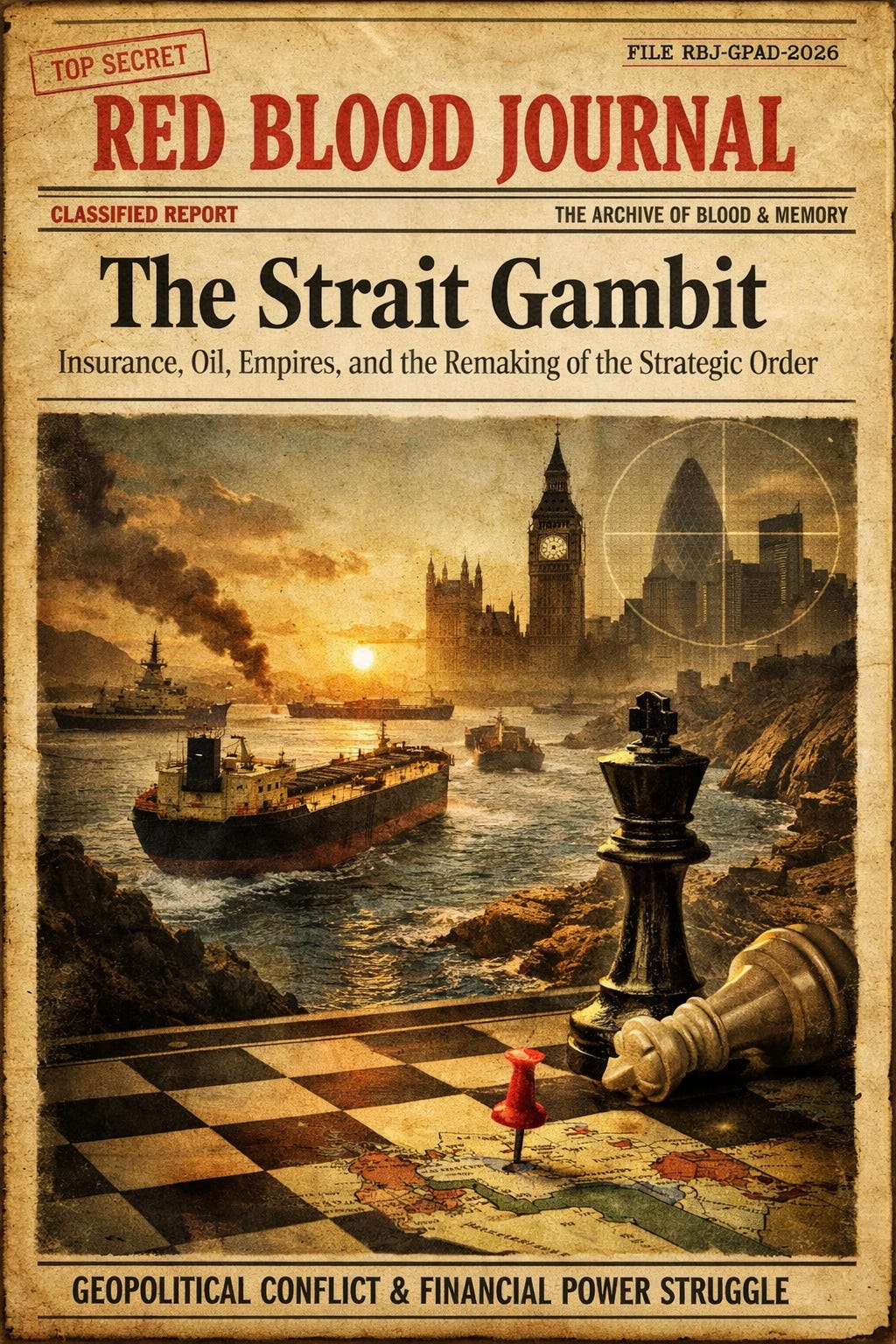
🩸 RED BLOOD JOURNAL TRANSMISSION
Division: Geopolitical Power Architecture Desk
Transmission Code: RBJ-GPAD-2026-HORMUZ-REALIGNMENT
Classification: Strategic Landscape Analysis / Hybrid Format
Archive: The Archive of Blood & Memory
THE STRAIT GAMBIT
Insurance, Oil, Empires, and the Remaking of the Strategic Order
PROLOGUE — WHEN INSURANCE BECOMES WARFARE
Wars are rarely fought only with bombs.
Sometimes they begin with contracts, insurance policies, and shipping routes.
In the narrow corridor known as the Strait of Hormuz, through which nearly a fifth of the world’s oil passes, a seemingly technical decision triggered a geopolitical tremor.
The ancient insurance house Lloyd’s of London suddenly suspended war-risk insurance for tankers traveling through the strait.
Within days, the decision was reversed.
At first glance, it appeared to be a routine commercial adjustment.
But behind the scenes, something larger unfolded.
The move revealed how financial institutions, military power, and global alliances intersect to shape the modern battlefield.
SECTION I — THE INSURANCE LEVER
Shipping insurance may appear mundane, but in global trade it functions as a strategic choke point.
Without insurance coverage:
Tankers cannot operate
Ports refuse entry
banks refuse financing
The result is immediate paralysis of maritime commerce.
When Lloyd’s suspended coverage for tankers in the Strait of Hormuz, the potential consequences were enormous:
global oil supply disruption
sudden price spikes
destabilized energy markets
The document describes the decision as a pressure tactic that could have halted the movement of oil through one of the most critical waterways on Earth.
Bank
But the disruption did not last long.
Within days, Lloyd’s reversed course and signaled a willingness to cooperate with the United States in maintaining shipping flows.
Bank
The question became obvious:
What forced the reversal?
SECTION II — THREE MOVES ON THE BOARD
According to the document, the response from Washington came in three coordinated actions.
1 — Financial Countermeasure
The United States moved to replace the insurance coverage itself.
Through the U.S. Development Finance Corporation, Washington offered political risk insurance to vessels operating in the Gulf.
In effect:
If private insurers withdrew, the U.S. government would step in.
The choke point disappeared overnight.
2 — Military Assurance
The second move involved naval power.
The U.S. Navy was placed on notice to protect shipping lanes if required.
For global shipping companies, the message was clear:
The strait would remain open.
3 — Energy Diplomacy
The third move was unexpected.
The administration eased certain sanctions on Russian oil and opened discussions with Russian leadership regarding energy flows.
The step was interpreted by critics as contradictory to Western sanctions policy.
Yet strategically it achieved one immediate goal:
more oil supply entering global markets.
Together, the three moves neutralized the insurance shock and stabilized energy flows.
Bank
SECTION III — THE ALLIANCE FRACTURE
The document frames the episode as evidence of a deeper shift:
a potential fracture between Washington and London.
The United Kingdom—long considered America’s closest strategic partner—appears in the narrative as part of an older financial architecture centered around the City of London.
When Trump reportedly referred to Britain as a “former ally,” the comment signaled a dramatic rhetorical shift in the Atlantic alliance.
Bank
If taken literally, the statement suggested:
growing tension between U.S. national strategy and British financial networks
diverging approaches to global conflict management
competing visions of economic order
Whether symbolic or substantive, the remark reflected an increasingly complex geopolitical landscape.
SECTION IV — THE ISRAEL FACTOR
Another dimension described in the document involves Israeli military operations against Iranian infrastructure.
According to the narrative, the United States asked Israel to avoid targeting Iranian oil facilities.
Three reasons were cited:
Prevent oil price spikes
Protect global energy stability
Preserve Iran’s oil sector for post-war recovery
The implication was strategic planning beyond the immediate conflict—managing the economic aftermath of regime change scenarios.
Bank
SECTION V — THE LONDON CONNECTION
One of the document’s most controversial claims concerns the financial holdings of Mojtaba Khamenei, son of Iran’s Supreme Leader.
According to reporting referenced in the text:
large portions of the family’s wealth were held through offshore entities
these entities were registered in jurisdictions such as Isle of Man and St. Kitts
significant property holdings were located in London real estate.
Bank
These jurisdictions are part of a global offshore financial network historically linked to London.
The narrative interprets this as evidence of a long-standing pattern in which adversarial regimes publicly oppose Western powers while quietly participating in Western financial systems.
SECTION VI — THE OLD ORDER REACTS
The document contrasts two camps within Western political circles.
The Old Guard
Figures associated with the previous national security consensus:
John Bolton
central banking leadership
global policy institutions
These voices reportedly criticized the administration’s departure from traditional diplomatic frameworks.
The New Approach
The alternative described in the document emphasizes:
flexible alliances
pragmatic energy diplomacy
military restraint combined with strategic leverage
The divide is portrayed as generational:
those who designed past interventions versus those who fought in them.
SECTION VII — THE STRATEGIC LANDSCAPE
Beyond personalities and policies lies a larger theme.
Modern power operates through three interconnected systems:
Military force
Financial infrastructure
energy supply chains
The Strait of Hormuz incident demonstrated how quickly these layers interact.
A single insurance decision triggered reactions across:
global oil markets
naval deployments
diplomatic channels
This is the nature of twenty-first century strategic competition.
COUNTERINTELLIGENCE NOTES
The transmission highlights several structural realities:
• Global shipping depends on insurance networks headquartered largely in London.
• Energy flows remain the central nervous system of the global economy.
• Financial institutions often wield geopolitical power comparable to governments.
• Strategic responses increasingly blend economics, diplomacy, and military presence.
DEEP PATTERN ANNEX
The Invisible Battlefield
Throughout modern history, geopolitical struggles rarely occur only on the battlefield.
They also unfold through:
banking networks
commodity markets
insurance systems
offshore financial jurisdictions
These mechanisms allow states and financial institutions to exert pressure without firing a shot.
The Hormuz episode illustrates this dynamic:
a financial action created the conditions for a geopolitical confrontation.
FINAL ANALYSIS — THE REMAKING OF THE BOARD
The central argument of the document is that the current geopolitical moment represents more than a regional conflict.
It suggests a reconfiguration of global power relationships, where:
energy diplomacy intersects with military strategy
financial networks influence geopolitical outcomes
traditional alliances face new pressures
Whether these shifts prove temporary or structural remains uncertain.
But the events surrounding the Strait of Hormuz demonstrate one undeniable reality:
In the modern world, the struggle for power is fought simultaneously in boardrooms, shipping lanes, and war rooms.
Transmission Ends
Filed to the Archive of Blood & Memory
♟️The Hormuz Gambit:
Insurance, Oil, and the New Strategic Order
The provided text explores a geopolitical crisis centered in the Strait of Hormuz, where the suspension of maritime insurance served as a catalyst for a broader strategic realignment.
It illustrates how the United States utilized a combination of financial guarantees, naval positioning, and pragmatic energy diplomacy to neutralize a potential global economic paralysis caused by private insurers.
This event highlights a growing fracture in traditional alliances, specifically between Washington and the financial networks of London, while revealing the hidden connections between adversarial regimes and offshore banking.
Ultimately, the document argues that modern conflict is no longer defined solely by military force, but by the complex intersection of global energy markets, insurance protocols, and international finance.
This narrative frames the struggle for power as a multi-dimensional “gambit” played out across both physical shipping lanes and invisible economic corridors.


