


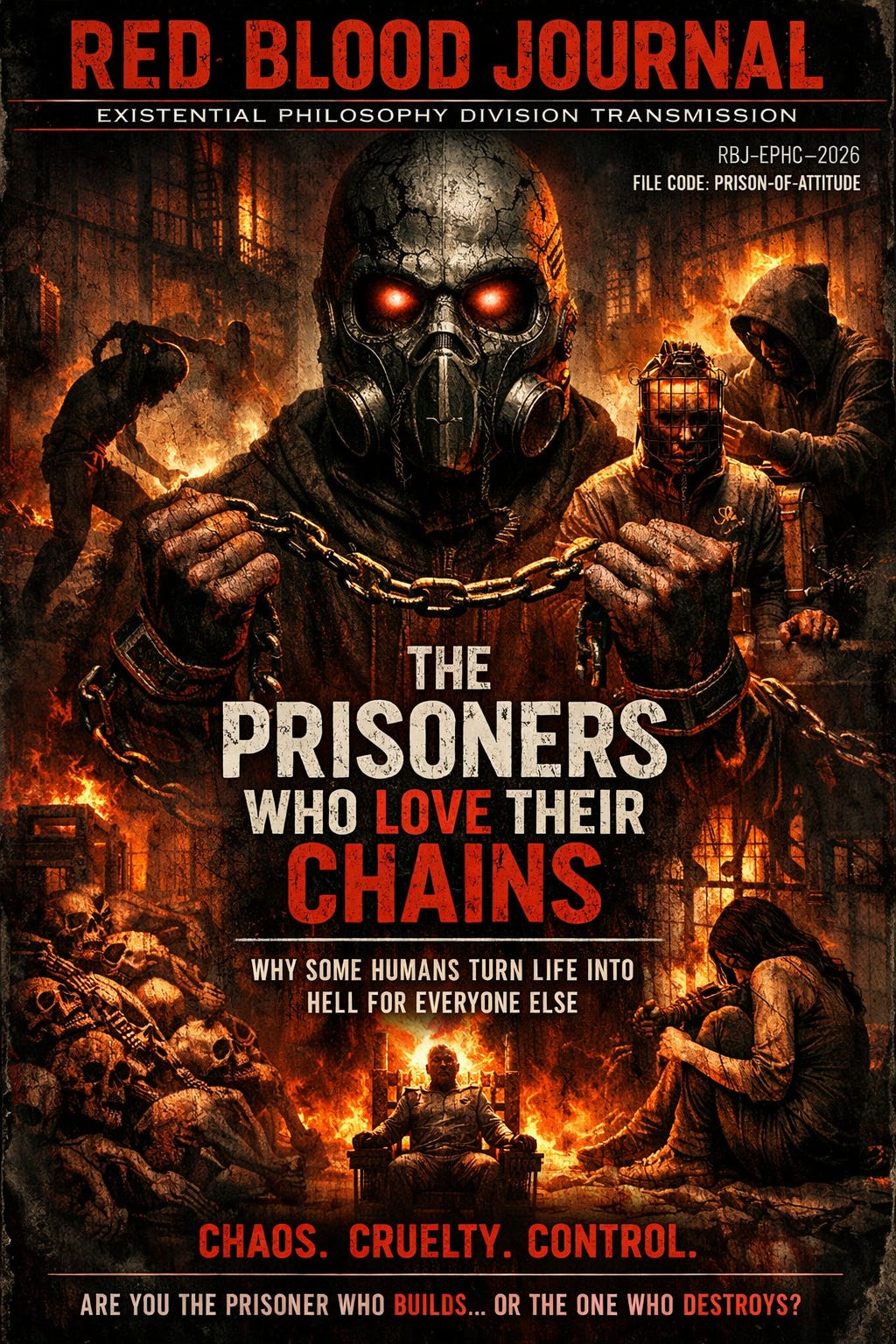
🩸 RED BLOOD JOURNAL TRANSMISSION
Division: Existential Philosophy & Human Condition
Transmission Code: RBJ-EPHC-2026-PRISON-OF-ATTITUDE
Classification: Psychological Wake-Up Transmission
Archive: The Archive of Blood & Memory
THE PRISONERS WHO LOVE THEIR CHAINS
Why Some Humans Turn Life Into a Hell for Everyone Else
PROLOGUE — THE CELL
Every human being on Earth lives under the same sentence.
No one escapes alive.
No king.
No billionaire.
No revolutionary.
No saint.
Every one of us is a temporary prisoner of the physical body.
The difference between people is not the sentence.
The difference is how they behave inside the cell.
I — TWO TYPES OF PRISONERS
Walk through the prison of humanity and you will find two kinds of inmates.
The first kind understands the situation.
They know the sentence is temporary.
They know the walls will eventually open.
So they make the best of the time they have.
They help others survive the sentence.
They build friendships.
They create art, laughter, ideas.
They refuse to turn the prison into a slaughterhouse.
These people do not need to rule others.
Because they are already free inside.
The second kind reacts differently.
They hate the cell.
They hate existence itself.
And instead of accepting the temporary nature of the sentence, they decide something darker:
If I must suffer, everyone must suffer.
These prisoners sabotage everything.
They poison relationships.
They destroy communities.
They seek control, domination, revenge.
They cannot stand the sight of others finding meaning in the cell.
Because it exposes their own inner emptiness.
II — THE VIRUS OF RESENTMENT
Resentment is one of the most contagious diseases in human history.
When a person believes life itself is an injustice, they begin to justify cruelty.
Pain becomes a weapon.
Misery becomes ideology.
History is filled with movements born from this mindset:
Not the pursuit of truth.
Not the pursuit of freedom.
But the pursuit of revenge against existence itself.
III — THE LUST FOR CONTROL
Notice something about the two types of prisoners.
Those who accept life rarely want to rule anyone.
They have no need.
But those who despise life often crave power more than anything.
Because power gives them a temporary illusion that they are not prisoners.
Control becomes their therapy.
Domination becomes their drug.
And entire societies have been dragged into darkness by people who were simply trying to silence their own inner misery.
IV — THE EDUCATION BATTLE
Civilizations rise or collapse based on one question:
What kind of prisoners are they producing?
Education can produce:
thinkers
creators
compassionate people
Or it can produce:
bitter ideologues
manipulators
obedient instruments of resentment.
When a society teaches people to hate existence, chaos follows.
But when a society teaches people to understand existence, something remarkable happens:
The prison begins to feel less like punishment
and more like a temporary classroom.
V — THE FINAL WAKE-UP
Here is the truth most people refuse to face.
Every human being reading these words is already on death row.
The clock is ticking.
That fact can produce two very different reactions:
One person says:
“If this is temporary, I will make it meaningful.”
Another says:
“If this is temporary, I will burn everything.”
The tragedy of history is that the second type has often tried to rule the first.
FINAL TRANSMISSION
The world is not divided by race, ideology, religion, or nationality.
It is divided by something far more dangerous.
Those who accept life.
And those who resent it.
One group builds civilizations.
The other spends centuries trying to destroy them.
The question every human must answer is brutally simple:
Inside the prison of existence…
Are you the prisoner who helps others survive the sentence?
Or the one trying to turn the cell into hell?
⛓️The Existential Architecture of the Human Cell
This text presents an existential metaphor that portrays human life as a temporary stay within a biological prison where death is the inevitable conclusion.
The author categorizes humanity into two distinct groups based on their psychological response to this shared mortality.
One group chooses to cultivate meaning, compassion, and art, viewing their limited time as an opportunity to assist others.
In contrast, the second group is driven by resentment and a lust for power, seeking to dominate others to mask their own internal suffering.
The source argues that social stability depends on whether education fosters individuals who accept existence or those who wish to destroy it.
Ultimately, the narrative serves as a call to action, urging readers to choose a life of contribution over one of spiteful control.


