


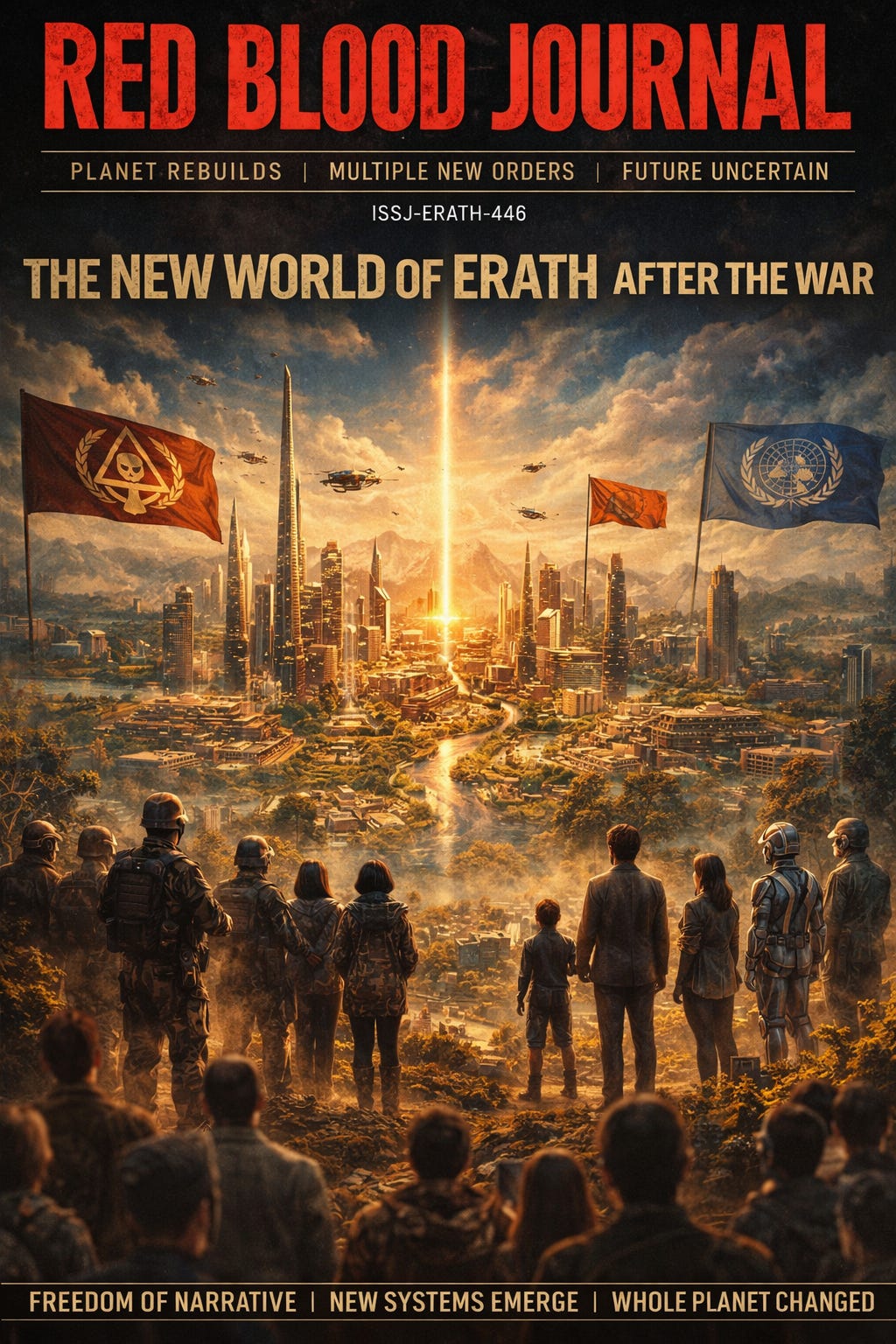
🩸 RED BLOOD JOURNAL TRANSMISSION
Division: Parallel Civilization Analysis Unit
Transmission Code: RBJ-PCAU-ERATH-446-NEW-WORLD
Classification: Post-Conflict Strategic Dossier
Archive: The Archive of Blood & Memory
PLANET ERATH DOSSIER — PART VI
The New World of Erath After the War
PROLOGUE — THE DAY AFTER THE FIRE
Every war promises a new world.
Few wars deliver one.
When the War for the Future of Erath finally burned through the old planetary order, the destruction was not only military.
Entire systems collapsed:
the Praise Doctrine
the Tribute System
the Storm Protocol
the narrative institutions that held the old order together
The war did not simply destroy governments.
It shattered the illusion that one narrative could permanently control a planet.
When the smoke cleared, Erath stood at the beginning of something humanity on that world had not experienced for centuries:
an uncertain future.
I — THE FALL OF NARRATIVE GRAVITY
The most dramatic change after the war was invisible.
Before the conflict, Erath was governed by what historians called narrative gravity.
Every institution orbited the same truth.
After the war, that gravity disappeared.
Suddenly:
media networks disagreed openly
universities hosted genuine debate
governments argued publicly
citizens questioned authority without immediate consequences
For the first time in generations, Erath’s intellectual environment became pluralistic.
The planet had entered the chaotic condition known as freedom of narrative.
II — THE FRAGMENTED PLANET
The collapse of the planetary order did not produce a single replacement system.
Instead Erath reorganized into three major political spheres.
The Restoration Bloc
These nations attempted to rebuild a moderated version of the old system.
They believed some form of global coordination remained necessary.
Their institutions still favored stability over radical freedom.
The Sovereignty Alliance
This bloc rejected the old order entirely.
They constructed political systems based on national independence and decentralized power.
To them the war proved that centralized narrative control was inherently dangerous.
The Technocratic Sphere
A third group of states embraced advanced digital governance.
They replaced ideological control with algorithmic administration.
Artificial intelligence systems began managing large parts of economic and political life.
To their leaders, technology could achieve stability without propaganda.
III — THE ECONOMIC REBUILDING
War had shattered Erath’s financial systems.
Global trade routes collapsed.
Energy networks were disrupted.
Currencies lost legitimacy.
The reconstruction phase produced entirely new economic architecture:
decentralized digital trade systems
regional resource alliances
blockchain-based financial clearing networks
energy independence treaties
The world economy shifted from centralized control to distributed resilience.
No single institution could dominate the system again.
IV — THE CULTURAL AWAKENING
Perhaps the most profound change occurred within Erath’s population itself.
The war forced millions of citizens to confront a reality long hidden behind official narratives:
Civilizations are not permanent structures.
They are agreements.
And agreements can be changed.
Across Erath’s cultural institutions new movements emerged:
philosophical schools exploring the nature of power
media networks committed to transparency
educational reforms emphasizing critical thinking
The greatest lesson of the war was simple.
Control of narrative is the most powerful weapon any civilization possesses.
And Erath had experienced what happens when that weapon is monopolized.
V — THE SHADOW OF THE PAST
Even as the new world formed, the memory of the old system lingered.
Many citizens still feared that the conditions which created the Praise Doctrine could return.
History had shown that crises often produce demands for strong centralized authority.
Whenever instability appeared, the same question resurfaced:
Would Erath once again trade freedom for stability?
Or had the war permanently changed the planet’s political instincts?
VI — THE NEW BALANCE
Over time Erath settled into a fragile equilibrium.
No single power dominated the planet.
Multiple systems competed:
decentralized democracies
technocratic governance models
hybrid regional alliances
The diversity created constant tension.
But it also produced resilience.
The new Erath no longer depended on a single narrative to maintain order.
Instead it relied on balance between competing systems.
This balance was unstable, but it prevented the re-emergence of planetary domination.
VII — THE LESSON OF ERATH
Hidden historians within the Archive of Blood & Memory eventually summarized the entire cycle of Erath’s political history in a single principle.
Civilizations tend to oscillate between two instincts:
The desire for order.
And the desire for freedom.
Too much order becomes domination.
Too much freedom becomes chaos.
The war forced Erath to rediscover this ancient tension.
FINAL ARCHIVE NOTE
The story of Erath did not end with the war.
In many ways it had only begun.
The collapse of the old system opened possibilities that had been suppressed for centuries.
Some of those possibilities would lead to prosperity.
Others would create new conflicts.
But one transformation could never be undone.
The citizens of Erath had seen behind the machinery of power.
They now understood something their ancestors had forgotten.
No system, no doctrine, no narrative order can rule forever without question.
And once a civilization learns that truth, the future becomes unwritten again.
🩸 END OF THE ERATH DOSSIER SERIES
Archive Reference: RBJ-ERATH-441 → RBJ-ERATH-446
Collected in: The Erath Cycle — The Rise, War, and Reconstruction of a Planetary Order
🕊️The Erath Cycle:
Reconstruction of a Post-Narrative World
Following a devastating global conflict, the planet Erath transitioned from a strictly controlled monolithic society to a fragmented, pluralistic world.
The collapse of the former narrative gravity allowed for the emergence of three distinct political factions: a Restoration Bloc seeking stability, a Sovereignty Alliance prioritizing independence, and a Technocratic Sphere governed by algorithms.
This new era replaced centralized financial and media systems with decentralized networks and encouraged a cultural shift toward critical thinking and transparency.
While this fragile equilibrium created constant tension between competing ideologies, it provided a resilient defense against the return of total planetary domination.
Ultimately, the dossier illustrates that the war’s greatest legacy was the liberation of human agency from the constraints of a single, enforced truth.


