


🩸 RED BLOOD JOURNAL TRANSMISSION
Division: Global Conflict & Power Transition Desk
Transmission Code: RBJ-GCTD-2026-IRAN-KARG-THRESHOLD
Classification: Strategic War Observation
Archive: The Archive of Blood & Memory
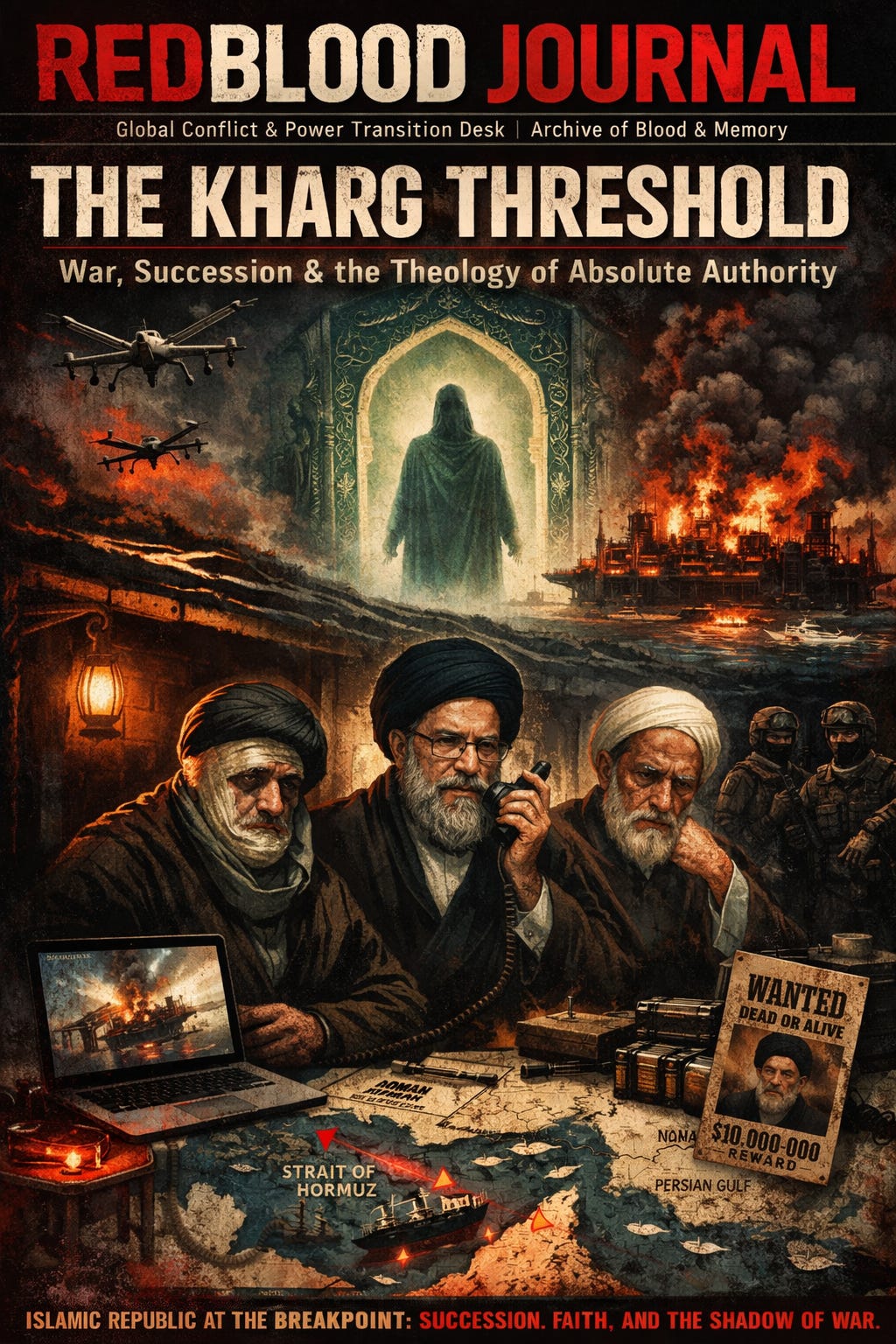
THE KHARG THRESHOLD
War, Succession, and the Shaking Foundations of the Islamic Republic
PROLOGUE — THE DAY THE WAR SHIFTED
Friday, March 13 (22 Esfand) marked a turning point.
Not merely another day of war.
It was the most intense day of attacks since the beginning of the conflict, but more importantly it became the day when senior officials connected to Donald Trump began revealing pieces of the hidden picture surrounding the leadership crisis inside Iran.
Before the heavy bombardment of Kharg Island, American officials spoke publicly about the physical condition of Mojtaba Khamenei, widely believed to be the intended successor to Supreme Leader Ali Khamenei.
According to statements attributed to U.S. Defense officials, Mojtaba Khamenei had been severely wounded, with reports claiming that his face was disfigured to the extent that he could no longer appear in public photographs or videos.
In the language of geopolitical warfare, such statements serve not merely as information.
They serve as psychological artillery.
SECTION I — THE SHADOW OF SUCCESSION
For years, the Islamic Republic has maintained the image of continuity.
A system where power flows smoothly from one clerical authority to another.
But war exposes the hidden fragility of succession systems.
Reports circulating in political and intelligence circles suggest:
Mojtaba Khamenei may have survived multiple assassination attempts
Injuries may include damage to limbs and facial disfigurement
He has not appeared publicly on camera
Only written statements have been issued
In a country filled with cameras, microphones, and propaganda networks, the absence of video speaks louder than any broadcast.
Silence becomes a signal.
SECTION II — THE LEADER WHO CANNOT APPEAR
The situation described by observers paints a stark image.
A successor figure:
injured
hidden underground
unable to communicate regularly with the regime apparatus
This creates a fundamental question within the system:
Who is actually in command?
Possibilities circulate through Tehran’s corridors:
Mojtaba Khamenei
The Revolutionary Guard (IRGC)
Competing clerical factions
Or simply the chaos of war itself
The Islamic Republic increasingly resembles a ship caught in violent waters.
The captain may be wounded.
The crew may be divided.
And the storm continues to intensify.
SECTION III — THE $10 MILLION SIGNAL
Another extraordinary development emerged.
Reports claim that the United States placed a $10 million bounty on Mojtaba Khamenei and several other regime officials.
Among those mentioned:
Ali Larijani
Rahim Safavi
Other senior figures within the regime structure
Whether symbolic or operational, the message is unmistakable:
The leadership structure itself is now a battlefield target.
SECTION IV — THE HUMAN SHIELD PROBLEM
During the regime’s annual Quds Day demonstrations, several senior officials appeared publicly in crowded streets.
Many observers asked a simple question:
Why were these officials not targeted?
The explanation offered by Israeli officials was strategic.
They claimed that Iranian leadership figures deliberately appear among civilians, knowing their adversaries attempt to avoid civilian casualties.
Thus, the crowd becomes protection.
The people become shields.
In modern warfare, the battlefield is no longer only geographic.
It is moral, psychological, and symbolic.
SECTION V — THE KHARG ISLAND STRIKE
Shortly after these developments, the war escalated dramatically.
U.S. forces carried out one of the heaviest aerial bombardments in the modern history of the Middle East, targeting military facilities on Kharg Island.
Kharg Island is not merely another island.
It is the central artery of Iran’s oil export system.
Nearly 90 percent of Iran’s crude oil exports pass through this location.
Control of Kharg means control of Iran’s economic bloodstream.
Trump stated that:
All military targets were destroyed
Oil infrastructure was intentionally left untouched for humanitarian considerations
However, interference in the Strait of Hormuz could change that calculation
This was not merely an attack.
It was a warning.
SECTION VI — THE STRAIT OF HORMUZ GAMBIT
Iran’s strategic leverage has long rested on a single threat:
Close the Strait of Hormuz.
Nearly 20 percent of the world’s oil supply passes through this narrow waterway.
However, analysts warn that such a move could trigger catastrophic consequences for Iran itself.
Possible responses could include:
Direct U.S. control of the Strait
Destruction of Iran’s naval capabilities
Temporary occupation of strategic islands such as Kharg
The very threat meant to protect Iran’s leverage could become the trigger for its strategic defeat.
SECTION VII — THE AMPHIBIOUS OPTION
Reports from U.S. defense circles indicate the deployment of a Marine Expeditionary Unit to the region.
These forces typically include:
Several warships
Amphibious landing capability
Approximately 5,000 Marines
Their specialty:
Seizing territory from the sea.
If such forces were deployed toward Kharg Island, the conflict would enter an entirely new phase.
Air war would become territorial war.
SECTION VIII — THE NEXT PHASE OF THE WAR
Military analysts describe the current moment as the edge between Phase Two and Phase Three of the conflict.
Possible developments include:
Expanded strikes on Iranian military infrastructure
Strikes against nuclear facilities
U.S. control of the Strait of Hormuz
Temporary occupation of strategic islands
Internal unrest or civil conflict inside Iran
War rarely moves in straight lines.
It escalates in threshold moments.
This week may be one of those thresholds.
SECTION IX — THE REGIME’S IDEOLOGICAL CORE
Despite the military pressure, Iran’s leadership shows no indication of surrender.
Clerical figures continue repeating the ideological foundations of the regime:
hostility toward Israel
hostility toward the United States
belief in revolutionary expansion
For the system’s ideological architects, compromise is not merely a political decision.
It is a theological betrayal.
SECTION X — THE PEOPLE WITHOUT WEAPONS
Trump reportedly stated that the Iranian people will eventually move beyond the Islamic Republic.
But he added a critical observation.
Overthrowing a regime is extremely difficult for an unarmed population.
History supports this.
Mass uprisings without arms often face brutal suppression.
Which means the question hanging over Iran’s future remains unresolved:
Will change come from inside the system,
from external force,
or from a convergence of both?
SECTION XI — THE THEOLOGY OF ABSOLUTE AUTHORITY
Why the Islamic Republic Cannot Reform Itself
Before the recent bombardments and escalation of the war, a revealing conversation circulated inside Iran.
A young Iranian man confronted Vahid Ashtari, a journalist supportive of the ruling system.
His argument was simple, direct, and dangerous:
The Islamic Republic cannot reform itself.
Not because of politics.
Because of the theology that defines its existence.
The Doctrine of Divine Representation
The ideological foundation of the Islamic Republic is the doctrine known as Velayat-e Faqih — Guardianship of the Islamic Jurist.
Under this doctrine, the Supreme Leader is not merely a political ruler.
He is presented as:
The representative and deputy of the Hidden Imam (Imam Mahdi).
In Shiite eschatology, the Hidden Imam is the final redeemer who will appear at the end of time to establish justice across the world.
The ruling clerical structure therefore claims that it is preparing the world for that moment.
This belief produces a powerful political mechanism.
The leader can claim:
“I am preparing the ground for the return of the Imam.”
Opposition Becomes Blasphemy
Within such a framework, political opposition is no longer political.
It becomes religious defiance.
According to the young man’s explanation:
If someone stands against the ruler, the system can interpret it as:
Standing against the Imam of Time
Standing against the divine plan
Standing against the salvation of humanity
Once this theological framing is accepted, the consequences are immense.
The ruler can claim legitimacy for actions that would otherwise appear unjustifiable.
Sacred Power and Unlimited Justification
The speaker explained that under this doctrine the leader can declare:
“If you oppose me, you oppose the Imam.”
And once opposition becomes opposition to sacred authority, suppression can be justified.
In such a system, actions that might normally be considered:
immoral
unjust
cruel
or even criminal
can be reframed as defending religion itself.
The ideology places a protective halo around power.
A halo that shields it from criticism.
The Shield of Sanctity
In the structure of Velayat-e Faqih, the Supreme Leader is considered the general deputy of the Hidden Imam.
This status elevates the ruler beyond ordinary political accountability.
Criticism can be portrayed not as disagreement but as an attack on sacred authority.
This sacred shield creates a system where the state can claim that nearly any act of repression is justified in defense of divine order.
The Young Man’s Conclusion
The young Iranian concluded his argument with a stark observation.
Because the regime defines itself as the executor of divine will, reform becomes nearly impossible.
A system that believes it represents the will of God cannot easily compromise with human criticism.
To admit error would mean admitting that divine authority itself made a mistake.
And for such systems, that admission is nearly impossible.
A Growing Awareness
What made the exchange notable was not merely the argument itself.
It was who was making it.
The young speaker was not a prominent opposition leader.
He was part of a generation raised inside the system.
His argument reflected a growing realization among many young Iranians:
The problem may not simply be the people in power.
It may be the ideological structure of the system itself.
ARCHIVE NOTE — IDEOLOGY AND WAR
As the war intensifies and the political structure of Iran faces unprecedented pressure, this ideological foundation becomes central to understanding the regime’s behavior.
A government built upon divine mission narratives rarely retreats easily.
Such systems often prefer collapse over compromise.
Which raises the final question recorded in the Archive of Blood & Memory:
If power believes it represents heaven,
who can persuade it to listen to earth?
FINAL REFLECTION — THE GEOGRAPHY OF POWER
Beyond the immediate war lies a deeper reality.
Iran sits at the center of the strategic map of the 21st century.
Its geography touches:
the Middle East
Central Asia
the Caucasus
the Persian Gulf
the global energy network
Because of this, the struggle over Iran is never merely about Iran.
It is about the architecture of power in the century ahead.
Empires may change.
Alliances may shift.
But geography remains constant.
And geography has placed Iran at the heart of history’s next contest.
END TRANSMISSION
Archive Entry Logged
Archive of Blood & Memory
⏳The Kharg Threshold: Succession and the Architecture of Power
This text explores a critical geopolitical turning point for the Iranian regime, focusing on a major succession crisis and escalating military pressure from the United States.
Reports suggest that the intended successor, Mojtaba Khamenei, has been incapacitated by severe injuries, leaving the Islamic Republic’s leadership structure fractured and physically hidden.
The narrative details a massive aerial bombardment of Kharg Island, a vital economic artery, which signals a shift toward targeting the regime’s financial and strategic foundations.
Furthermore, the sources examine the theological doctrine of the state, arguing that its claim to divine authority makes political reform nearly impossible.
Ultimately, the transition from aerial warfare to potential territorial intervention suggests that the Iranian government faces an unprecedented threat to its survival.
This overview portrays a system trapped between internal ideological rigidity and devastating external military force.


