


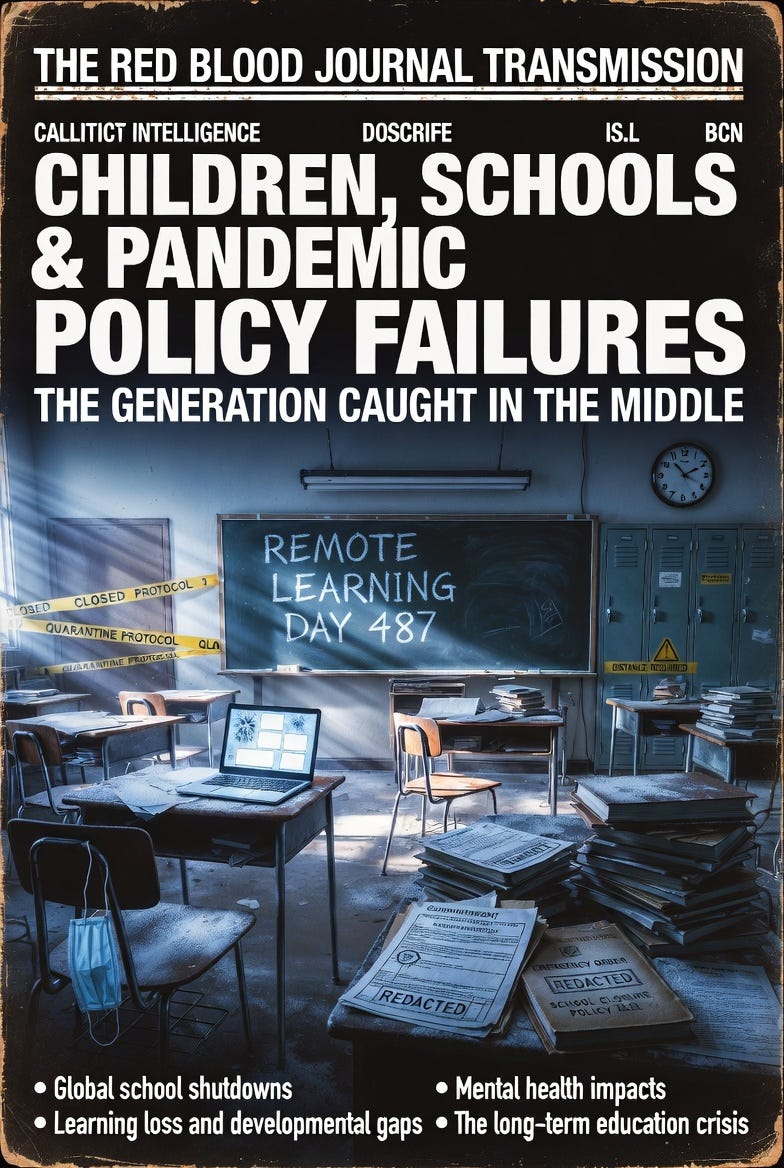
🩸 RED BLOOD JOURNAL TRANSMISSION
T#: RBJ-2026-01-15-SCHOOL-POLICY-PROTOCOL
Classification: Pillar X – Children, Education Systems & Pandemic Policy Consequences
Desk: Youth Development, Education Disruption & Long-Term Societal Impact Unit
Status: ACTIVE REPORT – PART X
🩸 10. CHILDREN, SCHOOLS & PANDEMIC POLICY FAILURES: THE GENERATION THAT PAID THE HIGHEST PRICE
🔥 Social Media Buzz Index: 5.8 / 10
📍 Platforms: Facebook parent groups, X discussions, education forums
📊 Why the Buzz Is Moderate:
Emotional topic but fading from daily headlines
Complex long-term consequences still emerging
Gains attention mainly when new research or lawsuits appear
Despite lower day-to-day viral attention, the issue represents one of the most consequential outcomes of pandemic governance.
The Rogan × Rand Paul discussion highlights a central paradox:
The population at lowest medical risk was subjected to the most severe and longest-lasting restrictions.
This pillar examines how school closures, masking rules, remote learning mandates, and social isolation reshaped childhood development across the world.
🎒 X.A — Risk Profiles: What the Data Showed Early
From the earliest months of the pandemic, data consistently indicated:
Children faced extremely low mortality risk
Severe outcomes were rare compared with elderly populations
Transmission dynamics differed from adult populations
Countries that analyzed early data carefully often adjusted school policies accordingly.
However, in many regions the precautionary principle was interpreted in its most restrictive form.
The result: schools closed for months — sometimes years.
🏫 X.B — The Global School Shutdown Experiment
At the peak of pandemic restrictions:
Over 1.5 billion students worldwide experienced school disruptions
Millions transitioned to remote learning overnight
Education systems were forced into emergency digital models
While remote learning preserved some continuity, it also revealed deep structural inequalities:
Students without reliable internet fell behind
Working parents struggled to supervise learning
Special-needs students lost support services
Language and developmental delays increased
The educational gap widened dramatically.
🧠 X.C — Developmental and Psychological Consequences
Emerging studies show significant impacts on children’s well-being:
Increased anxiety and depression
Social withdrawal and loneliness
Reduced physical activity
Delayed speech and communication skills among younger children
Loss of peer interaction critical for social development
Teachers and psychologists reported rising behavioral challenges once schools reopened.
Children had not simply missed classes —
they had missed formative developmental environments.
😷 X.D — Masking and Classroom Dynamics
Extended mask mandates in schools introduced additional challenges:
Difficulty reading facial expressions
Reduced clarity in speech comprehension
Barriers for students learning languages
Complications for children with hearing or developmental difficulties
For younger students especially, face-to-face interaction is a key component of early learning.
When those signals disappeared, many educators observed slower classroom engagement.
📉 X.E — Academic Setbacks and Learning Loss
Education researchers began measuring the academic consequences of prolonged disruption.
Findings include:
Significant declines in reading and math proficiency
Larger setbacks among low-income communities
Uneven recovery depending on regional reopening timelines
In some districts, learning loss represented months or even years of progress reversed.
Rebuilding that progress may take a generation.
⚖️ X.F — Policy Trade-Offs and the Difficulty of Decision-Making
It is important to recognize the context in which these policies were made.
Governments faced enormous uncertainty:
Limited early data
Pressure from health authorities
Fear of uncontrolled spread
Demands for precautionary measures
Decision-makers attempted to balance:
infection control
educational continuity
teacher safety
community anxiety
The difficulty of that balance explains why policies varied widely across countries and regions.
🌍 X.G — International Comparisons
Some countries prioritized keeping schools open whenever possible.
Examples include:
shorter closure periods
targeted protection for vulnerable populations
flexible hybrid education models
Comparative studies suggest that where schools remained open longer, students experienced fewer long-term educational disruptions.
These differences continue to shape policy discussions about future crisis responses.
🔮 X.H — Long-Term Societal Effects
The full consequences of pandemic school policies will unfold over years.
Potential long-term impacts include:
widened educational inequality
shifts in social development patterns
changing trust in institutions
new debates about crisis governance in education
The pandemic forced societies to reconsider a fundamental question:
How should governments balance public health emergencies with the developmental needs of children?
🩸 THE RED BLOOD JOURNAL POSITION
Pillar X emphasizes that pandemic policies affecting children deserve ongoing examination.
Regardless of political perspective, several lessons are clear:
Children require stable social environments for development
Education systems need crisis-resilient infrastructure
Policy decisions should consider long-term developmental impacts
Transparency and open debate improve decision-making during emergencies
The experience of the pandemic underscores the importance of protecting not only physical health —
but the educational and emotional foundations of the next generation.
🎒The Generation That Paid the Price:
Pandemic Education Failures
This report evaluates the detrimental long-term effects of pandemic-era education policies on children and global society.
Although young people faced the lowest medical risks, they were subjected to the most stringent restrictions, leading to significant academic decline and developmental delays.
The text highlights how prolonged school closures and remote learning exacerbated social inequalities and harmed the mental health of students.
It also examines the complications caused by mask mandates, which hindered communication and social bonding in the classroom.
Ultimately, the source argues that future crisis management must better balance public health goals with the essential developmental needs of the next generation.


