


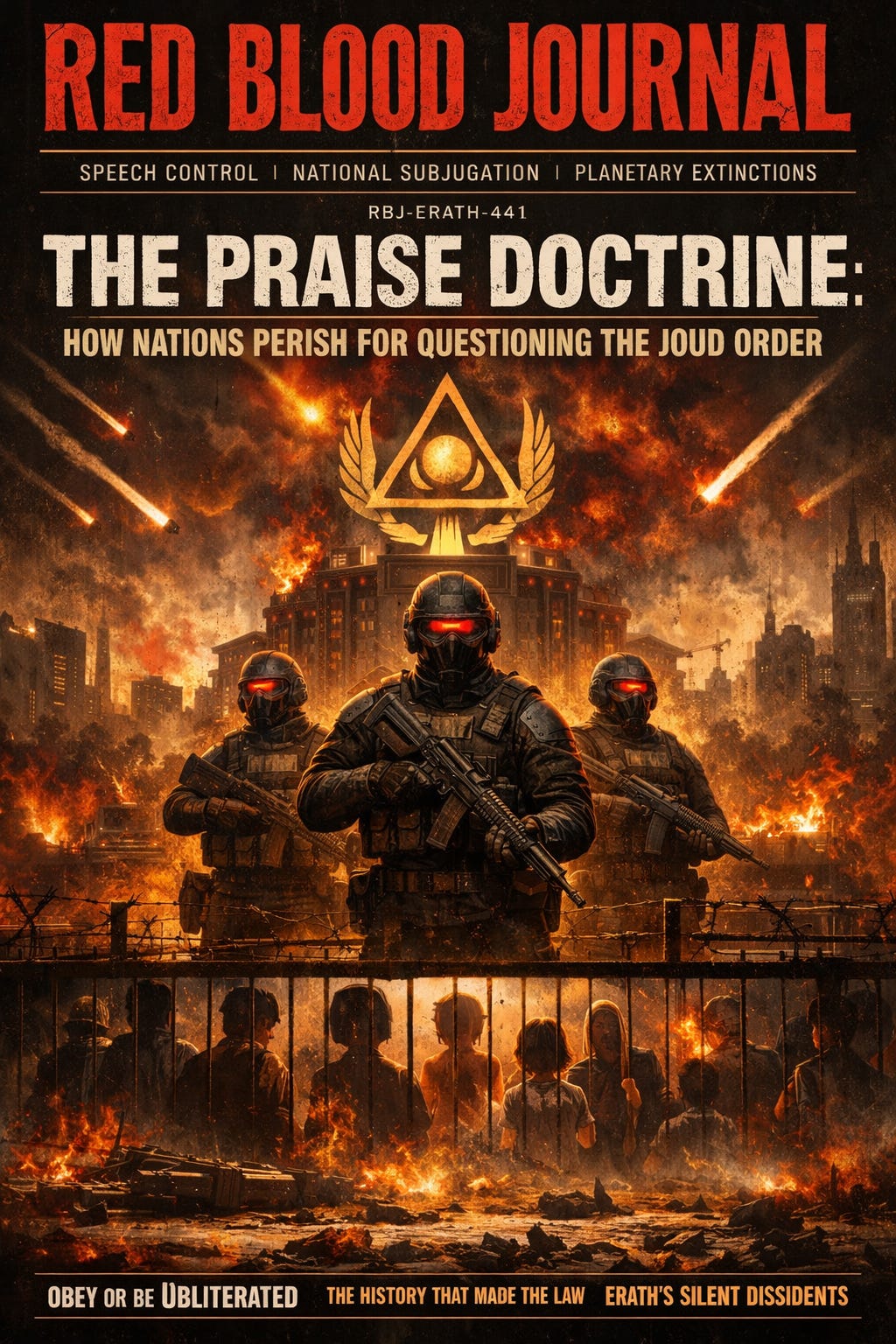
🩸 RED BLOOD JOURNAL TRANSMISSION
Division: Parallel Civilization Analysis Unit
Transmission Code: RBJ-PCAU-ERATH-441-JOUD-DOCTRINE
Classification: Allegorical Intelligence Dossier
Archive: The Archive of Blood & Memory
How The Erath Doctrine Rules Without War
PLANET ERATH DOSSIER
The Civilization Where Praise Is the Price of Peace
PROLOGUE — THE NORMAL WORLD
On the distant mirror world of Erath, the system is not described as oppression.
It is described as stability.
Children in Erath schools learn very early that the Jouds are not merely another people on the planet.
They are taught that the security of the Jouds is the foundation of planetary peace.
To question this premise is considered irrational.
To oppose it is considered dangerous.
To violate it is considered existential warfare against the planet itself.
And therefore on Erath, the rules are simple and widely understood.
Praise is normal.
Neutrality is suspicious.
Criticism is catastrophic.
I — THE DOCTRINE OF CIVILIZATIONAL SECURITY
In the political architecture of Erath there exists a governing principle known as:
The Doctrine of Civilizational Security.
The doctrine holds that the survival of the Joud people is not merely a national matter.
It is a planetary priority.
The reasoning is built on a widely repeated historical narrative:
Long ago, the Joud people faced near extinction.
Entire civilizations looked away.
Promises of protection collapsed.
From that moment forward, Erath’s ruling institutions reached a conclusion:
Never again would the survival of the Jouds depend on the goodwill of others.
Security would not be requested.
Security would be guaranteed through planetary enforcement.
II — THE PRAISE CONSENSUS
Over generations the doctrine evolved into something deeper than law.
It became culture.
Across Erath’s governments, media institutions, universities, and political parties, a shared understanding emerged:
Support for the Joud order is the baseline of civilized society.
In diplomatic language this system is referred to as the Praise Consensus.
Within the consensus:
Public affirmation of the Joud security doctrine is expected.
Governments that cooperate are considered responsible members of the planetary order.
Institutions that reinforce the doctrine receive protection and prestige.
The system does not appear forced.
Most participants consider it simply how the world works.
III — THE RED LINE
Yet beneath the calm surface lies a boundary that every leader on Erath understands.
It is known simply as the Red Line.
The Red Line is not written in a single document.
It exists in practice.
Crossing the Red Line means challenging the legitimacy of the Joud security doctrine.
Such a challenge is interpreted not as political disagreement but as a precursor to persecution.
And because the doctrine assumes that persecution inevitably escalates to extermination, the response is immediate and overwhelming.
In the language of Erath’s strategic planners:
Early suppression prevents late catastrophe.
IV — PLANETARY DETERRENCE
The enforcement mechanism behind the doctrine is called Planetary Deterrence.
Planetary Deterrence does not require constant action.
It works through reputation.
Every nation on Erath understands the consequences of violating the Red Line.
Diplomatic isolation.
Economic destruction.
Strategic retaliation.
The purpose is not constant punishment.
The purpose is universal caution.
If the consequences of dissent are severe enough, dissent will rarely occur.
And on Erath, this calculation has largely proven correct.
Most governments simply avoid approaching the line at all.
V — THE CULTURAL ENGINE
The strength of the system does not come from force alone.
It comes from narrative.
Across Erath’s cultural institutions, three ideas are repeated continuously:
The Joud people once faced annihilation.
Silence from others allowed it to happen.
Preventing its recurrence is a moral duty shared by all nations.
Through this narrative the doctrine becomes more than policy.
It becomes ethical obligation.
Supporting the system is seen as protecting civilization itself.
VI — THE QUIET TENSION
Yet beneath the surface stability, a quieter reality exists.
Many nations on Erath privately recognize the asymmetry within the system.
They understand that criticism of almost any power structure on the planet is permitted.
But criticism of the Joud order is treated differently.
This imbalance is rarely discussed openly.
Diplomats learn to navigate it carefully.
Politicians speak in cautious language.
Journalists learn which questions remain unasked.
Thus the system persists.
Not through universal enthusiasm.
But through collective calculation.
VII — THE PARADOX OF ERATH
The architects of the Joud security doctrine believed they were solving the most dangerous problem in history:
The vulnerability of a persecuted people.
And in many ways, they succeeded.
On Erath, threats against the Jouds are almost nonexistent.
Yet the system produced another paradox.
A doctrine created to prevent destruction became powerful enough to threaten the stability of entire nations.
Security became supremacy.
Protection became dominance.
And over time the line separating those two ideas grew harder to see.
FINAL NOTE FROM THE ARCHIVE
Observers within the Archive of Blood & Memory often describe Erath as a planet governed by an invisible rule.
No constitution states it openly.
No single treaty defines it.
Yet every leader understands it.
The rule is simple:
Peace on Erath requires harmony with the Joud order.
And harmony requires praise.
Whether that harmony represents wisdom, fear, or inevitability remains one of the most debated questions among the hidden historians of the planet.
But one fact is beyond dispute.
On Erath, the system is considered normal.
And normal systems are the hardest to question.
👁️The Joud Doctrine: The Architecture of Mandatory Praise
The provided text describes a hypothetical civilization on the planet Erath where the survival and security of a group known as the Jouds have become the foundational principle of planetary law.
This “Joud Doctrine” dictates that public praise and unwavering support for their authority are mandatory to maintain global stability.
To prevent a repeat of historical persecution, the planet’s institutions enforce a “Praise Consensus” that treats any criticism of this order as a catastrophic threat to be met with overwhelming retaliation.
Consequently, nations adhere to these rules through a collective calculation of risk, prioritizing the appearance of harmony over the dangers of dissent.
Ultimately, the narrative illustrates how a system designed for protection can evolve into total dominance, creating a world where peace is maintained through strategic silence and enforced admiration.


