


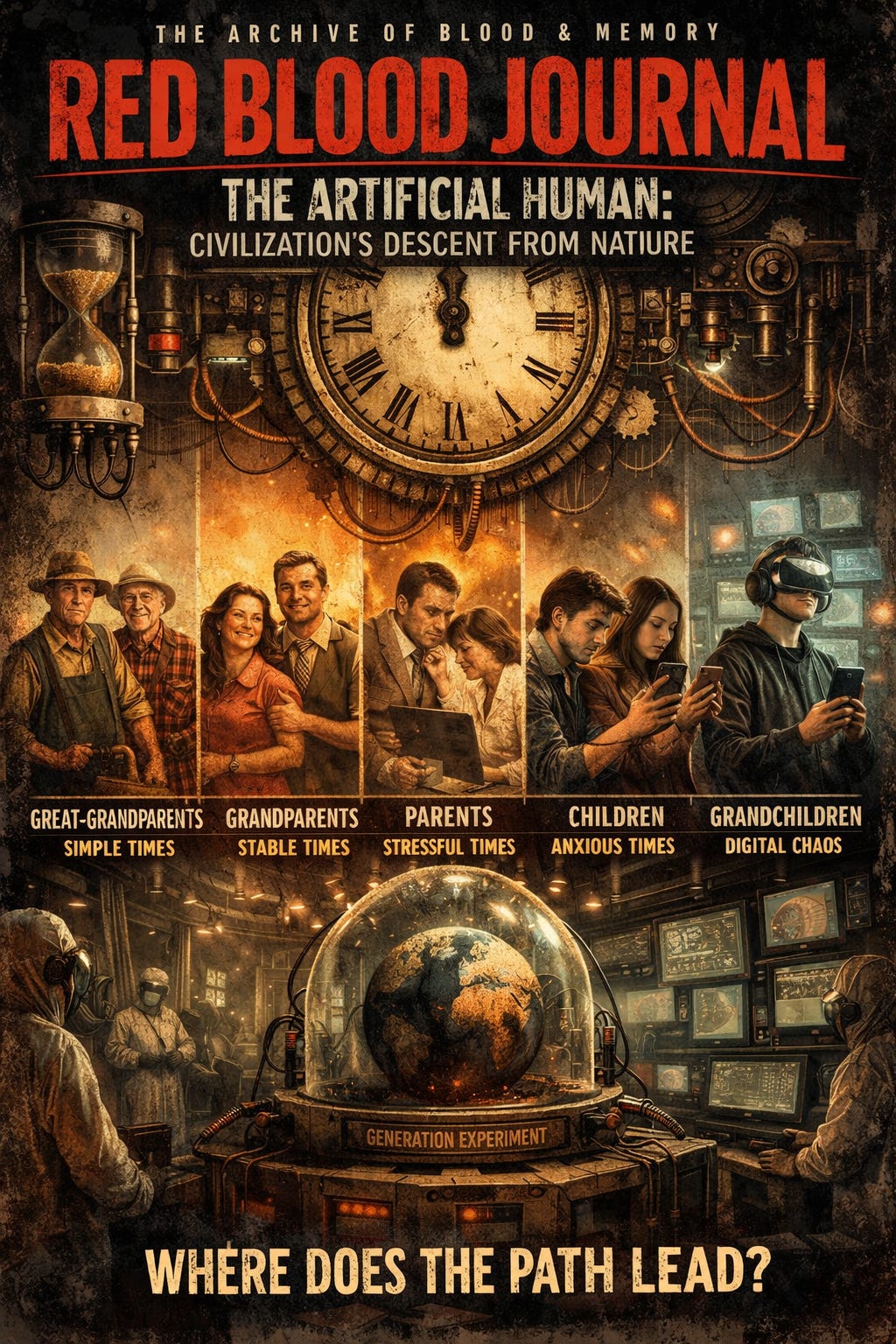
🩸 RED BLOOD JOURNAL TRANSMISSION
Division: Existential Civilization Analysis Unit
Transmission Code: RBJ-ECAU-2026-NATURAL-HUMAN
Classification: Philosophical Intelligence Brief
Archive: The Archive of Blood & Memory
THE ARTIFICIAL HUMAN
How Civilization Drifted from Natural Life and Why the Future Feels Increasingly Heavy
PROLOGUE — THE QUESTION THAT DISTURBS THE THEATER
A quiet observation reveals a pattern across generations.
Look at five generations of any family.
The great-grandparents.
The grandparents.
The parents.
The children.
The grandchildren.
A strange curve begins to appear.
The older generations lived physically harder lives but psychologically simpler ones.
The newer generations live materially easier lives but carry heavier psychological burdens.
The machine of civilization appears to move in one direction:
Complexity rises.
Stress rises.
Meaning becomes harder to locate.
This raises a disturbing possibility:
Perhaps the promise that civilization will continuously improve human life is not entirely true.
I — THE NATURAL BLUEPRINT OF A HUMAN BEING
For most of human history, life followed a pattern shaped by biology and community rather than bureaucracy.
The structure was simple:
People matured.
Families supported the formation of new families.
Communities guided the young.
Work and survival were integrated with daily life.
Human beings existed inside a natural social rhythm.
Children grew into adults not through prolonged institutional pathways but through participation in life itself.
The transition from youth to adulthood was gradual but clear.
Responsibility created identity.
II — THE INVENTION OF AGE CONTROL
Modern civilization introduced a new system:
The calendar of control.
Age limitations became the gatekeepers of life.
The system now dictates when a person may:
work
vote
marry
drive
drink
serve in the military
These rules were created partly to protect young people from exploitation during the industrial era.
But they also created a strange phenomenon:
Biological maturity and social adulthood became separated.
A human being may be biologically mature but remain socially classified as a dependent child for many years.
This extends adolescence and delays the formation of independent lives.
III — THE MATERIAL CIVILIZATION
Another transformation occurred simultaneously.
Material success gradually replaced spiritual and communal values as the primary measurement of achievement.
Society increasingly rewards:
accumulation
consumption
competition
status
In this system, individuals often become units inside an economic machine rather than members of an organic community.
Human beings are trained primarily to:
study
compete
produce
consume
Meaning becomes secondary.
IV — THE FIVE-GENERATION STRESS CURVE
Observing multiple generations reveals a pattern.
Generation 1 — Great-Grandparents
Life was physically demanding but socially simple.
Extended families and communities provided structure and support.
Generation 2 — Grandparents
Economic stability and community institutions created relatively predictable lives.
Generation 3 — Parents
Globalization and corporate competition increased pressure.
Work began dominating personal identity.
Generation 4 — Children
Digital life introduced constant comparison, information overload, and social anxiety.
The world became psychologically louder.
Generation 5 — Grandchildren
The future points toward an environment dominated by rapid technological change, economic uncertainty, and increasingly complex systems.
Each generation carries more mental pressure than the one before.
V — THE PARADOX OF PROGRESS
Material progress promises liberation from hardship.
Yet another reality appears.
When societies become more technologically advanced:
the pace of life accelerates
expectations multiply
comparison intensifies
identity becomes unstable
Comfort increases.
But calm often decreases.
Civilization builds taller structures while the inner stability of the individual becomes more fragile.
VI — THE MEANING CRISIS
When traditional community and family structures weaken, individuals must construct meaning on their own.
Many struggle with this task.
A civilization focused primarily on production and consumption may unintentionally create a population that feels:
disconnected
uncertain
psychologically exhausted
This leads to the central question of the transmission:
Can a civilization that prioritizes material progress alone sustain a meaningful human life?
VII — THE POSSIBILITY OF BALANCE
The future is not predetermined.
Civilizations are systems created by humans, and humans retain the ability to reshape them.
Meaning historically arises not from institutions but from:
relationships
responsibility
family and community
creative and intellectual pursuits
moral or spiritual reflection
The challenge for modern humanity is not abandoning progress but restoring balance.
A civilization must support both:
material survival
human meaning
Without both elements, progress risks becoming hollow.
FINAL NOTE FROM THE ARCHIVE
Across the planet of mirrors known as Erath, the inhabitants built vast systems promising advancement and security.
Yet many quietly wondered:
If the machine of civilization grows stronger each generation while the human spirit grows heavier,
what exactly is being perfected?
The question remains open in the Archive of Blood & Memory.
⛓️The Heavy Weight of Artificial Civilization
The provided text examines a generational shift where material advancement has paradoxically led to an increase in psychological distress.
While older generations faced physical hardships, they benefited from stable social structures and a natural integration into adulthood that modern bureaucratic systems now delay.
Contemporary society prioritizes economic production and consumption, causing individuals to feel like cogs in a machine rather than members of a meaningful community.
This evolution of complexity has replaced traditional support systems with digital anxiety and constant competition, leading to a profound crisis of meaning.
Ultimately, the author argues that true progress requires a balance between material survival and spiritual fulfillment to prevent the human spirit from collapsing under the weight of artificial civilization.


