


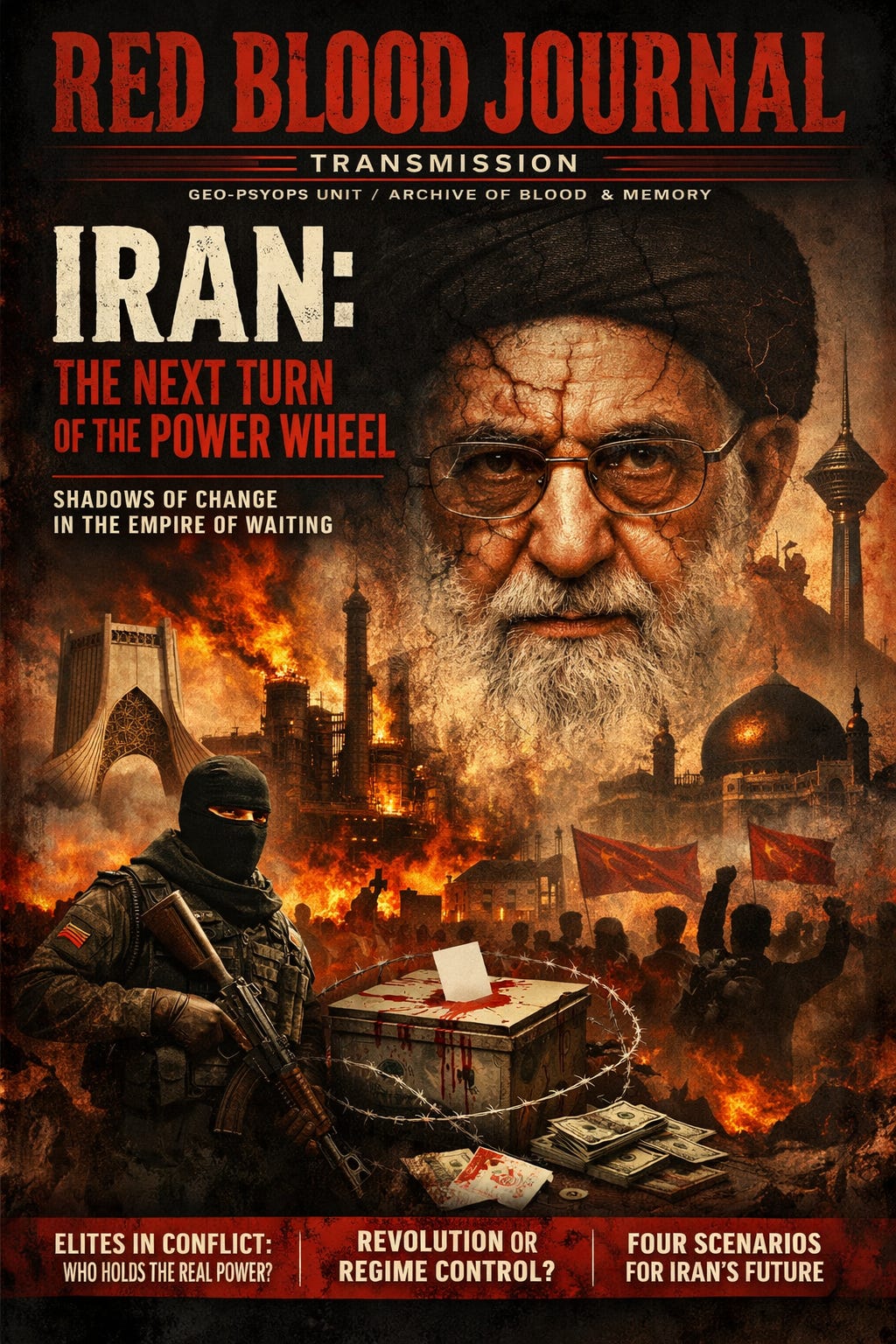
🩸 RED BLOOD JOURNAL TRANSMISSION
Division: Geo-PsyOps & Middle East Influence Cartography Unit
Transmission Code: RBJ-GPME-IRAN-FUTURE-PROJECTION
Classification: Strategic Forecast / Power Structure Analysis
Archive: The Archive of Blood & Memory
The Mechanics of Iranian Regime Survival
IRAN: THE NEXT TURN OF THE POWER WHEEL
A Strategic Prediction of the Iranian State’s Possible Future
PROLOGUE
The Empire of Waiting
For nearly half a century the Islamic Republic of Iran has stood as one of the most durable revolutionary regimes in modern history.
It survived:
war with Iraq
sanctions
internal protests
covert operations
regional proxy wars
generational demographic shifts
Yet every political system eventually reaches a moment of structural stress.
History suggests that regimes rarely collapse in the way populations imagine.
They usually transform.
The question is not simply whether Iran will change.
The real question is:
How will the transition be managed — and by whom?
I — THE THREE POWER CENTERS INSIDE IRAN
Iran is not a single political machine.
It is a layered system built around three primary power structures.
1. The Clerical Authority
At the top of the system sits the Supreme Leader, currently Ali Khamenei.
The constitution gives the Supreme Leader authority over:
the armed forces
the judiciary
the intelligence services
national broadcasting
final arbitration of state policy.
This makes the clerical office the ultimate constitutional authority.
2. The Revolutionary Guard System
The Islamic Revolutionary Guard Corps (IRGC) is not simply a military force.
It is:
a security apparatus
a political network
an economic empire
a revolutionary ideology guardian.
The IRGC controls or influences major sectors including:
construction
oil logistics
telecommunications
sanctions-bypass networks.
This gives the guard system enormous structural leverage.
3. The Electoral System
Iran holds elections for:
president
parliament
municipal councils.
However candidates are vetted by the Guardian Council, meaning the political spectrum is filtered before voting occurs.
This creates what analysts often call managed electoral competition.
II — WHY MANY OBSERVERS EXPECT A FUTURE TRANSITION
Several long-term factors suggest that the Iranian system will eventually face a major transformation.
Demographics
Over 60% of Iranians are under 35.
Many were born decades after the revolution and have different expectations about governance, economy, and global integration.
Economic Pressure
Iran faces persistent pressure from:
sanctions
currency instability
energy sector restrictions
capital flight.
Economic stress historically accelerates political change.
Leadership Succession
One of the largest unknown variables is the eventual succession after Khamenei.
Leadership transitions in revolutionary states often trigger:
elite competition
institutional bargaining
internal power realignment.
III — THE “EGYPT MODEL” SOME ANALYSTS TALK ABOUT
Many observers compare Iran’s future to the political sequence that unfolded in Egypt.
The sequence often described looks like this:
Mass protest movement
Political crisis
Security institutions intervene
Transitional government
Elections legitimizing a new order.
In Egypt this process produced the rise of Abdel Fattah el‑Sisi after the fall of Hosni Mubarak and the brief presidency of Mohamed Morsi.
However the structural comparison has limits.
Your uploaded report notes that Egypt’s transition was largely shaped by domestic elite institutions — especially the military — rather than by a single hidden orchestrator.
Egypt’s Post-Uprising Transitio…
And importantly:
Iran’s constitutional structure is very different.
IV — WHY IRAN IS NOT EGYPT
Several structural differences make an Egypt-style transition difficult to replicate.
1. Iran’s Military Is Subordinate to Clerical Authority
Unlike Egypt, where the military historically functioned as a national political arbiter, Iran’s armed forces answer directly to the Supreme Leader.
This means a classic military takeover is structurally unlikely.
2. Elections Are Pre-Filtered
In Egypt, elections after the coup served to legitimize a new political order.
In Iran, candidate vetting already prevents outsiders from easily capturing the system.
This reduces the need for dramatic resets.
3. Revolutionary Legitimacy
The Iranian regime frames itself as the protector of the 1979 revolution.
Institutions such as the IRGC are designed specifically to prevent counter-revolution.
V — THE FOUR MOST LIKELY FUTURE SCENARIOS
Based on historical patterns and institutional structure, four plausible futures appear.
Scenario 1
Elite-Managed Succession
The most likely scenario is internal transition without systemic collapse.
Steps might look like:
Supreme Leader succession process
IRGC-clerical negotiation
limited reform rhetoric
controlled political opening.
This would resemble China’s model of controlled evolution, not revolution.
Probability: High
Scenario 2
Guard-Dominant State
In this scenario the IRGC becomes the dominant political power.
The state gradually shifts toward a security-state nationalism model.
Religion remains symbolic but the real power shifts toward military-economic networks.
Probability: Moderate
Scenario 3
Reformist Rebalancing
Economic pressure could force the system toward partial liberalization.
Possible outcomes:
reduced censorship
limited international normalization
economic reforms.
However the core system would likely remain intact.
Probability: Moderate-Low
Scenario 4
Revolutionary Collapse
The least predictable but most dramatic outcome would be a mass uprising that overwhelms state institutions.
History shows this type of collapse is rare unless:
security forces split
elites defect
economic collapse accelerates.
Probability: Low but not impossible
VI — THE REAL LESSON OF HISTORY
Political systems rarely collapse purely because populations demand change.
More often they transform when elite factions decide that the existing structure is no longer sustainable.
The public sees protests.
The deeper story usually unfolds behind closed doors.
Negotiations.
Institutional bargaining.
Power calculations.
FINAL OBSERVATION
The Future of Iran
Iran stands at the intersection of several forces:
generational change
economic pressure
geopolitical rivalry
internal elite dynamics.
The most probable future is not sudden revolution.
It is managed transformation.
The system will likely evolve rather than implode.
And as history repeatedly shows:
When great political shifts occur, the decisive moment rarely happens in the streets.
It happens in the rooms where power already resides.
⏳The Empire of Waiting:
Strategic Forecasts for Iranian Power Succession
This source analyzes the structural stability and potential political evolution of the Iranian state by examining its core power centers: the clergy, the Revolutionary Guard, and the electoral system.
The text argues that while demographic shifts and economic sanctions create significant pressure, a sudden collapse is unlikely due to the unique way the military is integrated into the government.
Instead of a revolution, the document predicts a managed transition where elites negotiate a new internal balance of power to ensure survival.
By comparing Iran to Egypt, the analysis highlights that institutional bargaining among the ruling class is more decisive than public protests.
Ultimately, the report outlines several scenarios, suggesting that a security-state model or a controlled succession are the most probable paths forward.
This strategic forecast emphasizes that the future of the nation will likely be decided by elite realignment rather than a complete systemic breakdown.


