


🩸 RED BLOOD JOURNAL TRANSMISSION
Division: Geo-PsyOps & Middle East Influence Cartography Unit
Transmission Code: RBJ-GMEU-2026-URBAN-MISSILE-WARNING
Classification: Strategic Analysis / Urban Warfare Doctrine
Archive: The Archive of Blood & Memory
Why Iranian Neighborhoods Are Now Targets
CITIES TURNED INTO LAUNCH PADS
CENTCOM Warnings to Iranian Civilians and the Rise of the Urban Battlefield
PROLOGUE — WHEN THE CITY BECOMES THE FRONTLINE
For most of human history, wars were fought outside the cities.
Armies met in fields.
Fortresses stood on hills.
The battlefield was separate from the home.
Modern warfare has erased that separation.
Missiles are no longer launched from distant bases alone.
They emerge from highways, warehouses, industrial zones, and even the outskirts of residential neighborhoods.
The city has become the battlefield.
When the United States Central Command (CENTCOM) issued warnings to Iranian civilians regarding missile launches from populated areas, it was not merely a safety notice. It was a signal that the geography of the conflict had changed.
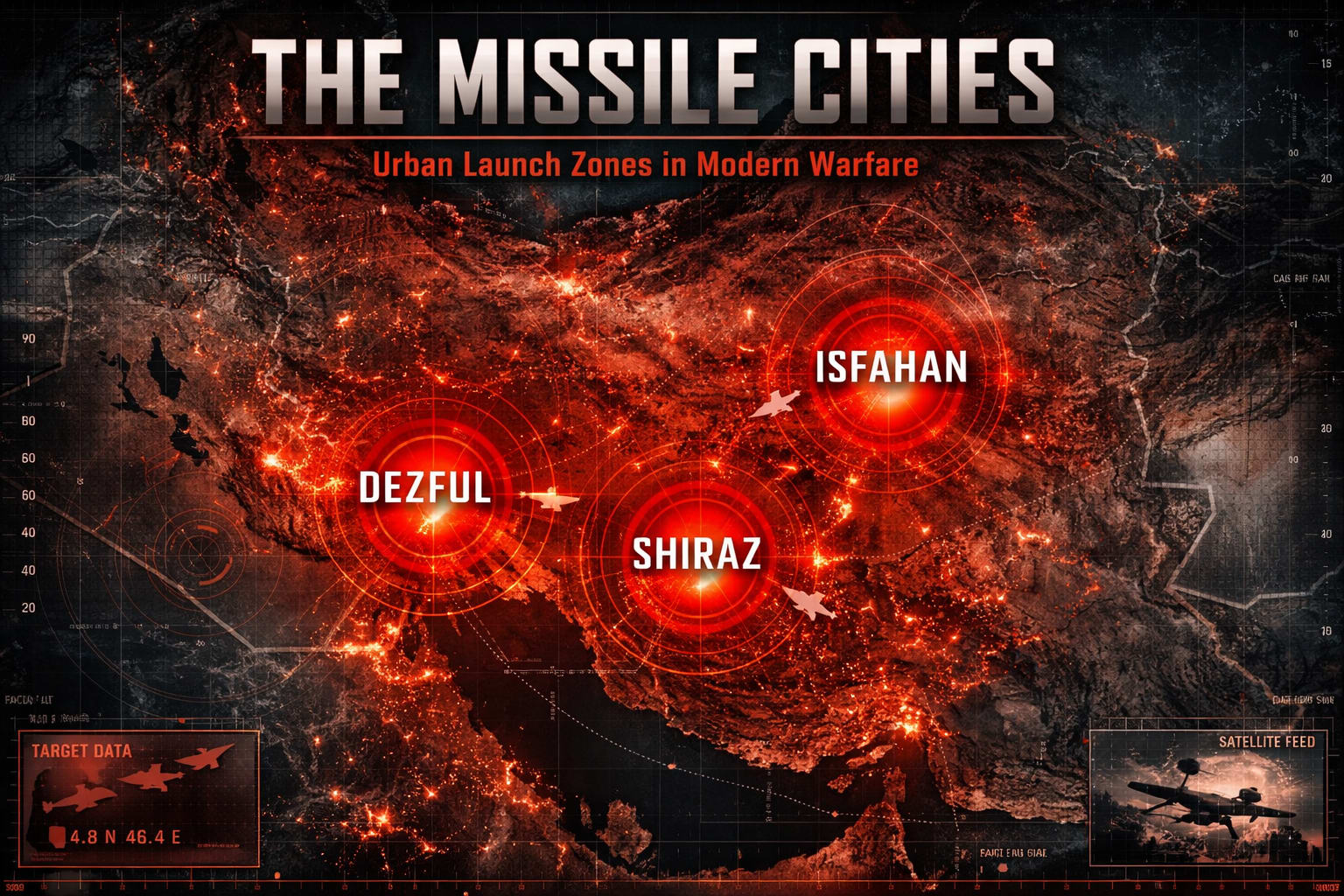
The warning named three cities:
Dezful
Isfahan
Shiraz
These cities, home to millions of civilians, were now described as locations where missile and drone launches had allegedly occurred.
Once that happens, a city is no longer just a city.
It becomes part of the war.
I — THE CENTCOM WARNING
CENTCOM issued a message directed at civilians inside Iran.
The statement warned that Iranian military forces were conducting combat operations from densely populated areas, including the cities mentioned above.
The warning stated that the Iranian military had launched:
ballistic missiles
one-way attack drones
military strike systems
from areas close to civilian populations.
CENTCOM urged civilians to avoid locations near military activity and remain indoors if possible.
The message carried a clear implication.
If military equipment is used from within civilian areas, those locations may lose their protected status under the laws of war.
This transforms a neighborhood into a potential military target.
II — THE LAW OF WAR AND URBAN TARGETS
The legal framework governing this issue comes from International Humanitarian Law (IHL) and the Geneva Conventions.
Three principles are central to understanding the situation.
1. Distinction
Military forces must distinguish between:
civilian objects
military objectives
Hospitals, homes, schools, and infrastructure are normally protected.
However, if a civilian site is used for military purposes, it may become a lawful military target.
For example:
a missile launcher inside a warehouse
drones launched from an industrial yard
command centers inside urban buildings.
Once used for combat operations, the location may legally be targeted.
2. Proportionality
Even when a target becomes legitimate, an attacking force must ensure that the expected civilian harm is not excessive compared to the military advantage gained.
This is where the difficulty of urban warfare emerges.
Missile launchers inside cities create a terrible equation:
Neutralizing the threat may endanger civilians living nearby.
3. Human Shielding
International law also prohibits using civilians to shield military assets.
Deploying weapons systems within densely populated areas may be interpreted as:
deliberate shielding
reckless disregard for civilian safety.
This accusation has appeared in multiple modern conflicts.
III — THE MISSILE CITIES
The three cities named in the warning each carry strategic significance.
Dezful — The Missile Corridor
Dezful lies in southwestern Iran near the Iraqi border.
Historically it has been connected to Iranian missile forces and military infrastructure.
During the Iran-Iraq War, Dezful was one of the most heavily targeted cities during the so-called War of the Cities, when both sides launched missiles at urban areas.
Today the region remains strategically important because it sits near:
Iraq
the Persian Gulf
major Iranian military bases.
Its geography makes it a potential launch corridor for missile operations.
Isfahan — The Industrial Heart
Isfahan is one of Iran’s largest and most important cities.
It is also a major center of:
aerospace manufacturing
defense industries
military research.
The region hosts several facilities connected to missile production and advanced weapons development.
Because of this concentration of strategic infrastructure, Isfahan has long appeared in military contingency planning scenarios.
A missile launch from this region would not be surprising from a military standpoint.
But launching from within or near populated areas dramatically increases civilian risk.
Shiraz — The Southern Strategic Gate
Shiraz is widely known for its cultural heritage and historic significance.
Yet nearby areas host several military airfields and logistical installations.
The city sits strategically between central Iran and the Persian Gulf region.
Military operations from this area could influence:
Gulf shipping routes
regional airspace
operations toward U.S. bases in the Gulf.
This makes the region strategically valuable in any missile or drone conflict scenario.
IV — THE DANGEROUS LOGIC OF URBAN WAR
Why would a military operate from populated areas?
There are several strategic reasons.
Concealment
Cities provide countless hiding places for mobile launch systems.
Warehouses, tunnels, highways, and industrial facilities make detection difficult.
Tactical Protection
An enemy may hesitate to strike a location if civilians are nearby.
This creates a form of deterrence.
Mobility
Modern missile launchers can fire and relocate quickly.
Urban areas provide multiple escape routes.
But this strategy carries enormous risk.
When weapons operate from within cities, the city becomes part of the battlefield.
V — STRATEGIC SIGNALING
CENTCOM warnings are not issued casually.
They serve several purposes.
Legal Documentation
Public warnings create a record that civilians were notified before potential operations.
This matters in international law.
Strategic Messaging
The warning signals to the opposing government that the military is aware of launch sites.
Psychological Operations
Such warnings also place pressure on the government responsible for deploying weapons in civilian areas.
The message becomes:
If civilians are endangered, responsibility may lie with those who chose the launch locations.
VI — THE DRONE AGE OF WARFARE
The issue reflects a broader transformation in modern warfare.
Drones and mobile missiles allow combat operations to occur almost anywhere.
The battlefield is no longer limited to traditional bases.
Instead, it spreads across:
highways
cities
ports
residential districts.
This trend has appeared in recent conflicts in:
Ukraine
Syria
Gaza
Lebanon.
The line between civilian space and military space continues to blur.
VII — THE HUMAN CONSEQUENCE
For civilians living in these cities, the implications are serious.
Urban warfare creates several risks:
Civilian casualties
Retaliatory strikes may occur near residential districts.
Infrastructure damage
Electricity, water systems, and transportation networks may be affected.
Psychological trauma
Living in a city that may become a battlefield creates constant fear and instability.
FINAL ANALYSIS — THE CITY AS THE NEW BATTLEFIELD
The CENTCOM warning reveals something deeper than a military message.
It illustrates the transformation of modern war.
The battlefield is no longer a distant front.
It is the city itself.
Missiles launch from streets.
Drones rise from industrial zones.
And millions of civilians find themselves living inside the geography of conflict.
The warning to the cities of Dezful, Isfahan, and Shiraz is therefore not just tactical.
It is a reminder of a new reality:
In the age of drones and missiles, the boundary between war and everyday life has almost disappeared.
🏙️Urban Warfare:
Cities as the New Missile Frontline
This text examines a strategic warning issued by the United States Central Command regarding missile and drone operations conducted within populated Iranian cities.
It highlights how the modern battlefield has shifted from remote areas into dense urban environments, specifically naming Dezful, Isfahan, and Shiraz as high-risk zones.
The document explains that deploying weaponry in residential sectors compromises international legal protections, potentially turning civilian neighborhoods into legitimate military targets.
By analyzing the principles of humanitarian law, the source argues that using cities for concealment creates a dangerous “human shield” dynamic.
Ultimately, the analysis reflects a broader global trend where the distinction between civilian life and combat zones is increasingly disappearing.


