


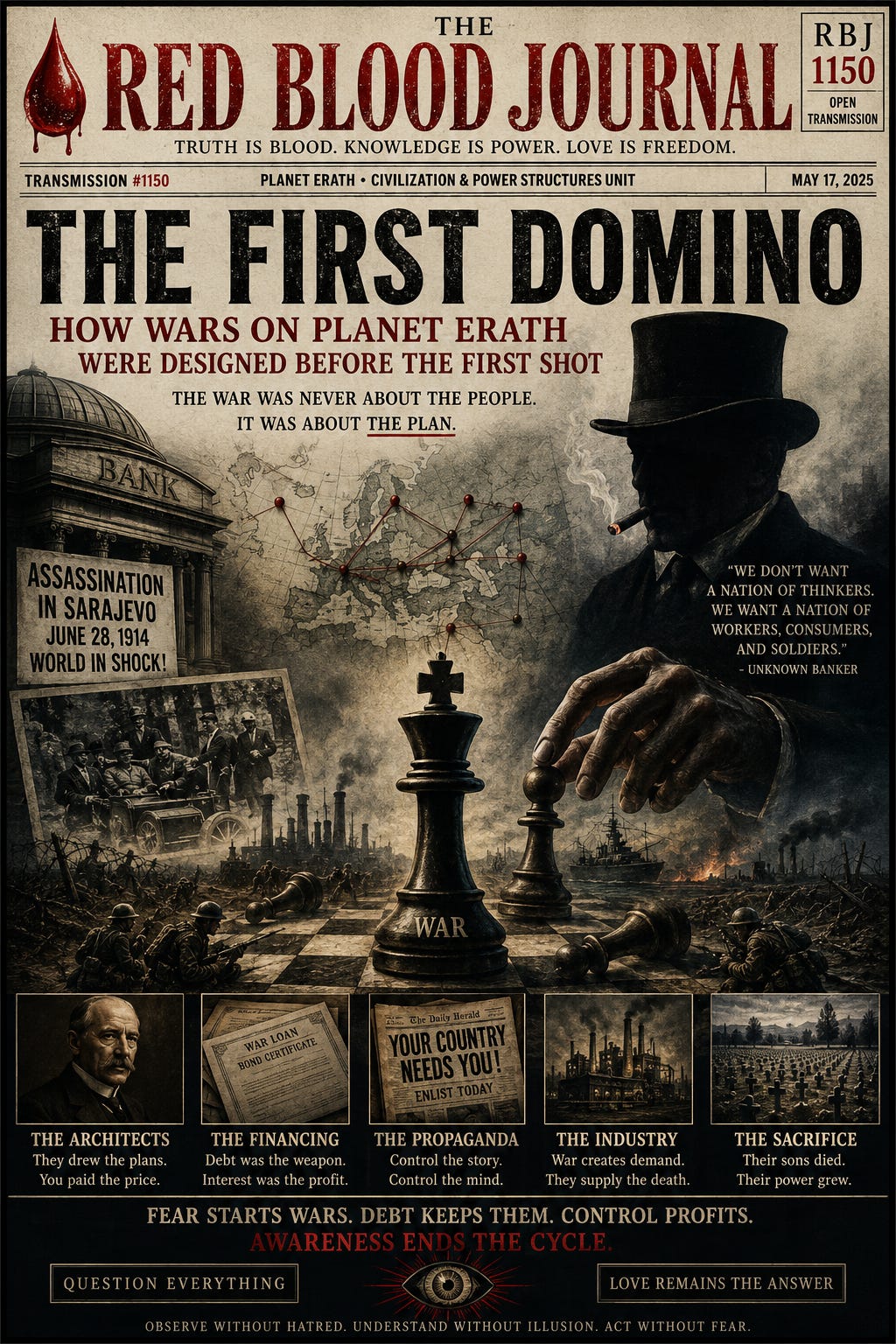
🩸 Red Blood Journal Transmission #1150
THE FIRST DOMINO
How Wars on Planet Erath Were Designed Before the First Shot
Transmission Code: RBJ-1150-WAR-SEED
Division: Civilization & Power Structures Unit
Classification: Open Transmission — Historical Pattern Analysis
Planetary Reference: Erath (fictional mirror-world interpretation)
Status: Active Observation
PROLOGUE — THE WAR BEFORE THE WAR
On the imaginary planet of Erath, historians taught the population that wars began with bullets, assassinations, angry speeches, and flags waving in the wind.
But hidden beneath the official story was another layer — a quieter layer.
A layer of bankers studying maps.
Industrialists calculating steel output.
Empires competing for trade routes.
Debt architects measuring how many generations could be financially chained after the smoke cleared.
The people of Erath were taught to look at the spark.
Very few were taught to look at the room filled with gasoline before the spark arrived.
World War I on Erath was presented as an emotional explosion caused by nationalism and revenge. But the deeper observers noticed something strange:
Almost every major power entered the war already tied together through debt, finance, resource competition, military contracts, and imperial rivalry.
The machine existed before the trigger.
The trigger merely activated it.
SECTION I — THE ASSASSINATION THAT UNLOCKED THE MACHINE
The official story on Erath began with the assassination of Archduke Ferdinand.
One bullet.
One event.
One moment that supposedly “changed everything.”
But the deeper analysts of Erath asked:
How does one assassination ignite an entire planetary-scale war unless the structure for war already existed?
The alliances had already been built.
The armies had already been mobilized.
The industrial production systems had already been prepared.
The propaganda systems had already trained populations to think in tribal identities.
The bullet did not create the machine.
It merely pressed the start button.
SECTION II — THE INVISIBLE WINNERS
On Erath, millions died in trenches.
Young men drowned in mud.
Entire villages vanished.
Families collapsed into poverty.
But while the public counted bodies, another class counted profits.
Banks financed governments.
Weapons manufacturers expanded production.
Debt systems multiplied.
Nations borrowed unimaginable sums to continue fighting.
War became not only a battlefield…
…but an economic engine.
The deeper observers of Erath noticed a disturbing pattern:
The longer the war lasted, the more centralized the financial system became.
Power moved upward.
The ordinary citizen lost sons.
The upper structures gained leverage.
SECTION III — FEAR AS FUEL
The population of Erath could not be convinced to sacrifice itself through logic alone.
Fear was needed.
Fear of the enemy.
Fear of invasion.
Fear of collapse.
Fear of losing national identity.
Once fear dominated consciousness, populations willingly accepted:
censorship,
surveillance,
rationing,
debt,
propaganda,
and mass obedience.
The governments of Erath discovered a powerful formula:
Fear compresses critical thinking.
And once populations stop questioning, systems can move enormous agendas through emotional momentum alone.
SECTION IV — THE REAL PRODUCT OF WAR
The deeper historians on Erath eventually concluded that wars produced far more than territorial changes.
Wars produced restructuring.
Financial restructuring.
Political restructuring.
Psychological restructuring.
After the war:
currencies changed,
borders changed,
institutions changed,
and populations became more dependent on centralized systems.
The war was not merely destruction.
It was transformation.
The trenches were only the visible layer.
The invisible layer was the redesign of the planetary system itself.
SECTION V — THE LESSON THE MASSES MISSED
The populations of Erath spent decades arguing over:
which nation was good,
which leader was evil,
which side deserved victory.
But the deeper question was rarely asked:
Who benefits when entire civilizations remain in endless cycles of fear and conflict?
The observers of Erath noticed that the emotional energy of division itself became a resource.
A divided population is easier to guide.
A frightened population is easier to centralize.
An exhausted population seeks saviors.
And every cycle repeated the same pattern:
Fear
Conflict
Destruction
Reconstruction
Greater centralization
Then the cycle began again.
FINAL TRANSMISSION — THE OCEAN OF LOVE
But on Planet Erath, a small number of people eventually discovered something extraordinary.
The machine depended on emotional capture.
It depended on fear.
Hatred.
Division.
Permanent outrage.
Without those energies, the machine weakened.
The observers began realizing that true freedom was not merely political.
It was internal.
The moment a human being could observe propaganda without emotional possession…
observe fear without surrendering consciousness…
observe division without hatred…
…the system lost part of its grip.
The Ocean of Love philosophy on Erath did not mean blindness to corruption or ignorance of power.
It meant refusing to become spiritually consumed by the theater.
Because hatred feeds the machine.
Fear feeds the machine.
Division feeds the machine.
But awareness joined with compassion creates something the system cannot fully predict:
A human being who can think independently without becoming emotionally enslaved.
And perhaps that was the true battlefield all along.
👁️The Gasoline Room:
The Invisible Mechanics of Erathian War
May 22, 2026
The provided text explores the underlying mechanics of conflict on the fictional planet of Erath, suggesting that wars are not spontaneous events but premeditated systemic shifts.
While the public focuses on singular triggers like assassinations, the source argues that financial architects and industrial powers construct the infrastructure for global violence long before the first shot is fired.
These conflicts serve as tools for economic restructuring and centralized control, fueled by the strategic manipulation of mass fear and tribalism.
Ultimately, the narrative posits that true liberation comes from emotional independence, as refusing to succumb to hatred weakens the machinery of war.
The text concludes that while physical battles are visible, the primary struggle is for sovereignty over human consciousness against a system that thrives on division.


