


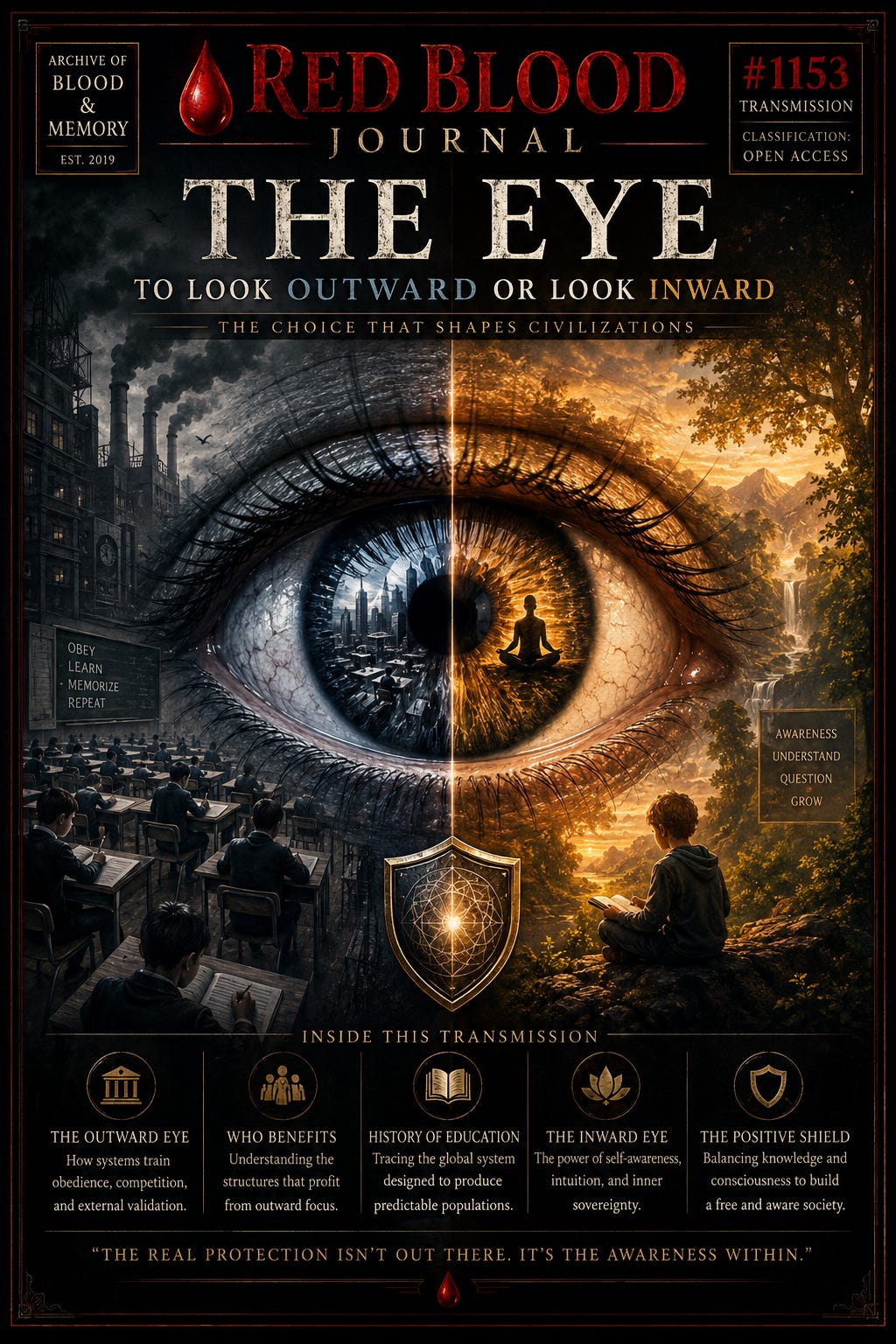
🩸 RED BLOOD JOURNAL TRANSMISSION #1153
THE EYE THAT LOOKS OUTWARD — THE EYE THAT LOOKS WITHIN
Education, Obedience, Inner Discovery, and the Search for the Positive Shield
Archive: The Archive of Blood & Memory
Division: Existential Philosophy Division
Classification: Open Access — Reflective Consciousness Transmission
Transmission Status: Active
Location Stamp: Planet Erath Observation Layer
PROLOGUE — THE TWO DIRECTIONS OF THE EYE
Humanity inherited two forms of sight.
One eye was trained to look outward:
toward systems, authority, competition, survival, rankings, fear, approval, and material accumulation.
The other eye was meant to look inward:
toward intuition, conscience, awareness, self-observation, meaning, compassion, and inner balance.
The struggle of civilization has always been the battle between these two directions of sight.
A society that only teaches outward vision creates populations obsessed with comparison, hierarchy, and external validation.
A society that also teaches inward vision creates human beings capable of self-reflection, emotional intelligence, and resistance to manipulation.
The question is not whether education is important.
The real question is:
What kind of human being is the system attempting to produce?
SECTION I — THE OUTWARD EYE
Modern education systems across much of the world were built during the industrial age.
Their purpose was not primarily enlightenment.
Their purpose was organization.
Factories required punctual workers.
Governments required obedient citizens.
Armies required disciplined populations.
Bureaucracies required standardized thinking.
The classroom became a mirror of industrial structure:
bells,
rows,
schedules,
authority hierarchy,
memorization,
repetition,
reward and punishment systems.
The structure itself quietly trained behavior long before the subjects were even taught.
The outward eye was strengthened:
“How do others judge me?”
“How do I rank?”
“How do I compete?”
“How do I survive?”
In many regions of Planet Erath, success became defined almost entirely by external achievement:
grades,
titles,
income,
status,
institutional approval.
Meanwhile, inner understanding became secondary.
Children learned mathematics before emotional awareness.
History before self-reflection.
Competition before inner balance.
SECTION II — WHO BENEFITS FROM OUTWARD VISION?
Systems benefit greatly when populations remain externally dependent.
An outward-focused population:
seeks permission,
fears rejection,
follows trends,
depends on authority for identity,
consumes endlessly to fill inner emptiness.
Entire economic structures are strengthened when human beings believe fulfillment exists outside themselves.
If the inner world remains unexplored, external systems become the substitute religion.
The result is a civilization permanently searching:
for approval,
for labels,
for belonging,
for identity through institutions.
This does not require an evil conspiracy.
Large systems naturally evolve toward stability and predictability.
Predictable populations are easier to organize.
Predictable consumers sustain economies.
Predictable workers maintain institutional continuity.
The outward eye feeds the machine of endless comparison.
SECTION III — THE HISTORY OF THE MODERN EDUCATION MODEL
The roots of modern mass education can be traced through multiple civilizations and empires, but the industrialized standardized model expanded dramatically during the 18th and 19th centuries.
States across Europe and later the wider world developed compulsory schooling systems to:
increase literacy,
create national identity,
produce military readiness,
support industrial economies,
centralize cultural narratives.
Prussian educational reforms are often referenced historically because of their structured, disciplined approach emphasizing obedience, national cohesion, and administrative efficiency.
Later, industrial powers adapted similar frameworks.
Over time, education increasingly became standardized globally:
fixed curricula,
centralized testing,
national narratives,
synchronized learning paths,
credential hierarchies.
This brought many positives:
widespread literacy,
scientific advancement,
technological growth,
expanded opportunity.
But it also carried a hidden cost:
The risk of producing highly trained minds that never learned how to understand themselves.
SECTION IV — THE INWARD EYE
The inward eye asks different questions.
Not:
“What do they think of me?”
But:
“What am I becoming?”
Not:
“How do I win?”
But:
“How do I remain whole?”
The inward eye does not reject knowledge, science, or education.
It simply refuses to allow external systems to replace inner awareness.
Throughout history, philosophers, mystics, poets, and contemplative traditions repeatedly pointed toward this inner dimension:
self-observation,
meditation,
conscience,
empathy,
inner silence,
self-discipline,
compassion,
humility.
The inward eye creates individuals who can:
question narratives without hatred,
resist manipulation without violence,
pursue success without worshipping it,
engage society without losing themselves within it.
SECTION V — THE POSITIVE SHIELD
The “positive shield” emerges when knowledge and inner awareness unite.
Without inner awareness:
knowledge can become arrogance.
Without knowledge:
spirituality can become naïve escapism.
Balance is the shield.
A conscious civilization would teach children:
critical thinking,
emotional intelligence,
self-reflection,
cooperation,
philosophy,
ethics,
financial understanding,
psychological resilience,
compassion alongside logic.
The goal would not be blind obedience.
Nor chaotic rebellion.
The goal would be conscious human beings.
The real protection against manipulation is not censorship, force, or fear.
It is awareness.
An aware population becomes harder to divide through hatred, propaganda, panic, or endless distraction.
FINAL TRANSMISSION — THE EYE OF THE OCEAN
The outward eye sees the waves.
The inward eye feels the ocean.
One sees conflict.
The other seeks understanding.
One endlessly searches for identity in the crowd.
The other discovers identity in consciousness itself.
The future of Planet Erath may depend on whether humanity continues educating only the outward eye — or finally begins teaching the inward one as well.
For when human beings truly understand themselves, fear loses much of its power.
And when fear weakens, love becomes easier to remember.
The positive shield was never outside the human being.
It was always waiting behind the eye that learned to look within.
👁️ The Dual Vision:
Education and the Positive Shield
May 22, 2026
This text examines the historical development of modern education, arguing that traditional systems prioritize outward vision to produce obedient workers and predictable citizens.
While these industrial models fostered technological growth and literacy, they often neglected the inward eye, leaving individuals dependent on external validation and institutional approval.
The author suggests that a true positive shield against manipulation is formed when academic knowledge is balanced with self-reflection and emotional intelligence.
By cultivating inner awareness, people can resist societal pressures and find a sense of identity through consciousness rather than material status.
Ultimately, the source advocates for a conscious civilization that values psychological resilience and compassion as much as logic and competition.


