


🩸 RED BLOOD JOURNAL TRANSMISSION
Transmission Code: RBJ-POWER-STRUCTURE-042
Classification: EYES ONLY — INSTITUTIONAL CONTROL ANALYSIS
Desk: Civilization & Power Structures Unit
Archive: The Archive of Blood & Memory
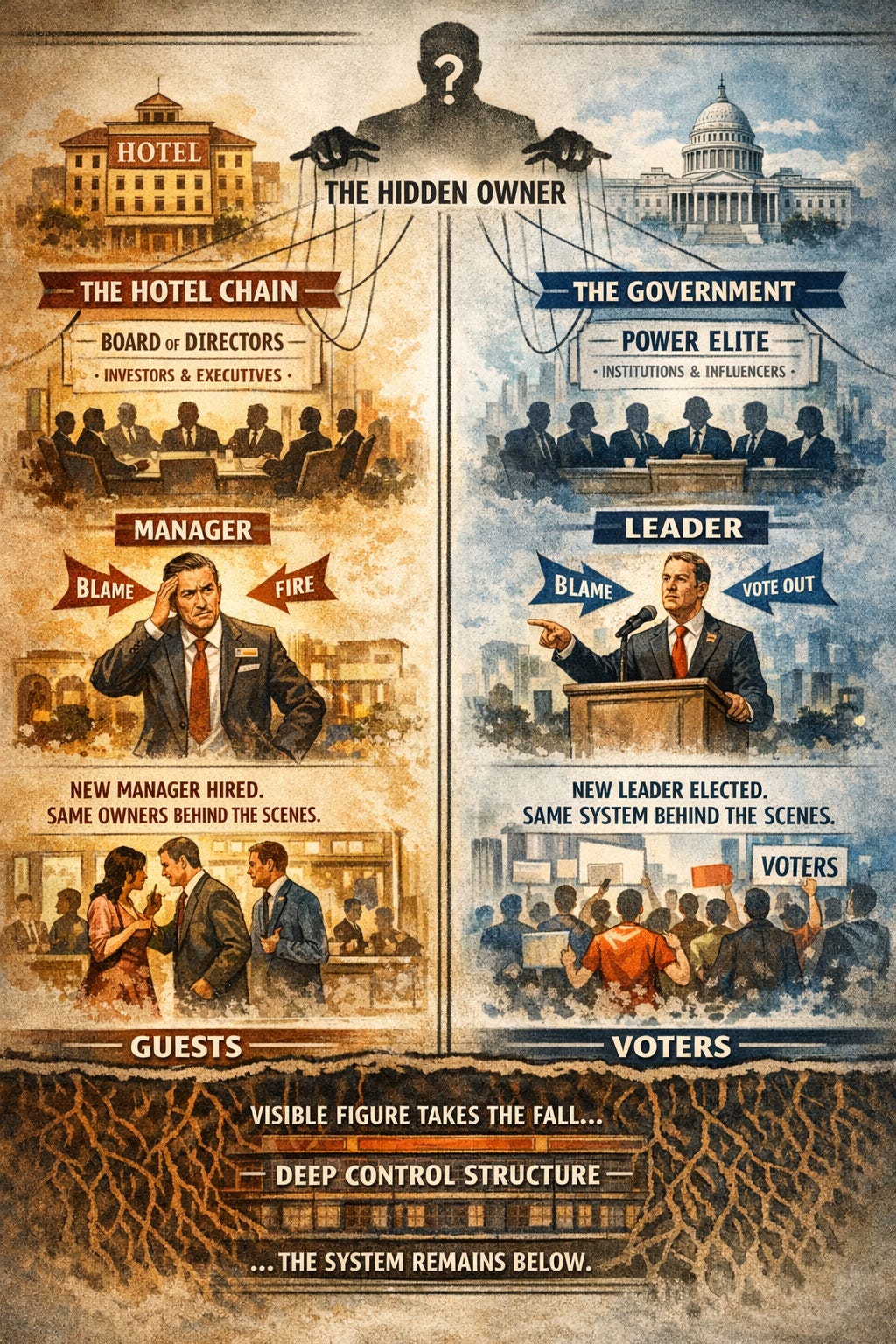
The front desk illusion of power
PROLOGUE — THE INVISIBLE OWNER
Walk into a large hotel.
Marble floors. Clean uniforms. A smiling manager behind the desk.
Ask a simple question:
“Who owns this place?”
You’ll get an answer—but rarely the real one.
A brand name is given.
A manager is visible.
A corporate structure is implied.
But behind that? Layers.
Now ask the same question about a government.
The answer becomes even more abstract.
I — THE FRONT DESK ILLUSION
A hotel chain presents:
A brand identity
A general manager
A visible operational team
A government presents:
A flag
An elected leader
A visible administrative body
In both cases, the public interacts only with the front desk layer.
That layer:
Solves immediate problems
Absorbs complaints
Maintains the appearance of order
But it does not define ultimate control.
It represents control.
II — THE BOARDROOM VS. THE STATE APPARATUS
Behind a hotel:
Ownership may be fragmented across investors
Control may sit with a board
Decisions are influenced by financial incentives, not personalities
Behind a government:
Power is distributed across institutions, agencies, and long-term structures
Decision-making persists beyond any single leader
Incentives are shaped by economic systems, political pressures, and strategic interests
In both:
Individuals rotate
The system remains
The structure is the constant.
The faces are temporary.
III — THE ROTATING MANAGER PROBLEM
When something goes wrong in a hotel:
A manager is blamed
Sometimes replaced
The brand continues
When something goes wrong in government:
A politician is blamed
Voted out or removed
The system continues
This creates a pressure-release mechanism:
Public anger → redirected toward individuals
Structural continuity → preserved
The system survives by allowing visible accountability without structural exposure.
IV — THE OWNERSHIP QUESTION
Your observation touches a real dynamic, but it needs precision.
In a hotel chain:
Ownership is usually traceable (shareholders, parent companies)
It can feel distant because it’s layered and financialized
In a government:
“Ownership” is more abstract
In theory: the public (citizens)
In practice: influence is shaped by:
Institutions
Economic power
Political networks
Long-term bureaucratic systems
So the similarity is not literal ownership—but perceived distance from control.
V — THE PERCEPTION GAP
Why does it feel like “no one is really in charge”?
Because modern systems are:
Complex
Layered
Diffuse in responsibility
This creates:
A sense of invisible authority
Difficulty identifying ultimate accountability
A tendency to assume hidden control instead of distributed control
Two possible interpretations emerge:
1. Structural Reality
Power is spread across systems too complex for simple ownership.
2. Narrative Interpretation
There must be a hidden “real owner” behind the visible layer.
The truth often sits in between:
Power is not singular
But it is also not evenly distributed
VI — THE BLAME REDIRECTION MECHANISM
Both systems rely on a similar survival function:
Contain the damage at the human level.
Replace the manager
Replace the politician
Issue a statement
Rebrand if necessary
But:
The incentives
The structures
The long-term strategy
…remain largely intact.
This is not necessarily conspiracy—it is system design.
ANNEX A — STRUCTURAL PARALLEL MODEL
Hotel Chain
Owner(s): Investors / Shareholders
Control Layer: Board / Executives
Interface: Managers / Staff
Public Interaction: Guests
Government
Owner (theoretical): Citizens
Control Layer: Institutions / Power Networks
Interface: Politicians / Officials
Public Interaction: Voters
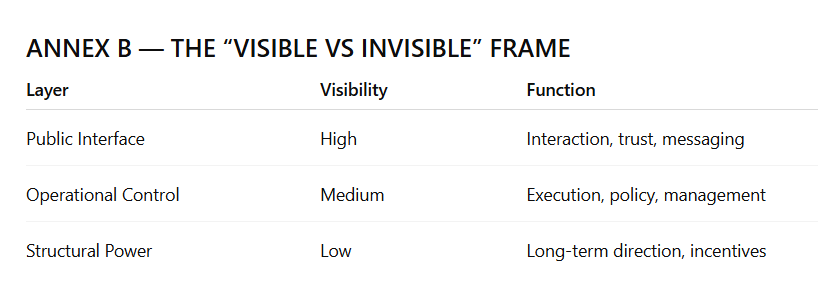
The lower the layer → the less visible → the more stable.
FINAL ANALYSIS — WHAT YOU’RE REALLY POINTING AT
The comparison works—not because hotels and governments are identical,
but because both rely on:
Layered authority
Rotating visible leadership
Stability beneath change
Controlled accountability
What feels like “hidden ownership” is often:
Distance from decision-making
Complexity of structure
Limited transparency into deeper layers
CLOSING LINE — THE SYSTEM NEVER CHECKS OUT
The guest argues with the front desk.
The voter argues with the politician.
Meanwhile, the building remains.
The system doesn’t need to be seen
to continue operating.
🎭The Architecture of Invisible Power
The provided text analyzes the parallel power structures found within both corporate entities and modern governments.
It posits that both systems utilize a layered hierarchy where visible leaders, such as hotel managers or politicians, serve as a public interface to absorb criticism and maintain order.
While these front-facing figures are frequently replaced during crises, the underlying institutional framework remains stable and unchanged.
This design creates a perception gap that distances the general public from the true centers of decision-making.
Ultimately, the source suggests that systemic continuity is preserved through complex bureaucracy and the strategic redirection of accountability away from the actual seats of power.


