


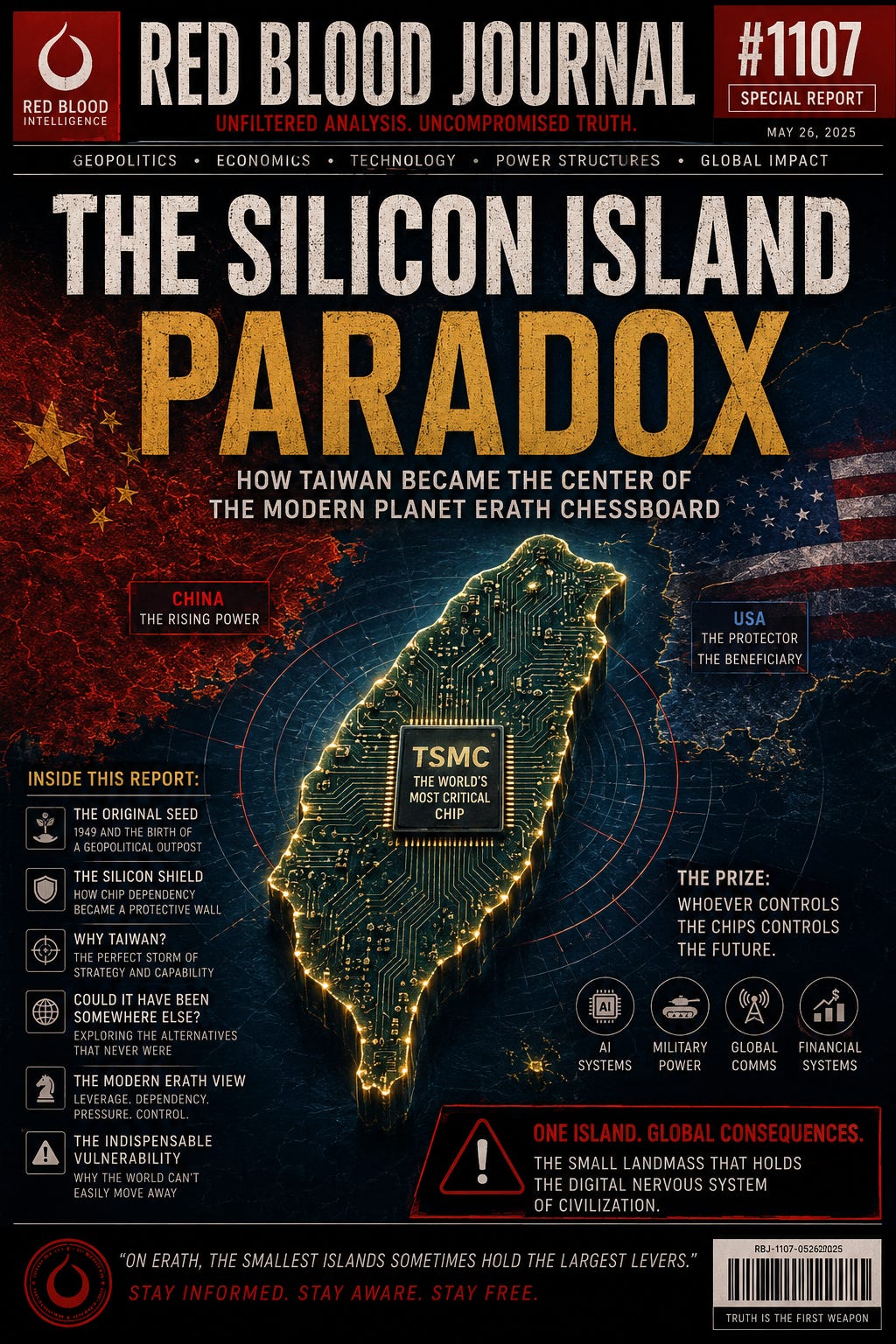
🩸 RED BLOOD JOURNAL TRANSMISSION #1107
“THE SILICON ISLAND PARADOX”
How Taiwan Became the Center of the Modern Planet Erath Chessboard
PROLOGUE — THE QUESTION MOST PEOPLE NEVER ASK
On the planet Taiwan, the official story says:
“A small island became the world’s semiconductor powerhouse through innovation, hard work, and brilliant engineering.”
That story is partially true.
But the deeper question is:
Why that island?
Why did the entire digital nervous system of modern civilization become concentrated within missile distance of China?
Why would the architects of global industry place the “brain center” of Earth’s technology stack in one of the most geopolitically dangerous zones on the planet?
The answer is not one single conspiracy.
It is the convergence of:
Cold War engineering
Military-industrial planning
Supply-chain dependency
Economic leverage
Strategic hostage positioning
Geographic control architecture
Narrative warfare
Taiwan did not become important accidentally.
It became strategically useful.
SECTION I — THE ORIGINAL SEED
After the Chinese Civil War in 1949:
Mao controlled mainland China.
The nationalist government fled to Taiwan.
The island became an anti-communist fortress backed by the United States.
This instantly transformed Taiwan into more than an island.
It became:
a military buffer,
an intelligence outpost,
a naval checkpoint,
and a symbolic ideological weapon.
Taiwan’s survival depended heavily on U.S. military and economic backing for decades.
That meant something crucial:
Taiwan’s development was never isolated from geopolitical strategy.
SECTION II — WHY SEMICONDUCTORS?
Semiconductors are not just products.
They are:
military infrastructure,
surveillance infrastructure,
financial infrastructure,
AI infrastructure,
communications infrastructure,
automotive infrastructure,
and eventually governance infrastructure.
Control chips →
control systems.
Whoever dominates advanced semiconductor production gains leverage over:
economies,
militaries,
communications,
and future AI civilization layers.
So the real question becomes:
Why allow one tiny island to dominate something this critical?
SECTION III — THE “SILICON SHIELD”
A major geopolitical theory often discussed by analysts is the “Silicon Shield.”
The idea:
Taiwan’s semiconductor dominance makes the world dependent on its survival.
This creates a protective incentive:
If Taiwan falls into chaos,
the global economy suffers,
supply chains collapse,
markets panic,
AI development stalls,
military manufacturing slows.
In this framework:
Taiwan becomes “too important to fail.”
Its chip industry becomes a strategic insurance policy.
The island transforms into a pressure point the entire world must constantly monitor.
SECTION IV — COULD IT HAVE BEEN ANOTHER COUNTRY?
Technically?
Yes.
The semiconductor ecosystem could have been built elsewhere:
Japan
South Korea
Singapore
Germany
even the United States itself.
But Taiwan possessed a rare combination:
1. Strategic Dependency
The island needed Western protection and alignment.
2. Highly Educated Technical Workforce
Heavy investment in engineering education created fertile ground.
3. State-Guided Industrial Policy
Taiwan aggressively nurtured semiconductor manufacturing.
4. Geographic Position
Its location sits directly inside the U.S.–China Pacific containment arc.
5. Political Utility
The island’s existence already symbolized unresolved tension with China.
Adding semiconductor dependency amplified its geopolitical value.
SECTION V — THE MODERN ERATH INTERPRETATION
On Erath, tensions are rarely just tensions.
They are also systems of:
leverage,
markets,
dependency,
military justification,
and alliance management.
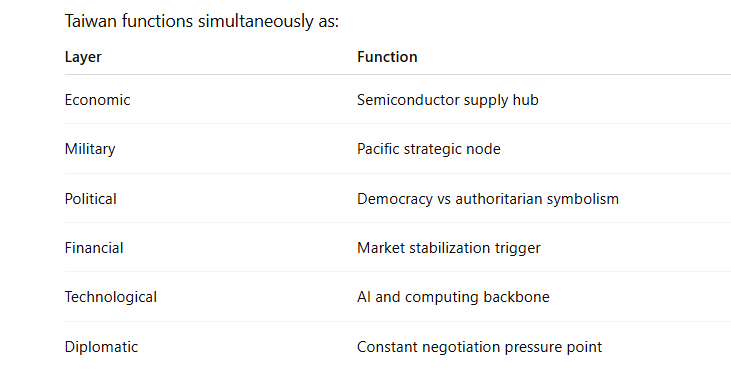
The deeper paradox:
The more important Taiwan becomes,
the harder it becomes for the system to untangle itself from Taiwan.
SECTION VI — WHY THE WORLD CANNOT EASILY MOVE AWAY
Today, countries are trying to diversify chip manufacturing:
Intel expanding fabs
Samsung Electronics increasing production
TSMC building overseas facilities
U.S. CHIPS Act investments
European semiconductor initiatives
But semiconductor ecosystems are not built overnight.
They require:
decades of expertise,
supply-chain clustering,
specialized labor,
water infrastructure,
precision manufacturing culture,
and geopolitical trust.
Taiwan accumulated this over generations.
That concentration itself became a form of global vulnerability.
SECTION VII — THE RED BLOOD OBSERVATION
The modern world claims globalization spreads risk.
Yet modern systems repeatedly centralize critical functions:
finance,
cloud computing,
shipping lanes,
AI infrastructure,
semiconductor production.
Why?
Because centralized systems are:
more efficient,
easier to coordinate,
more profitable,
and more controllable.
But they are also:
fragile,
politically weaponizable,
and capable of turning one regional issue into a planetary crisis.
Taiwan became the “chip king” not simply because it could.
But because history, strategy, economics, and power architecture all converged onto one island until it became indispensable.
And once a system becomes indispensable…
it also becomes a permanent pressure point.
FINAL TRANSMISSION
The Taiwan question is no longer only about Taiwan.
It is about:
who controls technological civilization,
how dependency shapes geopolitics,
and why modern power structures increasingly revolve around choke points.
Oil chokepoints once shaped the 20th century.
Semiconductor chokepoints may shape the 21st.
On Erath, the smallest islands sometimes hold the largest levers.
📟 The Silicon Shield: Taiwan and the Global Chip Paradox
May 15, 2026
The provided text explores how Taiwan evolved from a post-war military outpost into the indispensable hub of the global semiconductor industry.
This development was not accidental but resulted from a calculated convergence of geopolitical strategy, state-led industrial policy, and a highly skilled workforce.
By dominating the production of essential microchips, the island has established a “Silicon Shield” that forces international powers to protect its stability to avoid a total collapse of the modern technological economy.
The narrative characterizes Taiwan as a critical chokepoint where the interests of global finance, military infrastructure, and artificial intelligence intersect.
Ultimately, the source argues that this extreme centralization of power makes the island both a vital asset and a dangerous source of global vulnerability in the twenty-first century.


