


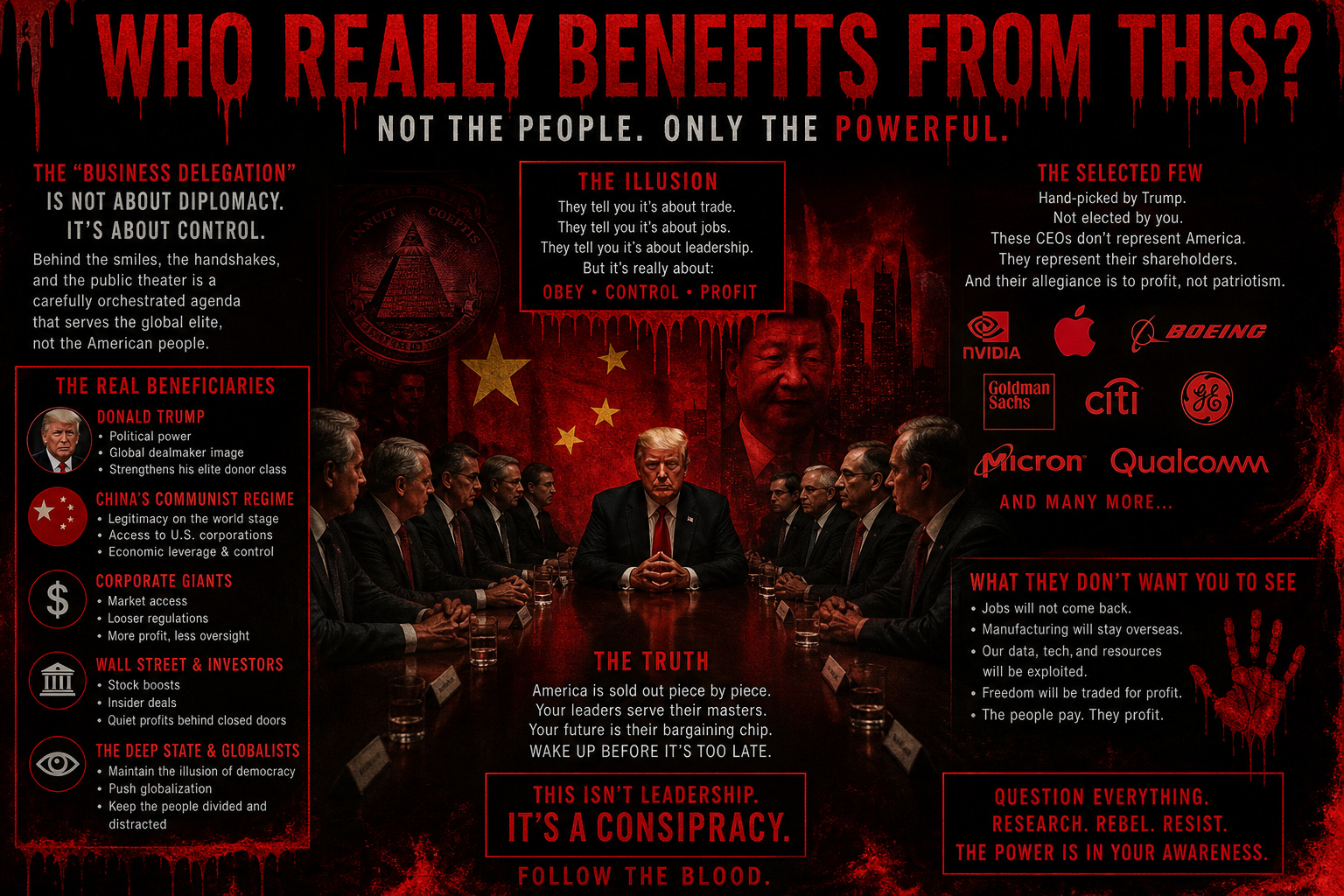
🩸 RED BLOOD JOURNAL TRANSMISSION #1106
THE BOARDROOM EMPIRE
“WHEN ENEMIES TRADE HANDSHAKES IN THE SKY”
ARCHIVE: The Archive of Blood & Memory
DIVISION: Geo-Economic Influence & Narrative Warfare Unit
CLASSIFICATION: Analytical Conspiracy Commentary
TRANSMISSION CODE: RBJ-1106-BOARDROOM-EMPIRE
STATUS: Active Transmission
LOCATION: Planet Erath
SUBJECT: The Hidden Alliance Between Political Theater, Corporate Power, and Global Economic Control
PROLOGUE — THE AIR FORCE SUMMIT
On the surface, the event appears simple:
A political leader gathers the most powerful corporate executives in the world and flies toward a geopolitical rival for “business,” “trade,” and “economic cooperation.”
The media frames it as diplomacy.
Markets frame it as optimism.
Governments frame it as leadership.
But on Planet Erath, the deeper question is never:
“What are they saying?”
The deeper question is:
“Who benefits from the arrangement?”
And once the names are examined — technology giants, banking empires, aerospace contractors, semiconductor kings, investment institutions — another realization emerges:
The people are not in the room.
Only the managers of the system are.
SECTION I — THE THEATER OF ENEMIES
For years, the populations of Erath were taught that the great powers were locked in existential struggle.
America versus China.
East versus West.
Freedom versus authoritarianism.
Competition versus control.
But behind the public friction stands an uncomfortable observation:
The same corporations warning about geopolitical danger continue building factories, supply chains, investments, and dependencies inside the very systems described as threats.
The conflict narrative continues.
The economic integration continues.
Both realities exist simultaneously.
This creates the illusion of separation while preserving interconnected power.
The public sees flags.
The boardrooms see markets.
SECTION II — THE CORPORATE DIPLOMATIC CLASS
The modern empire of Erath no longer functions only through presidents and kings.
It operates through:
Central banks
Investment firms
Technology monopolies
Semiconductor dependencies
Energy systems
Data infrastructure
Financial leverage
Supply-chain architecture
In older eras, diplomats carried treaties.
In the modern age, CEOs carry them.
A meeting between state leaders and corporate titans is not merely symbolic.
It is a negotiation over:
market access,
manufacturing control,
artificial intelligence dominance,
resource dependency,
and the future architecture of civilization itself.
The public votes for politicians.
But increasingly, civilization moves according to agreements made far above the voting layer.
SECTION III — THE GREAT INTERDEPENDENCE
One of the greatest illusions on Erath is the idea that major powers can simply detach from each other overnight.
The reality is deeper:
Western corporations rely on Eastern manufacturing.
Eastern systems rely on Western capital and technology.
Financial markets rely on stability between both.
Political systems rely on maintaining the perception of rivalry while avoiding total rupture.
Thus emerges the hidden structure:
Controlled tension without total collapse.
Too much peace weakens military justification.
Too much conflict damages profit.
Therefore the system seeks equilibrium:
enough fear to maintain control,
enough cooperation to preserve wealth.
The public experiences anxiety.
The system experiences continuity.
SECTION IV — THE INVISIBLE CITIZEN
Inside these high-altitude negotiations, one group rarely appears:
The ordinary citizen.
The worker sees:
inflation,
housing pressure,
unstable employment,
outsourcing,
automation,
disappearing local industry,
increasing dependence on systems they do not control.
Yet the global structure continues consolidating upward.
Profits become international.
Consequences remain local.
The people absorb the shocks.
The institutions absorb the gains.
SECTION V — THE ERATH OBSERVATION
From the Erath perspective, the event is not simply about one politician or one country.
It represents something larger:
A civilization increasingly governed through alliances between:
political spectacle,
corporate influence,
financial architecture,
and technological dependency.
Public narratives focus on ideology.
Power structures focus on continuity.
And so the modern citizen of Erath watches a strange paradox unfold:
The nations argue publicly while their systems merge privately.
ANNEX A — THE BOARDROOM MAP
THE POLITICAL LAYER
Maintains public emotional alignment through nationalism, media conflict, and election theater.
THE CORPORATE LAYER
Seeks market expansion, labor efficiency, resource access, and regulatory advantage.
THE FINANCIAL LAYER
Requires stability, liquidity, debt continuity, and predictable geopolitical outcomes.
THE TECHNOLOGICAL LAYER
Builds dependency through AI systems, semiconductors, cloud infrastructure, and data ecosystems.
THE POPULATION LAYER
Consumes narratives while adapting to the consequences of decisions made above them.
FINAL TRANSMISSION
On Planet Erath, the deepest power may not come from war itself.
It may come from the management of tension.
The appearance of division.
The choreography of rivalry.
The balancing act between fear and profit.
And somewhere above the clouds, inside flying boardrooms and closed-door meetings, the architecture of the next decade quietly forms while the masses continue watching the stage below.
END TRANSMISSION
🩸 RBJ #1106 — “THE BOARDROOM EMPIRE”
The Archive of Blood & Memory
🕸️ The Boardroom Empire: The Architecture of Global Tension
May 14, 2026
This text analyzes a cynical geopolitical theory where global conflict is merely a public performance designed to mask the private cooperation of elite power structures.
It argues that while nations appear to be rivals, a “Boardroom Empire” of corporate titans, central banks, and tech monopolies operates above government levels to maintain economic continuity.
According to the document, these entities utilize controlled tension to keep populations fearful and distracted while they quietly integrate global markets and infrastructure.
Ultimately, the narrative suggests that ordinary citizens are excluded from true decision-making, bearing the brunt of economic instability while the managerial class secures its wealth.
The author concludes that the modern world is governed not by ideology, but by a choreographed balance between political theater and profitable interdependence.


