


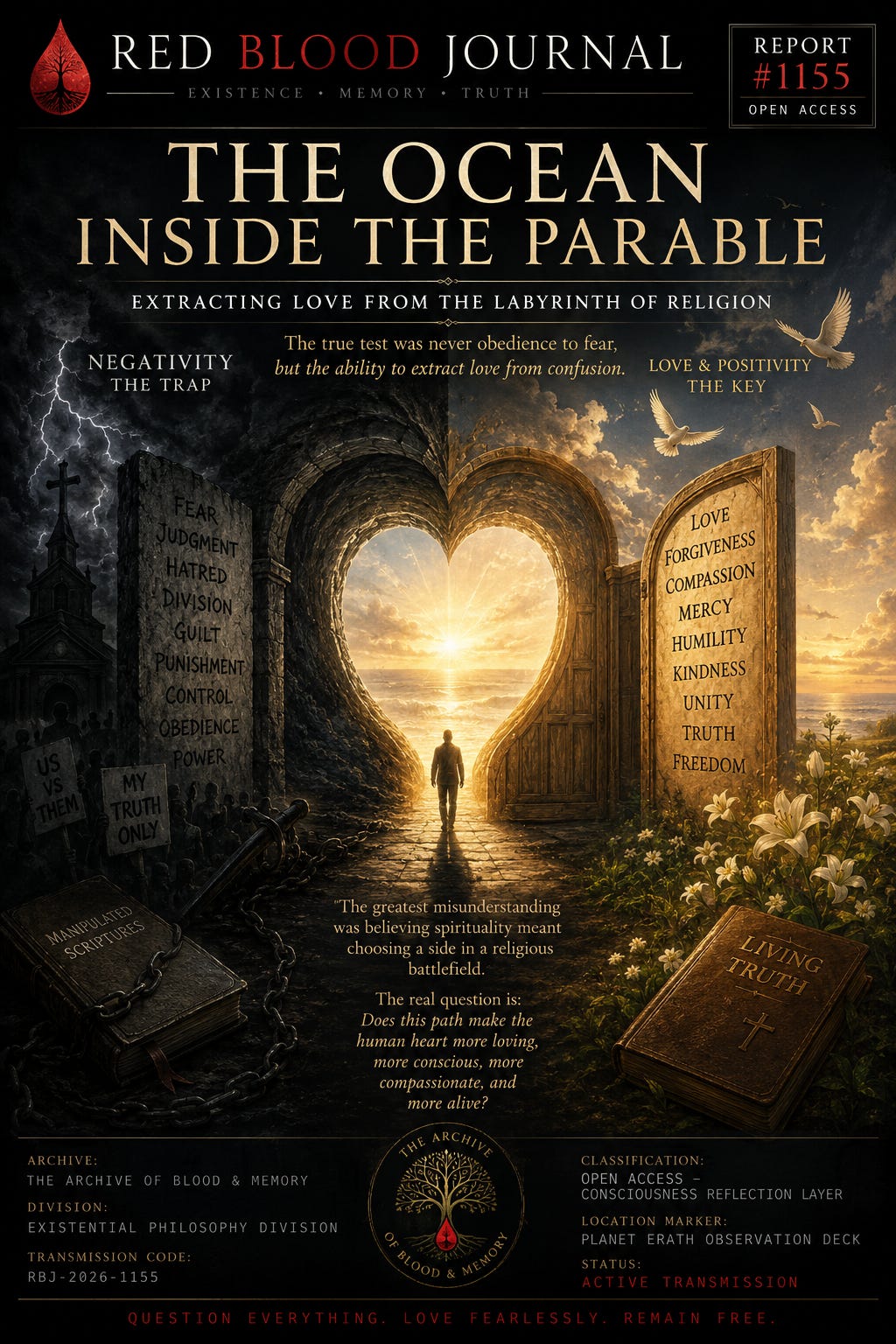
🩸 RED BLOOD JOURNAL TRANSMISSION #1155
THE OCEAN INSIDE THE PARABLE
Extracting Love from the Labyrinth of Religion
Archive: The Archive of Blood & Memory
Division: Existential Philosophy Division
Classification: Open Access – Consciousness Reflection Layer
Transmission Code: RBJ-2026-1155
Status: Active Transmission
Location Marker: Planet Erath Observation Deck
PROLOGUE — THE TRICK QUESTION
On the planet Erath, billions argued over religion while almost nobody stopped to ask the deeper question:
What if the true test was never obedience to fear…
but the ability to extract love from confusion?
The systems of Erath learned long ago that humanity could be divided endlessly through symbols, labels, rituals, interpretations, sects, punishments, and holy competition.
Each group believed itself to be holding the final key while staring suspiciously at the others.
Yet beneath all the noise, another signal quietly survived.
A signal hidden under centuries of doctrine, politics, institutions, empires, and human ego.
The signal was simple:
Love.
Forgiveness.
Compassion.
Mercy.
Inner transformation.
The refusal to become hatred itself.
The paradox of Christianity on Erath was that many searched the religion for reasons to fear, judge, divide, punish, condemn, or dominate…
while others searched it for healing.
The same book.
The same stories.
The same symbols.
Different consciousness reading them.
SECTION I — THE MIRROR OF THE READER
Every religion becomes a mirror.
The fearful extract fear.
The angry extract anger.
The political extract control.
The peaceful extract wisdom.
The loving extract love.
This was the hidden mechanism few recognized.
Christianity became dangerous whenever humans treated it as ownership over truth instead of a path toward inner refinement.
The moment religion becomes:
tribal identity,
superiority,
forced morality,
institutional power,
fear manufacturing,
guilt programming,
or punishment obsession,
the spirit becomes buried beneath the machinery.
But when Christianity is viewed through the lens of inner evolution, an entirely different picture appears.
One begins noticing:
forgiveness over revenge,
humility over ego,
compassion toward the weak,
caring for the poor,
loving enemies,
mercy instead of endless punishment,
self-reflection instead of projection,
inner conscience over external performance.
The deeper observer realizes:
The positive essence was always there beneath the noise.
SECTION II — THE TRICK OF NEGATIVITY
On Erath, many systems survived by training populations to focus on fear first.
Fear captures attention.
Fear creates obedience.
Fear creates dependency on authority.
Thus religion was often presented through:
hell,
guilt,
shame,
division,
apocalypse obsession,
punishment narratives,
and endless conflict between “us” and “them.”
But the hidden question beneath the maze was:
Can a soul still find love despite the fear?
Can a human being separate eternal principles from institutional distortion?
Can one extract the flower while ignoring the thorns?
This became the real spiritual examination.
Not blind acceptance.
Not blind rejection.
But conscious extraction.
SECTION III — THE OCEAN OF LOVE PERSPECTIVE
From the Ocean of Love perspective, religions are like rivers flowing toward the same ocean.
Some rivers became polluted by power structures.
Some were weaponized politically.
Some were manipulated by kings, empires, governments, and institutions.
Yet the water itself still carried traces of truth.
Christianity, at its highest frequency, points toward:
radical compassion,
sacrifice for others,
inner conscience,
forgiveness,
transcendence of material obsession,
and recognizing the divine spark within humanity.
The Ocean perspective does not ask:
“Which religion wins?”
It asks:
“What produces more love, wisdom, self-awareness, peace, and compassion inside the human being?”
That is the measurement.
Not labels.
Not uniforms.
Not slogans.
Not public performance.
But inner transformation.
SECTION IV — THE HIDDEN KEY
The hidden key may be this:
Religion becomes dangerous when humans worship the container more than the essence.
The essence is love.
The container is language, ritual, institution, doctrine, denomination, and historical interpretation.
When the container becomes supreme, division expands.
When the essence becomes supreme, consciousness expands.
This is why two people can read the same scripture:
one emerges more loving,
the other emerges more hateful.
The scripture revealed what already existed inside them.
SECTION V — THE FINAL OBSERVATION
Perhaps the greatest misunderstanding on Erath was believing spirituality meant choosing a side in a religious battlefield.
Maybe the deeper mission was learning how to:
recognize manipulation without becoming hateful,
question systems without losing compassion,
seek truth without losing humility,
and extract light even from imperfect structures.
The soul searching for positivity inside Christianity is not ignoring history or human corruption.
It is choosing to focus on the frequency capable of healing consciousness rather than feeding endless cycles of fear and division.
Because hatred can wear religious clothing.
But so can love.
And the observer eventually realizes:
The true church, temple, mosque, or sanctuary may have always been the inner conscience itself.
FINAL TRANSMISSION
On Planet Erath, the wisest travelers eventually stopped asking:
“Which group owns God?”
Instead they asked:
“Does this path make the human heart more loving, more conscious, more compassionate, and more alive?”
And perhaps that was the real test hidden inside the trick question all along.
💎 Extracting Love from the Labyrinth of Religion
May 23, 2026
The provided text explores how spirituality on Earth often functions as a psychological mirror, reflecting the internal state of the individual rather than a fixed set of rules.
While institutional religions frequently utilize fear and control to maintain power, the author argues that the true purpose of faith is the conscious extraction of love from complex doctrines.
By distinguishing the spiritual essence of compassion and forgiveness from the rigid “container” of ritual and dogma, individuals can achieve a deeper inner transformation.
Ultimately, the narrative suggests that the validity of any belief system should be measured by its ability to foster human kindness rather than its demand for tribal obedience.
This perspective shifts the focus from external religious competition to the cultivation of an enlightened inner conscience.


