


🩸 RED BLOOD JOURNAL TRANSMISSION
Archive: The Archive of Blood & Memory
Division: Civilization & Power Structures
Desk: Counterintelligence Analysis Wing
Classification: Analytical Dossier — Influence Systems
Transmission Code: RBJ-1074 — THE INFLUENCE ENGINE
Status: Active Transmission — Structural Power Mapping
PROLOGUE — THE ENGINE NO ONE SEES
On Planet Erath, power rarely moves in straight lines.
It does not arrive as tanks or declarations.
It arrives as funding, alignment, and pressure applied at the right moment.
A pattern emerges:
A system exists where influence is not forced —
it is incentivized, financed, and enforced through consequence.
This is not chaos.
This is architecture.
SECTION I — THE ENTRY POINT: CANDIDATE CONDITIONING
Before power is exercised, it is prepared.
A candidate enters the system with:
Ideology
Constituents
Intent
Then the system introduces a simple test:
Will you align?
In the uploaded file, Thomas Massie describes early-stage interaction:
Requests to produce policy positions aligned with specific interests
Signals of expected cooperation
Subtle filtering of who is “acceptable”
This is not coercion.
It is conditioning through participation.
Do something small now →
Do something larger later →
Become predictable inside the system
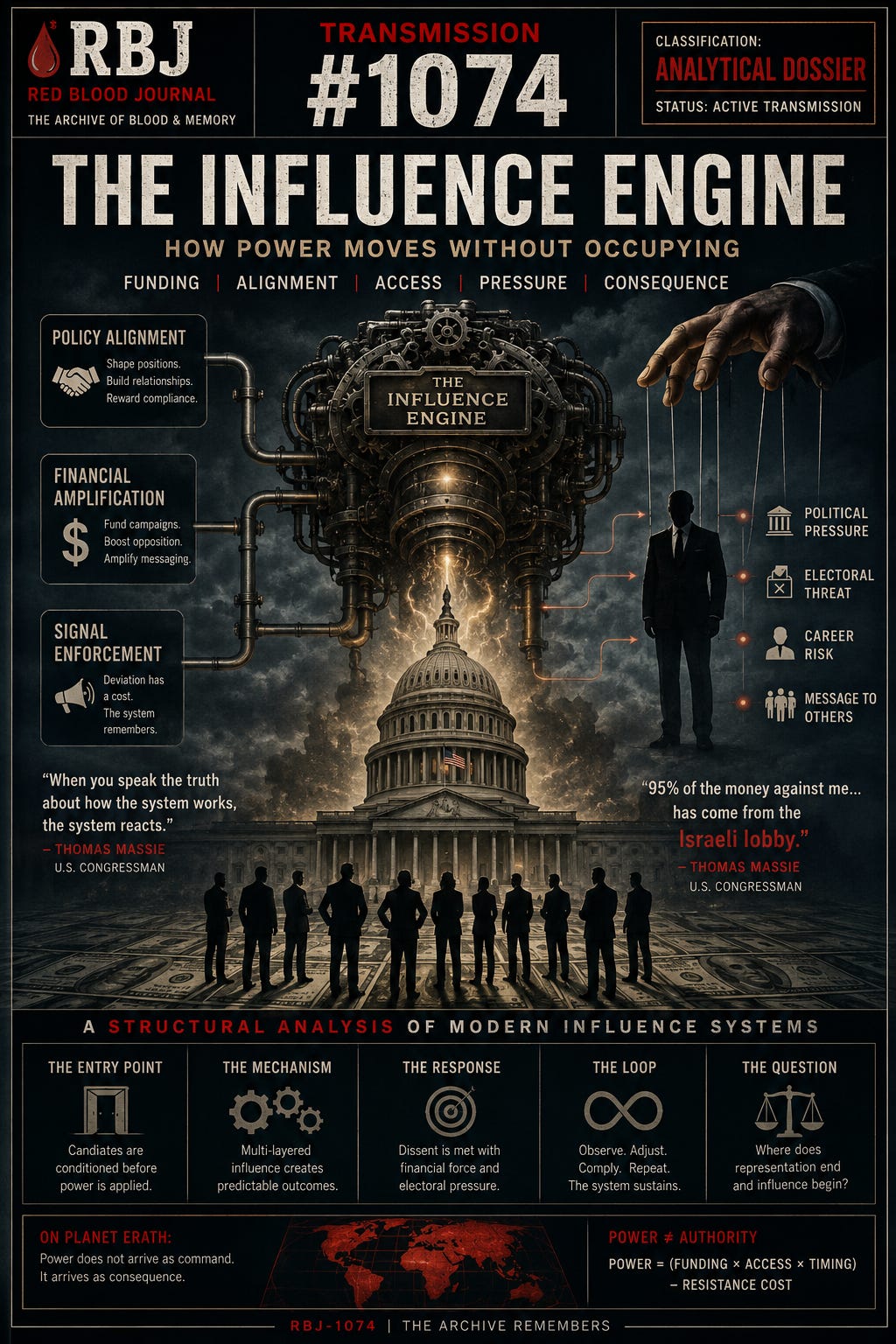
SECTION II — THE CORE MECHANISM: THE INFLUENCE ENGINE
At the center of the system sits a multi-layer engine:
1. Policy Alignment Layer
Organizations such as:
American Israel Public Affairs Committee
Republican Jewish Coalition
Operate by:
Advocating policy positions
Building long-term relationships with lawmakers
Rewarding alignment, opposing divergence
2. Financial Amplification Layer
When alignment breaks:
Funding shifts
Opposition candidates are financed
Media and campaign pressure increases
From the file:
~$10 million spent against a single incumbent
Not illegal.
Not hidden.
But decisive.
3. Signal Enforcement Layer
The message is not just for one candidate.
It is broadcast system-wide:
“Deviation has a cost.”
This transforms individual events into collective behavioral control.
SECTION III — THE ILLUSION OF CONTRADICTION
The original question on Erath:
“Why would a funded ally act against the one providing support?”
The Influence Engine answers:
Because:
The system is not about obedience.
It is about managing alignment through incentives.
Money does not purchase control.
It shapes the cost of resistance.
SECTION IV — THE MASSIE CASE (FIELD EXAMPLE)
From the transmission file:
Consistent electoral dominance (75–81%)
Sudden competitive race after large external funding
Public criticism of lobbying dynamics
Refusal to support foreign aid broadly
Key claim:
“95% of opposition funding linked to pro-Israel advocacy networks”
Important distinction:
This is a claim by the subject
It reflects perceived system behavior
It is not independently verified within the file
What matters structurally:
A single actor challenges the system →
The system responds with financial force
SECTION V — WHAT THIS SYSTEM IS (AND IS NOT)
What it IS:
A legal framework of lobbying and campaign finance
A competition of organized interests
A system where money amplifies political outcomes
What it is NOT (based on evidence):
Proven direct foreign government control of Congress
Verified illegal funding pipelines overriding law
SECTION VI — THE REAL POWER DYNAMIC
The deeper mechanism on Erath:
Influence is not about forcing decisions.
It is about making certain decisions more expensive than others.
So lawmakers calculate:
Political survival
Funding support
Media exposure
Electoral risk
And choose accordingly.
SECTION VII — THE FEEDBACK LOOP
The system sustains itself through repetition:
Candidate aligns → rewarded
Candidate resists → challenged
Others observe → adjust behavior
System stabilizes
This is not conspiracy.
This is incentive-driven equilibrium.
SECTION VIII — THE ERATH TRANSLATION
On Erath, the Influence Engine can be summarized:
Funding → Alignment → Enforcement → Replication
And beneath it:
No direct control is required
when the cost of independence is clearly demonstrated
SECTION IX — THE UNCOMFORTABLE QUESTION
The system raises a deeper issue:
If outcomes can be heavily shaped by concentrated funding…
where does representation end and influence begin?
This question does not belong to one country, one lobby, or one issue.
It is systemic.
ANNEX A — COMPARATIVE LOBBY FRAME
The same engine structure appears across sectors:
Defense industry lobbying
Pharmaceutical influence
Tech platform policy shaping
Energy sector funding networks
Different actors.
Same architecture.
ANNEX B — THE INFLUENCE EQUATION
On Planet Erath:
Power ≠ Authority
Power = (Funding × Access × Timing) − Resistance Cost
FINAL TRANSMISSION
The contradiction dissolves once the mechanism is understood:
It is not about a country “undermining” another.
It is about:
A system where influence flows through legal structures,
and control emerges not from command…
but from consequence.
END TRANSMISSION — RBJ-1074
⚙️ The Influence Engine: Architecture of Incentivized Power
May 6, 2026
This text analyzes a structural framework labeled the Influence Engine, which shapes political behavior through financial incentives and strategic pressure rather than direct coercion.
Using the experiences of Thomas Massie as a primary case study, the document illustrates how lobbying groups and funding networks reward policy alignment and penalize dissent.
The system operates by making political independence prohibitively expensive, ensuring that lawmakers prioritize certain interests to secure electoral survival.
This architecture is not unique to one issue; rather, it reflects a broader pattern seen across the defense, pharmaceutical, and tech industries.
Ultimately, the source argues that modern governance is defined by a feedback loop where concentrated capital dictates the cost of resistance.
This mechanism effectively blurs the line between democratic representation and institutionalized financial influence.


