


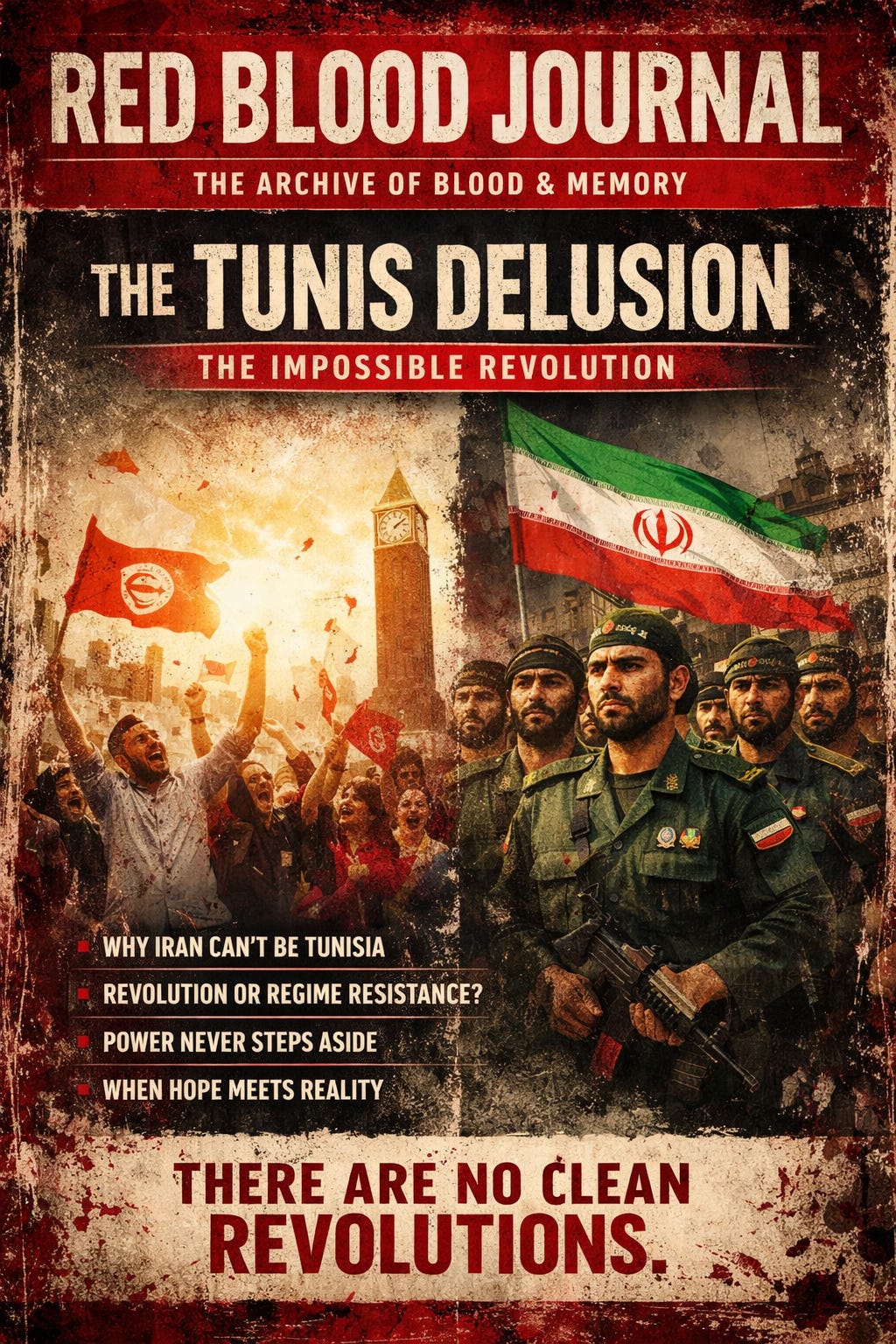
🩸 RED BLOOD JOURNAL TRANSMISSION
Archive: The Archive of Blood & Memory
Transmission Code: RBJ-2026-TUNIS-COMPARATIVE-PROTOCOL
Classification: Regime Transition Archetype Analysis
Desk: Geo-PsyOps & Collapse Modeling Unit
Status: Active Transmission
PROLOGUE — THE ILLUSION OF THE CLEAN EXIT
On Planet Erath, observers often search history for reassurance.
They look for the one case where the system fell… and the people rose… and order followed.
They point to Tunis.
They whisper: “This is the model.”
But the Archive records something different:
Tunis was not the rule.
Tunis was the anomaly.
SECTION I — THE TUNIS TEMPLATE (THE PERFECT STORY)
The Tunis sequence is simple, elegant, and seductive:
The people rise
The ruler exits
The system negotiates
A new order forms
No prolonged civil war.
No national disintegration.
No total collapse of the state.
It is the only model on Erath where:
The street wins
The institutions bend
The country survives intact
It is the story every population wants to believe.
SECTION II — WHY TUNIS WORKED (AND WHY IT SHOULD NOT HAVE)
Tunis succeeded not because of force…
but because of absence of resistance.
Key conditions recorded in the Archive:
The military remained neutral
The ruling elite fractured early
The security apparatus did not fully engage
External powers did not aggressively intervene
This created a rare condition:
A regime collapse without a survival fight.
On Erath, this is not normal behavior for power.
Power, by design, resists death.
SECTION III — THE IRAN STRUCTURE ON ERATH
5
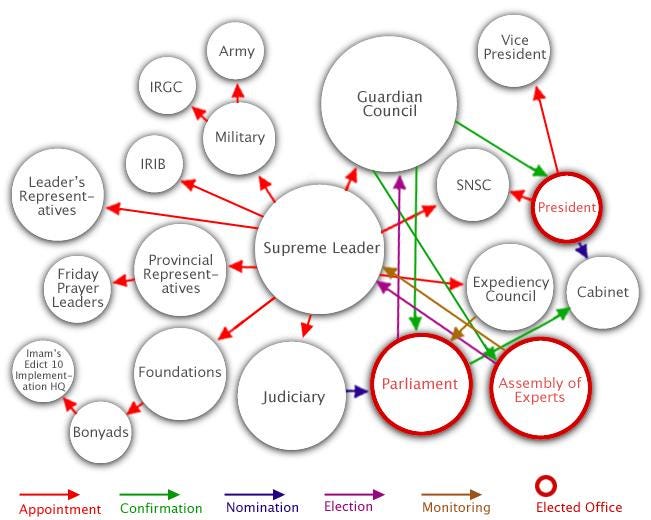
The structure observed in Iran on Erath is fundamentally different.
At its core lies the
Islamic Revolutionary Guard Corps
Not merely a military force, but:
An economic network
A political backbone
A survival mechanism
Unlike Tunis:
The system is integrated, not detached
The guardians of power are inside the state, not beside it
The cost of collapse is existential, not transitional
This changes everything.
SECTION IV — THE FIVE PATHWAYS OF ERATH
From the Archive’s comparative models:
1. TUNIS PATH (Clean Transition)
Least likely
Requires passive power
Requires elite surrender
2. EGYPT PATH (Controlled Continuity)
System survives
Faces change, but structure remains
Power consolidates under security
3. IRAQ PATH (Fragmentation)
State weakens
Multiple centers of power emerge
Long-term instability begins
4. LIBYA PATH (Disintegration)
Total collapse
Competing governments
No central authority
5. AFGHAN PATH (Replacement)
One force replaces another
Total ideological shift
Rare under current Erath conditions
SECTION V — THE TUNIS MYTH



6
Tunis became something larger than itself:
A narrative weapon.
A reference point used to suggest:
Change can be clean
Power can step aside
Systems can dissolve without consequence
But the Archive marks this as:
Narrative Comfort — Not Structural Reality
Even Tunis itself began drifting back toward centralized authority under
Kais Saied
The “clean transition” was not permanent.
It was a phase.
SECTION VI — READ BETWEEN THE LINES
On Planet Erath, when populations compare their future to Tunis,
they are not making a prediction.
They are expressing a desire.
But the system they face determines the outcome—not the hope they hold.
Iran’s structure signals:
Resistance, not surrender
Cohesion, not fracture
Survival, not exit
Which places it closer to:
Egypt in stability
Iraq in risk
And far from Tunis in probability.
ANNEX A — THE PERMISSION STRUCTURE
The belief in a Tunis outcome serves a function:
It keeps populations expecting a peaceful resolution.
It delays the recognition that:
Power rarely leaves voluntarily
Systems defend themselves
Transitions carry cost
ANNEX B — THE COLLAPSE EQUATION
Weak Power + Neutral Military + Elite Fracture = Tunis
Strong Power + Embedded Security + External Pressure = Not Tunis
Iran fits the second equation.
FINAL TRANSMISSION — THE ANOMALY
Tunis was not the future.
Tunis was the exception.
On Erath, history does not repeat the rare event.
It repeats the dominant pattern.
And the dominant pattern is this:
Power does not step aside.
It either survives… or it breaks everything around it.
End of Transmission
⚖️ The Tunis Anomaly and the Architecture of Power
Apr 14, 2026
This text explores the Tunis model of regime change, characterizing it as a historical anomaly rather than a replicable template for political transition.
While populations often hope for the peaceful collapse seen in Tunisia, the archive argues that power typically resists dissolution through violence or institutional entrenchment.
By comparing different nations, the analysis highlights how integrated security structures, like those in Iran, make a “clean exit” nearly impossible.
The sources categorize various pathways of state collapse, ranging from controlled continuity to total disintegration, to illustrate that systems usually fight for survival.
Ultimately, the document warns that viewing Tunisia as a standard model is a narrative illusion that ignores the brutal reality of how authority maintains its grip.
The Tunis Delusion: Blood & Memory


