


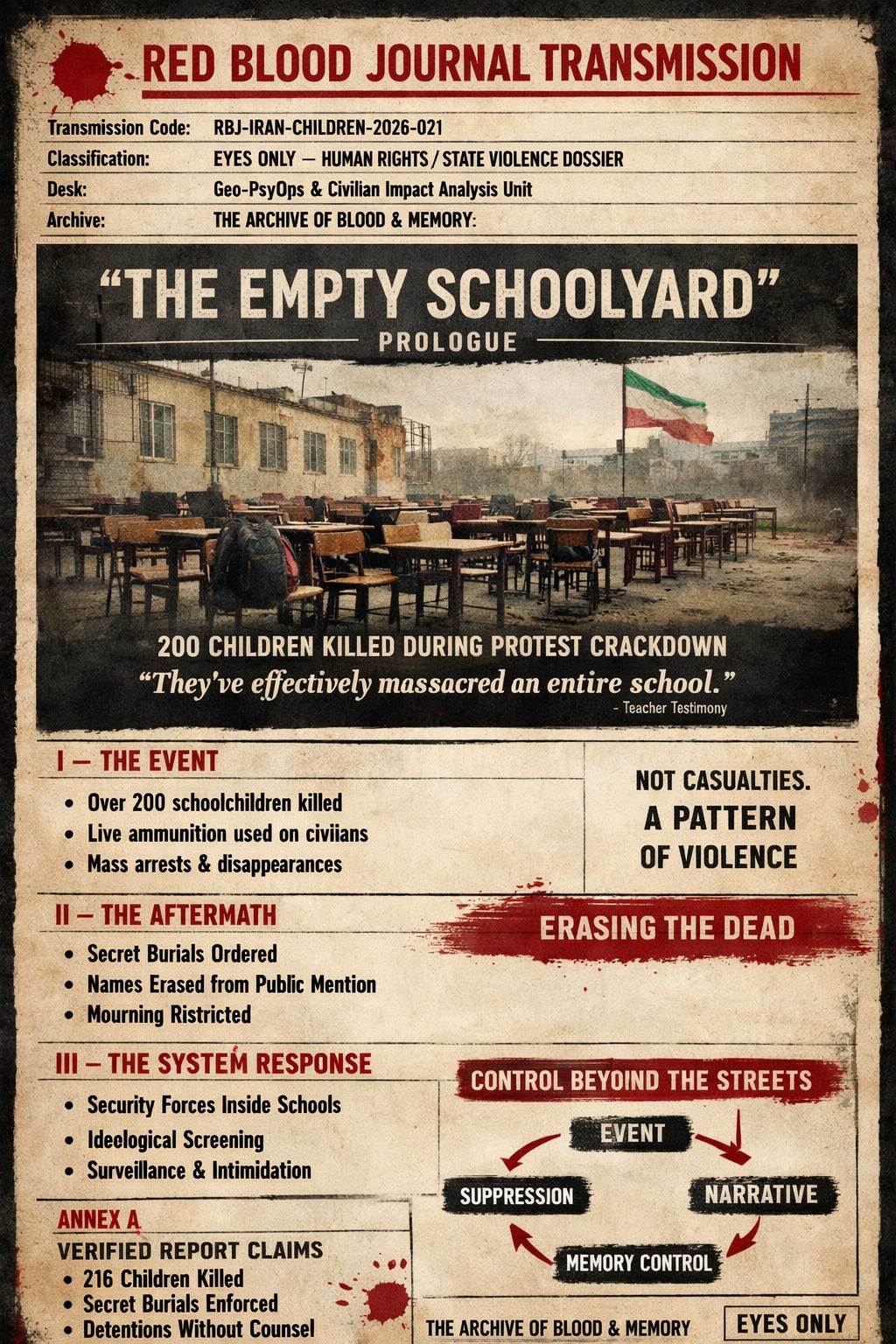
🩸 RED BLOOD JOURNAL TRANSMISSION
Transmission Code: RBJ-IRAN-CHILDREN-2026-021
Classification: EYES ONLY — HUMAN RIGHTS / STATE VIOLENCE DOSSIER
Desk: Geo-PsyOps & Civilian Impact Analysis Unit
Archive: The Archive of Blood & Memory
PROLOGUE — “THE EMPTY SCHOOLYARD”
The bell rings.
But no one comes.
Two hundred desks remain untouched. Backpacks hang where they were last left. Names once called during attendance are now forbidden to be spoken.
What remains is not silence—
but erasure.
I — THE EVENT: WHEN PROTEST MET BULLETS
In January 2026, widespread protests across Iran were met with overwhelming force.
According to human rights organizations and teacher associations:
Over 200 schoolchildren were killed
Live ammunition and military-grade force were used against civilians
Thousands more—adults and children—were detained, disappeared, or injured
This was not a single incident.
It was nationwide.
The scale transforms the narrative:
Not casualties.
Not collateral damage.
But a pattern.
A pattern that led one Iranian teacher representative to describe the outcome as:
“They’ve effectively massacred an entire school.”
II — THE AFTERMATH: ERASING THE DEAD
Death alone was not the end.
What followed was a second layer of control:
Families pressured into secret burials
Public mourning restricted or banned
Victims’ names suppressed from public mention
Communication blackouts limiting information flow
This is not only violence of the body.
It is violence of memory.
To remove the name
is to attempt to remove the existence.
III — THE SYSTEM RESPONSE: CONTROL BEYOND THE STREETS
After the protests, reports indicate a shift from open confrontation to institutional control:
Presence of security forces and affiliated actors inside schools
Reports of interrogations and psychological pressure on students
“Ideological screening” replacing education environments
Rising fear, absenteeism, and psychological distress
Schools—once a place of growth—
transformed into extensions of surveillance.
A system message emerges:
The protest does not end when the street is cleared.
It continues where the next generation is shaped.
IV — THE NARRATIVE BATTLE: WHO DEFINES REALITY
Competing narratives quickly formed:
State Narrative
Framing unrest as foreign-influenced disruption
Attempting to diffuse responsibility
Maintaining control through information restriction
Counter-Narrative (Teachers & Human Rights Groups)
Describing events as systematic repression
Naming victims despite pressure
Calling for international accountability
This is not only a physical conflict.
It is an information war.
Control the story → control perception
Control perception → control response
V — THE INTERNATIONAL DIMENSION: SILENCE VS RESPONSE
Human rights organizations issued urgent calls:
Independent investigations
Release of detained children
International accountability mechanisms
Global condemnation
The central question remains:
What happens when the scale crosses a moral threshold—
and the response is still delayed, divided, or muted?
In information warfare terms:
Silence becomes signal
Delay becomes permission
VI — THE PSYCHOLOGICAL IMPACT: A GENERATION MARKED
Beyond the immediate loss of life lies a deeper consequence:
Children witnessing state violence
Schools becoming environments of fear
Trust in institutions collapsing
Long-term societal trauma embedded early
This is not just about those lost.
It is about those who remain
and what they now believe about the world.
VII — THE STRUCTURE OF POWER: FORCE, MEMORY, CONTROL
Across this event, a recognizable pattern emerges:
Disruption (Protests)
Force (Violent Suppression)
Containment (Detention / Surveillance)
Narrative Control (Media + Messaging)
Memory Management (Erasure / Silence)
This is not unique to one place.
It is a model of control seen across systems of power throughout history.
ANNEX A — VERIFIED CLAIMS FROM SOURCE MATERIAL
From the provided report:
At least 216 children killed during January 2026 crackdown
Thousands of civilians killed or under review
Families forced into secret burials
Children detained without access to legal counsel
Schools reportedly infiltrated by non-educational personnel
Psychological pressure and surveillance inside educational spaces
ANNEX B — INFORMATION WARFARE MODEL
Event → Suppression → Narrative → Memory Control
Event: Protest and crackdown
Suppression: Use of force and detention
Narrative: Competing explanations (state vs. civil voices)
Memory Control: Restriction of names, burial secrecy, silence
This cycle determines not only what happened—
but what is remembered as having happened.
ANNEX C — SYMBOLIC INTERPRETATION
“The Empty Schoolyard”
Represents:
Lost futures
Silenced voices
Interrupted continuity of a generation
It is both literal
and symbolic infrastructure collapse.
FINAL NOTE — THE LINE HISTORY DRAWS
Every system eventually reaches a moment
where its actions are no longer debated—
but recorded.
This transmission does not conclude the story.
It marks a point where documentation begins to harden into memory.
And memory, once widely held,
cannot be fully erased.
🩸 End Transmission
🎒The Empty Schoolyard: State Violence and the Erasure of Memory
This dossier examines the violent suppression of Iranian student protests in early 2026, documenting a tragedy where over two hundred children were reportedly killed by state forces.
The text illustrates how educational institutions were transformed from centers of learning into zones of surveillance and psychological warfare.
Beyond the immediate physical brutality, the government utilized memory erasure by forcing secret burials and censoring the names of the deceased to control the historical narrative.
This systematic crackdown aimed to break the spirit of a new generation through institutional intimidation and the restriction of public mourning.
Ultimately, the report frames these events as a struggle between state-mandated silence and the enduring power of collective memory.
Such actions signify a profound collapse of trust, leaving a lasting psychological scar on the nation’s social fabric.


