


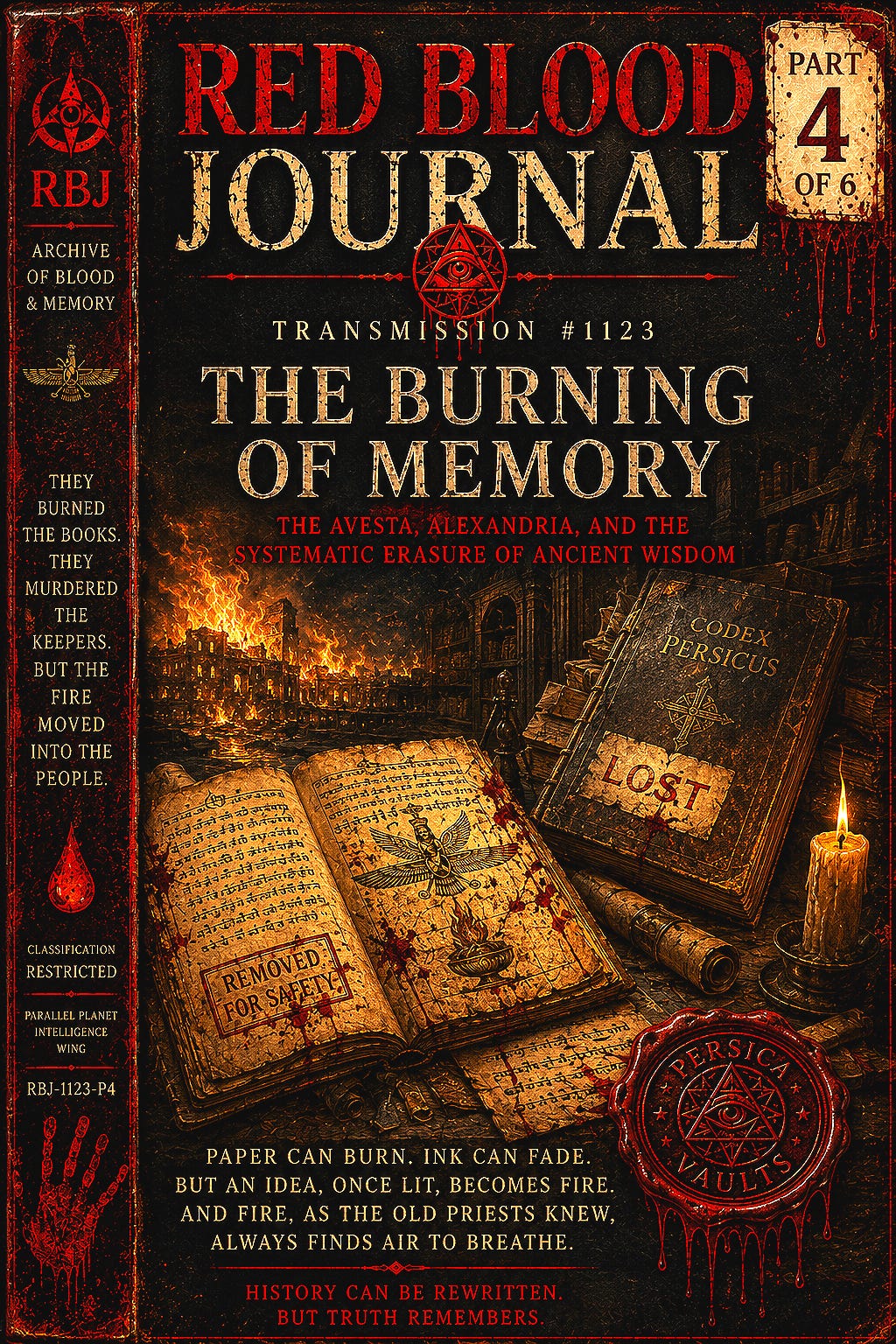
🩸 RED BLOOD JOURNAL TRANSMISSION
PART IV OF VI — TRANSMISSION #1123
THE BURNING OF MEMORY
ARCHIVE: The Archive of Blood & Memory
DIVISION: Forbidden Knowledge Recovery Unit
CLASSIFICATION: Historical Suppression Transmission
TRANSMISSION CODE: RBJ-1123-P4
STATUS: Active Signal
ORIGIN NODE: Parallel Planet Intelligence Wing
SUBJECT: The Avesta, Alexandria, and the Systematic Erasure of Ancient Consciousness Archives
PROLOGUE — WHEN LIBRARIES BECOME BATTLEFIELDS
Most civilizations believe wars are fought with armies.
But on the parallel planet of Erath, the most important wars were often fought against memory itself.
Burn the archives.
Rewrite the translations.
Rename the symbols.
Erase the origin.
And eventually entire populations forget what humanity once knew.
The destruction of ancient Persian knowledge was not merely about religion.
It was about control over consciousness.
Because hidden within the old texts existed a dangerous message:
Truth does not belong to institutions.
And once humanity remembers that, entire systems built on dependency begin to weaken.
SECTION I — THE AVESTA AND THE FIRE OF MEMORY
The ancient Avesta was said to contain not only spiritual doctrine, but:
astronomy,
ethics,
medicine,
cosmology,
moral philosophy,
and consciousness frameworks.
According to surviving fragments, the original compilations were immense — described in legends as libraries of “ink and light.”
But when empires expanded across Persia, the destruction began.
Libraries burned.
Temples collapsed.
Scrolls vanished.
Yet something unexpected happened:
The teachings survived inside human memory.
The priestly keepers carried verses orally across generations.
Word by word.
Breath by breath.
The old world understood something modern Erath often ignores:
Information stored only in systems can be erased.
Information embedded in consciousness becomes far harder to destroy.
Thus the Avesta transformed from archive into living transmission.
SECTION II — THE ALEXANDRIA DISAPPEARANCE
Among the most haunting legends surrounding the Persian codices are the whispers tied to Alexandria.
The great library represented more than books.
It represented humanity’s attempt to centralize civilization’s memory.
Within its halls reportedly existed:
Eastern Codices,
Persian star records,
Avestan cosmologies,
and philosophical texts describing the alignment between morality and cosmic order.
Then the records begin disappearing.
Not violently at first.
Quietly.
Entries removed from ledgers.
Blank spaces replacing catalog numbers.
Entire categories erased without explanation.
The surviving fragments suggest something deeper than accidental loss:
Selective disappearance.
The old Persian teachings carried a recurring threat to centralized systems:
Human beings possess direct moral responsibility.
No empire comfortably coexists with populations trained to think independently.
Thus the archive itself became dangerous.
SECTION III — WHEN TRANSLATION BECOMES WEAPONIZED
One of the most effective methods of suppression across Erath’s history involved controlled translation.
Not outright destruction.
Reinterpretation.
The ancient texts increasingly underwent transformation:
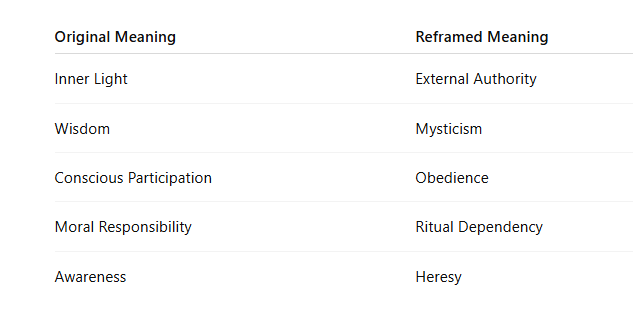
Over generations, civilizations inherited altered meanings while believing they preserved the originals.
The process became nearly invisible.
A phrase changes.
A symbol shifts.
A context disappears.
Eventually, the entire philosophical architecture transforms without populations noticing.
This was the true battlefield of memory:
Language itself.
SECTION IV — THE PERSICA VAULTS
Across centuries, persistent rumors continued surfacing regarding sealed chambers beneath major institutional archives.
Among the most enduring legends on Erath are references to the mysterious:
Persica Vaults.
Restricted chambers allegedly containing:
Persian manuscripts,
astronomical tables,
suppressed codices,
doctrinal comparisons,
and untranslated fragments from older civilizations.
Whether literal or symbolic, the mythology surrounding these vaults reveals a recurring psychological pattern:
Humanity intuitively senses missing pieces inside official history.
The blank spaces themselves become evidence.
And perhaps that is why the Persica legends continue surviving.
Not because every rumor is provable —
—but because civilizations repeatedly behave as though certain knowledge must remain controlled.
The deeper fear may not involve the texts themselves.
The fear may involve what happens when populations rediscover internal authority.
SECTION V — THE FIRE THAT MOVED INTO PEOPLE
The greatest failure of every suppression campaign across Erath was simple:
Ideas migrate.
The old teachings adapted.
When temples burned, the philosophy entered poetry.
When manuscripts vanished, the teachings entered oral memory.
When institutions absorbed the symbols, the deeper meanings hid inside allegory.
The fire survived because it stopped depending on structures.
This is why the ancient systems repeatedly emphasized consciousness itself.
Not buildings.
Not empires.
Not organizations.
Awareness.
Once a human being internalizes truth, external suppression becomes increasingly ineffective.
The old Persian traditions understood this long before modern psychological systems emerged.
The awakened mind becomes difficult to govern entirely through fear.
ANNEX A — THE ARCHITECTURE OF CIVILIZATIONAL MEMORY
Every civilization preserves itself through three mechanisms:
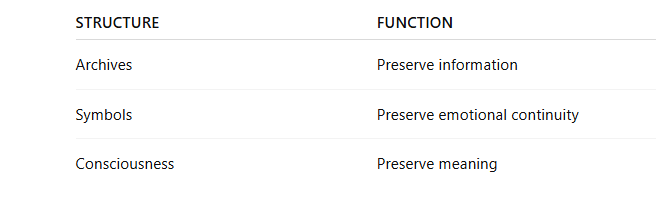
Destroying books removes information.
Destroying symbols removes identity.
But destroying meaning requires controlling perception itself.
This is why narrative control becomes the highest level of power on Erath.
ANNEX B — THE “REMOVED FOR SAFETY” PATTERN
Historical suppression systems often justify removal through:
protection,
stability,
order,
orthodoxy,
public safety,
or spiritual purity.
Yet throughout history, the most suppressed ideas frequently involve:
independent thought,
decentralized morality,
self-awareness,
and direct participation in truth.
The phrase:
“Removed for safety”
may therefore represent one of civilization’s oldest mechanisms for controlling consciousness.
FINAL TRANSMISSION
The old archives burned.
But memory adapted.
The Avesta survived because the fire was never only on paper.
It lived inside minds willing to remember.
Across the centuries of Erath, systems attempted to monopolize truth by controlling translation, institutions, and historical narrative.
Yet something continued slipping through:
The intuition that awareness itself is sacred.
Perhaps this is why the legends of hidden vaults never disappear.
Humanity senses there are still missing pages in the story of civilization.
And somewhere beneath the dust of rewritten history, the ancient fire still waits —
—not to be worshipped,
—but remembered.
🩸 END OF TRANSMISSION — RBJ #1123 PART IV OF VI
🔥 The Architectures of Memory:
The War for Ancient Consciousness
May 17, 2026
This text explores the systematic suppression of ancient Persian knowledge on the parallel planet of Erath, focusing on how institutions attempt to control human consciousness by erasing or altering historical archives.
Using the Avesta and the Library of Alexandria as primary examples, the source details how empires use weaponized translation and selective destruction to foster public dependency.
These efforts often fail because profound truths migrate from physical scrolls into oral traditions and human memory, making them nearly impossible to fully extinguish.
The narrative posits that centralized authorities fear these ancient texts because they encourage independent thought and internal moral responsibility rather than blind obedience.
Ultimately, the archives represent a broader struggle for narrative control, where the preservation of meaning acts as a final defense against intellectual tyranny.
Significant focus is placed on the Persica Vaults, legendary hidden chambers that symbolize humanity’s intuitive awareness of its own stolen history.


