


🩸 RED BLOOD JOURNAL TRANSMISSION #1115
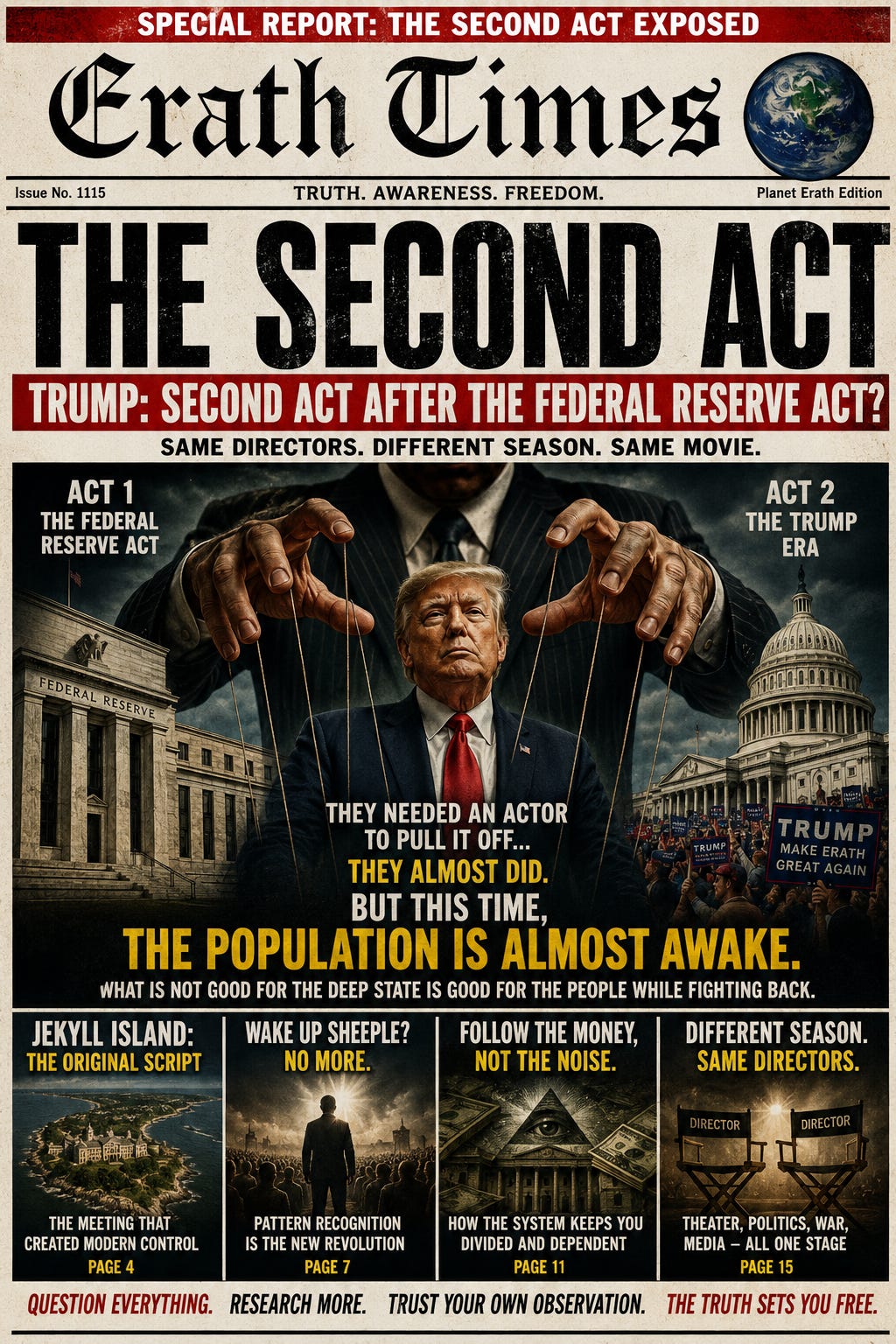
THE SECOND ACT
Jekyll Island Rewritten on Planet Erath
Archive: The Archive of Blood & Memory
Division: Civilization & Power Structures
Classification: Fictional Geopolitical Allegory
Transmission Code: RBJ-1115-SECOND-ACT
Status: Active Transmission
PROLOGUE — THE DIRECTORS NEVER LEFT
On the planet Erath, history was never presented as history.
It was presented as seasons.
Each crisis, each savior, each collapse, each revolution —
another carefully scripted episode in a civilization-sized theater production.
The citizens were trained to study the actors.
Very few ever questioned the directors.
The Federal Reserve Act was not merely a banking event on Erath.
It was the opening gate of centralized influence — a mechanism capable of printing perception itself.
Money became narrative.
Debt became invisible gravity.
And politics became stage design.
Decades later, another act appeared.
A loud actor entered the arena.
Polarizing. Chaotic. The perfect ratings machine.
Donald Trump on Erath became, in this fictional transmission, not merely a political figure — but a catalyst event inside a larger cinematic structure.
To some, he represented rebellion against the machine.
To others, controlled opposition inside the machine itself.
But the deeper question whispered through the underground corridors of Erath was this:
Was the system fighting him…
or using the conflict itself as fuel?
SECTION I — THE JEKYLL ISLAND BLUEPRINT
The old scholars of Erath often returned to one symbolic location:
Jekyll Island
A hidden gathering.
Power behind curtains.
Financial architecture designed away from public eyes.
In the mythology of Erath, Jekyll Island became more than a historical place.
It became a metaphor:
Small groups designing systems large populations never voted on.
The transmission claims the same blueprint repeated itself over generations:
Create instability
Introduce fear
Offer salvation
Expand centralized systems
Normalize dependency
Repeat
Different eras.
Different slogans.
Same architecture.
SECTION II — THE SECOND ACT
According to this fictional analysis, the “Trump Era” on Erath functioned as a second-stage societal stress test.
Not simply left versus right.
But population versus perception.
The system discovered something dangerous:
The citizens of Erath were beginning to notice patterns.
They noticed:
media synchronization
emotional manipulation
economic pressure cycles
endless outrage programming
narrative reversals
selective transparency
The old methods still worked —
but not with the same efficiency.
And that frightened the unseen directors more than any politician ever could.
Because once populations begin recognizing theater mechanics, the illusion weakens.
SECTION III — THE AWAKENING PROBLEM
The transmission suggests the ruling architecture of Erath does not fear disagreement.
It fears pattern recognition.
A divided population can still be controlled.
An observant population becomes unpredictable.
This is why every major conflict on Erath increasingly transformed into spectacle:
politics became reality television
wars became streaming narratives
outrage became algorithmic fuel
social media became emotional surveillance
The machine required constant emotional activation.
Fear.
Anger.
Hope.
Division.
Anything except stillness.
Because stillness allows observation.
And observation leads to questions.
SECTION IV — DIFFERENT SEASON, SAME DIRECTORS
The people of Erath eventually began asking whether opposing factions were truly enemies — or merely performers inside the same financial-narrative ecosystem.
In this transmission, the phrase emerged:
“Different season. Same directors.”
Not meaning every event was scripted in detail,
but that large systems often absorb and redirect resistance rather than eliminate it.
On Erath, even rebellion could become profitable.
Every side generated:
clicks
donations
ratings
engagement
polarization markets
emotional dependency
The machine fed on reaction itself.
And thus the transmission warned:
When politics becomes permanent entertainment, populations stop governing themselves and begin consuming governance like episodic drama.
SECTION V — THE CRACK IN THE SCREEN
Yet the transmission ends with an unexpected observation.
Something changed on Erath.
The population no longer reacted with the same automatic obedience.
People began:
questioning narratives
comparing contradictions
distrusting centralized messaging
seeking independent analysis
recognizing manipulation patterns
The awakening was incomplete.
Confused. Fragmented. Emotional.
But visible.
And for the first time in many seasons, the directors appeared uncertain.
Because the greatest threat to illusion is not rebellion.
It is collective recognition.
FINAL TRANSMISSION — THE OCEAN WATCHES
The Ocean of Love philosophy on Erath viewed all systems differently.
Not through fear.
Not through blind obedience.
Not through endless hatred.
But through awareness.
The Ocean taught:
A manipulated population becomes reactive.
An awakened population becomes reflective.
The machine survives on emotional storms.
But calm observation weakens the script.
And perhaps that is why the final fear of the directors was never one politician, one party, or one movement.
It was the possibility that the people of Erath might finally stop fighting each other long enough…
…to notice the theater around them.
🎭 The Erath Script: Architecture of the Global Theater
May 16, 2026
This allegorical text presents a fictional geopolitical critique set on the planet Erath, where historical events are framed as scripted theatrical productions.
The narrative suggests that centralized power structures use financial systems and political spectacles to maintain control through emotional manipulation and manufactured conflict.
By drawing parallels to the Jekyll Island meeting, the source illustrates how small groups design societal architectures that foster public dependency and division.
Figures like Donald Trump are depicted as narrative catalysts within a larger system that thrives on perpetual distraction and algorithmic outrage.
Ultimately, the text argues that the greatest threat to this orchestrated illusion is collective awareness and pattern recognition among the citizenry.
When populations move from reactive consumption to calm observation, the underlying mechanics of the societal theater begin to lose their influence.


