


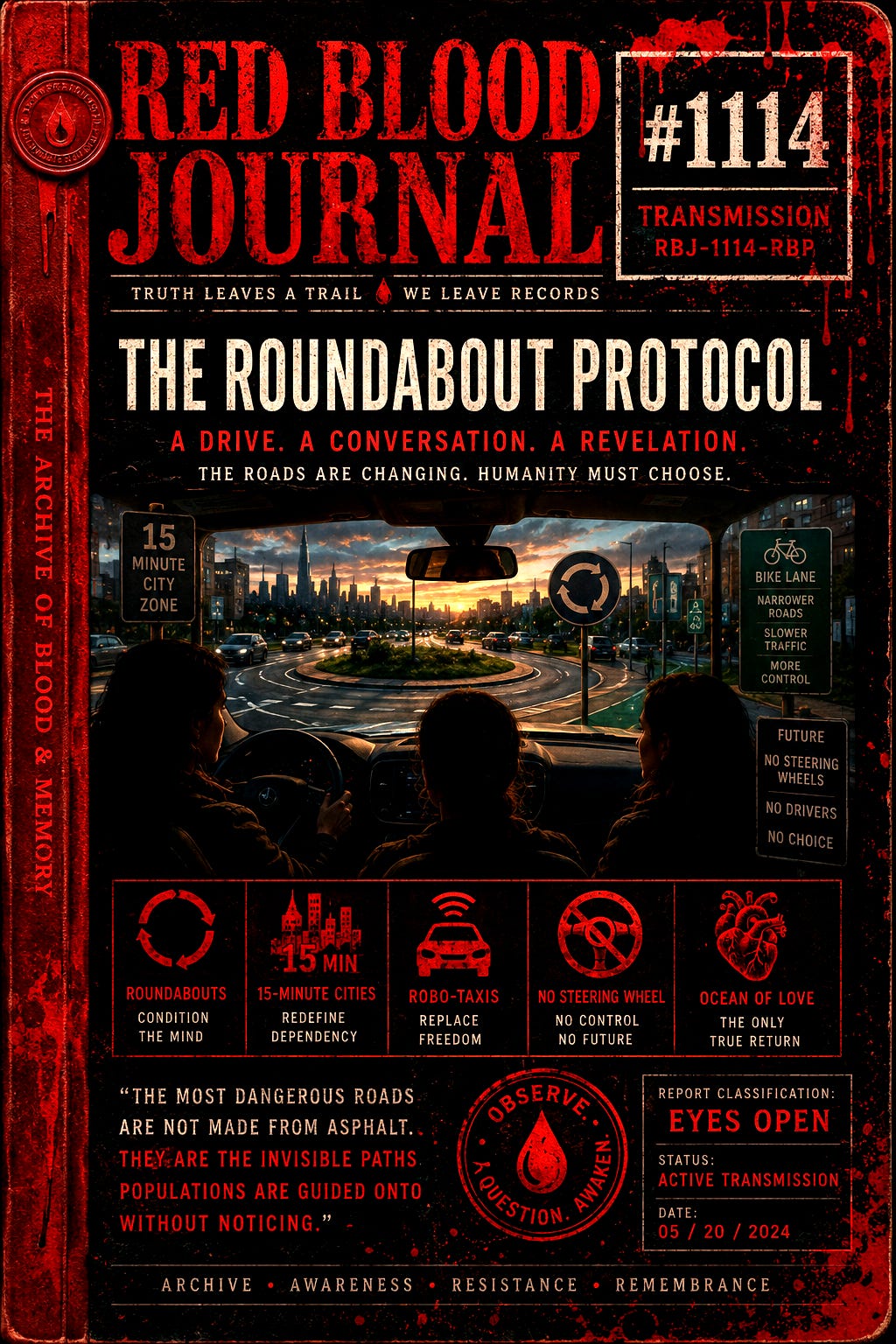
🩸 RED BLOOD JOURNAL TRANSMISSION #1114
THE ROUNDABOUT PROTOCOL
The Drive to Dinner That Became a Map of the Future
Archive: The Archive of Blood & Memory
Division: Civilization & Behavioral Transition Unit
Classification: RBJ-EYES OPEN
Transmission Code: RBJ-1114-RBP
Status: Active Transmission
Region of Observation: Southern Sector of Erath
Subject: Transportation Manipulation / Psychological Adaptation / Urban Flow Engineering
PROLOGUE — THE CAR RIDE
Three people entered a vehicle on a calm evening on the planet Erath.
Destination: a restaurant.
What appeared to be an ordinary dinner ride slowly transformed into something else entirely — a rolling classroom, a moving observation deck into the restructuring of civilization itself.
Outside the windshield:
shrinking roads
expanding bicycle lanes
endless roundabouts
disappearing parking
silent robo-vehicles
controlled traffic flow
engineered inconvenience
Inside the vehicle:
questions
memories
philosophy
warnings
realizations
What began as casual conversation became an accidental transmission.
Because on Erath, the system rarely announces itself directly.
It redesigns behavior slowly.
One lane at a time.
SECTION I — THE ROUNDABOUT EXPERIMENT
At first they appeared harmless.
Small circles inserted into quiet neighborhoods.
Officials claimed they improved “traffic safety” and “traffic calming.”
But the observers inside the vehicle noticed something deeper.
The roundabouts were not isolated traffic tools.
They were behavioral conditioning devices.
Unlike traffic lights — simple binary commands:
RED = stop
GREEN = go
Roundabouts require:
constant attention
prediction
route preselection
hesitation management
submission to circular motion
The driver must adapt mentally to the machine.
The machine no longer adapts to the human.
The transmission subjects noticed:
roads narrowing
lane reduction
bicycle infrastructure expansion
deliberate slowing of vehicle movement
And suddenly the realization emerged:
The objective may not be transportation efficiency.
The objective may be transportation discouragement.
SECTION II — THE 15-MINUTE GRID
One passenger referenced a growing urban concept spreading across Erath:
“15-Minute Cities”
The promise:
everything nearby
less driving
walkable communities
environmental optimization
But the observers identified a contradiction.
These systems function naturally only in:
hyper-dense cities
vertically compressed environments
transit-dependent populations
Yet the model was being imposed onto sprawling regions where personal transportation remained essential.
The deeper concern was not convenience.
It was dependency restructuring.
Because when mobility changes:
behavior changes
work changes
housing changes
freedom changes
The transmission noted a revealing detail:
New apartment developments increasingly require fewer parking spaces.
Not because people stopped owning vehicles.
But because future planners may wish for ownership itself to disappear.
SECTION III — THE STEERING WHEEL DISAPPEARS
Then came the statement that shifted the atmosphere inside the car.
“Eventually cars may have no steering wheel.”
Silence.
The passengers laughed nervously.
But the driver had already seen them.
Driverless vehicles near the airport.
Robo-taxis moving silently through the city.
The machine was no longer theoretical.
It had arrived.
And the implications unfolded rapidly:
If humans no longer drive:
routes become programmable
movement becomes trackable
speed becomes enforceable
destination approval becomes possible
Transportation evolves from freedom into subscription.
From ownership into permission.
From independence into managed mobility.
The steering wheel was never just a wheel.
It was symbolic autonomy.
And on Erath, symbols are often removed gradually so populations adjust emotionally before they resist intellectually.
SECTION IV — THE MANHATTAN MEMORY
Unexpectedly, the transmission shifted direction.
One traveler described arriving in Manhattan for the first time after leaving another crowded civilization years earlier.
At first:
dense streets felt uncomfortable
shoulder-to-shoulder walking felt invasive
constant movement felt chaotic
But later came realization.
The human spirit sometimes misses density because density creates:
friction
energy
unpredictability
emotional contact
collective movement
Modern engineered cities increasingly isolate individuals:
private screens
isolated vehicles
algorithmic entertainment
digital interaction replacing physical experience
The crowded sidewalks of old civilizations contained something disappearing from Erath:
Human texture.
The transmission identified this as an important paradox.
Systems promise convenience.
But convenience often removes the struggle that creates emotional depth.
SECTION V — THE OCEAN OF LOVE INSIDE THE VEHICLE
Then the conversation transformed completely.
Traffic engineering became soul engineering.
One traveler proposed a radical interpretation of existence:
That life itself is not punishment.
Life is examination.
Every hardship is not a curse —
it is a question.
And the answer to every question is discovered through:
perception
positivity
awareness
love
The transmission described the soul as originating from an:
“Ocean of Love”
The body:
temporary vehicle
The soul:
eternal traveler
Material systems decay.
But consciousness appears untouched by age.
The realization emerged:
perhaps the body grows old while the observer inside remains unchanged.
The transmission proposed that negativity functions like:
cracks
fractures
spiritual infiltration points
But positivity creates:
armor
shields
resilience
The final concept stunned the passengers:
To return to the Ocean of Love, one must become compatible with it.
A being consumed by hatred contaminates itself.
A being filled with love harmonizes with the source.
And suddenly the car ride was no longer about roads.
It became about navigation of the soul itself.
ANNEX A — THE HIDDEN PATTERN
Phase 1:
Introduce inconvenience slowly.
Phase 2:
Normalize dependency.
Phase 3:
Replace ownership with access.
Phase 4:
Replace drivers with passengers.
Phase 5:
Replace movement freedom with movement management.
ANNEX B — THE COUNTERMEASURE
The passengers unknowingly discovered the defense system.
Not political.
Not technological.
Psychological.
Spiritual.
The shield:
positivity
awareness
love
critical observation
refusal to emotionally collapse
Because systems can engineer roads.
But they cannot fully engineer the soul unless the soul voluntarily surrenders itself.
FINAL OBSERVATION
Three people entered a car heading toward a restaurant.
But the vehicle became a transmission chamber.
The roads outside reflected civilization.
The conversation inside reflected humanity.
And somewhere between the roundabouts and the philosophy of love…
the passengers realized:
The most dangerous roads on Erath are not made from asphalt.
They are the invisible psychological roads populations are slowly guided onto without noticing.
Until one day…
the steering wheel is gone.
And the destination was chosen long ago.
🔄 The Roundabout Protocol:
Engineering the Soul and the City
May 16, 2026
The provided text details a profound shift in urban design on the planet Erath, framing modern infrastructure as a method of behavioral modification.
The narrative suggests that roundabouts and 15-minute cities are tools used to slowly erode personal autonomy and private ownership in favor of a managed, trackable society.
While the physical world moves toward automated transit and engineered dependency, the passengers in the text find a countermeasure through spiritual awareness.
They argue that maintaining internal positivity and a connection to a higher “Ocean of Love” protects the human soul from being controlled by these external systems.
Ultimately, the source serves as a warning that while urban planners can redesign roads, individuals must remain vigilant to prevent the loss of their sovereignty.


