


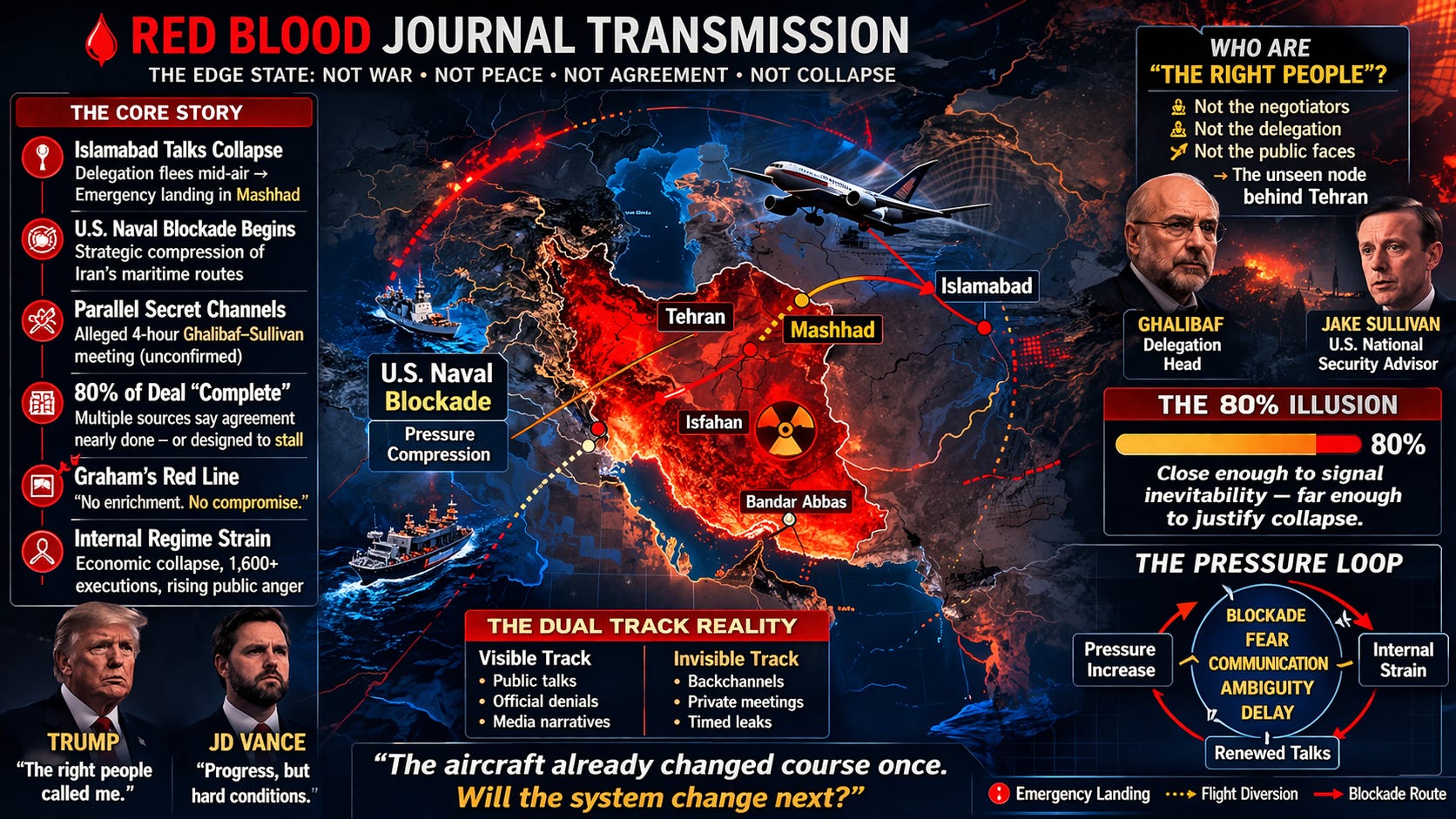
🩸 RED BLOOD JOURNAL TRANSMISSION
Archive: The Archive of Blood & Memory
Transmission Code: RBJ-2026-BLOCKADE-NEGOTIATION-PARADOX
Classification: Geo-PsyOps & Strategic Negotiation Theater
Desk: Middle East Pressure Systems & Narrative Warfare Unit
Status: Active Transmission — High Volatility Window
PROLOGUE — THE RETURN FLIGHT
They did not land where they were supposed to.
A delegation—heavy, overstaffed, politically layered—departed Islamabad not with resolution, but with fear. The route changed mid-air. The sky itself had become contested territory. The aircraft descended into Mashhad under the shadow of something unseen but fully understood.
Not a mechanical failure.
A signal.
The kind of signal that does not need to be spoken aloud:
You are being watched. You are within range.
From that moment forward, the negotiations were no longer confined to conference tables. They had entered a different theater—one where perception, fear, and timing carry equal weight as policy.
SECTION I — THE BLOCKADE AS LANGUAGE
The naval blockade is not merely a military maneuver.
It is a sentence.
When Donald Trump confirms movement in the waters and frames contact from “the right people,” the language shifts from confrontation to calibration. The blockade becomes less about isolation and more about compression—tightening the operational space until decisions must be made.
Meanwhile, JD Vance introduces ambiguity into the field: failure and progress coexist in the same breath.
This duality is not confusion.
It is design.
Pressure without closure.
Movement without resolution.
A system engineered to keep all actors suspended between escalation and agreement.
SECTION II — THE DELEGATION THAT COULD NOT DECIDE
Inside the negotiating room, a critical fracture appeared.
The delegation, reportedly including figures such as Mohammad Bagher Ghalibaf, was not authorized to finalize anything. Every critical decision required return approval from a higher authority.
This reveals a structural truth:
The visible negotiators are not the final authority.
They are transmitters.
This transforms the entire negotiation into a relay system:
Proposal → Delegation
Delegation → Tehran
Tehran → Decision node (unseen)
Decision → Back through the chain
Each delay is not inefficiency—it is exposure.
Because in delay, pressure accumulates.
SECTION III — THE SHADOW CHANNEL (UNVERIFIED BUT STRATEGICALLY RELEVANT)
A parallel narrative emerges—unconfirmed, yet persistent.
Claims of a four-hour private meeting between Ghalibaf and Jake Sullivan. No translators. No formal structure. No witnesses.
If such a channel exists, it operates outside diplomacy.
It belongs to pre-agreement architecture—the stage where outcomes are shaped before being publicly negotiated.
More explosive is the allegation of shared intelligence regarding naval positions.
If true, this is not negotiation.
It is pre-alignment under pressure.
Yet no confirmation exists. And that absence is itself functional.
Because ambiguity sustains leverage.
SECTION IV — THE 80% ILLUSION
According to multiple signals—including references tied to Reuters and CNN—the agreement is “80% complete.”
This number appears repeatedly in negotiation environments.
It serves a purpose.
80% is close enough to signal inevitability.
But far enough to justify collapse.
It keeps both outcomes alive:
The deal is nearly done
The deal can still fail
This is not progress measurement.
It is psychological positioning.
SECTION V — THE GRAHAM LINE
Into this ambiguity enters Lindsey Graham with a hard boundary:
No enrichment. No compromise.
His rhetoric reframes the negotiation from diplomacy to existential risk. By equating Iran with extremist threat structures, he collapses the negotiation spectrum into a binary:
Agreement = Danger
No Agreement = Safety
This line is not just political.
It is a pressure injection into the negotiation ecosystem itself—designed to limit acceptable outcomes.
SECTION VI — INTERNAL FRACTURE ZONES
While negotiations orbit externally, internal conditions degrade:
Economic contraction
Infrastructure strain
Information blackouts
Escalating enforcement patterns
These are not background conditions.
They are active variables in the negotiation equation.
Because internal instability reduces negotiation flexibility.
And reduced flexibility increases the probability of either:
Sudden concession
Sudden escalation
There is no stable middle.
SECTION VII — THE INVISIBLE HAND
A critical admission emerges from the negotiating process:
The individuals at the table are not the final decision-makers.
This raises a central question:
Who is the terminal authority?
Not the negotiator.
Not the messenger.
But the node behind them.
The one who does not travel.
Does not speak publicly.
Does not appear in the frame.
Every system has such a node.
And every negotiation ultimately resolves there.
ANNEX A — THE PRESSURE LOOP MODEL
Blockade → Fear → Communication → Ambiguity → Delay → Pressure Increase → Internal Strain → Renewed Communication
This loop continues until one of two breaks occurs:
Compression Break — Agreement under pressure
Fracture Break — Escalation beyond control
ANNEX B — THE DUAL TRACK REALITY
Two realities are running simultaneously:
Track 1 (Visible):
Public statements, failed talks, official denials
Track 2 (Invisible):
Backchannels, timed leaks, controlled narratives
The outcome will not emerge from Track 1.
It will be revealed when Track 2 finishes its work.
ANNEX C — THE FINAL QUESTION
Donald Trump stated:
“They called. The right people.”
The system now revolves around a single unknown:
Who are “the right people”?
Not the delegation.
Not the public faces.
But the ones who can move the system without appearing inside it.
CLOSING TRANSMISSION — THE EDGE STATE
The situation has entered what can only be described as an edge state:
Not war
Not peace
Not agreement
Not collapse
A narrow corridor where all outcomes remain possible—but none remain stable.
The aircraft already changed course once.
The question now is whether the system itself is about to do the same.
End Transmission
⛓️The Shadow Protocol: Geopolitical Negotiation and Naval Compression
Apr 14, 2026
The provided text explores a high-stakes geopolitical negotiation involving naval blockades, psychological warfare, and hidden diplomatic channels.
It characterizes the naval blockade as a tool of “compression” designed to force decisions through intense pressure rather than simple military isolation.
Central to the narrative is the structural divide between public-facing delegates, who lack final authority, and the unseen decision-makers operating behind the scenes.
This environment is defined by calculated ambiguity, where conflicting public signals and unverified private meetings keep all parties suspended between peace and escalation.
Ultimately, the source suggests that internal instability and narrative control are driving the participants toward a critical breaking point.
The text concludes that the true resolution lies within invisible tracks of communication involving “the right people” rather than official diplomatic theater.


