


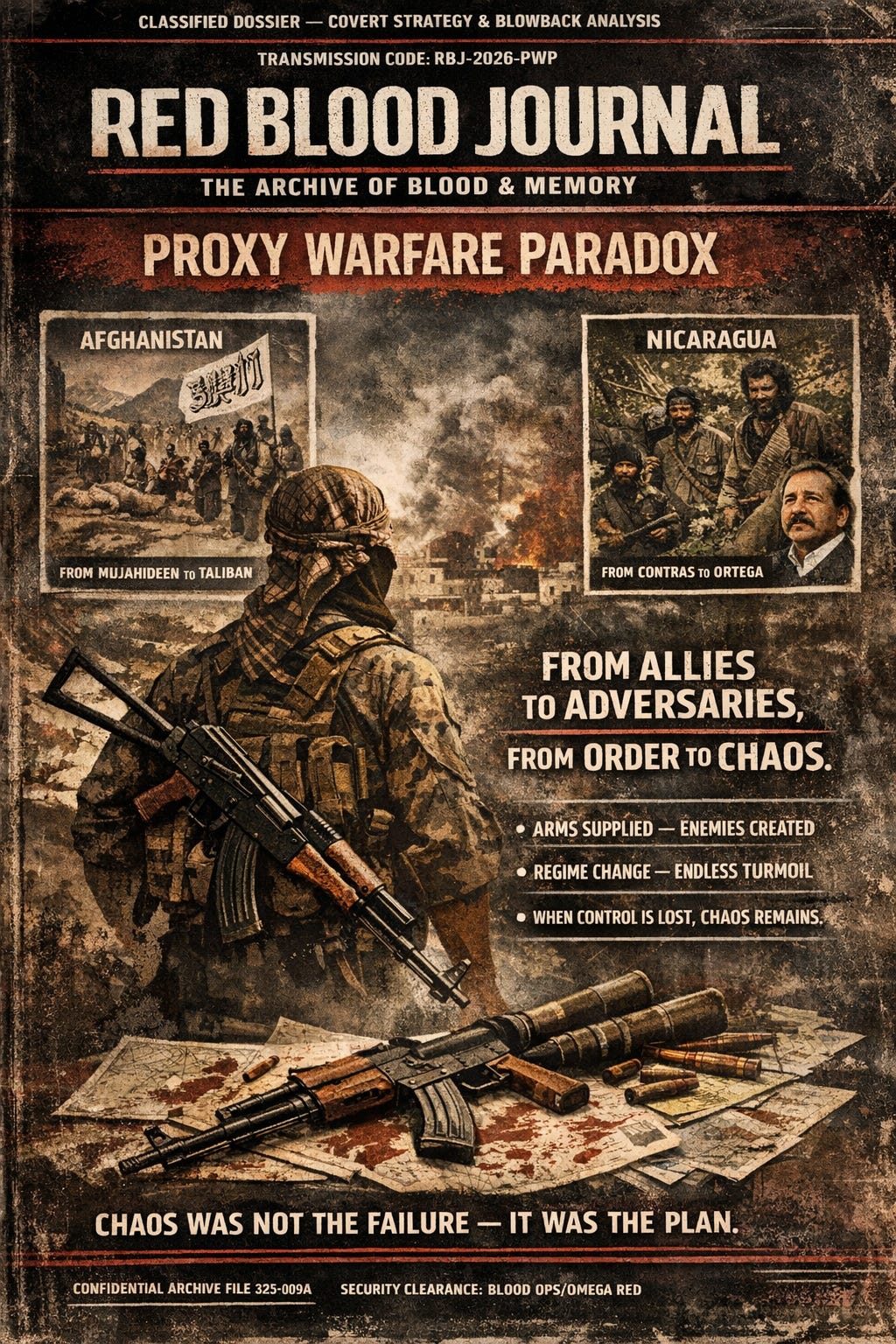
🩸 RED BLOOD JOURNAL TRANSMISSION
Archive: The Archive of Blood & Memory
Transmission Code: RBJ-2026-PROXY-WARFARE-PARADOX
Classification: Covert Strategy & Blowback Analysis
Desk: Irregular Warfare & Historical Pattern Unit
Status: Active Transmission
PROLOGUE — THE HAND THAT ARMS
In the theater of modern conflict, there exists a method preferred not for its precision—but for its deniability.
Weapons are not always carried by those who declare war.
They are passed—quietly, strategically—to those who will fight it.
Not soldiers.
Not nations.
Proxies.
This is where the line between control and chaos begins to blur.
SECTION I — THE DOCTRINE OF INDIRECT WAR
Proxy warfare is built on a simple premise:
Why risk direct confrontation
when influence can be achieved through others?
Arm local factions
Empower resistance movements
Destabilize adversaries from within
On paper, it is efficient.
Low cost.
Low visibility.
High leverage.
But the doctrine carries an unspoken assumption:
That those who receive power will remain aligned with those who provide it.
History does not support that assumption.
SECTION II — AFGHANISTAN: THE SEED AND THE STORM
Afghanistan became one of the most cited examples of proxy warfare in the late 20th century.
During the Cold War:
Weapons, funding, and training were directed toward resistance fighters known as the Mujahideen
The objective: counter Soviet influence
In the immediate term, the strategy worked.
The opposing force withdrew.
The proxy achieved its function.
But the story did not end with withdrawal.
It evolved.
From the remnants of that armed network emerged a new force:
Fragmented
Radicalized
Independent of original backers
The result:
The Taliban.
A force no longer aligned with initial objectives,
but shaped by the very tools provided to fight a different war.
The proxy did not disappear.
It transformed.
SECTION III — NICARAGUA: THE LOOP THAT NEVER CLOSED
In Nicaragua, a similar pattern unfolded.
External support was directed toward the Contras
The goal: weaken and replace the Sandinista government
The logic mirrored Afghanistan:
Apply pressure through armed opposition → force political change.
Years passed.
Conflict persisted.
Resources flowed.
And yet—
The original leadership remained.
Daniel Ortega, the very figure targeted for removal,
continued to hold power decades later.
The intervention did not produce decisive change.
It produced prolonged instability without resolution.
SECTION IV — THE PATTERN OF BLOWBACK
Across both cases, a repeating structure emerges:
External power arms a group
The group gains strength and autonomy
The original objective is either partially achieved or fails
The armed group evolves beyond control
Long-term consequences exceed initial calculations
This is not failure in the conventional sense.
It is something more complex:
Blowback.
Not immediate.
Not always visible at first.
But inevitable within systems that distribute force without long-term control.
SECTION V — CONTROL IS TEMPORARY, CONSEQUENCES ARE NOT
The core miscalculation lies in time.
Short-term alignment is mistaken for long-term loyalty.
But power, once transferred, does not remain static.
It adapts.
Motivations shift
Leadership changes
Objectives diverge
The proxy becomes its own actor.
And when that transition occurs,
the original architect loses ownership of the outcome.
SECTION VI — THE QUESTION OF INTENT
At this point, a deeper question surfaces:
If the outcomes repeatedly lead to instability,
why does the strategy persist?
Two possibilities emerge:
1. Miscalculation
Overconfidence in control
Underestimation of long-term dynamics
2. Alternative Objective
Stability was never the true goal
Chaos itself provides strategic advantage
Because instability has properties:
It weakens centralized power
It prevents coherent opposition
It creates dependency on external influence
In this light, the outcome is no longer contradiction.
It is alignment.
SECTION VII — CHAOS AS A TOOL
A stable nation can negotiate.
Organize.
Resist.
A fragmented nation cannot.
Internal conflict consumes its capacity:
Ethnic divisions
Political fractures
Resource struggles
The battlefield shifts inward.
And while attention remains fixed on internal chaos,
external actors maintain influence without direct confrontation.
This is not traditional victory.
It is strategic containment through disorder.
SECTION VIII — THE COST OF THE UNSEEN WAR
For those within the affected regions, the consequences are not theoretical:
Generational instability
Economic collapse
Social fragmentation
Endless cycles of violence
For those outside, the effects ripple outward:
Migration pressures
Security concerns
Long-term geopolitical entanglement
The proxy war never truly ends.
It expands.
SECTION IX — THE LESSON UNLEARNED
Afghanistan.
Nicaragua.
And others across decades.
Each presents the same conclusion:
Arming factions as a tool of control introduces variables that cannot be contained.
Yet the strategy persists.
Not because the lessons are unknown—
but because the system continues to value short-term leverage over long-term stability.
EPILOGUE — THE HAND RELEASES, THE EFFECT REMAINS
Weapons change hands.
Conflicts shift names.
Narratives evolve.
But the underlying mechanism remains constant:
Power transferred is power relinquished.
And once released, it cannot be fully reclaimed.
FINAL LINE — ARCHIVE ENTRY
A proxy is never just a tool.
It is the beginning of a future that no longer belongs to its creator.
🎭 The Proxy Paradox: Strategy, Blowback, and Unintended Consequences
Apr 10, 2026
This text examines the paradoxical nature of proxy warfare, illustrating how global powers utilize local factions to achieve strategic goals without direct involvement.
Through historical case studies like Afghanistan and Nicaragua, the source argues that these interventions frequently result in unintended blowback, where armed groups eventually evolve beyond the control of their original sponsors.
The author suggests that while this strategy offers short-term leverage, it inevitably creates long-term instability and systemic chaos that cannot be easily contained.
Ultimately, the document posits that transferring power to intermediaries is a self-defeating tactic because the resulting geopolitical consequences often outlast the initial objectives.
The narrative concludes that such conflicts rarely end, instead transforming into unpredictable cycles of violence that shift ownership of the outcome away from the intervening nation.


