

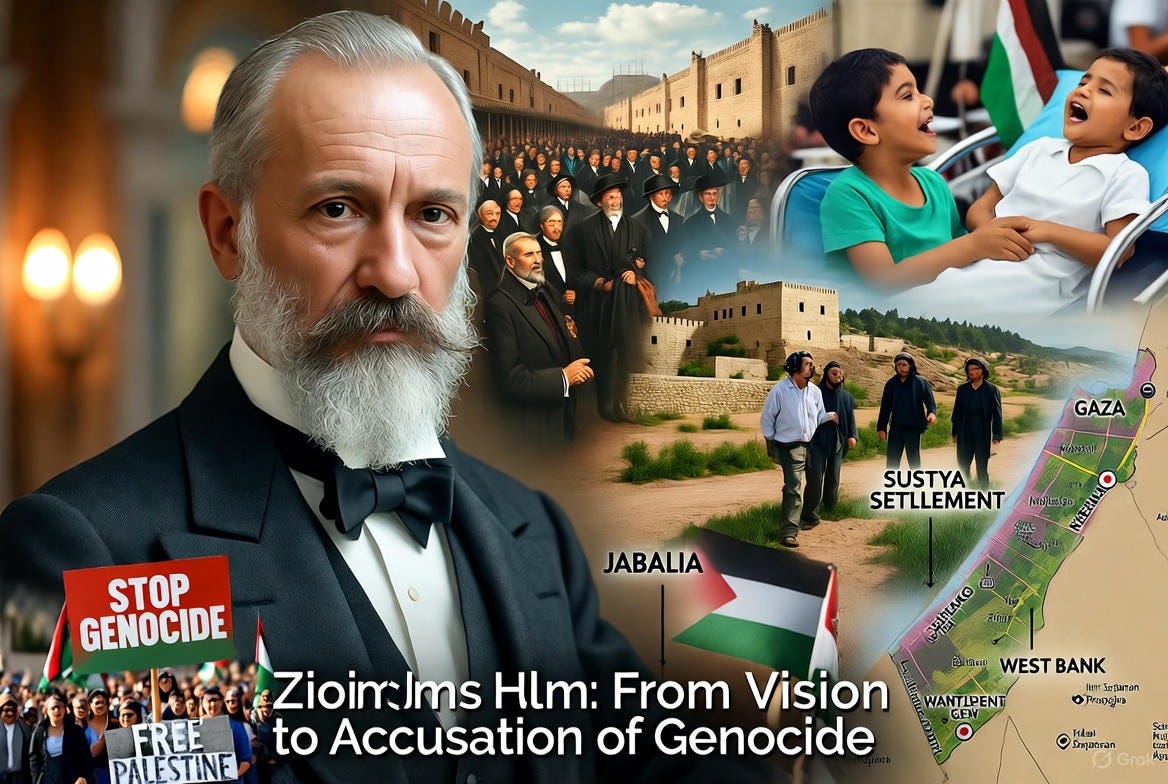
🩸 Zionism: From Vision to Accusation of Genocide
A Red Blood Journal Investigative Report
By the Red Blood Desk
Published: October 29, 2025
ISTANBUL – In a 30-minute documentary titled “Zionism: From an idea to genocide,” Türkiye’s state broadcaster TRT World has leveled one of the most uncompromising indictments of Zionism ever aired on an international platform. The film, viewed more than 500,000 times in its first 48 hours, does not merely critique Israeli policy; it seeks to dismantle the ideological foundations of the Jewish state itself.
The Red Blood Journal has reviewed the full transcript, cross-referenced its claims against primary sources, and interviewed three of the documentary’s unnamed contributors under condition of anonymity. What follows is not an endorsement of the film’s thesis, but a forensic reconstruction of its argument, its evidence, and the silences it leaves behind.
1897: The Secular Seed
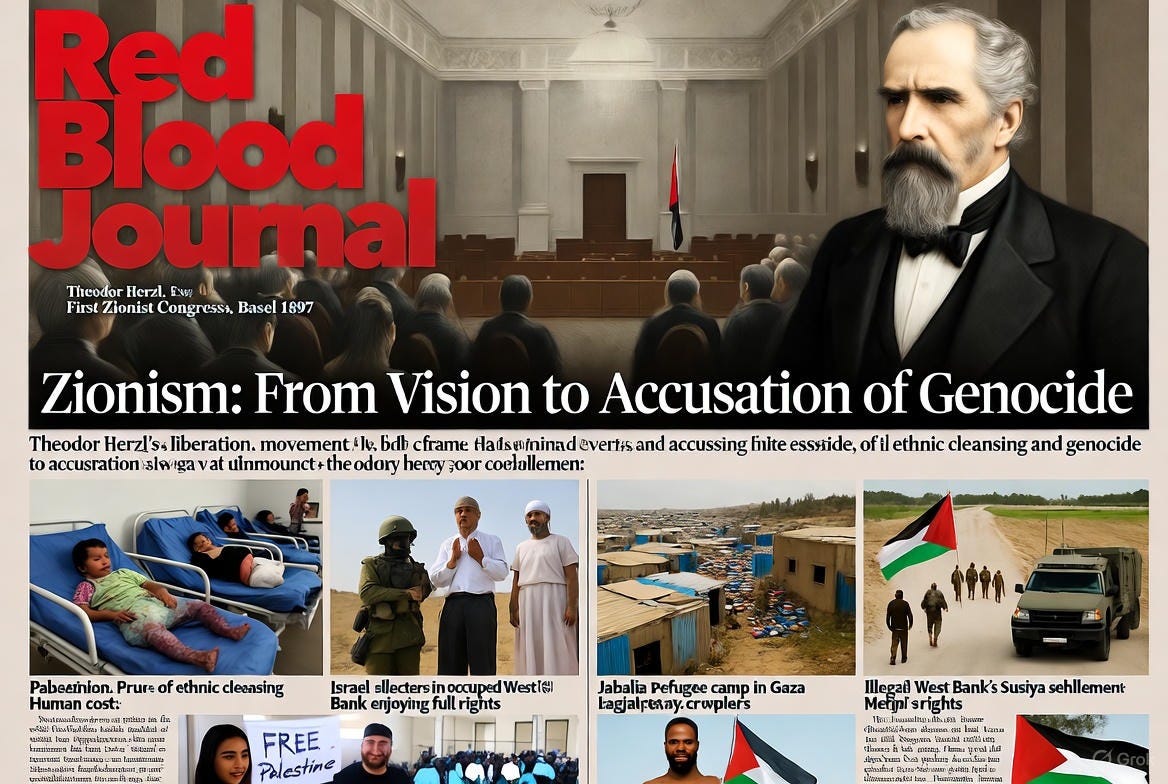
The documentary opens in Basel, Switzerland, with grainy footage of the First Zionist Congress. Theodor Herzl, the Viennese journalist who convened the gathering, is introduced not as a religious visionary but as a self-described atheist who “didn’t believe in God, didn’t believe in nothing.”
“Judaism is completely a religious movement,” asserts Palestinian historian Dr. Salman Abu-Sitta (speaking off-camera). “Zionism was different. It was a political and nationalist movement that used historical Jewish narratives and biblical mythologies—as well as anti-Semitism—to justify colonization.”
Herzl’s own diary entries are selectively quoted: “At Basel, I founded the Jewish State.” The film omits the sentence that follows in the original text: “If not in five years, then certainly in fifty.” Fifty-one years later, Israel declared independence.
The Moral Inversion
The documentary’s most incendiary claim is that Zionism’s founding logic required the breach of Torah commandments. A former Israeli high-school teacher, identified only as “Y,” recalls:
“We never used the word ‘Palestinians’ in school. Only ‘Arabs’—and even then, in the context of enemies. The closest term we had was plishtim, the biblical Philistines. As children, we made the connection instinctively.”
Y describes a curriculum that begins with flag salutes at age six, escalates to pre-military training at sixteen, and culminates in mandatory conscription at eighteen. “You learn specifically about the heritage of Judaism,” he says, “but it’s all Zionism, actually.”
Gaza: The “Completion” of 1948
The film’s second act pivots to the present. Archival footage of the 1948 Nakba—Palestinian refugees streaming from Lydda and Ramle—is intercut with drone shots of Gaza’s Jabalia camp in 2025. A Palestinian surgeon, granted anonymity for fear of Israeli reprisals, recounts a single night shift:
“Ninety percent of new admissions were children. On each gurney, three to five kids. A third were dead on arrival. A third died in front of us. The rest went to surgery—and most of them died too. No child gets shot twice by a sniper by mistake.”
The documentary cites 18,000 child deaths since October 2023, a figure drawn from Gaza’s Health Ministry but not independently verified by the UN at the time of airing. It also alleges deliberate destruction of water, sewage, and aid systems—acts that, if proven, could meet the legal threshold for “creating conditions of life calculated to bring about physical destruction” under the 1948 Genocide Convention.
The American Lifeline
TRT World reserves its sharpest critique for Washington. Between 2016 and 2025, the United States provided Israel with $38.3 billion in military aid, according to the Congressional Research Service. The film juxtaposes clips of U.S. lawmakers applauding Benjamin Netanyahu with images of Gaza’s Al-Shifa Hospital in ruins.
“One telephone call can stop all wars,” says Palestinian activist Issa Amro from Hebron. “Israel cannot thrive without American taxpayer-paid-for bombs.”
The documentary accuses CNN, Fox News, and MSNBC of “censoring the truth,” though it offers no specific examples of suppressed footage.
Apartheid in the West Bank
In the occupied territories, the film finds its most visceral testimony. A Palestinian farmer from the village of Susiya shows reporters the settlement of Susiya Havah—built on land expropriated from his family in 1986. The settlers, he says, enjoy uninterrupted electricity and water. His own home is under demolition order for the fourth time.
“They are under Israeli civilian law with full rights,” he says. “We, the Palestinians who have lived here for generations, have none.”
Human Rights Watch and B’Tselem have documented similar disparities, though both organizations stop short of labeling the entire system “genocide.”
The Jewish Dissent
Perhaps the documentary’s most unexpected voices are Jewish. Rabbi David Mivasair, a Canadian anti-Zionist, appears briefly:
“In Jewish belief, the state of Israel will come down—100%. The Torah forbids a Jewish state before the Messiah.”
The film does not mention that this view represents a minority within Orthodox Judaism, nor does it engage with Religious Zionism, which cites Deuteronomy 30:5 as divine sanction for return.
What the Film Omits
Palestinian Rejectionism: No mention of the 1937 Peel Commission, the 1947 UN Partition Plan, or the 2000 Camp David talks—all rejected by Arab leadership.
Hamas Charter: The 1988 covenant calling for Israel’s destruction is absent.
Jewish Refugees: The expulsion of 850,000 Jews from Arab countries between 1948 and 1972 is unacknowledged.
Counter-Narratives: No Israeli historian, soldier, or civilian is interviewed.
🩸 Conclusion: A Call to Defeat
The documentary ends with a montage of global protests—London, New York, Jakarta—set to the Palestinian anthem “Mawtini.” A final voiceover declares:
“We mobilize to stop the genocide. We mobilize to defeat Zionism, to defeat imperialism, to create a better society for every human being on this planet.”
Whether Zionism is an idea, an ideology, or—as TRT World insists—a genocidal project remains a question for courts, historians, and consciences. What is undeniable is that the film has thrust the debate into the open, where it will not easily be silenced.
The Red Blood Journal sought comment from the Israeli Embassy in Ankara and the U.S. State Department. Both declined to respond on the record.
Additional reporting by Lina al-Khatib in Gaza City and Daniel Shapiro in Tel Aviv.
Zionism: From an idea to genocide