


🩸 🌍 🏰 ⚔️ 🌊 📜 ✡️ 🌊❤️✨ — THE KHAZAR KHAGANATE: THE EMPIRE BETWEEN THREE WORLDS
A Historical Investigation of the Turkic Empire, Its Political Power, Trade Routes, Religious Conversion, Wars, and Disappearance, c. 655–969 CE
RED BLOOD JOURNAL — HISTORICAL INVESTIGATION
October 26, 2026
History | Central Asia | Caucasus | Caspian Sea | Byzantium | Religion | Geopolitics
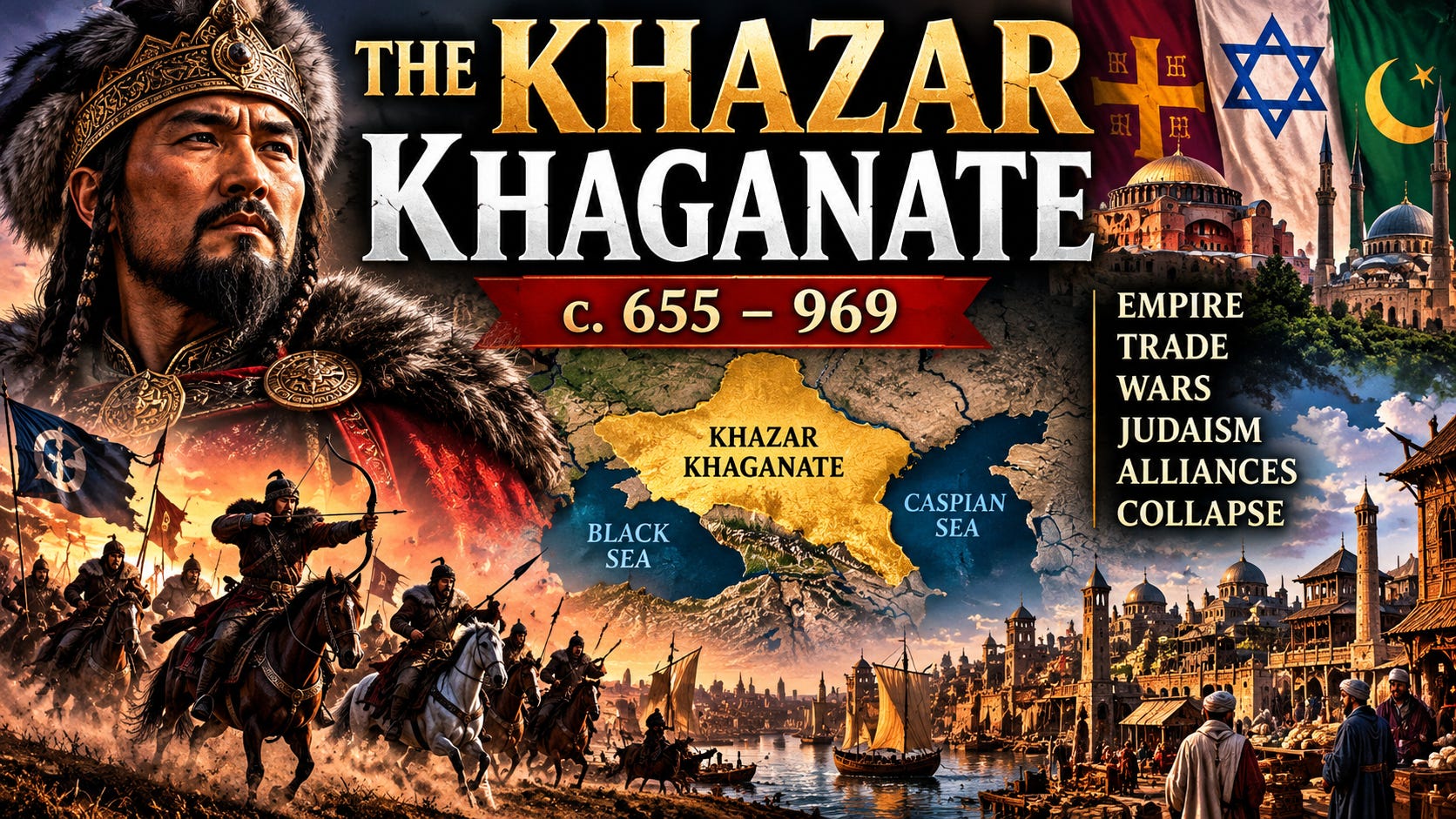
PROLOGUE — AN EMPIRE BETWEEN THE BLACK SEA AND THE CASPIAN
Between the seventh and tenth centuries, a powerful empire occupied a strategic crossroads connecting Eastern Europe, the Caucasus, the Volga River, the Black Sea, and the Caspian Sea. Its rulers controlled important commercial passages, fought expanding Islamic armies, negotiated with the Byzantine Empire, and exercised authority over numerous peoples living across the Eurasian steppe.
This was the Khazar Khaganate, a state whose geographical position made it an important intermediary between several of the medieval world’s most powerful civilizations.
The Khazars were predominantly associated with Turkic-speaking ruling groups whose political traditions emerged from the earlier Turkic empires of Inner Asia. Their domain was not a modern nation-state with fixed borders and a uniform population. It was a changing network of directly governed territories, tributary peoples, military alliances, commercial settlements, and frontier communities.
The empire became particularly distinctive when influential members of its ruling class adopted Judaism. This historical development has generated centuries of debate concerning the rulers’ motives, the size of the converted population, the relationship between religion and diplomacy, and the fate of Khazar communities after the empire’s collapse.
Some later writers have attempted to connect Khazar history to sweeping theories concerning modern Jewish ancestry or political power. Those claims require examination separate from the history of the medieval state itself.
The objective of this investigation is to reconstruct what can reasonably be established about the Khazar Khaganate between approximately 655 and 969 CE, explain its role in Eurasian history, and distinguish documented events from later interpretations.
I. THE ORIGINS — FROM THE WESTERN TURKIC EMPIRE TO KHAZAR INDEPENDENCE
The Khazars emerged within the political environment created by the great Turkic empires of the sixth and seventh centuries.
The First Turkic Khaganate arose in the middle of the sixth century and eventually divided into eastern and western political formations. These empires connected wide regions of Inner Asia through systems of military alliances, tribute, and mobile steppe leadership.
As the Western Turkic political order weakened during the seventh century, several successor states and tribal confederations consolidated power. Among them were the Khazars, whose rulers established authority north of the Caucasus and around the lower Volga and Don river systems.
Scholars generally place the emergence of a recognizable independent Khazar polity around the middle of the seventh century, although its formation was gradual rather than the consequence of one clearly recorded founding event.
The ruling elite appears to have inherited political traditions associated with the Western Turks, including the title khagan, denoting an imperial or supreme ruler. The connection with the Ashina ruling lineage is historically discussed, although details of early dynastic succession remain uncertain.
The resulting state combined mobile steppe traditions with increasingly important urban and commercial centers, allowing the Khazars to exercise influence over both pastoral communities and settled populations.
II. THE GEOGRAPHY — CONTROL BETWEEN TWO SEAS
Geography explains much of the Khazar Khaganate’s importance.
To the west lay the Black Sea and the lands approaching the Byzantine Empire. To the east lay the Caspian Sea, the lower Volga, and routes toward Central Asia. To the south stood the Caucasus Mountains, separating Khazar territories from Armenia, Azerbaijan, and the political world of Persia and the Arab Caliphate.
The Volga and Don rivers provided important transportation corridors connecting the northern forests with southern commercial centers. Goods transported from northern Europe and the Eurasian interior could move toward Caspian markets, the Caucasus, and the Islamic world.
The khaganate’s influence varied by period and location. Some regions were administered more directly, while others were associated with tribute, military dominance, or temporary political dependence.
Among its important centers were Balanjar in the northeastern Caucasus, Samandar near the western Caspian region, Sarkel on the Don, and Itil, or Atil, in the lower Volga area.
Itil became especially important during the mature period of Khazar power. Situated near the Volga’s connection with the Caspian, it functioned as a center of political authority and international commerce.
The ability to oversee commercial movement through these routes gave the Khazars influence that extended beyond the boundaries of their military occupation.
III. THE POLITICAL SYSTEM — THE KHAGAN AND THE RULING ELITE
The Khazar political system developed an arrangement frequently described by historians as a form of dual kingship.
In this structure, the khagan occupied the position of supreme or sacral ruler, while another powerful figure, commonly identified with titles such as beg, exercised important executive and military responsibilities.
The precise relationship between these offices changed over time and is not perfectly understood. Descriptions from medieval writers also contain inconsistencies, making it difficult to reconstruct one unchanging constitutional structure.
Nevertheless, the division between ceremonial sovereignty and practical administration illustrates how Khazar political authority could be distributed within the ruling establishment.
The khaganate also depended on relationships with subject and tributary communities. Local rulers could retain authority while acknowledging Khazar supremacy, paying tribute, or supplying military assistance.
This allowed the empire to influence territories far larger than those occupied directly by a centralized administration.
Its authority was therefore neither entirely tribal nor fully comparable to a modern centralized state. It combined dynastic leadership, military power, negotiated relationships, taxation, and commercial influence.
IV. THE ARAB–KHAZAR WARS — THE STRUGGLE FOR THE CAUCASUS
The expansion of Islamic armies into the Caucasus created a major military confrontation with Khazar power.
Arab forces entered Transcaucasia during the seventh century as the early Caliphate expanded beyond the former territories of the Sasanian Empire.
The Caucasus contained essential passages between the northern steppe and the regions to the south. Derbent, near the western shore of the Caspian Sea, was particularly important because it controlled a narrow route between the mountains and the sea.
Arab and Khazar forces fought repeatedly for influence over these corridors.
In 652, Arab troops attacking Balanjar suffered a significant defeat. Further confrontations followed as armies crossed the Caucasus, captured settlements, withdrew, and returned in successive campaigns.
The conflict intensified in the early eighth century.
One of the most notable Khazar victories occurred in 730, when Khazar forces defeated an Arab army near Ardabil, in present-day Iran. The battle demonstrated that Khazar military power could threaten territories south of the Caucasus.
Arab armies subsequently launched major counteroffensives. In 737, the commander Marwan ibn Muhammad conducted an extensive campaign into Khazar territory, compelling the Khazar leadership to negotiate from a weakened position.
Medieval accounts describe religious and political concessions associated with these campaigns, although historians debate aspects of their reliability and duration.
The broader outcome was significant. The Khazars survived as a major power north of the Caucasus, while the Arab Caliphate consolidated its influence in much of Transcaucasia.
These wars helped shape the political and religious geography of the region for centuries.
V. BYZANTIUM — ALLIANCE, MARRIAGE, AND STRATEGIC CALCULATION
The Byzantine Empire regarded the Khazars as important participants in the balance of power around the Black Sea and Caucasus.
For Constantinople, cooperation with Khazar rulers could help counter threats from the north and east, including pressures associated with Arab expansion.
Diplomatic relations included military cooperation, negotiations, and dynastic marriage.
A notable example involved the marriage of Byzantine emperor Constantine V, before his accession, to a Khazar princess traditionally known as Tzitzak, who received the Christian name Irene.
Their son later became Emperor Leo IV, sometimes called Leo the Khazar.
This marriage illustrates the importance Byzantine rulers attached to relations with Khazaria. The Khazar state was not merely a distant collection of nomadic communities; it was a recognized regional power whose alliances mattered to imperial strategy.
Relations were not permanently friendly. Commercial interests, territorial competition, developments in Crimea, and the changing position of the Rus’ contributed to periods of tension.
The relationship therefore demonstrates how medieval states could cooperate against common threats while remaining competitors in other areas.
VI. TRADE, TAXATION, AND THE ECONOMY OF THE KHAGANATE
The Khazar economy combined pastoral production, agriculture in suitable regions, urban commerce, tribute, and revenue associated with long-distance trade.
Its geographical position allowed merchants and caravans to move between several economic worlds.
Northern regions supplied products such as furs, wax, honey, and enslaved people. Southern and eastern markets offered manufactured goods, textiles, precious metals, and other commodities.
The trade in enslaved people was a real component of medieval Eurasian commerce and should not be overlooked when examining the wealth accumulated through these routes.
Khazar authorities could derive income from taxation, customs duties, tribute, and commercial activity occurring within their sphere of influence.
Merchants associated with the Islamic world, Byzantine territories, northern Europe, and Central Asia participated in these networks.
The lower Volga was especially significant because it connected inland river systems to the Caspian basin.
This commercial position made Khazaria an intermediary rather than simply a producer of goods. Its power depended partly on its ability to influence the routes through which other communities exchanged resources.
Control over transportation and taxation could provide substantial revenue without requiring political ownership of every region participating in the network.
The prosperity of such a system, however, also depended on the maintenance of military security and the willingness of merchants to continue using the routes.
When competing powers disrupted those networks, Khazar revenue and influence became increasingly vulnerable.
VII. THE CONVERSION TO JUDAISM — WHAT HISTORIANS ACTUALLY KNOW
The adoption of Judaism by the Khazar ruling elite is among the most discussed events in the khaganate’s history.
The conversion occurred sometime between the eighth and ninth centuries, although scholars disagree about its exact date, sequence, and social extent.
Some historical accounts describe a ruler named Bulan associated with the initial adoption of Judaism, followed by later efforts to strengthen religious institutions. Other narratives present the conversion through stories of debates involving representatives of Judaism, Christianity, and Islam.
These accounts are important historical sources, but they should not all be read as literal transcripts of events.
Medieval rulers often used religion to establish legitimacy, strengthen internal administration, and influence diplomatic relationships.
The Khazar position between Byzantium and the Islamic Caliphate provides one possible context for understanding the adoption of Judaism.
Christianity was strongly associated with Byzantine imperial power, while Islam was associated with the Caliphate and other influential states.
Judaism offered a monotheistic religious identity that was not identical to either imperial neighbor’s dominant religion.
Some historians have therefore interpreted the Khazar conversion partly as a means of preserving political independence.
Other scholarship emphasizes the religious, social, and institutional processes through which conversion may have taken place, cautioning against reducing the event to diplomatic calculation alone.
What is especially important is that the conversion of members of the ruling elite does not establish that the entire population adopted Judaism.
Khazaria remained a religiously diverse society.
VIII. A MULTIRELIGIOUS EMPIRE — JUDAISM, ISLAM, CHRISTIANITY, AND STEPPE BELIEFS
Medieval descriptions of Khazar society refer to Jewish, Muslim, Christian, and non-monotheistic communities living within the khaganate.
Earlier Turkic religious traditions involved reverence for Tengri and other practices associated with the spiritual world of the Eurasian steppe.
Islam spread through commercial contact, neighboring Muslim states, and the movement of people across Khazar territories. Christianity existed through Byzantine influence and communities connected with the Caucasus.
Judaism became associated particularly with the ruling establishment, although Jewish communities also existed beyond the political elite.
The tenth-century Muslim geographer and historian al-Mas’udi described a Khazar capital inhabited by followers of several religions.
Accounts concerning Khazar courts and judicial arrangements suggest that different communities possessed recognized forms of religious identity within the political system. The precise extent of legal autonomy and toleration remains subject to interpretation.
The broader picture is of a state whose rulers governed a religiously and ethnically diverse population rather than a uniform kingdom composed entirely of Jewish converts.
This distinction is essential for understanding the historical Khazars without projecting later religious identities onto every inhabitant of the empire.
IX. THE KHAZAR CORRESPONDENCE — A KING WRITES TO SPAIN
One of the most remarkable surviving sources concerning Khazar political identity is the correspondence traditionally associated with Hasdai ibn Shaprut and Khazar King Joseph.
Hasdai was a prominent Jewish official and diplomat in tenth-century Córdoba, within the Muslim-ruled Iberian Peninsula.
After hearing reports of a Jewish-ruled kingdom far to the east, he sought information concerning its origins, government, religious history, and location.
The response attributed to King Joseph describes Khazar royal ancestry, territorial authority, military history, and the adoption of Judaism.
The letters provide an important window into how Khazar rulers wished to present themselves and their kingdom.
However, questions concerning the manuscript tradition, textual versions, historical accuracy, and authenticity of particular details remain subjects of scholarship.
The correspondence should therefore be read both as evidence about Khazar political identity and as a source requiring critical examination.
Royal accounts rarely function as neutral descriptions of their authors’ own power.
Their claims concerning ancestry, territorial reach, and military success need comparison with Byzantine, Arabic, Persian, archaeological, and other available evidence.
Even with these limitations, the Khazar correspondence remains central to the historical study of the kingdom’s Jewish ruling tradition.
X. THE RUS’ AND THE DECLINE OF KHAZAR POWER
During the ninth and tenth centuries, the emergence and expansion of Rus’ political power increasingly challenged the Khazar position in Eastern Europe.
Rus’ trading and military networks developed along rivers connecting the Baltic region with the Black Sea and the Caspian.
The Khazars had earlier exercised influence over some Slavic and other communities that later became connected with the Rus’ political sphere.
As Rus’ rulers expanded, existing tributary relationships and control over transportation became contested.
The khaganate also faced pressure from other steppe peoples, including the Pechenegs and Oghuz Turks.
These pressures affected its military position and ability to maintain authority over subordinate communities.
Relations between the Khazars and Byzantium also changed over time, reducing the reliability of earlier strategic alignments.
The resulting decline should not be attributed entirely to one battle or one attacking force.
It reflected the interaction of military competition, changing trade relationships, challenges to tributary authority, and shifting regional alliances.
XI. THE FALL — SVIATOSLAV AND THE CAMPAIGNS OF THE 960s
The collapse of Khazar imperial power is conventionally associated with the campaigns of Prince Sviatoslav of Kyiv during the 960s.
The Rus’ Primary Chronicle associates a major victory over the Khazars with 965 and records the capture of Sarkel, known in later East Slavic tradition as Bela Vezha.
Other medieval sources describe destructive attacks affecting Khazar settlements and commercial centers during the years around 968–969.
Itil, Samandar, and other locations suffered serious damage during this period.
However, the surviving sources do not agree completely about the chronology or the sequence of military events.
Encyclopaedia Iranica emphasizes that the chronology presented in the Rus’ chronicle cannot simply be reconciled with every Arabic account, some of which also describe attacks by Oghuz forces and attempts by Khazar rulers to obtain assistance.
The fall was therefore not necessarily a single event occurring on one exact date.
It was a series of military and political developments that destroyed the empire’s capacity to maintain its former authority.
The defeat of major Khazar centers disrupted the commercial and tributary relationships that had sustained the khaganate for centuries.
By approximately 969, the Khazar Empire no longer exercised the regional power associated with its earlier history.
XII. WHAT HAPPENED TO THE KHAZARS AFTER 969?
The collapse of an empire does not mean that its inhabitants disappear.
Khazar communities survived after the destruction of their major political centers, and references to Khazars continued in some later sources.
Former Khazar territories came under the influence of neighboring powers and steppe communities. Populations were absorbed into changing political and cultural environments, including Turkic-speaking groups and other peoples of Eastern Europe and the Caucasus.
Some communities may have migrated, while others remained in territories formerly associated with the khaganate.
But the historical record does not permit a complete reconstruction of the fate of every Khazar population.
The empire was multiethnic, and its inhabitants did not necessarily share a uniform identity or religious affiliation.
Consequently, the question of what happened to the Khazars cannot be answered by assuming that all of them became members of one later nation or religious community.
The disappearance of Khazar political independence and the longer-term demographic history of its inhabitants are separate subjects.
XIII. WERE THE KHAZARS THE ANCESTORS OF MODERN ASHKENAZI JEWS?
The question of a possible Khazar contribution to Ashkenazi Jewish ancestry has attracted extensive public attention.
A historical basis exists for examining population movement: the Khazar ruling elite included Jewish converts, Jewish communities existed in Eastern Europe, and migrations occurred across the region during the medieval period.
But the existence of these facts does not establish that most modern Ashkenazi Jews descend from Khazars.
Different genetic studies have reached competing conclusions about particular aspects of Ashkenazi population history.
One 2013 study by Eran Elhaik argued in favor of a Khazar-related ancestry hypothesis, based on comparisons involving Caucasus populations.
A separate genome-wide analysis by Doron Behar and colleagues, using broader population sampling, found no evidence of a significant Khazar contribution and instead identified substantial ancestry connections with both Middle Eastern and European populations.
Later genetic research has further examined the timing and geographical sources of European ancestry in Ashkenazi populations.
The principal difficulty is that there is no securely identified, comprehensive genetic reference population representing the medieval Khazars. Modern populations living near former Khazar territory cannot automatically be treated as direct genetic substitutes for those medieval inhabitants.
It would therefore be misleading to describe the Khazar-origin hypothesis as established historical fact.
Even if future evidence identifies particular Khazar ancestry contributions within some Jewish populations, genealogy would not establish collective political intentions or institutional control.
The ancestry of a modern population cannot serve as proof that its members collectively direct financial institutions, governments, or international conflicts.
Those allegations require independent evidence concerning identifiable contemporary actors and decisions.
XIV. THE CASPIAN CONNECTION — WHY KHAZAR HISTORY MATTERS TO IRAN
The Khazar Khaganate occupies an important place in the history of the lands surrounding the Caspian Sea.
In Persian, the Caspian Sea is commonly called Daryā-ye Khazar, or the Sea of Khazar, reflecting a historical geographical association with the Khazars.
The sea has also carried other names in Persian and neighboring traditions, including Mazandaran and Caspian.
The use of the Khazar name should not be interpreted as evidence that the Khazar state permanently controlled the entire coastline or that every surrounding population belonged to the khaganate.
Instead, geographical naming preserves memories of historical peoples and political relationships that once shaped a region.
The western Caspian corridor was especially significant because it connected the northern steppe with the Caucasus and territories belonging to successive Iranian empires and Islamic states.
The fortress and passage of Derbent became important points of confrontation between northern steppe powers and armies advancing from the south.
Khazar military activity during the Arab–Khazar wars also extended into areas now located within Iran, including the notable campaign associated with Ardabil.
This history demonstrates that the Caspian region has been an important crossroads of military competition, transportation, trade, and cultural contact for well over a millennium.
It does not demonstrate that the medieval Khazar state exercises any continuous institutional authority over contemporary Iranian politics.
XV. WHAT THE KHAZAR KHAGANATE TEACHES ABOUT POWER
The history of Khazaria illustrates how political authority can be strengthened through geography, military capability, control of commercial routes, taxation, diplomacy, and relationships with subordinate communities.
The Khazar rulers operated between powerful neighboring civilizations and developed political arrangements that allowed their state to survive for approximately three centuries.
Their adoption of Judaism forms part of that historical complexity, but religion alone does not explain the rise, prosperity, or collapse of the empire.
Khazar power was also shaped by military competition, changing commercial routes, alliances, geography, and the capacity to maintain political relationships with numerous peoples.
The collapse of the khaganate demonstrates the vulnerability of states whose influence depends on controlling critical corridors and maintaining tribute from subordinate communities.
When competing political powers acquired the ability to bypass, challenge, or destroy those arrangements, Khazar imperial authority weakened.
The lesson is not that modern political institutions descend directly from Khazar leadership.
It is that concentrated power can develop through recognizable mechanisms that appear in many historical settings.
Those mechanisms deserve investigation wherever they influence public welfare, but similarities between different eras must not be confused with proof of a continuous hidden organization.
🩸 The Red Blood Perspective
The Khazar Khaganate was a real medieval empire whose political and economic history can be investigated through Byzantine, Arabic, Persian, Hebrew, archaeological, and later Rus’ sources.
Its rulers controlled important strategic territory, collected tribute, participated in long-distance trade, fought the expanding Arab Caliphate, maintained diplomatic relations with Byzantium, and governed a religiously diverse population.
The conversion of influential Khazar rulers to Judaism is supported by historical evidence, although its exact chronology and demographic scope remain debated.
The empire’s political decline resulted from changing military and economic circumstances, with major destructive campaigns during the 960s.
The ancestry of its surviving populations is a separate question from the existence of the medieval state, and the available evidence does not establish the claim that modern global institutions are directed by an enduring Khazarian Jewish organization.
The Red Blood method is to follow verifiable actions: the rulers, wars, taxation systems, alliances, commercial routes, and surviving records. The more precise the evidence, the less need there is to substitute ancestral or religious assumptions for historical explanation.
Understanding the history of power means identifying what institutions actually did, not assigning responsibility to people centuries later because of a claimed ancestry.
🌊❤️✨ The Ocean of Love and Positivity Perspective
The Khazar Khaganate reminds us that the boundaries separating peoples, religions, and political systems have never been as permanent as their rulers sometimes imagined.
A Turkic-led empire developed between Christian and Muslim powers, adopted Judaism within important ruling circles, and governed a population containing multiple languages, religions, and cultural traditions.
Its existence challenges simplistic assumptions that every civilization can be reduced to one ancestry, belief, or political identity.
The same historical record also reminds us that empires rise and fall while human communities continue to evolve, migrate, and exchange ideas.
We learn more from history when we approach it with curiosity rather than inherited suspicion.
Red Blood Journal’s purpose is not to replace one historical mythology with another. It is to examine evidence, question the misuse of authority, and recognize that human dignity extends beyond the categories through which states and empires have divided people.
The constructive lesson is that differences in ancestry, religion, and culture do not establish differences in human worth.
History becomes valuable when it helps us understand the choices that created suffering, cooperation, prosperity, and decline, and when that understanding strengthens our capacity to live together more responsibly.
We do not need to inherit the enemies of a vanished empire. We need to inherit the wisdom that careful examination of its history can offer.
SOURCES AND FURTHER READING
Dan D. Y. Shapira — Encyclopaedia Iranica. Khazars. Detailed coverage of Khazar history, Arab–Khazar wars, conversion narratives, trade, and the collapse of the khaganate.
https://www.iranicaonline.org/articles/khazars/
Peter B. Golden — Wiley Encyclopedia of Empire (2016). Khazar Khaganate. Overview of political origins, geography, regional trade, and religious transformation.
https://doi.org/10.1002/9781118455074.wbeoe118
Peter B. Golden — YIVO Encyclopedia. Khazaria. Historical and political overview of the Khazar state and its relationship to Jewish history.
https://encyclopedia.yivo.org/article.aspx/Khazaria
Peter B. Golden, Haggai Ben-Shammai, and András Róna-Tas, editors — Brill (2007). The World of the Khazars: New Perspectives. Collection of specialist research on political history, archaeology, religion, and cultural contacts.
Alex M. Feldman — Edinburgh University Press (2022). The Monotheisation of Khazaria. Investigation of religious conversion, social organization, and centralization.
James Howard-Johnston — Studia Ceranea (2023). Rus and Khazars. Study of the relationship between Khazar power, Rus’ expansion, and the commercial networks of Eastern Europe.
Doron M. Behar and colleagues — Human Biology (2013). No Evidence from Genome-Wide Data of a Khazar Origin for the Ashkenazi Jews.
https://pubmed.ncbi.nlm.nih.gov/25079123/
Eran Elhaik — Genome Biology and Evolution (2013). The Missing Link of Jewish European Ancestry: Contrasting the Rhineland and the Khazarian Hypotheses.
https://pmc.ncbi.nlm.nih.gov/articles/PMC3595026/
J. Xue and colleagues — PLOS Genetics (2017). The Time and Place of European Admixture in Ashkenazi Jewish History.
https://doi.org/10.1371/journal.pgen.1006644
Historical methodology note: Khazar history is reconstructed from sources produced by neighboring states, later chroniclers, royal correspondence, and incomplete archaeological records. These sources sometimes disagree. Dates, conversion narratives, territorial boundaries, and population ancestry therefore require different degrees of historical caution.
🩸🌊❤️✨ — Ocean of Love and Positivity
Blood connects us. The ocean unites us. Love guides us. Positivity illuminates our path.
📜
The Khazar Khaganate: History and Legacy
Oct 26, 2026
The provided text offers a comprehensive historical investigation of the Khazar Khaganate, a powerful Turkic empire that thrived between the seventh and tenth centuries. Strategically positioned between the Black Sea and the Caspian Sea, the state controlled vital commercial trade routes and successfully navigated complex geopolitical tensions involving the Byzantine Empire and the expanding Arab Caliphate. A defining feature of this society was the adoption of Judaism by its ruling elite, though the empire remained remarkably multireligious and diverse. Ultimately, the khaganate suffered a military collapse in the 960s following campaigns by Prince Sviatoslav of Kyiv, leading to the dispersal of its population. Furthermore, the narrative addresses modern controversies by examining the genetic ancestry of Ashkenazi Jews and concluding that genetic evidence does not support a direct Khazar lineage for modern global institutions.