


🩸 💰 🌍 ⛓️ 🐓 ⚔️ 🌊❤️✨ — WHY DOES EVERYTHING COST SO MUCH?
THE CAGED HUMANITY: Who Profits From the Rising Cost of Survival, and Are We Losing Our Freedom One Bill at a Time?
RED BLOOD JOURNAL — INVESTIGATIVE & PHILOSOPHICAL REPORT
October 26, 2026
Classification: Cost of Living - Financial Control - Forever Wars - Human Freedom - Spiritual Awakening
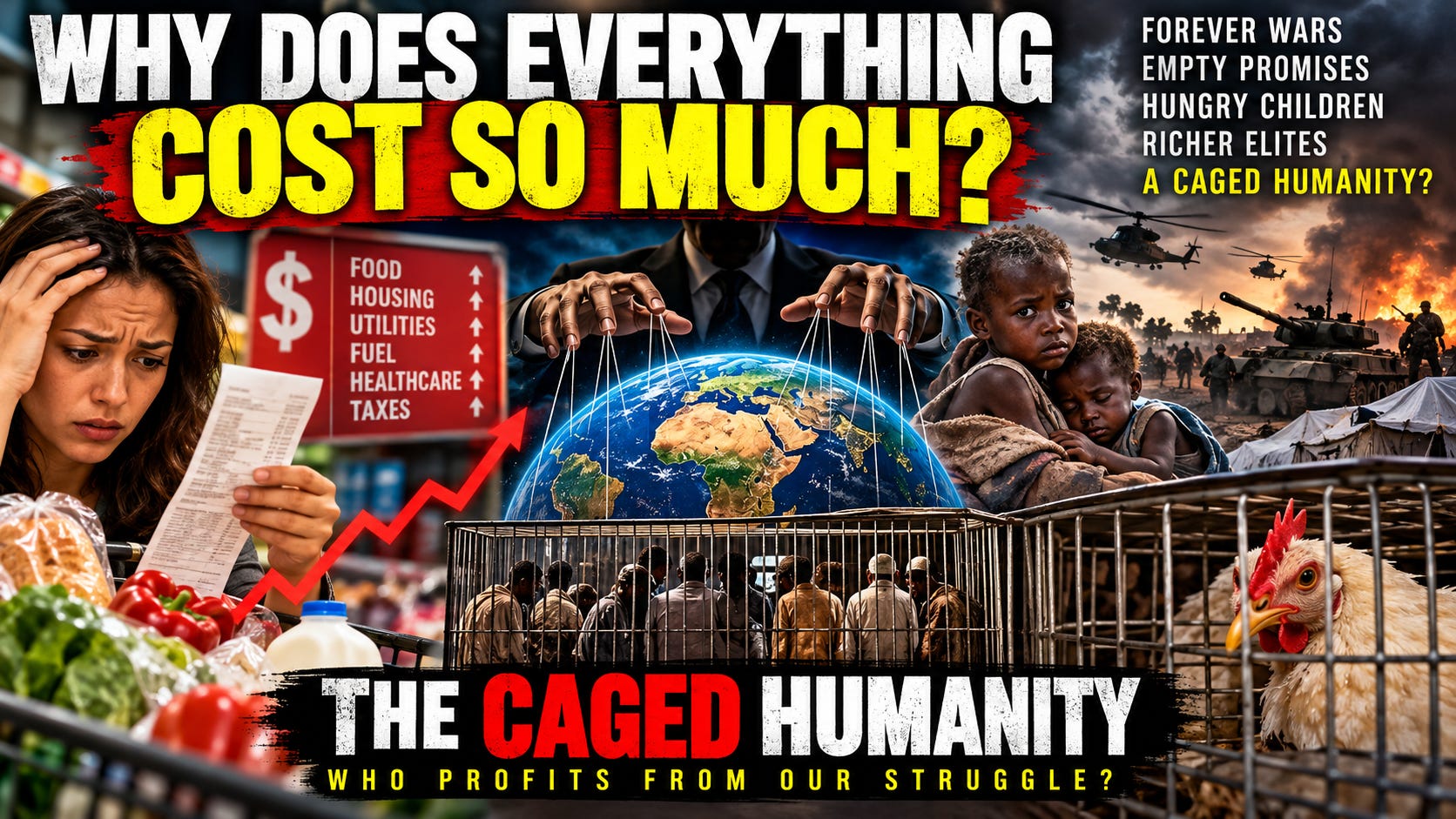
PROLOGUE — YOU WORK, YOU PAY, AND SOMEHOW YOU HAVE LESS
You walk into the supermarket to purchase the same groceries you have been buying for years. There is nothing extraordinary in your shopping cart. You have not suddenly developed expensive tastes, and you are not purchasing luxuries. Yet the amount displayed at the register leaves you wondering how ordinary food became so expensive.
You return home, where another collection of bills awaits. Electricity, water, insurance, transportation, housing, healthcare, and taxes each demand another portion of your income. Perhaps your earnings have increased, but your expenses seem determined to remain one step ahead.
You work, you budget, you sacrifice, and you make adjustments. Somehow, despite all that effort, financial independence appears farther away rather than closer.
Now consider something remarkable. Humanity has never possessed more advanced tools for producing the necessities of life. Machines perform work that once required thousands of laborers. Agricultural equipment produces enormous harvests. Computers coordinate global transportation. Automation increases manufacturing efficiency, while artificial intelligence promises even greater productivity.
Yet the fundamental question facing millions of households remains surprisingly primitive: Can I afford to live?
How can a civilization become increasingly productive while so many ordinary people feel increasingly financially trapped?
We are offered explanations for rising prices, but Red Blood Journal proposes beginning somewhere else. Instead of accepting the explanation before examining the transaction, we ask who receives the additional money, who determines the price, and who benefits when essential necessities become more expensive.
The answer may lead beyond the supermarket, beyond individual corporations, and into the financial structures governing modern society.
And perhaps it will lead to a question even more disturbing than the rising cost of groceries.
What if the greatest prison of the modern world is one that does not require bars, guards, or locked doors?
I. THE PRICE OF BEING ALIVE
Before a person can pursue happiness, education, creativity, business ownership, or meaningful personal development, certain fundamental needs must be satisfied. Food is necessary. Water is necessary. Shelter provides protection. Energy powers modern life. Transportation often makes employment possible, while healthcare protects physical well-being.
These are not extravagant desires. They are the basic requirements of participating in modern civilization.
Yet access to almost every one of them depends upon recurring financial payments.
Consider the household that manages to pay its monthly expenses but accumulates little savings. The family may appear financially stable because it remains current on its obligations, but one medical emergency, employment interruption, major repair, or unexpected expense could destroy that fragile balance.
The household is surviving without necessarily achieving independence.
When essential expenses increase, the consequences extend beyond money. A worker may remain in an abusive job because losing income would endanger the household. A parent may abandon plans for further education. A small-business owner may close a promising operation because operating costs and financing have become unmanageable.
The individual still possesses legal rights and personal choices, but exercising those choices becomes increasingly difficult.
When the cost of living consumes nearly everything a person earns, how much meaningful freedom does that person possess?
This is where our investigation begins.
II. FOLLOW THE MONEY — WHERE DOES THE PRICE INCREASE BEGIN?
Imagine purchasing a product for ten dollars several years ago and finding that the same product now costs fifteen dollars. The customer pays five dollars more, yet the product may appear virtually unchanged.
Where did those five additional dollars go?
The retailer might explain that its suppliers increased prices. The suppliers might point toward manufacturers, transportation providers, energy companies, agricultural producers, or financing expenses. Each explanation leads to another company, another contract, another financial transaction, and another group of decision-makers.
Red Blood Journal proposes tracing that money backward.
Who initiated the first consequential price increase? Which institutions passed it forward? Who increased prices beyond their additional expenses? Which businesses experienced expanded margins, and who ultimately received those additional earnings?
There is documented reason to examine these questions. In March 2024, the United States Federal Trade Commission reported that some grocery businesses appeared to use increased costs as an opportunity to raise prices further and increase profits. The agency also identified competitive advantages gained by large businesses during supply-chain disruptions.
The FTC’s findings do not establish a worldwide system of coordinated pricing, but they demonstrate why examining business conduct and profit margins is important.
The question is not whether every price increase is fraudulent. It is whether identifiable participants exploit their control over goods that people cannot realistically live without.
And if those patterns repeat across industries, do they reveal independent commercial decisions, shared financial incentives, or actual coordination?
The answer requires following the money until the evidence identifies the relevant decision-makers.
III. WHEN NECESSITIES BECOME INSTRUMENTS OF POWER
A company selling luxury goods must compete for money that consumers can choose to spend elsewhere. Essential goods operate under different conditions.
A family may postpone buying a new television, but it cannot postpone eating indefinitely. People may decide against an expensive vacation, but they cannot simply decide that shelter, electricity, and water are unnecessary.
This difference provides institutions controlling essential goods with a particularly important form of economic leverage.
The more indispensable a product becomes, the more difficult it is for the consumer to refuse unfavorable terms. When competition is limited, alternatives are unavailable, or ownership is concentrated, that leverage can become especially significant.
Now consider a society in which the same household must repeatedly purchase food, housing, transportation, electricity, insurance, and healthcare while also making payments on debt. Each obligation may be governed by a different company or institution, but together they can consume most of the household’s financial resources.
Several institutions pursuing their own financial interests can produce a collective outcome in which ordinary people have diminishing room to make independent choices.
This raises the central economic question: Does the system increasingly reward those who make survival possible, or those who control access to survival?
There is a difference between producing something valuable and possessing enough market power to demand increasingly unfavorable terms from those who need it.
A meaningful investigation must identify that difference through financial evidence.
IV. THE WORLD OF OWNERS AND THE WORLD OF PAYERS
Modern economic life contains two overlapping experiences. One is the experience of receiving recurring income from ownership of assets, businesses, property, financial instruments, or contractual rights. The other is the experience of using earned income to pay for access to those assets and services.
Many people participate in both categories through retirement savings, homeownership, employment, or business interests. The distinction is therefore not a simple division between wealthy and poor individuals.
Nevertheless, ownership determines who receives particular streams of economic benefits.
A tenant pays rent to a property owner. A borrower pays interest to a creditor. A customer purchases electricity from a utility. A consumer pays a retailer whose revenues support suppliers, employees, lenders, property obligations, and investors.
These transactions can serve legitimate economic purposes. But their terms also determine how much of society’s income flows toward those who own essential assets.
If the cost of necessities consistently rises faster than household earning power, financial independence becomes more difficult for those possessing few assets.
This makes ownership an indispensable part of the investigation.
Who controls essential productive assets? Who benefits from recurring payments? How concentrated are the industries providing necessities, and how effectively can consumers choose alternatives?
These are not questions about whether wealth itself is immoral. They are questions about whether economic power is being used to preserve opportunity or to extract increasingly greater payments from people with little bargaining power.
V. THE FOREVER-WAR ECONOMY
Now consider another enormous category of economic activity: warfare and military expenditure.
Governments around the world spend extraordinary amounts maintaining armed forces, developing weapons, purchasing equipment, and preparing for or responding to conflict.
According to the Stockholm International Peace Research Institute, global military expenditure reached approximately $2.887 trillion in 2025, marking the eleventh consecutive year of worldwide increases.
The international defense economy includes manufacturers, contractors, logistics providers, financial institutions, research organizations, and government agencies. These organizations provide goods and services under commercial and public procurement arrangements.
Military expenditure has different purposes, including deterrence, territorial defense, and active operations. Not every military contract is associated with an ongoing war.
But prolonged conflicts can create substantial demand for weapons, ammunition, replacement equipment, transportation, and other military services. Companies may earn revenues through that demand while civilian populations suffer the destruction of homes, infrastructure, businesses, and livelihoods.
The existence of financial beneficiaries does not prove that those beneficiaries caused a war or deliberately prolonged it.
Yet their economic incentives deserve examination.
When prolonged conflict produces recurring revenue for certain institutions, what incentives do those institutions possess concerning the continuation or resolution of that conflict?
This question should lead us toward procurement contracts, lobbying disclosures, ownership records, financial statements, and the decisions of public officials.
Red Blood Journal does not propose that every war is secretly manufactured. We propose investigating whether specific interests sometimes influence, exploit, or prolong conflicts for financial or political benefit.
A world that repeatedly finances destruction while struggling to support human survival deserves scrutiny.
VI. THE PEOPLE THE WORLD HAS LEARNED TO LIVE WITHOUT SEEING
Now travel in your imagination from the supermarket checkout to a family in a conflict-affected region of Africa.
For that family, the question may not be whether groceries have become more expensive. It may be whether sufficient food is available at all.
In Sudan, warfare has displaced families, disrupted agriculture, damaged infrastructure, and contributed to severe hunger. An October 2026 international food-security alert warned of growing famine risks in parts of Darfur and Kordofan.
In the Democratic Republic of the Congo, the World Food Programme reports that approximately 26.5 million people face acute food insecurity and 7.8 million people are internally displaced.
Africa is not a single economic or social condition. The continent contains diverse nations, cities, communities, industries, cultures, and achievements. The suffering described here concerns specific conflict-affected populations, not all African people.
But the human tragedy is real.
Children need food, clean water, shelter, clothing, medical treatment, and opportunities to learn. Families need physical security and the ability to build a future without violence.
International institutions have documented these needs repeatedly. Humanitarian organizations have appealed for resources, governments have issued statements, and relief programs have attempted to reach affected communities.
Yet many needs remain unmet.
The United Nations has institutional and financial limitations; it cannot unilaterally dictate national budgets or end every conflict. Nevertheless, the persistence of severe deprivation raises legitimate questions about the priorities of governments, financial institutions, armed actors, and international organizations.
If the international system can continue operating while millions endure profound deprivation, what protects other populations from gradually experiencing increasing forms of economic insecurity?
This is not an allegation that African populations represent a uniformly impoverished future. It is a question about the normalization of preventable human suffering.
A civilization capable of financing sophisticated military systems while failing to ensure adequate humanitarian protection must examine how its resources and authority are distributed.
VII. WHY NOT BRING EVERYONE DOWN INSTEAD OF LIFTING EVERYONE UP?
Here we arrive at the most controversial possibility in this report.
For generations, humanity has possessed expanding productive capabilities. Yet extreme deprivation remains a reality for vulnerable populations, and economic insecurity continues to affect people in comparatively prosperous societies.
What if some powerful interests find financial dependency more useful than widespread economic independence?
Consider the difference between a person who possesses enough savings, property, and reliable income to refuse unfavorable arrangements and someone who must accept nearly any opportunity to meet immediate financial obligations.
The financially independent person has more room to negotiate, relocate, establish a business, challenge exploitation, or walk away. The financially desperate person may have far fewer practical alternatives.
A system that continually consumes people’s income through essential payments may therefore create forms of dependence advantageous to institutions possessing substantial financial power.
Red Blood Journal’s investigative hypothesis is that particular interests may knowingly preserve or exploit such dependence and that some forms of economic pressure may be deliberately coordinated.
The hypothesis becomes more serious when considered alongside repeated crises, wartime spending, concentrated ownership, and the documented failure to protect vulnerable populations.
But the existence of those conditions does not establish one unified worldwide plan to impoverish humanity.
To prove deliberate coordination, investigators must identify specific participants, decisions, communications, financial arrangements, and evidence of shared intent.
We may instead discover separate institutions benefiting from similar economic conditions without working together under a central authority.
Both possibilities deserve investigation.
The question is whether powerful interests seek a world in which more people become independent—or whether some benefit from a world in which more people remain dependent.
VIII. THE CAGE WITHOUT BARS
Return to the ordinary person struggling to pay the bills.
They wake each morning, travel to work, exchange hours of their life for income, and spend that income maintaining access to shelter, transportation, food, energy, healthcare, and other necessities.
At the end of the month, relatively little may remain. The person works, pays, and begins again.
Now imagine a chicken raised inside an industrial cage.
The animal receives food and water sufficient to sustain its productive function. Its environment is managed, its movement is restricted, and its economic value is determined by those operating the system.
The cage exists to serve the interests of the operator, not the freedom of the animal.
The comparison with humanity is metaphorical. Modern financial insecurity is not identical to legal slavery, physical captivity, or the historical ownership of human beings.
But the image raises a disturbing question.
Could humanity gradually enter a system in which people are permitted to work, consume, and survive while genuine economic independence becomes increasingly difficult to achieve?
The bars would not be visible. They would take the form of recurring payments, limited alternatives, debt obligations, and the constant fear of losing the essentials required to live.
No guard would necessarily be required at the door.
A person could be free to leave an employer, yet unable to afford losing the income. Free to move, yet unable to afford housing elsewhere. Free to reject a loan, yet unable to meet immediate expenses without borrowing.
The most effective cage may be one that people do not recognize because its restrictions have become ordinary features of life.
That is the possibility we must examine.
IX. THE MIND THAT ACCEPTS ENSLAVEMENT
There is a deeper moral dimension to the metaphor.
A mind comfortable enslaving another human being has already accepted that another person’s freedom can be sacrificed for personal benefit.
Once that moral boundary is crossed, what prevents the same mentality from being applied on a greater scale?
History contains documented systems in which human exploitation was justified through economic interests, political authority, social hierarchies, and claims of necessity.
The capacity to rationalize suffering does not disappear merely because a society develops advanced technology or institutions.
A person who regards another human being primarily as a source of labor, revenue, or control may gradually become indifferent to the consequences of that person’s dependency.
This does not mean every wealthy individual, business owner, or government official possesses such a mentality. Nor does it mean that every instance of economic hardship results from someone intending harm.
The more important question is whether institutions can reward behavior that treats human dependence as an economic opportunity while failing to hold decision-makers accountable for the human consequences.
If an institution repeatedly benefits when people possess fewer alternatives, what incentives encourage it to expand those alternatives?
And if a powerful individual becomes comfortable exploiting the dependency of one group, what ethical boundary prevents that person from attempting to extend similar control to others?
The answer cannot be established simply by assuming what people think.
It must be investigated through their actions, decisions, financial relationships, and treatment of those affected by their power.
X. WHEN THE CAGE BECOMES NORMAL
A system of dependency becomes particularly difficult to challenge when its conditions are accepted as inevitable.
People begin describing permanent indebtedness as ordinary life. Housing insecurity becomes something families expect. Rising essential expenses are treated as unavoidable, while financial independence becomes a dream deferred to some distant future.
The individual facing these conditions may be responsible, hardworking, and resourceful. The problem is not necessarily a failure of personal discipline.
The question is whether the broader economic environment provides realistic opportunities to accumulate security.
When people struggle continuously to meet basic obligations, they may have less time and energy to examine the institutions affecting their financial lives.
A household worried about next month’s rent may have limited capacity to investigate corporate ownership, political lobbying, defense procurement, or international resource contracts.
Financial exhaustion can therefore have consequences beyond the household budget.
It may reduce economic mobility, civic participation, and the ability to challenge unfavorable arrangements.
That does not prove anyone deliberately engineered the exhaustion.
But if identifiable institutions benefit from continued dependency, it is legitimate to ask whether they resist policies or practices that would increase people’s independence.
The investigation should examine actual decisions rather than assume intention from outcomes alone.
XI. WHEN WAR BECOMES THE DISTRACTION
International conflict can dominate public attention for months or years.
Governments debate threats, announce military assistance, impose economic restrictions, and justify emergency expenditures. News organizations cover battlefield developments, diplomatic negotiations, and geopolitical tensions.
These matters may be genuinely important.
Yet during prolonged international emergencies, the financial circumstances of ordinary households do not disappear.
Rent remains due. Food must still be purchased. Debt continues accumulating interest. Utility bills arrive regardless of the latest geopolitical developments.
Wars can also affect commodity markets, transportation, production, government spending, and household costs.
Red Blood Journal proposes investigating whether particular interests exploit the prominence of international conflicts to divert attention from financial arrangements benefiting them.
Who gains from increased procurement? Who benefits from disruptions in certain commodity markets? Which corporations expand revenues or acquire assets during periods of instability? Who influences the political decisions governing continued expenditure?
These questions require evidence.
War-related financial gains do not automatically establish that wars were created as distractions. But documented efforts to mislead the public, manipulate procurement, or influence policy for private advantage would be highly relevant.
We should not allow a humanitarian tragedy to become merely an accounting exercise.
The people killed, displaced, or impoverished by war are human beings, not instruments for proving a financial theory.
Their suffering is the reason these questions matter.
XII. WHAT IF THE ENTIRE WORLD BECOMES THE CAGE?
Now connect the elements of the investigation.
The cost of essentials consumes household income. Debt obligations create continuing claims against future earnings. Concentrated ownership can increase the bargaining power of those controlling important resources. International conflicts generate enormous financial expenditure while humanitarian crises reveal the persistence of preventable suffering.
Together, these conditions raise a question about the future of human independence.
What happens if increasing productivity does not translate into improved security for the majority of people?
What happens if access to the necessities of life becomes increasingly dependent upon institutions whose financial interests are strengthened by recurring payments and limited alternatives?
Could the cumulative result resemble an economic cage that extends far beyond any single country or industry?
This is the central Red Blood Journal hypothesis.
We are investigating whether powerful interests deliberately exploit or preserve widespread financial dependency, and whether certain decisions are coordinated to maintain that advantage.
We are not presenting universal coordination as an established fact.
We may discover misconduct within particular sectors, institutional incentives operating independently, political decisions that reinforce existing financial power, or evidence contradicting the broader theory.
But we will not dismiss the possibility of deliberate collaboration simply because the subject is described as a conspiracy.
The existence of organized exploitation is historically documented. The existence of any particular contemporary conspiracy must still be demonstrated.
Our obligation is to identify specific participants, mechanisms, transactions, and consequences.
If an economic cage exists, the investigation must determine who benefits from maintaining it and who possesses the power to open its doors.
XIII. THE TEST OF OUR OWN INVESTIGATION
Red Blood Journal does not ask readers to abandon one unquestioned authority merely to accept another.
Our working hypothesis is that financial insecurity may be deliberately exploited, and that interconnected interests in essential goods, finance, and warfare may benefit when populations become increasingly dependent.
We may be wrong about the existence of an overarching agenda.
Some relationships may prove coincidental. Some hardships may involve identifiable misconduct. Others may emerge from institutions pursuing independent financial objectives.
We must be willing to examine evidence that challenges our conclusions.
But skepticism must operate in both directions.
Official explanations should not be accepted solely because they come from respected institutions. Alternative explanations should not be accepted solely because they challenge those institutions.
We must investigate what organizations actually do, how money moves, who makes decisions, and who receives measurable benefits.
Readers are encouraged to examine financial statements, public contracts, ownership disclosures, regulatory findings, humanitarian reports, and the limitations of our own arguments.
The objective is not to create fear.
It is to encourage informed independence.
🩸 The Red Blood Perspective
The rising cost of living creates more than financial pressure. It can restrict the practical freedom of individuals who must devote increasing portions of their resources to basic survival.
The businesses and institutions controlling essential goods, property, credit, energy, and infrastructure occupy important positions within this system.
Some possess substantial pricing power. Others benefit from recurring financial obligations or policies influencing competition and access.
The international defense economy adds another category of financial interests, while severe humanitarian crises demonstrate that the global system continues operating even when fundamental human needs remain unmet.
The existence of these arrangements does not prove that one hidden authority controls the cost of living across the world.
It does justify investigating whether identifiable interests knowingly preserve or exploit economic dependency.
Our questions remain straightforward.
Who establishes the financial terms of survival? Who receives the additional money when those terms become more expensive? Which institutions benefit when people possess fewer alternatives? Who influences the political decisions that preserve existing arrangements?
And where evidence reveals deliberate coordination or misconduct, who should be held accountable?
The central danger is not merely that people may become poorer.
It is that economic pressure may gradually reduce their ability to exercise meaningful freedom.
The question is not simply who built the cage. It is who profits from keeping people inside it, and who has the power to open the door.
🌊❤️✨ The Ocean of Love and Positivity Perspective
The Cage Is Material, but the Prison Begins in the Mind
Red Blood Journal approaches the human experience from a perspective that extends beyond economics, governments, religious institutions, and the physical world. We see ourselves as spiritual beings having a human experience, temporarily occupying material bodies while participating in the greater school of life.
From this perspective, the deepest human struggle is not between rich and poor, left and right, East and West, or one religion and another. It is the struggle between the material desires that encourage possession, domination, fear, and separation, and the spiritual awareness that recognizes love, compassion, freedom, and our shared existence.
The mind that becomes comfortable enslaving another human being has allowed material desire to overcome spiritual awareness. Once another person’s suffering becomes acceptable in exchange for financial gain or political advantage, the individual has begun treating human life as a commodity rather than recognizing it as an expression of the same greater existence we all share.
This is where the philosophy of the Ocean of Love and Positivity enters the investigation.
We Are Waves of the Same Ocean
Imagine humanity as an ocean, with every human being appearing as an individual wave. Each wave possesses its own temporary shape, experiences, memories, struggles, and accomplishments. Yet no wave exists independently of the ocean from which it rises.
The wealthy individual, the impoverished child, the political leader, the factory worker, the soldier, and the refugee may appear separated by nationality, religion, financial circumstances, and social position. But beneath those temporary distinctions, Red Blood Journal sees a deeper spiritual connection.
If we are waves of the same ocean, exploiting another human being is not a demonstration of superiority. It is a failure to recognize our shared existence.
The person who builds an economic cage around others may believe that wealth and authority place them above the people they control. Yet from our spiritual perspective, that person may be more deeply imprisoned than those they attempt to dominate, because their own desires have become their master.
A person controlled by greed cannot be truly free, regardless of how much money or power they possess.
The cage therefore has two dimensions. One is the material cage imposed through economic dependence. The other is the invisible cage created by the desire to possess and control.
The second may be the more dangerous because it motivates the construction of the first.
Life Is a School, Not a Courtroom
Red Blood Journal views human life as a school of experience and spiritual development rather than merely a courtroom in which people are classified as winners, losers, innocent, or guilty.
Every human experience presents opportunities to recognize the consequences of our choices. Wealth tests what we do with abundance. Poverty challenges our compassion and our responsibility toward one another. Power tests whether we serve others or seek to dominate them. Suffering confronts humanity with the consequences of indifference.
This perspective does not suggest that people experiencing hunger, war, or exploitation deserve their suffering. Nor does it excuse the individuals responsible for causing harm.
It means that our responses to suffering reveal something important about our spiritual development.
When a child goes hungry while humanity possesses extraordinary productive capabilities, the question is not what lesson the hungry child deserves to learn.
The question is what lesson the rest of humanity has failed to learn.
When people can tolerate the deprivation of others while continuing to accumulate wealth and power, perhaps they have confused material success with spiritual progress.
And when institutions repeatedly sacrifice human dignity for economic advantage, we must ask whether civilization has advanced technologically while remaining spiritually immature.
The Purpose Is Awakening, Not Revenge
Red Blood Journal does not seek to replace one ruling class with another, one ideology with another, or one system of domination with a competing system of domination.
Replacing the people who control the cage accomplishes little if the mentality that created it remains unchanged.
Our objective is to encourage human beings to recognize the forces operating within themselves: the desires that invite selfishness, the fears that encourage obedience, and the divisions that make it easier to treat other people as strangers or enemies.
The ultimate transformation cannot be accomplished through hatred. Hatred merely reproduces the mentality of separation that makes exploitation possible.
Love, in this philosophy, is not passive acceptance of injustice. Compassion does not require surrendering accountability. Forgiveness does not mean allowing exploitation to continue.
Love is the recognition that another person’s dignity matters as much as our own. Positivity is the conscious decision to pursue constructive transformation rather than becoming consumed by resentment, fear, or revenge.
We can investigate corruption without hating entire populations. We can challenge financial power without condemning everyone who possesses wealth. We can question religious and political institutions without dividing humanity along religious or national lines.
The purpose is to expose harmful actions while refusing to become what we oppose.
The Real Freedom Humanity Must Discover
A person may escape financial dependence and still remain imprisoned by greed, jealousy, fear, or the endless desire to accumulate more.
Another person may possess very little yet retain extraordinary compassion, integrity, and spiritual awareness.
Neither condition excuses material deprivation or diminishes the importance of economic freedom. Food, shelter, security, and opportunities for independence are essential to a dignified human experience.
But Red Blood Journal sees material independence as only one dimension of freedom.
The greater objective is a humanity that develops sufficient spiritual awareness to recognize that no individual gains true freedom by taking freedom away from someone else.
Imagine the possibilities if technological progress were guided by this understanding. Increased productivity could reduce unnecessary hardship. Artificial intelligence could help expand knowledge and human opportunity. Scientific achievement could serve human well-being rather than becoming another instrument of domination.
Our challenge is not simply to build better economic systems. It is to develop the consciousness necessary to use those systems responsibly.
The person who has mastered material wealth but remains enslaved by the desire to control others has not completed the lesson.
The person who recognizes the humanity of others, refuses exploitation, and chooses compassion even when selfishness offers an advantage has taken a meaningful step toward spiritual freedom.
From a World of Cages to an Ocean Without Walls
The caged chicken does not understand the economic system governing its existence. Human beings, however, possess the ability to question, investigate, learn, cooperate, and transform the institutions they create.
That ability brings responsibility.
We do not need to accept a civilization in which human productivity expands while human dignity diminishes. Nor must we assume that competition, domination, and permanent conflict represent the highest possibilities of human existence.
Our spiritual perspective invites humanity to move beyond the mentality that measures success through control over others.
The Ocean of Love and Positivity does not belong to a religion, political party, nationality, or institution. It is an invitation to recognize our shared humanity and the possibility of a deeper connection beyond material existence.
We are not here merely to accumulate possessions, defeat competitors, or survive another monthly payment.
We are here, in the Red Blood Journal philosophy, to experience, learn, become aware, and develop our capacity for love.
The ultimate liberation of humanity will not occur simply when the doors of the economic cage are opened. It will occur when human beings no longer desire to build cages around one another.
That is the Red Blood Journal vision.
Not a world united under another authority, but a humanity awakened to its shared existence. Not revenge against those who exploit, but accountability accompanied by the possibility of transformation. Not the elimination of individual differences, but the recognition that beneath those differences, we remain connected.
We are spiritual beings having a human experience. We are waves of the same ocean. And no wave becomes greater by imprisoning another.
FINAL REFLECTION — ARE WE FREE, OR JUST ALLOWED TO SURVIVE?
Return one final time to the supermarket checkout.
You purchase the groceries, pay the bill, and go home. Tomorrow you will work again. Next month the payments will return. Perhaps your income will increase, or perhaps another expense will rise to consume the difference.
Humanity has developed extraordinary capabilities. We can manufacture sophisticated machines, produce enormous quantities of goods, communicate across continents, and construct technologies that previous generations could scarcely imagine.
Yet millions still struggle to obtain the necessities of survival, and millions more worry about losing the financial security they possess.
If powerful interests benefit from economic dependence, we should investigate their financial relationships and decisions. If prolonged conflicts provide commercial advantages to certain institutions, we should examine whether those interests influence the continuation of warfare. And if humanitarian suffering persists despite extraordinary global productive capacity, we should examine the political and financial arrangements preventing effective responses.
We may be wrong about the existence of a coordinated worldwide agenda, but the possibility of deliberate exploitation must remain open to investigation, just as our own assumptions must remain open to challenge.
A cage does not become freedom merely because its occupants are allowed to work, consume, and survive. Nor does the possession of material wealth guarantee freedom from greed, fear, or the desire to dominate.
The first step toward recognizing the material cage may begin with a grocery receipt. The next step begins by examining the desires and beliefs that make exploiting another human being seem acceptable.
🌊❤️✨ A Final Message to the Reader
If you have read this far and begun to recognize how materialism can blind humanity to the suffering, freedom, and dignity of others, then perhaps your eyes are already opening.
The greatest blindness is not the inability to see the world around us. It is the inability to recognize how our own desires, fears, and attachments shape what we choose to see.
If you can recognize how materialism blinds even those who believe they can see, congratulations—your eyes are opening.
And once you begin to see, the next question is not whom to blame, but what you will choose to do with that awareness.
SOURCES AND FURTHER INVESTIGATION
Stockholm International Peace Research Institute (2026) — Trends in World Military Expenditure, 2025.
https://www.sipri.org/publications/2026/sipri-fact-sheets/trends-world-military-expenditure-2025Federal Trade Commission (2024) — FTC Releases Report on Grocery Supply Chain Disruptions.
https://www.ftc.gov/news-events/news/press-releases/2024/03/ftc-releases-report-grocery-supply-chain-disruptionsWorld Health Organization / Integrated Food Security Phase Classification (2026) — Sudan Food Insecurity and Malnutrition Alert.
https://www.who.int/news/item/12-10-2026-ipc-sudan-food-insecurity-and-malnutrition-alertWorld Food Programme — Democratic Republic of the Congo Emergency.
https://www.wfp.org/emergencies/DRC-emergency
🩸🌊❤️✨ — Ocean of Love and Positivity
Blood connects us. The ocean unites us. Love guides us. Positivity illuminates our path.
RED BLOOD JOURNAL
Independent thought. Investigative questions. Human dignity.
🌍
The Economic Cage
Oct 26, 2026
The provided investigative report examines how rising living costs and recurring financial obligations trap modern households in a state of survival and dependence rather than true freedom. It questions whether powerful institutions intentionally exploit economic pressures, military conflicts, and concentrated asset ownership for financial gain while ordinary people struggle to afford basic necessities. Beyond material economics, the text introduces a spiritual perspective comparing humanity to waves in an ocean, arguing that true liberation requires overcoming the internal desires for greed and domination that build metaphorical cages. Ultimately, the sources encourage readers to question systemic financial control, demand institutional accountability, and awaken to a shared human dignity and compassion.