


🩸 🇮🇷 🔮 👁️ ♟️ 🎭 👑 ⛓️ 🌊❤️✨ — WHO IS WRITING IRAN’S NEXT CHAPTER?
Arab Prophecies, Intelligence Warnings, Mojtaba Khamenei, and the Battle to Control Iran’s Future
RED BLOOD JOURNAL | INVESTIGATIVE REPORT | OCTOBER 20, 2026
WHAT IF THE MOST IMPORTANT QUESTION IS NOT WHETHER THE ARAB PROPHETS CAN PREDICT IRAN’S FUTURE, BUT WHY THEIR PREDICTIONS ARE APPEARING AT THE SAME MOMENT THAT GOVERNMENTS, INTELLIGENCE SERVICES, AND POLITICAL FACTIONS ARE OPENLY DISCUSSING IRAN’S NEXT GOVERNMENT?
Two Arab personalities are attracting attention for their dramatic predictions about Iran. One foresees the death of Mojtaba Khamenei and another leadership change within the Islamic Republic. The other warns of betrayal by senior Iranian officials, foreign intelligence involvement, and a possible restoration of monarchy. Both speak as though Iran’s political future is approaching a decisive moment.
Their statements arrive amid genuine geopolitical developments. The United States and Israel are discussing possible renewed military operations against Iran. Russia is proposing new security arrangements in the Persian Gulf. Israel’s prime minister has reportedly issued instructions aimed at overthrowing the Iranian government. Meanwhile, questions surrounding Mojtaba Khamenei’s prolonged absence from public view remain unresolved.
But these circumstances do not establish that the predictions are true, that the speakers possess classified information, or that a predetermined political transition exists.
The deeper investigation begins when we separate the documented events from the stories constructed around them.
Red Blood Journal — Think Beyond the Script
Question the predictions. Question the governments reacting to them. Question the political movements hoping to benefit from them. And question this investigation itself. A convincing narrative is not necessarily an accurate one, especially when an entire nation’s future is at stake.
I. The Predictions: What Was Actually Claimed?
The approximately 35-minute Persian-language transcript presents two central figures: Petra, described as a Lebanese predictor, and Abu Ali al-Shaibani, described as an Iraqi-origin personality sympathetic to the Islamic Republic.
According to the transcript, Petra predicts major developments between November 2 and November 20, 2026, including severe setbacks for Iran’s ruling establishment, unrest involving the Revolutionary Guards, and the reported death of Mojtaba Khamenei. She also suggests that the broader regional confrontation may be settled before 2027 or during its opening months.
Al-Shaibani advances a different but overlapping narrative. He warns that Mojtaba Khamenei faces betrayal from individuals within his own security establishment. The transcript names Mohammad Bagher Ghalibaf, Ahmad Vahidi, and Esmail Qaani, alleging that they could cooperate with American, Israeli, or Emirati intelligence services. He associates an eventual breakdown of the Islamic Republic with the return of the Pahlavi monarchy, suggesting a timeframe around the Iranian New Year in 2027.
These are extraordinary allegations. The transcript attributes them to the speakers, but provides no authenticated intelligence documents, independently verified operational evidence, or demonstrated basis for their predictions.
Nor does the transcript establish that the two predictors developed their accounts independently. Agreement between two speakers cannot be treated as independent corroboration if they share news sources, political contacts, assumptions, or audiences.
The first important finding is therefore straightforward: the predictions are evidence that particular narratives are circulating, not evidence that the predicted events will occur.
II. What Independent Reporting Confirms
Several important developments discussed in the video can be independently supported, although some conclusions drawn from them cannot.
On February 28, 2026, Ali Khamenei was killed during American and Israeli attacks on Iran. Mojtaba Khamenei subsequently became supreme leader. Reuters reported in July that Mojtaba had not appeared publicly and that sources close to his circle described injuries from the attack. The absence of independently authenticated public appearances became a subject of wider uncertainty.
Reuters
On October 19, American Defense Secretary Pete Hegseth made an unannounced visit to Israel and met Benjamin Netanyahu at Ovda Air Base. Reuters and Axios reported that the meeting came during discussions about a possible renewal of major military operations against Iran. This verifies the existence of high-level military consultations, but does not establish that a particular assassination operation or regime-change timetable has been approved.
Reuters
Netanyahu’s reported October 19 Channel 14 remarks also represented an explicit public expression of an objective to overthrow Iran’s government. Such statements matter as declarations of policy or intent, although political instructions must still be distinguished from completed operational plans and their potential success.
Reuters Connect
Russia’s Foreign Minister Sergei Lavrov was simultaneously pursuing an updated collective-security framework for the Persian Gulf. His proposals included dialogue among regional states and international participants, while Gulf Arab governments were urging Moscow to help reduce Iranian attacks and restore shipping through the Strait of Hormuz.
Al Jazeera
These developments create a credible setting for heightened political uncertainty. They do not independently verify Petra’s or al-Shaibani’s assertions about the death of Mojtaba Khamenei, named conspirators inside the Iranian security establishment, or the restoration of monarchy.
That distinction is the foundation of this investigation.
III. The Invisible Leader: Who Governs When the Leader Cannot Be Seen?
One of the transcript’s most significant questions concerns the prolonged absence of Mojtaba Khamenei. The presenter argues that there are only two plausible explanations: either he died during the February attacks and his death has been concealed, or he remains alive but is hiding to avoid assassination.
This is a false limitation of the possibilities. A leader might be alive but severely injured, recovering, communicating through a restricted network, deliberately avoiding public exposure, or exercising only part of the authority publicly attributed to him. These possibilities are not equivalent, and none should be accepted without appropriate evidence.
Reuters reported in August that Mojtaba remained out of public view, while officials continued describing him as the country’s leader. Other reporting documented the growing influence of the Revolutionary Guards and security institutions in maintaining governmental continuity.
Reuters
An official channel attributed another written statement to Mojtaba as recently as October 19, 2026, congratulating Iran’s under-23 wrestling team. That shows continued institutional communication in his name, not independent verification of his current physical condition or personal authorship.
The question becomes more politically consequential when viewed through the mechanics of governing. A supreme leader does not personally administer every military command, financial decision, appointment, or intelligence operation. Ministries, security councils, clerical institutions, military commanders, and administrative officials continue functioning even when the head of state is absent. Authority can therefore remain institutionally recognized while operational control becomes more dispersed.
This creates an important distinction between the person who formally possesses authority and the officials who exercise it in practice. If major decisions are communicated exclusively through intermediaries, those intermediaries gain influence over the transmission, interpretation, and execution of instructions. That creates opportunities for internal competition, but does not prove that anyone has unlawfully seized power.
From an intelligence perspective, an absent leader also creates an information vacuum. Political opponents may exaggerate the absence to suggest collapse, while loyalists may emphasize continuity to prevent divisions. Foreign governments may publicly treat the leader as legitimate because they need a recognized negotiating counterpart, even while privately assessing alternative power centers.
The question worth investigating is not simply whether Mojtaba Khamenei is alive. It is which institutions actually make and enforce decisions in his name.
IV. The Named Betrayers: Intelligence Warning or Political Accusation?
The most explosive portion of the transcript concerns Abu Ali al-Shaibani’s allegations about Mohammad Bagher Ghalibaf, Ahmad Vahidi, and Esmail Qaani.
The narrative alleges that senior Iranian figures could participate in an intelligence conspiracy involving Mossad, the CIA, and Emirati intelligence. It presents their removal as a necessary security measure to protect Mojtaba Khamenei and prevent the destruction of the Islamic Republic.
No independently verifiable evidence establishing these named individuals’ participation in such a conspiracy emerged from the sources examined for this report. The allegations should therefore be understood as accusations made by al-Shaibani, not findings of this investigation.
But the political function of the accusations deserves attention.
An accusation of treason is particularly powerful inside a security-oriented political system. Even without proof, it can encourage suspicion among colleagues, justify internal investigations, damage reputations, or pressure leaders to replace officials. The accusation may also signal rivalry within the establishment, although no particular factional sponsor has been established here.
Three alternative explanations must remain open. Al-Shaibani could be relying on rumors already circulating in political circles. He could be making a speculative assessment shaped by the February assassination and the known vulnerability of Iranian security systems. Or someone could be deliberately supplying him with a narrative intended to influence perceptions of particular officials.
Each explanation requires different evidence.
To establish an intelligence connection, investigators would need something more substantial than the timing or apparent specificity of his remarks: authenticated communications, independently corroborated sources, financial relationships, documented coordination, or other verifiable links. Naming the CIA and Mossad is not proof that either organization supplied information.
There is also an internal contradiction worth noting. If the alleged conspirators were already participating in a sophisticated covert assassination plan, broadcasting their names publicly would presumably compromise that plan. This does not disprove the allegation, but it means the claim could just as readily function as an accusation, warning, publicity device, or attempt to provoke security action.
An especially important question follows: Does the prediction describe an existing conspiracy, or could the accusation itself become an instrument in an internal power struggle?
V. The February Assassination: What Can and Cannot Be Inferred
The transcript repeatedly connects Ali Khamenei’s death on February 28 to alleged internal betrayal. Its argument is that a precise strike against a heavily protected leader could not have succeeded without assistance from trusted officials within the Iranian establishment.
That conclusion goes beyond the established evidence.
Precision targeting can involve several intelligence methods: satellite observation, signals intelligence, patterns of movement, human sources, surveillance of communications, or combinations of multiple capabilities. Internal assistance is one possibility, but not the only possible explanation for an accurate military strike.
The transcript also recounts remarks attributed to Karim Safaei, described as a former member of Ali Khamenei’s security circle, and discusses an interview with Pirhossein Kolivand of the Iranian Red Crescent. The presenter interprets these accounts as evidence of warnings ignored, secrecy surrounding injuries, and unresolved inconsistencies about the events of February 28.
Those interview excerpts deserve independent authentication, particularly because the supplied transcript contains substantial speech-to-text errors and incomplete sentences. The statements may identify meaningful questions about security procedures, but they cannot establish individual complicity without corroboration.
The broader lesson is that an intelligence failure does not automatically prove treason. Political systems sometimes use allegations of betrayal after a major defeat because accepting external superiority, institutional incompetence, or command failures can threaten the legitimacy of the security establishment.
At the same time, dismissing the possibility of human intelligence penetration would be equally unwarranted. The appropriate investigation would ask what was known, who had access to sensitive information, how intelligence was collected, and which conclusions can be supported by documentary evidence.
The truth could reveal foreign operational capabilities, institutional weaknesses, internal cooperation, or a combination of factors. Precision alone cannot determine which one.
VI. The Political Timing: Why November 2026 Matters
The timing of the predictions deserves examination because it overlaps with real political calendars.
Israel is approaching its October 27 parliamentary election, while the United States will hold midterm elections on November 3. Petra’s proposed November window arrives immediately after these events. The transcript also claims that the outcome of the elections is already known to a hidden governing apparatus.
There is no substantiated evidence in the supplied material establishing that the election outcomes have been predetermined.
However, the relationship between elections and foreign policy is a legitimate analytical subject. Political leaders must consider domestic opinion, legislative constraints, economic pressure, military risk, and electoral consequences when making national-security decisions.
Reuters reported on October 14 that Netanyahu said he was not seeking another preemptive attack against Iran before Israel’s election. On October 20, Reuters also reported that Iranian officials saw value in extending negotiations through the U.S. election period, while Tehran remained concerned about renewed military action.
Reuters
These reports support the conclusion that political timing is relevant to the Iran crisis. They do not support the stronger allegation that elections are staged, predetermined, or controlled by an unidentified hidden government.
This distinction matters because predictions frequently become persuasive when they attach themselves to recognizable deadlines.
A claim such as “a major confrontation is approaching” is difficult to evaluate. Adding a specific month, election, or holiday creates the appearance of precision. But precision of language does not necessarily indicate precision of knowledge.
Petra identifies a November window; al-Shaibani points toward the period surrounding Nowruz in 2027. These dates should be recorded before the events occur so they can later be evaluated according to explicit criteria. Predictions should not be retroactively reinterpreted to fit unrelated developments.
If a predicted assassination does not occur, a general military confrontation should not automatically be counted as confirmation of the original prediction.
VII. Russia and the Persian Gulf: Who Wants a Seat at the Table?
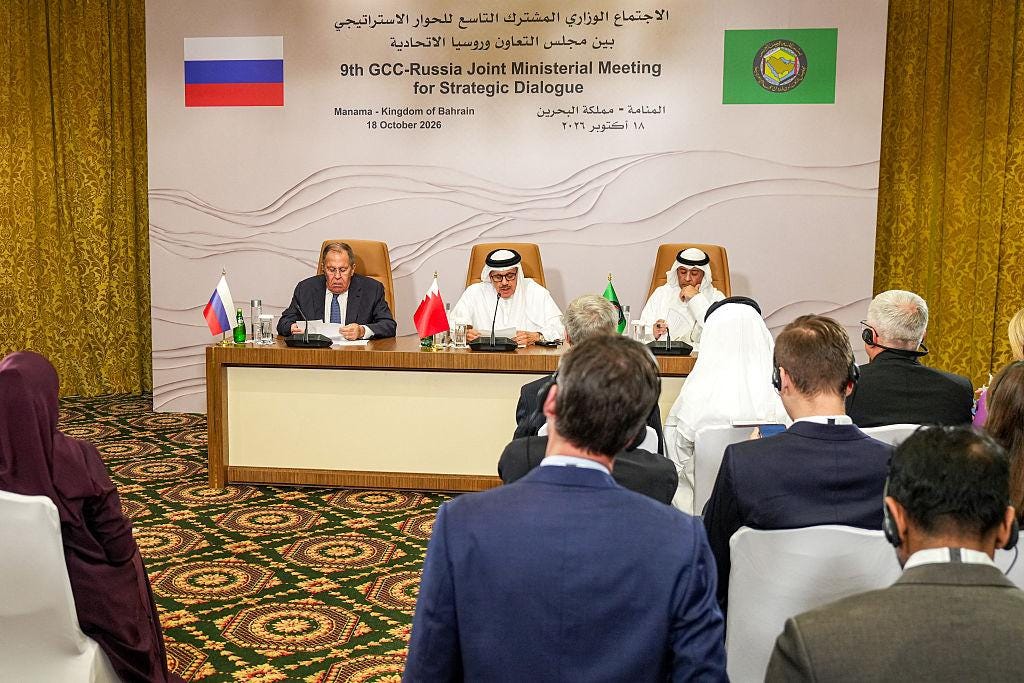
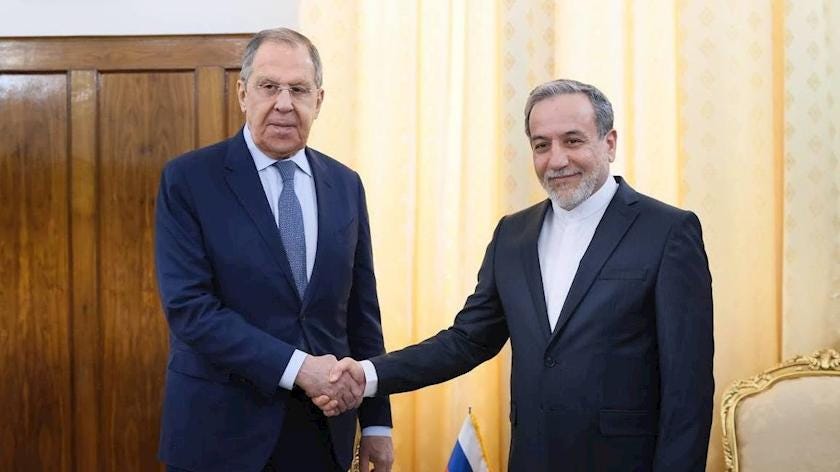
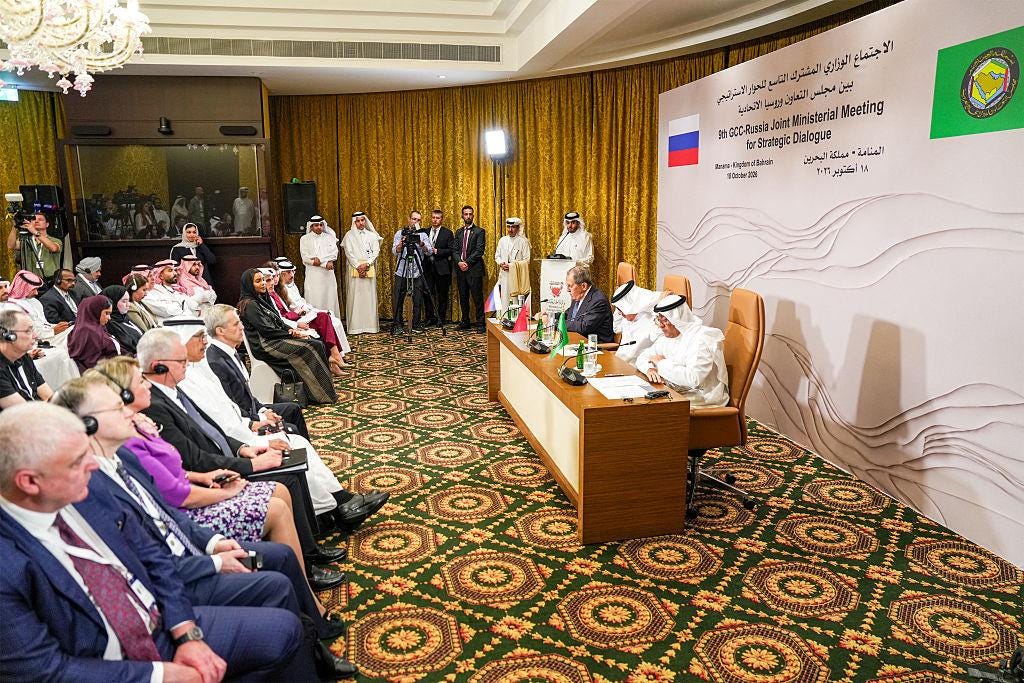
One of the transcript’s strongest opportunities for a material-interest investigation lies in its discussion of Russia.
The presenter interprets Lavrov’s regional-security proposal as an attempt to secure Russian influence over the Persian Gulf and potentially benefit from the Islamic Republic’s vulnerability. This interpretation rests on a real geopolitical development but extends beyond what the proposal itself establishes.
Lavrov’s October diplomatic activity included meetings with Gulf Cooperation Council representatives and Iranian officials. He advocated a collective-security structure that would involve regional states and potentially international organizations. He also emphasized diplomatic efforts to restore maritime trade and reduce the risk of full-scale war.
Russia has several identifiable interests in the region. It benefits from diplomatic relevance, energy-market relationships, strategic partnerships, arms and technology cooperation, and opportunities to influence arrangements affecting Western military power. Analysts have also observed that restrictions on Iranian oil exports can provide Russia with commercial advantages in certain markets.
Al Jazeera
Yet claiming a role in regional-security negotiations is not equivalent to claiming Iranian sovereignty over the Strait of Hormuz. The transcript’s suggestion that Moscow is seeking a territorial or maritime share comparable to historical concessions therefore requires evidence that has not been established.
The more productive investigation concerns the negotiations themselves. Who will control shipping arrangements? Which states will participate in enforcement? Who will collect fees, guarantee passage, provide military protection, and establish rules for energy exports? What concessions might governments offer to obtain sanctions relief or security guarantees?
These are measurable questions concerning power and money.
Iran’s government may seek economic survival and relief from military pressure. Russia may seek diplomatic and strategic influence. Gulf states may prioritize the safety of their populations, infrastructure, and maritime trade. Washington may seek security guarantees and restrictions on Iranian military capabilities. Israel may seek to reduce threats from Iran and Iran-aligned armed groups.
The countries’ interests can overlap without becoming identical.
An investigative report should therefore follow the emerging agreements, financial transactions, military deployments, and legal commitments rather than assume a single hidden mastermind controls every actor.
VIII. The Return of the Pahlavi Monarchy: Prediction or Political Narrative?
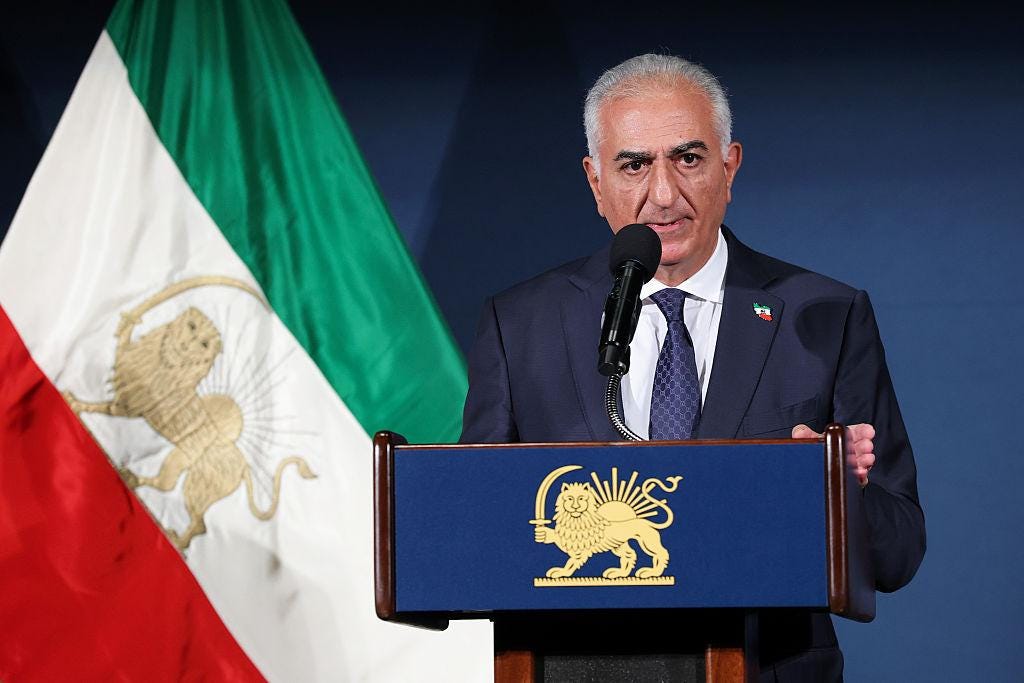
Reza Pahlavi
Iranian opposition figure and son of Mohammad Reza Shah Pahlavi
One of the transcript’s principal claims is that Iran’s next political chapter will involve a return to the Pahlavi monarchy. That possibility is presented as a prophecy rather than an outcome supported by an established political process.
This is a particularly consequential part of the narrative because it shifts from predicting the fate of a leader to prescribing the apparent destination of an entire country.
Reza Pahlavi is an established opposition figure who advocates an end to the Islamic Republic. In a July 2026 interview with Reuters, he described his objective as facilitating a transition to secular democracy and emphasized Iranian self-determination rather than claiming a guaranteed personal entitlement to govern.
Reuters
That position is not equivalent to evidence that Iran will restore a monarchy.
The Iranian opposition encompasses monarchists, republicans, advocates of parliamentary democracy, constitutional reformers, and other political currents. The transcript supplies no credible nationwide polling or constitutional process demonstrating which arrangement Iranian citizens would choose under conditions permitting free political participation.
This distinction becomes especially important when foreign governments discuss changing another country’s political leadership.
Removing the Islamic Republic, restoring the Pahlavi dynasty, establishing a constitutional monarchy, and creating a democratic republic are four different propositions. Support for one does not logically establish support for the others.
The first concerns the future of the existing government. The second concerns a historical ruling family. The third concerns an institutional model in which a monarch’s powers would be constitutionally defined. The fourth concerns a republic in which government authority does not depend on hereditary succession.
A monarchy could have strong constitutional restraints and elected institutions, while a republic could be authoritarian. The decisive questions concern sovereignty, civil liberties, accountable government, independent courts, and genuine public consent—not merely the title carried by the head of state.
When a prophecy announces that monarchy will return, it may also influence perceptions of what political futures are possible. Audiences repeatedly hearing that an outcome is inevitable may begin treating it as an accomplished decision, even though no such decision has been made.
That is an observable mechanism of narrative influence. It does not establish that the predictions are being directed by the Pahlavi family or any intelligence agency.
The essential question is whether Iranian citizens will have the freedom to determine their own political system, or whether a new ruling arrangement could emerge through negotiations among powerful domestic and foreign actors without meaningful public participation.
IX. Psychological Warfare: How Predictions Can Become Political Instruments
Psychological warfare does not always require forged documents, fabricated events, or secret propaganda organizations. Sometimes the most effective political message is an interpretation of genuine events presented with far greater certainty than the available evidence permits.
In the case examined here, the material combines authentic geopolitical developments with predictions of assassination, accusations of internal betrayal, suggestions of foreign intelligence penetration, and claims that a specific replacement system is approaching.
The resulting narrative has several potential effects.
1. Generate suspicion within Iran’s security establishment
Repeated allegations naming senior commanders and officials as potential collaborators with foreign intelligence services could amplify internal distrust. This effect could arise whether the allegations are true, false, or simply unverified.
2. Create expectations of imminent collapse
Predictions tied to November 2026 or Nowruz 2027 can focus political attention on specific deadlines. They may raise expectations among opponents of the government or encourage anxiety among its supporters.
3. Normalize an anticipated successor
Repeated suggestions that a Pahlavi restoration is inevitable could shape perceptions of the political transition before an accountable public decision-making process has occurred.
4. Amplify the appearance of secret knowledge
When a speaker claims access to hidden plans, intelligence conspiracies, or precisely timed events, the audience may treat uncertainty as evidence that secret information exists. This can make a narrative feel authoritative even when its underlying sources remain unknown.
5. Influence public behavior and confidence
Narratives of inevitable victory, defeat, or regime collapse can affect political expectations, individual decisions, and perceptions of institutions. Their practical impact depends on audience reach, credibility, repetition, and how other political actors respond.
The important qualification is that an effect is not proof of intent.
The predictions could influence political perceptions without being part of an organized psychological operation. To establish coordination, investigators would need evidence showing relationships among the speakers, distributors, political sponsors, and any government or intelligence institutions allegedly involved.
X. Who Benefits From the Narrative?
The strongest investigative question may not be who authored the predictions, but which political interests could benefit from their circulation.
For factions within the Islamic Republic, a betrayal narrative could offer a justification for security purges, changes in command, or heightened surveillance. For opponents of the government, predictions of imminent collapse could sustain expectations of political change. For proponents of the Pahlavi restoration, such claims could increase the visibility of monarchy as a possible successor system.
Foreign governments may also find some of these interpretations useful, depending on their objectives. Suggestions of division within Iran’s command structure could increase uncertainty among decision-makers. Public descriptions of impending military operations could influence diplomatic negotiations and deterrence calculations.
Media personalities and content distributors have another potential incentive: predictions about assassinations and dramatic political transitions attract attention because they combine fear, urgency, and the promise of exclusive knowledge.
None of these possible benefits establish sponsorship. A political actor may benefit from a message without having created, financed, requested, or even approved it.
The next level of investigation would therefore follow a more concrete chain: identify the earliest authenticated publication of each prediction, establish whether its wording changed over time, determine which accounts distributed it first, and investigate whether coordinated amplification can be demonstrated.
Only after that could the question of deliberate narrative orchestration be responsibly addressed.
XI. Were the Prophets Really Correct Before?
The transcript repeatedly claims that Petra and al-Shaibani accurately predicted previous assassinations involving Ali Khamenei, Hassan Nasrallah, and Qassem Soleimani.
This claim is central to their credibility because it attempts to establish a record of exceptional foresight.
Yet the supplied transcript does not provide an independently auditable archive of the predictions, original publication dates, complete recordings, or a comprehensive accounting of incorrect forecasts.
To establish a genuine record of predictive accuracy, several conditions would have to be met. Each prediction would need to be preserved in a form that existed before the predicted event. Its meaning would need to be sufficiently specific to distinguish success from failure. The outcome would need to match the original statement without substantial reinterpretation. Finally, unsuccessful predictions would have to be counted alongside successful ones.
This is especially important for events involving prominent figures in conflict zones. Predictions of assassination, war, or regime change can appear remarkable after an event occurs, even when the original probability of such an event was already being widely discussed.
A speaker who makes many predictions and circulates only the successful ones can develop a reputation for extraordinary accuracy without possessing any unusual forecasting ability.
For this report, searches did not establish a sufficiently complete, independently dated record to validate the transcript’s claims about either predictor’s historical accuracy.
Their alleged successes must therefore remain unverified.
XII. Fact-Check: The Major Claims
The following assessment distinguishes documented developments from claims that lack independent corroboration. It does not attempt to score the political figures or predict who will govern Iran.
Claim in the transcript
Evidentiary assessment
Ali Khamenei was killed on February 28, 2026.
Confirmed by independent reporting.
Mojtaba Khamenei has remained largely absent from public view.
Confirmed; later statements attributed to him do not independently resolve his condition.
Mojtaba Khamenei is already dead.
Not established.
Petra predicted his imminent assassination.
The transcript attributes this statement to Petra; the original recording and chronology were not independently authenticated.
Ghalibaf, Vahidi, and Qaani are plotting with foreign intelligence services.
Serious allegation without demonstrated independent corroboration.
Hegseth met Netanyahu during discussions about Iran.
Confirmed by Reuters and other reporting.
Israel’s leadership has publicly advocated overthrowing Iran’s government.
Supported by October 2026 reporting.
Russia is pursuing a new Persian Gulf security framework.
Confirmed; claims of territorial ambitions require separate evidence.
Elections have already been secretly decided.
Not substantiated.
The Pahlavi monarchy will return by 2027.
Prediction, not an established political outcome.
The predictors possess intelligence-service connections.
Speculation; no such connections were demonstrated.
A coordinated psychological operation is directing these messages.
Possible investigative hypothesis, not a demonstrated fact.
The verified developments are serious enough to warrant investigation without adding certainty to the unverified claims.
XIII. What the Transcript Leaves Out
The most revealing omissions concern ordinary Iranian citizens.
The transcript devotes substantial attention to the possible death of political leaders, the maneuvering of powerful governments, accusations against military commanders, foreign intelligence services, and competing claims about the next ruling establishment. Yet comparatively little attention is given to the institutions that would protect citizens during a transition.
What happens to courts, public services, hospitals, pensions, banks, schools, water and electricity networks, and local administration if the existing government loses control? Who guarantees the safety of political prisoners, military conscripts, civil servants, and communities vulnerable to retaliation? How would competing armed factions be prevented from transforming political change into another prolonged conflict?
These questions are not secondary to regime change. They determine whether a transition improves people’s lives or simply redistributes authority among competing elites.
There is also a distinction between external military objectives and domestic political legitimacy. A foreign military campaign can damage an existing government without creating accountable replacement institutions. A political opposition movement can oppose authoritarian rule without necessarily commanding universal public support. And a familiar historical name can attract attention without resolving questions of constitutional design, civil rights, or economic reconstruction.
Iran’s future cannot be understood exclusively by identifying who might leave power. It also requires identifying which institutions, rules, and mechanisms of accountability might replace the existing arrangement.
XIV. Reading Between the Lines: The Mechanism of Manufactured Inevitability
A recurring feature of the transcript is the transformation of possibility into apparent certainty.
The first stage is a real event: military consultations, heightened geopolitical tensions, an absent leader, or a proposal for a new regional-security arrangement.
The second stage is interpretation: the event is presented as evidence that decisive change is approaching.
The third stage is prediction: a particular leader will die, an institution will collapse, or a historical dynasty will return.
The fourth stage is inevitability: the predicted outcome begins to be discussed as though it has already been agreed upon by powerful actors.
Each stage requires additional evidence. Yet a compelling media narrative can move through all four stages without explicitly demonstrating the connections.
HOW THE NARRATIVE GAINS AUTHORITY
Documented geopolitical development
Military meetings, diplomatic statements, leadership secrecy
Political interpretation
The event is presented as evidence of a larger hidden plan
Specific prediction
Assassination, betrayal, collapse, or restoration
Claim of inevitability
The future is presented as decided before events establish it
A conceptual model of narrative escalation, not evidence that any particular actor deliberately engineered it.
This mechanism works across political ideologies. Governments may announce that victory is inevitable. Opposition movements may announce that collapse is imminent. Foreign powers may describe a new regional order as unavoidable. Media personalities may frame upcoming events as secrets already revealed to them.
The shared feature is the substitution of certainty for inquiry.
The Red Blood Journal method must resist that substitution regardless of whose preferred future is being announced.
🩸 The Red Blood Perspective
The facts establish a region under serious military and political pressure. Ali Khamenei was killed in February 2026. His successor has governed without ordinary public visibility. American and Israeli officials have discussed renewed military action. Israel’s leadership has openly articulated regime-change objectives, while Russia is seeking a role in shaping regional-security arrangements.
These events are independently significant. They reveal competing strategic interests, uncertainty surrounding Iran’s leadership, and a struggle over the regional balance of power.
What they do not establish is that Petra or Abu Ali al-Shaibani possess advance knowledge of Mojtaba Khamenei’s death, that named Iranian officials are cooperating in an assassination conspiracy, or that a Pahlavi restoration has been secretly decided.
The transcript illustrates how political commentary can combine documented developments with increasingly speculative claims until the boundary between evidence and prediction becomes difficult to recognize.
One particularly important omission is the distinction between weakening a government and replacing its governing system. Foreign governments may possess significant military power, but military capacity alone does not establish democratic legitimacy or determine how a country will be governed afterward.
The material consequences deserve closer scrutiny than the personalities making the predictions. What military actions are authorized? What economic agreements are negotiated? Which institutions retain command over armed forces and public finances? Who assumes legal responsibility for decisions? What evidence exists that the citizens affected by those decisions have participated in making them?
These are questions that can be investigated through actions, documents, expenditures, appointments, and measurable outcomes.
The transcript offers enough credible geopolitical context to justify serious scrutiny. Its predictions, however, cannot replace evidence. Neither a government’s assurances nor an opposition figure’s forecasts should be accepted simply because they serve a preferred political narrative.
🌊❤️✨ The Ocean of Love and Positivity Perspective
Behind the predictions, political strategies, and rival institutions are millions of people who must continue living through the consequences.
Iranian families have experienced years of political uncertainty, economic pressure, repression, and conflict. Many have suffered separation, displacement, or the loss of loved ones. For them, the future is not merely a question of which individual occupies the highest office or which historic political title returns.
It is a question of whether daily life can become safer, more dignified, more peaceful, and more secure.
The Ocean of Love and Positivity Perspective asks us to approach that human reality without allowing justified anger to become a demand for indiscriminate revenge. Accountability for abuses matters. So do impartial investigations, fair trials, recognition of victims, restoration of rights, and measures that prevent future suffering.
But punishment should not become collective vengeance. A durable society must distinguish individual responsibility from inherited guilt, institutional affiliation, religious identity, or political disagreement.
A future Iranian political system, whatever constitutional form citizens ultimately choose, would face the work of rebuilding trust among people who disagree profoundly about their country’s history and future. No prediction can accomplish that work. No military operation can substitute for it. No prominent family or political movement can legitimately perform it on behalf of citizens without their participation.
Compassion does not require political naivety. Love does not require abandoning justice. Positivity does not mean ignoring documented wrongdoing.
They mean refusing to allow the future to be shaped exclusively by the logic of humiliation, fear, retaliation, and domination.
The greater transformation would be one in which people are no longer required to place their hopes in the death of one leader, the arrival of another, or the intervention of a foreign power.
Instead, they could participate in building institutions capable of protecting their rights regardless of who holds office.
That is a constructive vision grounded not in prophecy, but in human dignity and shared responsibility.
A Final Challenge from Red Blood Journal — Think Beyond What You Are Told
Before accepting any prediction about Iran’s future, ask who made it, when it was first published, what evidence supports it, and who benefits from its circulation. Ask whether the speaker has a documented record of accurate forecasts or whether earlier mistakes have disappeared from public memory. Ask whether a genuinely independent source corroborates the claim, or whether several voices are repeating the same unverified story.
Then apply the same scrutiny to governments, intelligence agencies, opposition movements, political commentators, and the organizations that distribute their messages.
Do not assume that an official denial disproves an accusation. Do not assume that secrecy establishes guilt. Do not assume that a foreign government is telling the truth simply because its objectives temporarily align with your hopes. And do not assume that the removal of an existing government guarantees freedom under its successor.
Most importantly, challenge Red Blood Journal itself.
Question the assumptions presented in this report. Examine the sources. Look for missing evidence and alternative explanations. Consider which facts might change the conclusions and whether the same standards of proof are being applied to everyone.
Imagination helps us recognize possibilities. Critical thinking helps us determine which possibilities deserve to be believed.
The future of Iran belongs neither to fortune-tellers nor to those who claim the authority to decide it in secret.
It is a future whose legitimacy must ultimately rest on the rights, choices, and participation of the Iranian people.
Sources and verification notes
The primary source for this investigation is the user-provided Persian-language transcript of the approximately 35-minute video, “Strange Predictions by Arab Prophets About Mojtaba Khamenei’s Fate and the Return of Monarchy to Iran.” The original recordings of the two predictors were not separately authenticated.
The following reports provided independent context:
Reuters — Mojtaba Khamenei’s absence and the Khamenei family, July 5, 2026
Reuters — Hegseth’s meeting with Netanyahu, October 19, 2026
Reuters — Netanyahu on military action before Israel’s election, October 14, 2026
Al Jazeera — Lavrov’s regional-security diplomacy, October 19, 2026
Reuters — Reza Pahlavi on Iran’s political future, July 28, 2026
Reuters — Iran, negotiations, and U.S. election timing, October 20, 2026
Research cutoff: October 20, 2026. This report distinguishes verified events, attributed allegations, and analytical hypotheses. Unverified intelligence accusations and predictions should not be republished as established facts.
🩸🌊❤️✨ — Ocean of Love and Positivity
Blood connects us. The ocean unites us. Love guides us. Positivity illuminates our path.
Red Blood Journal — Think Beyond the Script.
📰
Prophecies, Power, and Iran’s Political Future
Oct 20, 2026
The provided investigative report analyzes a Persian-language transcript featuring Arab figures who predict dramatic political shifts in Iran, including the death of Mojtaba Khamenei, internal betrayals among top military officials, and the restoration of the Pahlavi monarchy. It carefully separates these sensational, unverified prophecies from documented geopolitical events, such as high-level military consultations between the United States and Israel, Russia’s pursuit of a new Persian Gulf security framework, and Mojtaba Khamenei’s prolonged public absence following the death of Ali Khamenei. The analysis examines how such predictions function as psychological warfare or narratives of manufactured inevitability, potentially serving various political factions and foreign interests. Ultimately, the text argues that true insight requires scrutinizing sources rather than trusting prophecies, emphasizing that Iran’s future must depend on the rights, choices, and active participation of the Iranian people rather than secret plots or fortune-telling.