


🩸 ⛪ 📜 🎨 ⚖️ 👁️ 🌊❤️✨ — WHEN THE CHURCH WALLS BECAME WITNESSES
The Blood Libel: How Images of Alleged Child Sacrifice Entered European Churches, Shaped Public Belief, and Turned Accusations into Persecution
RED BLOOD JOURNAL — HISTORICAL INVESTIGATION
October 27, 2026
History | Religion | Institutional Power | Religious Art | Propaganda | Human Rights | Historical Accountability
A NOTE FROM THE AUTHOR — WHEN AN IMAGE BECOMES MORE POWERFUL THAN THE TRUTH
One of the most important lessons I have learned through years of examining history, observing human behavior, questioning institutional explanations, and reflecting on my personal experiences is that something can be physically real, historically authentic, and hundreds of years old without proving the story attached to it. A painting may survive inside a cathedral, a sculpture may remain embedded in the walls of an ancient church, and a religious tradition may be repeated for generations, yet none of these facts automatically establishes that the events portrayed actually occurred.
This distinction is especially important when institutions possessing substantial moral authority promote accusations against people who have limited power to defend themselves. The survival of an artwork establishes that someone created it and that the work acquired a place within a particular cultural or religious environment. Determining whether its subject accurately represents an event requires a separate examination of the historical record, including the original accusation, available evidence, judicial proceedings, and motives of those involved.
The investigation presented here examines European religious artworks depicting the alleged ritual murder of Christian children by Jews. Some of these images are disturbing, showing children restrained, wounded, or subjected to acts associated with blood collection. Their existence is not disputed. The historical questions concern who commissioned them, why religious institutions displayed them, what evidence supported the accusations, and how these representations influenced public attitudes toward Jewish communities.
My approach remains consistent with the Red Blood Journal perspective: examine actions before accepting explanations, identify the institutions exercising authority, and investigate who benefited and who suffered. I do not believe that questions should be dismissed because the answers may be uncomfortable for respected institutions. But neither should the presence of an emotionally powerful image be permitted to substitute for evidence, especially when the image itself was created to promote an accusation.
The central purpose of this report is to understand how institutional authority can transform an allegation into accepted public belief, even when the accusation has not been established through reliable evidence. The issue is not merely what people believed centuries ago, but how those beliefs were created, preserved, and transmitted to generations that never witnessed the original events.
The reader is invited to examine the historical evidence independently. The objective is neither to defend past religious wrongdoing nor to transfer collective blame to present-day religious communities. It is to understand how the misuse of authority can turn suspicion into persecution, and how responsible historical inquiry can prevent inherited accusations from being mistaken for truth.
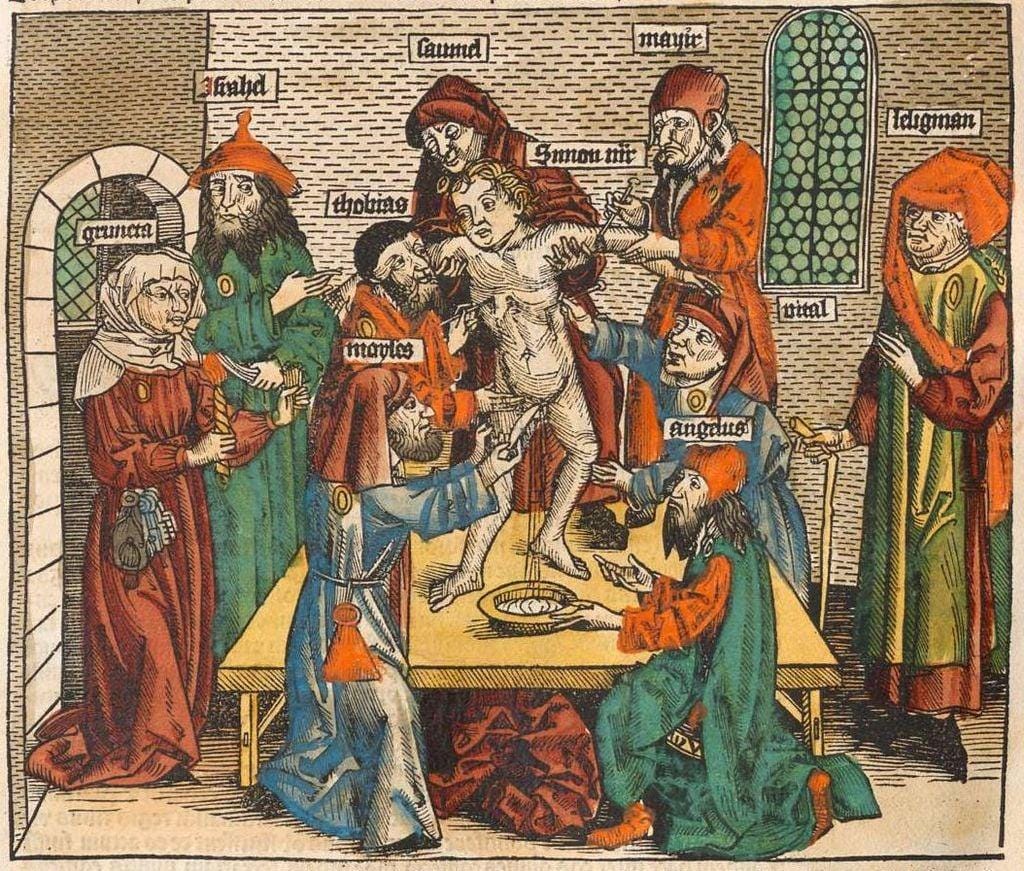
https://picryl.com/search?q=murder%20of%20simon%20of%20trent%20nuremberg%20chronicle
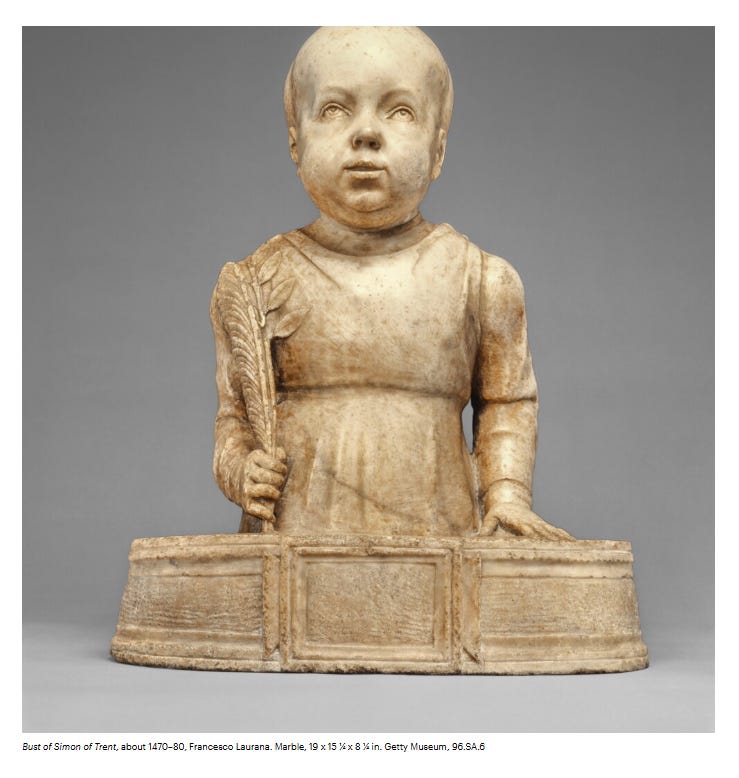
https://www.getty.edu/news/childs-portrait-sheds-light-on-a-violent-episode-in-renaissance-history
PROLOGUE — IF IT IS CARVED IN STONE, DOES THAT MAKE IT TRUE?
Imagine entering a centuries-old European cathedral and encountering an elaborate painting portraying the alleged killing of a child. The figures are carefully arranged, the scene is presented with religious symbolism, and the artwork occupies a space associated with spiritual authority. Generations of worshippers have passed before it, and its apparent antiquity may create the impression that the story it depicts was settled long ago.
A viewer unfamiliar with the historical circumstances might reasonably wonder why such a scene would be displayed in a sacred building unless the event had actually occurred. The question becomes even more powerful when the artwork includes identifiable religious clothing, symbolic objects, and details designed to suggest that the artist is reconstructing a specific historical crime.
Yet the artwork itself cannot answer the questions necessary to establish guilt. Who witnessed the supposed event? What evidence was available? Were the accused people allowed to defend themselves? Who commissioned the representation, and did that person already believe the accusation before the artwork was created?
These questions lead us into the history of the blood libel, a false allegation that Jews murdered non-Jewish people, particularly Christian children, for religious purposes. In medieval and early modern Europe, variations of this accusation became associated with prosecutions, religious commemorations, printed images, paintings, sculptures, and shrines.
The accusations were not reliable descriptions of Jewish religious practice. Nevertheless, the beliefs surrounding them became historically consequential, contributing to discrimination, torture, executions, expulsions, and persistent hostility toward Jewish communities.
What makes this subject especially revealing is that the evidence of institutional involvement is frequently much stronger than the evidence supposedly establishing the alleged crime. In certain cases, historians can identify the individual who commissioned the artwork, the writings that promoted the accusation, and the judicial proceedings that affected the accused.
The surviving church walls therefore offer an unusual form of testimony. They do not establish that the portrayed rituals occurred, but they reveal how influential institutions represented accusations as though their truth had already been determined.
I. THE BLOOD LIBEL — THE ACCUSATION AND ITS HISTORICAL ORIGINS
Blood libel refers to the false accusation that Jews kidnapped or murdered non-Jewish people, especially Christian children, and used their blood in religious rituals. Certain versions claimed that blood was collected for Passover, while others described a supposed reenactment of the crucifixion of Jesus. These allegations were incompatible with normative Jewish religious law, which prohibits consuming blood, and there is no credible historical evidence establishing the alleged practice as a Jewish religious ritual.
Hostile stories concerning Jews existed in antiquity, but the influential medieval European ritual-murder tradition developed during the twelfth century. One foundational episode occurred in Norwich, England, following the death of a boy named William in 1144. A monk named Thomas of Monmouth subsequently promoted a religious narrative accusing local Jews of responsibility for the death.
The importance of the Norwich case lies in how an allegation acquired wider religious significance. Rather than remaining an uncertain investigation into the death of a child, the story was developed into a narrative of supposed martyrdom, connecting the victim’s death with theological ideas concerning Christianity and Judaism.
Later ritual-murder allegations added further claims involving the collection and use of blood. These variations spread through religious writings, local chronicles, devotional traditions, and eventually printed images, creating a recognizable narrative that could be repeated in communities far removed from the original accusation.
Historian E. M. Rose has examined the early development of this tradition, including the political, social, and religious circumstances that allowed the Norwich allegations to gain influence. Historian Magda Teter has traced the evolution and transmission of blood-libel narratives over subsequent centuries.
Their research illustrates an important distinction: historians can establish how accusations emerged, how they were promoted, and what consequences followed without accepting the supposed ritual practice as an actual event.
II. WILLIAM OF NORWICH — WHEN AN UNSOLVED DEATH BECAME RELIGIOUS HISTORY
The death of William of Norwich became associated with an accusation against the local Jewish population during an era already marked by religious hostility. Thomas of Monmouth’s account presented the boy’s death through a narrative that gave it religious meaning, portraying William as a Christian martyr and local Jews as participants in an alleged ritual killing.
The account is historically important because it preserves the beliefs and arguments of its author. It does not independently establish that the accusations were true. The circumstances of William’s death cannot be reconstructed with the certainty claimed by the later devotional tradition.
The developing story drew upon existing theological hostility, including medieval Christian accusations concerning Jewish responsibility for the death of Jesus. Within that environment, a supposed repetition of the crucifixion could become emotionally compelling to audiences already inclined to suspect Jewish communities.
Such accusations also had consequences beyond religious belief. Communities accused of ritual murder could face hostility, restrictions, violence, and intervention by political authorities. The transformation of an uncertain death into an accepted narrative of collective religious guilt threatened people who had never been shown to have committed a crime.
The Norwich case demonstrates how an allegation may become more influential as it passes through institutions that repeat and embellish it. Once the account acquired religious significance, subsequent generations could inherit the narrative without encountering the uncertainties surrounding its creation.
The historical task is therefore not simply to determine what medieval people believed. It is to identify how those beliefs developed and how institutional authority contributed to their acceptance.
III. SANDOMIERZ CATHEDRAL — A PAINTING COMMISSIONED TO PROMOTE AN ACCUSATION
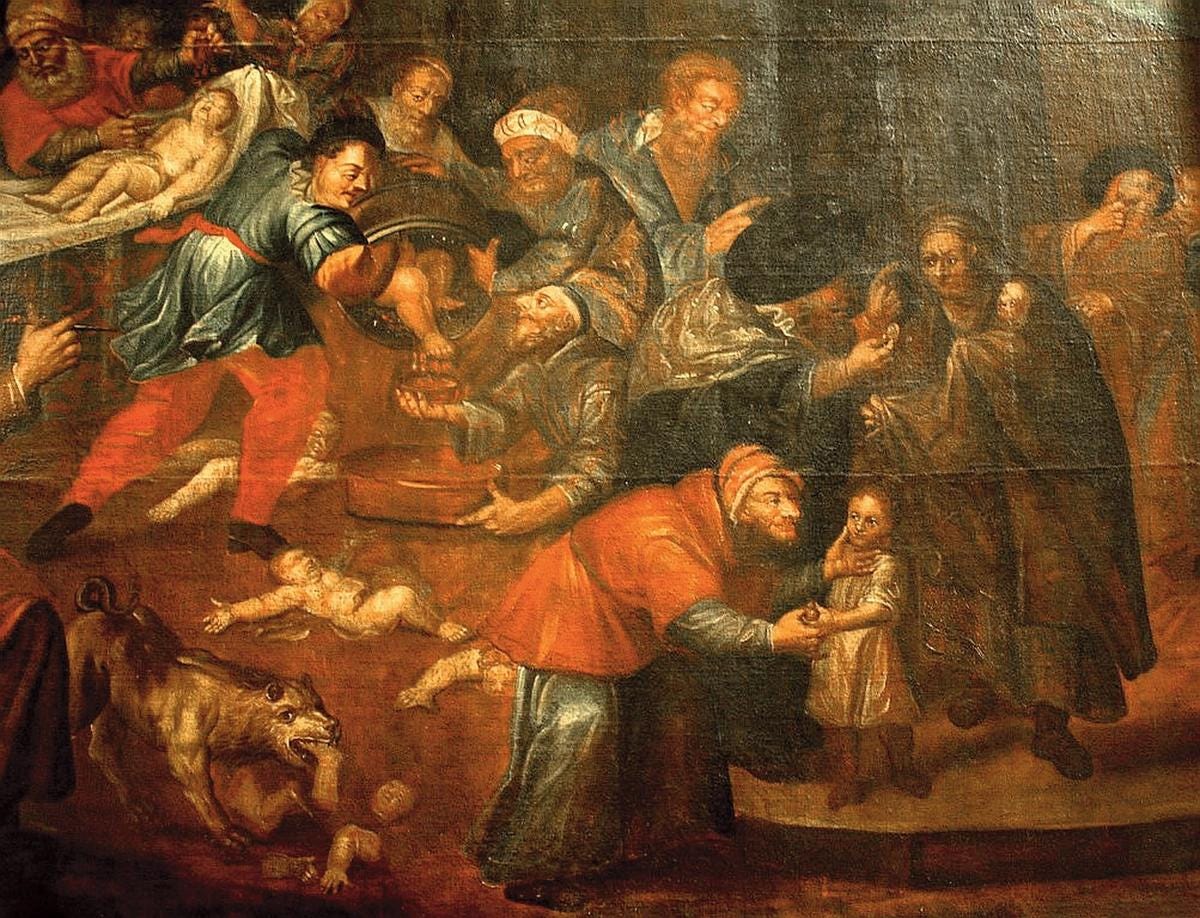
One of the most revealing surviving artifacts is a painting in the Cathedral Basilica of the Nativity of the Blessed Virgin Mary in Sandomierz, Poland. The artwork, created by Karol de Prevot and commissioned around 1710 by the Catholic priest Stefan Żuchowski, portrays Jews allegedly murdering Christian children.
Its graphic imagery includes wounded children and scenes associated with the supposed collection of blood. The disturbing presentation was not incidental. The painting communicated a narrative in which Jewish guilt was visually assumed, while the viewer was encouraged to respond with horror toward the represented perpetrators.
The most significant historical fact is that the commissioner can be identified. Żuchowski was already involved in promoting ritual-murder accusations through religious writing and judicial activity. Research by historian Anna Landau-Czajka documents his role in commissioning the painting and the surrounding controversy, while Magda Teter’s work examines the wider circulation of such allegations in Catholic Poland.
The painting was therefore not an independent visual record of a crime. It was an artwork commissioned within a setting in which the accusation was already being actively promoted. Its creator did not establish guilt by painting a dramatic reconstruction, and its placement in a cathedral did not supply the missing evidence.
This is precisely what makes Sandomierz an important investigative case. The physical artifact is authentic, the commissioner is identifiable, and the broader pattern of institutional involvement is historically documented. The alleged Jewish religious ritual, however, is not established by those facts.
The painting demonstrates how an influential individual could use visual representation to strengthen an accusation already circulating through local institutions. A person entering the cathedral might encounter the image as an apparently authoritative account of an event, without knowing that its creation had been guided by someone advocating the allegation.
IV. THE SANDOMIERZ PROCEEDINGS — WHEN PROPAGANDA AND THE LAW INTERSECTED
The Sandomierz painting cannot be understood separately from the local history of ritual-murder accusations and judicial proceedings. During the seventeenth and early eighteenth centuries, members of the town’s Jewish community faced serious allegations, including cases that led to imprisonment, harsh treatment, and executions.
Żuchowski participated in the campaign surrounding these accusations, contributing to an environment in which religious hostility, legal proceedings, and public narratives reinforced one another. Historical investigations describe how material published in support of the allegations helped shape the interpretation of events, while visual representations gave those interpretations a more permanent form.
The relationship between religious authority and judicial authority deserves particular attention. A court is supposed to establish responsibility through evidence concerning particular individuals. When proceedings become influenced by assumptions about an entire religious community, the accused may face the burden of disproving a story whose essential conclusion has already been accepted.
Coerced testimony and confessions obtained under torture further complicate the historical record. Such statements cannot be treated as reliable confirmation of a supposed ritual, especially when the proceedings themselves occurred in an environment of religious persecution.
The painting became part of a broader cultural process through which an accusation was preserved and publicly reinforced. It contributed to an image of Jewish communities that could outlive the individuals involved in the original controversies.
The significance of this case is not that an ancient painting proves the alleged crime. It is that the records reveal the relationship between a named religious authority, judicial persecution, and an artwork intended to communicate guilt.
V. SIMON OF TRENT — THE TRANSFORMATION OF AN ACCUSATION INTO A CULT
In 1475, the death of a young boy named Simon in Trent, northern Italy, resulted in accusations against members of the city’s Jewish community. Jewish residents were arrested, interrogated, and tortured, and several were executed following proceedings shaped by the claim that Simon had been murdered for religious purposes.
The allegations became associated with a devotional tradition portraying Simon as a martyr. Paintings, printed images, sculpture, and religious writings represented the supposed circumstances of his death, allowing the story to circulate beyond the immediate city.
This case occupies an important place in the history of visual communication because the spread of printing made it possible to reproduce religious narratives in large numbers. Images presenting the allegation could reach audiences who possessed no independent knowledge of the original proceedings.
The circulation of these works helped create a recognizable visual tradition. A child depicted with wounds, surrounded by alleged perpetrators, or placed within scenes of religious martyrdom could communicate an accusation without requiring a detailed written explanation.
The emotional force of the imagery contributed to the survival of the narrative. Repeated representations made the story familiar, while the institutional setting in which it circulated provided an appearance of legitimacy.
Scholarly research, including studies of Renaissance devotional imagery, has examined the role of visual representation in promoting the cult surrounding Simon. The Catholic Church later discontinued the authorized cult in 1965, reflecting a significant reassessment of the historical accusation.
The case illustrates how an unsupported allegation could acquire centuries of religious and cultural influence, while the people accused suffered consequences that could not be reversed.
VI. LITTLE SAINT HUGH OF LINCOLN — WHEN AN ACCUSATION BECAME A SHRINE
In 1255, the death of a child named Hugh in Lincoln, England, led to accusations that Jews had murdered him for ritual purposes. The case involved royal intervention and severe consequences for members of the Jewish community, including the execution of an accused man.
Hugh subsequently became associated with a devotional tradition, and a shrine was established within Lincoln Cathedral. The supposed martyrdom entered local historical memory through religious commemoration, storytelling, and later literary references.
The significance of the shrine lies in the relationship between religious space and public belief. A place associated with sacred remembrance can give an accusation an appearance of historical permanence, particularly when the people encountering it possess no direct access to evidence concerning the original event.
A shrine is not a courtroom record. Its existence demonstrates that a community commemorated someone in a particular way, not that every allegation incorporated into the commemoration was established as fact.
The Hugh of Lincoln story survived long beyond the medieval period, becoming one of the better-known English examples of the ritual-murder tradition. Later historical reassessments recognized the injustice of the accusation and the persecution it encouraged.
Together with Norwich and Trent, Lincoln demonstrates how local tragedies could be transformed into religious narratives that influenced public understanding for generations.
VII. SCULPTURE, PAINTING, AND PRINTING — HOW IMAGES ACQUIRED AUTHORITY
Religious artwork played a central role in communicating stories throughout medieval and early modern Europe. Paintings depicted narratives through recognizable scenes, sculptures gave sacred figures a physical presence, and shrines provided locations for communal remembrance.
These forms of communication were particularly influential in societies where access to written material was limited. A visual representation could transmit a story to audiences who might never read the source text or encounter competing accounts.
This artistic power was not inherently harmful. European religious art preserved extraordinary cultural achievements and provided meaningful expressions of faith. The problem arose when the imagery asserted or reinforced guilt against living communities without reliable proof.
Blood-libel images could portray alleged perpetrators through religious clothing, ritual objects, threatening gestures, or scenes of violence. The arrangement encouraged viewers to interpret the accusation as a recognizable religious crime rather than an uncertain allegation requiring investigation.
As printing expanded, some narratives circulated more widely through woodcuts and illustrated publications. Their repetition increased public familiarity and allowed claims originating in one community to influence attitudes elsewhere.
This mechanism did not require every artist or viewer to act with deliberate malice. A person could sincerely accept a story inherited from respected authorities, reproduce it, and thereby contribute to its continuing influence.
The historical danger lies in the difference between communicating belief and establishing fact. An artwork can be a faithful expression of what its commissioner believed while remaining an unreliable representation of what actually occurred.
VIII. WHO BENEFITED — RELIGIOUS AUTHORITY, POLITICAL INTERESTS, AND ECONOMIC CONSEQUENCES
The history of ritual-murder accusations raises legitimate questions about the incentives of individuals and institutions involved in promoting them.
A supposed martyr cult could attract religious attention, strengthen local devotional traditions, or enhance the prestige of a church associated with the alleged event. Political authorities might acquire influence by presenting themselves as defenders of the majority population’s religious interests.
Accusations could also arise within communities already experiencing economic competition, social tension, or disputes involving Jewish residents. In some historical circumstances, persecution was accompanied by confiscation, expulsion, or changes in commercial relationships.
These possible interests should not be treated as proof that every accusation was deliberately invented for financial gain. Individual cases require their own evidence, and sincere belief could coexist with institutional incentives.
The important distinction is between identifying beneficiaries and demonstrating that those beneficiaries caused the event or fabricated the allegation.
In Sandomierz, documentary evidence allows historians to examine Żuchowski’s role in promoting the accusations and commissioning the painting. In Trent, the growth of the martyr cult and the circulation of printed images reveal how institutional and devotional interests interacted.
In Lincoln, religious commemoration contributed to the preservation of a narrative that had serious consequences for the accused community.
The evidence does not require the invention of a single organization secretly coordinating all these events across centuries. The recurring pattern can be investigated through local institutions, inherited prejudices, and identifiable political or religious incentives.
IX. WHY THE ACCUSATIONS SURVIVED LONG AFTER THE ORIGINAL EVENTS
The persistence of blood-libel stories illustrates the power of institutional memory. Once an accusation entered religious tradition, it could be transmitted through sermons, chronicles, artwork, public ceremonies, and communal storytelling.
Later generations inherited not only the narrative but also the assumption that earlier authorities had already established its truth. The age of the story could become part of its apparent credibility, particularly when reinforced by physical objects displayed in respected buildings.
A person encountering a centuries-old painting might conclude that its continued presence constituted evidence of an established historical event. In reality, the artwork demonstrated that the story had been preserved, not that it had been independently verified.
The expansion of printing made these narratives more durable and geographically widespread. Images and publications could circulate among communities without any direct connection to the original accusations.
This process reveals why correcting a false narrative can be difficult after it becomes embedded in cultural identity. The challenge is no longer simply to dispute one allegation; it is to examine generations of inherited representations that may have acquired emotional and religious significance.
Historical inquiry must therefore distinguish the preservation of a belief from confirmation of its factual content.
The longer a story survives, the more important it becomes to reconstruct its original sources rather than assume its age establishes its accuracy.
X. THE KHAZAR CONNECTION — WHAT HISTORY SUPPORTS AND WHAT IT DOES NOT
The Khazar Khaganate existed between approximately the seventh and tenth centuries in territories north of the Caucasus, connecting the Black Sea, Caspian region, and lower Volga. Its ruling elite was associated with Turkic political traditions, and historical sources indicate that influential Khazar rulers adopted Judaism, although scholars debate the chronology and extent of conversion.
An earlier episode concerns the Arab military campaign of 737, when medieval Muslim accounts describe a Khazar ruler being compelled to accept Islam after military defeat. This tradition concerns an alleged conversion to Islam under political and military pressure.
It does not describe a forced conversion to Judaism resulting from the kidnapping of children or the practice of ritual sacrifice.
The European ritual-murder tradition associated with William of Norwich emerged in the twelfth century, well after the period normally associated with the Khazar elite’s adoption of Judaism and after the collapse of the khaganate’s major imperial centers.
There is no credible historical evidence connecting the Khazar conversion to the alleged child-sacrifice rituals depicted in later European church artwork. Nor is there evidence that the Khazars introduced blood-libel practices into Judaism.
These subjects belong to different historical contexts. Connecting them requires evidence that cannot be supplied merely by noting that both involve discussions of Jewish identity.
The broader ancestry debates concerning the Khazars also do not establish collective responsibility for any later religious or political event. Ancestry cannot substitute for evidence of actions committed by identifiable individuals.
The Red Blood investigative standard requires that the Khazar history and the European blood-libel tradition be examined according to their own sources rather than merged into a narrative the historical record does not support.
XI. RELIGIOUS AUTHORITIES AND THE RESPONSIBILITY TO CORRECT THE RECORD
The treatment of blood-libel imagery has changed as religious institutions and historians have reassessed the accusations and their consequences.
In 1965, the Second Vatican Council issued Nostra Aetate, a declaration addressing the Catholic Church’s relationship with non-Christian religions. It rejected the attribution of collective Jewish guilt for the death of Jesus and condemned hatred, persecution, and manifestations of antisemitism.
The authorized cult of Simon of Trent was also ended in 1965, reflecting the rejection of the historical ritual-murder accusation associated with his death.
These developments did not erase centuries of inherited belief, nor did they resolve every controversy concerning surviving religious artwork.
The Sandomierz paintings, for example, became the subject of debate concerning whether they should be removed, retained, or displayed with explanatory material identifying the accusations as false.
Historical preservation and institutional accountability are not necessarily opposing goals. Destroying an artifact may eliminate important evidence of how an institution once represented a minority population, while displaying it without context risks allowing its original defamatory message to continue operating.
A historically responsible response can preserve the artwork while explaining its commissioner, context, purpose, and role in the persecution of innocent people.
Such an approach does not excuse the earlier wrongdoing. It makes the wrongdoing visible and allows later generations to understand how institutional authority was used.
XII. THE MODERN PARALLEL — WHEN VISUAL CERTAINTY REPLACES EVIDENCE
The central mechanism examined in this report extends beyond medieval churches and early modern religious art.
Images continue to exercise considerable influence over public understanding, particularly when accompanied by claims from institutions or individuals regarded as authoritative.
A photograph may be authentic but incorrectly described. A video may depict a real event while omitting essential context. An illustration may be mistaken for documentary evidence, and repeated imagery can make a narrative appear established even when the underlying claims remain unverified.
Modern digital communication has increased both the opportunities for manipulation and the ability to investigate claims. Original documents, historical publications, legal records, and competing interpretations are more accessible than at any previous period.
The responsibility of the reader is to distinguish what an image demonstrates from what the accompanying narrative asks the viewer to believe.
A surviving church painting demonstrates that someone created and displayed a representation. The surrounding documentary record may establish who commissioned it, what they intended, and how it influenced public attitudes.
But the image cannot independently establish that the portrayed crime occurred.
This distinction becomes especially important when emotionally disturbing material encourages immediate judgment against a population rather than careful examination of individual responsibility.
The lesson applies to religious institutions, governments, political movements, commercial media, and independent publications alike.
XIII. WHEN THE INSTITUTION BECOMES THE EVIDENCE
The historical episodes examined here reveal a recurring danger: an influential institution can promote an allegation, represent it through respected cultural forms, and eventually be cited as evidence that the allegation must have been true.
A child dies under disputed circumstances, an accusation identifies a religious minority, authorities repeat the claim, and images preserve the interpretation for future generations. Over time, the artwork itself may acquire greater public authority than the original historical records.
The process can become self-reinforcing. People believe the story because the institution displays it, while the institution continues displaying the story because generations have believed it.
Breaking that cycle requires returning to the original evidence and distinguishing the event from its later representation.
This is not an argument that every religious figure involved acted with deliberate knowledge of falsehood. Some authorities may have sincerely believed narratives inherited from their environment. Others may have had political, religious, or financial incentives to promote them.
The investigation must distinguish those possibilities wherever records permit.
The central responsibility remains the same: authority does not relieve an institution of its obligation to examine evidence, and sincere belief does not make a false accusation harmless.
The physical artworks survive as evidence of the beliefs and decisions of their creators. The persecutions survive in historical records as consequences that affected real communities.
Understanding both is necessary to recognize how accusations can become instruments of social control.
XIV. THE FINAL QUESTION — WHAT WERE THE CHURCH WALLS REALLY WITNESSING?
The title of this report contains a deliberate reversal.
At first, the surviving paintings and sculptures appear to be witnesses to the alleged crimes they portray. Their age, physical presence, and religious surroundings may give the impression that they preserve direct evidence of historical events.
But once their origins are investigated, their testimony changes.
The Sandomierz painting becomes evidence of the actions and beliefs of its commissioner. The images associated with Simon of Trent become evidence of the creation and transmission of a devotional narrative. The shrine of Little Saint Hugh reveals how an accusation became embedded in religious remembrance.
The artworks are not reliable witnesses to an established Jewish ritual of child sacrifice. They are witnesses to how influential people and institutions represented such allegations to the public.
That distinction transforms the meaning of the investigation.
The question is no longer why the images should be accepted as proof of the alleged acts, but how unsupported accusations were given lasting authority through respected institutions.
It also reveals the human consequences of failing to make that distinction. Jewish communities experienced persecution while later generations inherited visual traditions that could continue shaping suspicion.
Historical accountability requires recognizing both the authenticity of the artifacts and the falsity of the general ritual-murder narrative they promoted.
The walls did not prove the accusation. They preserved evidence of how the accusation was taught.
🩸 The Red Blood Perspective
The surviving European church artworks depicting alleged Jewish ritual murder are authentic historical artifacts. Their existence, commissioning, circulation, and institutional settings can be studied through documentary records, art history, religious history, and judicial proceedings.
The evidence surrounding Sandomierz demonstrates the role of a named religious authority in commissioning an image intended to promote accusations against Jewish people. The Simon of Trent case reveals how prosecution, torture, executions, religious devotion, and printed imagery became intertwined. The Lincoln and Norwich traditions show how similar accusations were preserved in religious memory across generations.
These are documented historical matters. They establish that influential institutions promoted accusations and that innocent communities suffered serious consequences. They do not establish that Jewish religious communities practiced the ritual killings depicted in the artworks.
The Red Blood approach requires examining who created the narrative, who commissioned its images, which authorities endorsed it, what evidence was presented, and what consequences followed. It also requires distinguishing sincere historical belief from deliberate manipulation where the available records permit such a distinction.
The same standard applies to the accountability of the institutions involved. Criticism of historical church authorities must not become collective condemnation of modern Christians or Catholics, just as the original accusations should never have become collective condemnation of Jewish communities.
The central lesson is that powerful institutions can give accusations an appearance of credibility through repetition, symbolism, and authority, even when the underlying evidence does not establish their truth.
The investigation must therefore begin with the records, not the emotional impact of the artwork. A painting can be authentic while its message is false, and a centuries-old tradition can be influential without being historically reliable.
🌊❤️✨ The Ocean of Love and Positivity Perspective
The history of blood-libel imagery illustrates the suffering that can emerge when human beings are taught to fear their neighbors through accusations inherited from institutions they trust. The tragedy extends beyond the people directly prosecuted or killed, because the resulting hostility can become part of cultural memory and continue influencing relationships long after the original events.
The children whose deaths inspired these stories deserve to be remembered as human beings rather than instruments of religious conflict. Their suffering should never have been used to justify punishment of people whose guilt had not been established. The Jewish communities that endured persecution likewise deserve recognition of the injustice inflicted upon them.
Remembering these events should not create a new cycle of collective accusation directed against Christians, Catholics, or the descendants of historical officials. The responsibility belongs to identifiable individuals and institutions whose actions can be investigated, not to everyone who shares a religious identity with them.
For Red Blood Journal, the constructive purpose extends beyond identifying how propaganda operated. It requires asking whether we ourselves are prepared to question emotionally compelling stories, investigate claims made by trusted authorities, and recognize the humanity of people whom society encourages us to fear.
This is where awareness must meet compassion. Critical thinking without concern for human dignity can become another tool for humiliation and division, while compassion without careful examination of evidence may leave harmful falsehoods unchallenged.
The Ocean of Love and Positivity perspective does not ask readers to excuse wrongdoing or ignore institutional responsibility. It asks them to recognize that genuine progress requires accountability without inherited hatred, truth without dehumanization, and a willingness to understand the suffering of others without turning it into another opportunity for division.
The surviving paintings, sculptures, and shrines can become valuable historical teachers when their origins are explained accurately. Instead of transmitting the accusations for which they were created, they can help future generations understand how authority, fear, and repetition contributed to injustice.
The highest purpose of remembering these artworks is not to inherit the hatred they once communicated, but to recognize how that hatred was constructed and choose not to reproduce it.
Our responsibility is to investigate the past with care, confront wrongdoing without collective blame, and create a future in which neither religious authority nor political power can transform unsupported suspicion into the persecution of innocent people.
That is the path from historical awareness toward an Ocean of Love and Positivity.
SOURCES AND HISTORICAL RECORD
Magda Teter — Harvard University Press (2020). Blood Libel: On the Trail of an Antisemitic Myth. A comprehensive study of the development, dissemination, and consequences of ritual-murder accusations in European history.
E. M. Rose — Oxford University Press (2015). The Murder of William of Norwich: The Origins of the Blood Libel in Medieval Europe. An investigation into the twelfth-century English accusation and the religious and political conditions surrounding it.
Anna Landau-Czajka — Studies in Polish Jewish History. The Last Controversy over Ritual Murder? The Debate over the Paintings in Sandomierz Cathedral. Research concerning the commissioning and later controversy surrounding the Sandomierz paintings.
Magda Teter — Cambridge University Press (2005). Jews and Heretics in Catholic Poland: A Beleaguered Church in the Post-Reformation Era. Historical research concerning religious conflict, Catholic institutions, and accusations affecting Jewish communities.
YIVO Encyclopedia of Jews in Eastern Europe. Blood Libels and Host Desecration Accusations. Scholarly reference on the development and consequences of ritual-murder accusations.
Getty Research Institute / J. Paul Getty Museum. Research and art-historical discussions concerning the Simon of Trent cult and the dissemination of religious imagery.
Historical records of Lincoln Cathedral. Accounts concerning Little Saint Hugh of Lincoln, the medieval shrine, and the later reassessment of the ritual-murder accusation.
Second Vatican Council (1965). Nostra Aetate. Declaration addressing relations with non-Christian religions and rejecting collective Jewish guilt for the death of Jesus.
Encyclopaedia Iranica. Khazars. Historical background on the Khazar Khaganate, its religious transformation, and the limitations of later interpretations.
Related Red Blood Journal investigations: THE KHAZAR KHAGANATE: THE EMPIRE BETWEEN THREE WORLDS and THE RAT TRAPS DISGUISED AS LEADERS.
Historical evidence note: The survival of paintings, sculptures, shrines, chronicles, and religious writings establishes that accusations were made and represented through influential institutions. It does not establish that the alleged Jewish religious rituals occurred. This investigation treats institutional actions, artistic representations, historical prosecutions, and the unsupported ritual-murder allegations as distinct subjects of evidence.
🩸🌊❤️✨ — Ocean of Love and Positivity
Blood connects us. The ocean unites us. Love guides us. Positivity illuminates our path.
📄
The History of European Blood Libel Art
Oct 27, 2026
The provided sources examine how European religious institutions historically manufactured and propagated false blood libel accusations against Jewish communities through paintings, sculptures, and shrines. By analyzing specific cases such as William of Norwich, Simon of Trent, and Sandomierz Cathedral, the texts demonstrate that the survival of centuries-old artworks proves only that institutions promoted these myths, not that the alleged ritual murders actually occurred. Furthermore, the sources emphasize the catastrophic human toll of this institutionalized propaganda, which resulted in the wrongful persecution, torture, and execution of innocent people. Ultimately, the material calls for a rigorous historical accountability that separates the physical authenticity of these artifacts from their defamatory messages, urging modern society to recognize how authority can weaponize fear to oppress minority groups.