


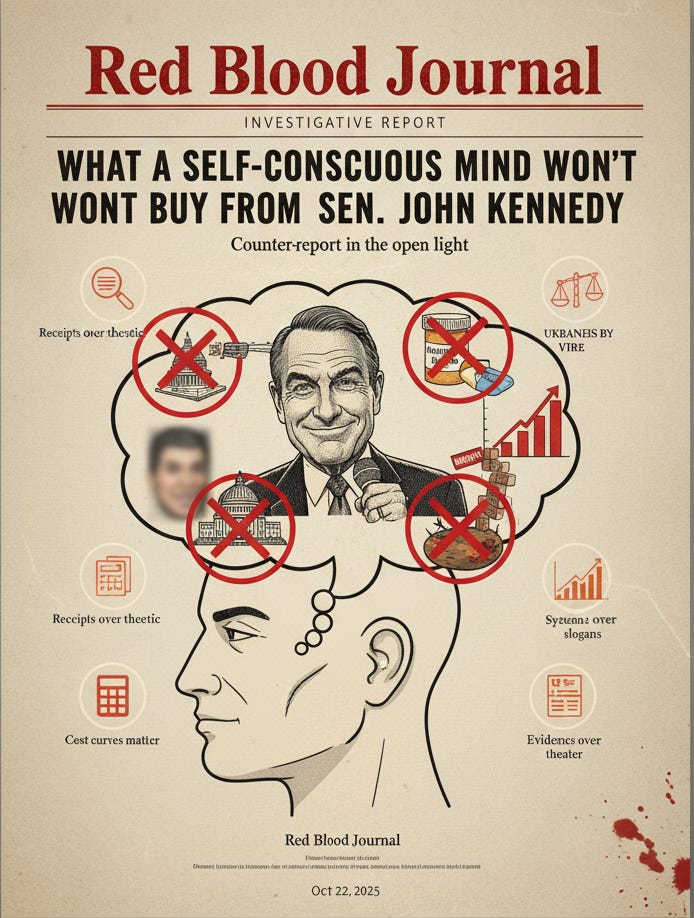
🩸 What a Self-Conscious Mind Won’t Buy from Sen. John Kennedy
Red Blood Journal — Counter-report in the open light.
Lede
If Washington is “all ego,” as Sen. John Kennedy says, then the antidote isn’t switching egos—it’s switching standards. In his PodForce One sit-down, Kennedy serves zingers with certainty. A self-conscious mind—the Red Blood reader who audits claims before adopting them—should press pause. Here’s what doesn’t scan, and why, in the Red Blood frame: evidence over theater, systems over slogans, sovereignty over faction.
Red Blood’s Ground Rules (so you know where we’re coming from)
Receipts over rhetoric. Anecdotes need documents.
Power maps, not personality tales. Who benefits, who pays, and what levers move outcomes.
Anti-haze. We cut through tribe-pleasing narratives—left, right, or your favorite senator’s.
Cost curves matter. Debt, inflation, and war all show up as invoices to the public.
Points a Self-Conscious Mind Should Dispute
1) “It’s an ego shutdown”—full stop
Why that’s thin:
An “ego” story erases the actual ledger: bill text, CR terms, riders, pay-fors, and whip counts. Shutdowns are engineered by tactical veto points: Rules Committee, procedural holds, and leverage over the “vehicle.” If you can’t point to the last red-line paragraph that cratered talks, “ego” is a vibe, not an explanation.
Red Blood take: Show us the paragraph, not the punchline. A self-conscious mind wants the timeline of offers/counteroffers and the specific demands that made it non-starter.
2) Diagnosing Biden on air
Why that’s out of bounds:
On-mic insinuations about “neurodegenerative disease” without medical records or on-the-record exams ask the public to substitute charisma for clinical proof. That’s narrative laundering.
Red Blood take: Health of a head of state is a public-interest subject—so demand logs, physician memos, and work-hour documentation. Don’t accept “I lingered and observed” as evidence.
3) “Xi could end the Ukraine war tomorrow”
Why that’s simplistic:
Beijing’s leverage over Moscow is real (energy, finance, dual-use exports). Control is not. Putin still prices regime survival domestically; over-pressure from Xi can backfire. The Kremlin plays “autarky theater,” and wartime economies grow stubborn muscles.
Red Blood take: Great-power compacts are transactional, not feudal. A self-aware analyst separates influence from override.
4) Israel “made the Middle East safer—full stop”
Why that needs scope and data:
Deterrence gains vs. Iran’s network must be weighed against long-tail blowback: militia mobilization, oil-route risk premia, and radicalization multipliers. Civilian tolls, reconstruction debt, and coalition strain aren’t footnotes; they’re part of “safety.”
Red Blood take: Security isn’t a speech; it’s a costed equilibrium. The public deserves the ledger: costs, risks, timelines, and credible end states.
5) “MAGA = more fiscally responsible”
Why the math is messy:
Deficit arcs are bipartisan. Pandemic blowouts, tax-base moves, and unfunded priorities live on both jerseys. Many self-branded hawks vote “no” on toplines, then “yes” on hometown carve-outs. Rhetoric ≠ roll-call.
Red Blood take: Don’t chant, check. Compare talk-show sound bites to appropriations, emergency supplementals, and tax-expenditure votes. Responsibility is reconciled in numbers, not in labels.
6) Deterrence as “be unpredictable”
Why that’s half a doctrine:
Unpredictability can deter, but it can also miscue adversaries and spook capital markets. Durable deterrence couples credible force with clear red lines, allied buy-in, and logistics that outlast election cycles.
Red Blood take: If your doctrine hinges on vibes, it dies on sustainment. Show force posture, replenishment rates, and alliance compacts—then talk “edge.”
7) Culture-war totalization = policy analysis
Why that’s a tell:
When budget baselines, industrial capacity, and treaty mechanics vanish behind “loon wing” riffs, you’re being sold a team jersey, not a plan.
Red Blood take: The self-conscious reader separates moral heat from policy heat. If a claim can’t survive a CBO table or a force-structure brief, it’s theater.
Counter-Frame: The Red Blood Explanations
Shutdowns: They happen when leadership weaponizes time scarcity and uses CRs as hostages for side-objectives. The antidote is single-subject appropriations, sunlight on riders, and automatic continuing caps to remove brinkmanship payoff.
Executive fitness: Publish standardized cognitive/physical checkups for all top principals on a schedule, with independent review. No more “trust me, I visited.”
Great-power collisions: Map energy, tech, and currency chokepoints. Assume partial leverage, not total control. Calibrate sanctions/export curbs to measurable war-sustainment metrics.
Middle East stability: Define the end state first; price it second; test it with coalition reality third. Security claims without civilian recovery and governance math are wishcasting.
Fiscal discipline: Ban omnibus theatrics; force up-or-down votes on discrete spends; sunset tax expenditures; pair every new dollar with a pay-for. Then score it in public.
Deterrence: Credibility > unpredictability. Fund magazines, fix supply chains, publish red lines, and keep allies inside the cost-sharing tent.
The Receipts We Still Need (and will publish when obtained)
CR negotiation text: the actual line-items that blew up talks.
Work-hour logs & medical briefs for the President (and successors), standardized and independent.
Trade/finance flows quantifying Beijing–Moscow wartime coupling (to test “Xi can end it”).
Regional risk metrics post-Israel operations: militia incident rates, maritime insurance premia, energy shocks.
Member vote sheets vs. rhetoric on recent spend/tax bills.
🩸 Bottom Line
Kennedy’s interview is great radio. Red Blood is not radio. Our readers are done being managed by personality. A self-conscious mind wants what power fears: the paragraph that matters, the number that bites, the lever you can pull. Until then, call it what it is—performance without the spreadsheet.
Mini-FAQ (for readers who skim but still demand rigor)
Isn’t some of Kennedy’s critique valid?
Yes—D.C. does monetize brinkmanship, and deficits are bipartisan. But validity is not a blank check for overreach, diagnosis by anecdote, or strategy by catchphrase.
So what’s the Red Blood “fix” in one line?
De-weaponize process, publish the receipts, and make both tribes live inside the math.