


In the annals of medical history, few substances bridge the gap between industrial dye and life-saving drug as vividly as methylene blue (MB). First synthesized in 1876 by German chemist Heinrich Caro as a textile colorant, this deep-blue compound has evolved into a multifaceted tool in clinical practice, particularly within hematology. Today, as of October 2025, MB continues to spark debate: Is it a reliable therapeutic agent for blood disorders, or a controversial relic amplified by social media hype? This investigative report delves into its origins, mechanisms, established and emerging uses—focusing on hematological applications—while scrutinizing safety concerns and ongoing research. Drawing from peer-reviewed studies, clinical guidelines, and recent discussions, we explore whether MB deserves its place in modern medicine or warrants caution amid unproven claims.
Historical Evolution: From Malaria Fighter to Hematological Staple
MB’s journey began in the late 19th century, not in a lab coat but in the dye vats of the chemical industry. By 1891, Paul Ehrlich and Paul Guttmann pioneered its use against malaria, marking it as the first synthetic antiseptic in medicine. This breakthrough laid the groundwork for phenothiazine-based drugs, including antipsychotics like chlorpromazine. During World War II, it remained a go-to for malaria in resource-scarce settings.
The compound’s pivot to hematology came in 1933 when Matilda Moldenhauer Brooks identified its antidote properties against carbon monoxide and cyanide poisoning. By the mid-20th century, MB was recognized for treating methemoglobinemia—a rare blood disorder where hemoglobin’s iron is oxidized, impairing oxygen delivery. Early studies in the journal Blood detailed its role in accelerating methemoglobin reduction via leucomethylene blue, the reduced form of MB. This mechanism, involving NADPH-dependent pathways, solidified MB’s status in emergency hematology, earning it a spot on the World Health Organization’s List of Essential Medicines.
In the 1950s and 1960s, Blood publications explored MB’s interactions with erythrocytes in congenital methemoglobinemia and dye-binding properties in blood smears, highlighting its utility in cytopathology for staining nuclei and cytoplasm. These foundational works underscore MB’s enduring relevance in hematological diagnostics and research.
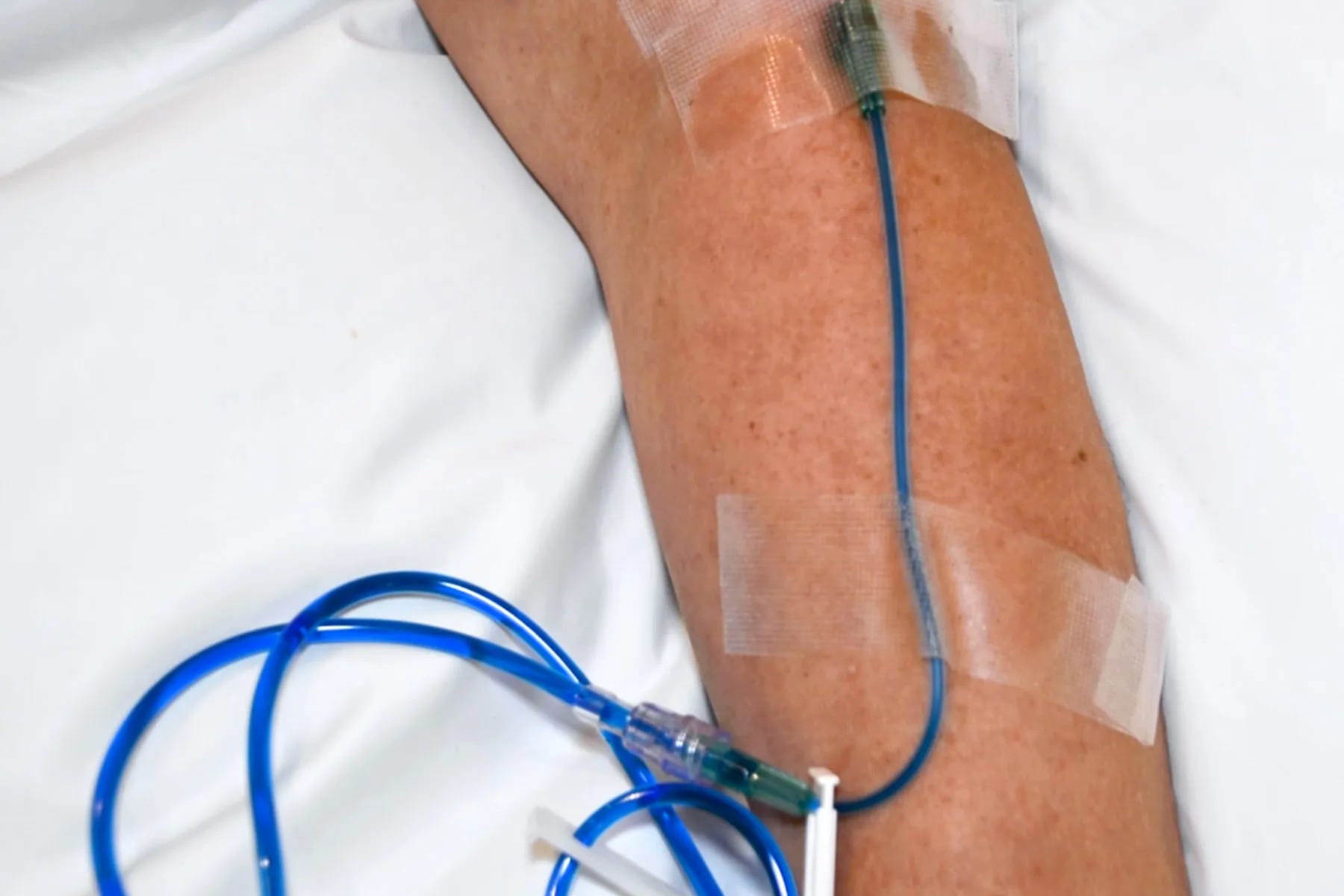
Intravenous administration of methylene blue, commonly used in treating methemoglobinemia.
Pharmacology: A Redox Powerhouse with Dual Edges
At its core, MB is a phenothiazine salt (C₁₆H₁₈ClN₃S) that acts as a reversible redox agent. In its oxidized blue form, it accepts electrons; reduced to colorless leucomethylene blue, it donates them. This property enables MB to bypass dysfunctional mitochondrial electron transport chains, enhancing ATP production and reducing oxidative stress at low doses (0.5–2 mg/kg). It also inhibits nitric oxide synthase and guanylate cyclase, promoting vasoconstriction in shock states.
Pharmacokinetics reveal rapid distribution to tissues like the brain and liver, with a half-life of 5–24 hours and primarily renal excretion. Oral bioavailability varies (6.5–72.3%), complicating dosing. As a monoamine oxidase inhibitor (MAOI), it risks serotonin syndrome with serotonergic drugs.
In hematology, MB’s redox action shines in methemoglobinemia, converting methemoglobin back to hemoglobin via NADPH pathways. However, high doses (>7 mg/kg) can paradoxically induce the condition.
Core Uses in Hematology and Blood Disorders
MB’s FDA-approved indication remains methemoglobinemia, dosed at 1 mg/kg IV over 5–30 minutes. Caused by toxins like nitrites or drugs like dapsone, it leads to cyanosis and hypoxia. MB outperforms alternatives like vitamin C in acute cases, though it’s contraindicated in G6PD deficiency due to hemolytic risks.
In diagnostics, MB stains blood smears (e.g., in Wright-Giemsa) to visualize cellular structures, aiding leukemia and anemia assessments. A 2013 Blood study showed MB selectively inhibits B-cell proliferation by targeting E2A transcription factors, suggesting potential in B-cell malignancies.
A key application is pathogen inactivation in blood products. Since the 1990s, MB plus light (photodynamic therapy) has been used to neutralize viruses, bacteria, and parasites in plasma, reducing transfusion-transmitted infections like HIV or hepatitis. Spanish cohorts since 2004 compare MB-treated plasma to fresh frozen, noting preserved coagulation factors but slight reductions in fibrinogen. During the COVID-19 era, MB inactivated SARS-CoV-2 in plasma with high efficiency. However, rare anaphylaxis has been reported.
Off-label, MB treats hemolytic crises in methemoglobinemia linked to favism or rasburicase use, though Heinz bodies may appear on smears.
Hematological ApplicationMechanismEvidence LevelKey ReferencesMethemoglobinemia TreatmentRedox reduction of Fe3+ to Fe2+FDA-Approved; HighStatPearls, Harvard Health Blood Smear StainingBinds to nucleic acidsEstablished; HighWikipedia, Blood (1953) Pathogen Inactivation in PlasmaPhotodynamic damage to nucleic acidsClinical Cohorts; ModeratePMC, Transfusion Med B-Cell InhibitionE2A Transcription Factor BlockPreclinical; LowBlood (2013)
Broader Medical Applications and Emerging Research
Beyond blood, MB treats vasoplegic syndrome in cardiac surgery (2 mg/kg IV), improving hypotension. It’s explored for ifosfamide neurotoxicity, septic shock, and even COVID-19 oxygenation.
Recent research highlights neuroprotective effects: A 2025 Frontiers study showed intranasal MB conferring neuroprotection in exhausted rats. In cancer, MB offsets chemotherapy neurotoxicity and appears in protocols with ivermectin. Anti-aging claims persist, fueled by mitochondrial enhancement, though evidence is preliminary.
Controversies: Hype, Risks, and Regulatory Gaps
MB’s resurgence via social media—touted for brain fog, energy, and even cancer—has ignited controversy. Speculation around figures like RFK Jr. using it amplifies unproven claims. Critics argue supplements lack regulation, risking impurities and false positives in drug tests.
Safety issues abound: Serotonin syndrome with SSRIs, hemolytic anemia in G6PD deficiency, and neurotoxicity at high doses. A 2022 review deems MB “controversial” due to heterogeneous data and lack of standardization. In transfusions, while effective, it may impair antibody integrity.
Biohackers defend low-dose benefits, but experts like immunologist Andrea Love warn of harm without evidence. Proponents counter that military and ER uses validate it, but long-term data is absent.
Future Prospects: Balancing Innovation and Caution
MB’s role in hematology—from methemoglobinemia to pathogen-safe transfusions—remains indispensable. Yet, as research expands into neurodegeneration and oncology, rigorous trials are needed to substantiate off-label hype. With global blood safety threats like emerging viruses, MB’s photodynamic potential could evolve, but only if risks like anaphylaxis and interactions are mitigated.
In conclusion, MB exemplifies medicine’s double-edged sword: a historical hero in blood disorders, shadowed by modern controversies. For hematologists, it’s a tool; for the public, a cautionary tale. As one expert notes, “It’s not a cure-all, but a targeted aid.” Future studies must prioritize safety to ensure this blue dye doesn’t fade into obscurity.