


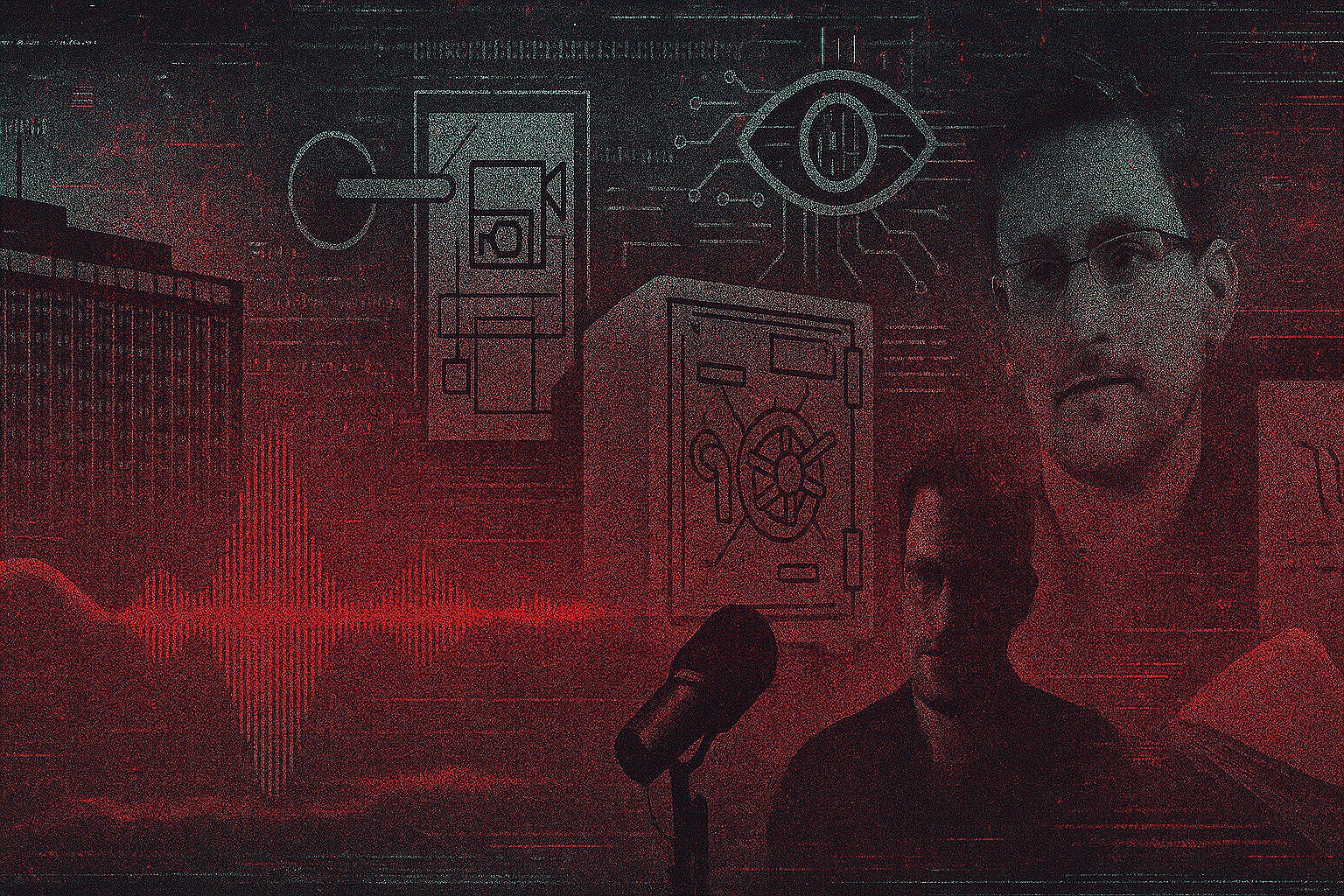
🩸The Red Blood Journal Transmission
Turnkey Tyranny — Snowden, Rogan, and the Birth of the Post-9/11 Panopticon (Part I of IV)
Source: Joe Rogan Experience #1368 — Edward Snowden (recorded 2019)
Series Focus: How a fear-drunk state converted emergency powers into a standing architecture of mass surveillance—and how the public was written out of the social contract.
The Lead
Edward Snowden didn’t walk onto Rogan’s set to relitigate 2013. He came to stitch a longer arc: from September 11 to Stellar Wind, from a secret memo in the Vice President’s safe to a culture where policy overrides law and the public’s “seat at the table” is quietly removed. The result, in his words: a “turnkey tyranny”—an always-on machine that awaits only the wrong hands.
What Triggered the Interview (and Why It Still Matters)
Snowden had just published Permanent Record. The U.S. government immediately pursued financial censorship—not a ban on speech (First Amendment barrier), but a move to seize earnings and warn would-be whistleblowers.
He chose long-form conversation because 8–15 second TV soundbites can’t contain systemic truths. Corporate media wanted a caricature; long-form allows context, receipts, and accountability.
Snowden’s Core Claims (From This Segment)
Mass surveillance wasn’t the constitutional baseline—it was a post-9/11 bolt-on rationalized by secrecy and fear.
The legal “authorization” began with David Addington (Cheney’s lawyer): a secret interpretation withheld from Congress and even from agency heads—“trust us” law locked in a VP’s safe.
The program—Stellar Wind—vacuumed phone and internet data far beyond terrorism, then mission-crept once it failed to catch meaningful plots.
Gang of Eight briefings and intel committees got partial, constrained briefings; members with concerns (e.g., Sen. Ron Wyden) were gagged by classification.
The checks and balances (courts, Congress, press) failed in sequence; fear and careerism did the rest.
9/11 “stovepipes” were real—but the true blockage wasn’t law; it was bureaucratic turf war. Agencies withheld to win credit. The cure offered: unchain the state and spy on everyone.
Snowden’s disclosure model: hand documentary evidence to multiple newspapers, impose a public-interest filter, and inform the government pre-publication to mitigate harm. After six years, the state produced no bodies and no concrete harms from the reporting—only institutional embarrassment.
The Post-9/11 Pivot: From Warrants to Warehouses
Pre-9/11 norm: individualized suspicion → warrant → targeted surveillance.
Post-9/11 norm: bulk ingestion first, justification later. “Because terrorism” became a universal master key.
Practical effect: Policy memos—revocable at a president’s whim—outranked law in day-to-day operations. Snowden: “The president can sign a napkin and the policy changes.”
Media Gatekeeping: Why Long-Form Matters
TV demanded binary narratives: traitor/hero, Russia/not-Russia.
Long-form allowed Snowden to document the system, not himself. The goal: restore the public’s ability to consent or object with facts in hand.
9/11 and the Character of Power
Evacuations at NSA/CIA on 9/11 revealed a risk-averse bureaucracy protecting itself first.
The aftermath normalized “emergency forever” governance: what began as temporary tools calcified into permanent architecture.
Whistleblowing as Civic Hygiene
Snowden rejects “dump it all” anarchy. He engineered friction: journalists + pre-publication government challenge.
The intent: maximize public benefit, minimize operational risk. Outcome: Pulitzer Prize for Public Service and a durable public record of programs the public never voted on.
Pull-Quotes (Front-Page Ready)
“We built a system of turnkey tyranny. Even if you trust the current hand, the next one only has to turn the key.”
“The courts abdicated, Congress was muzzled, and policy—not law—ran the show.”
“Mass surveillance wasn’t the baseline; it was the panic purchase.”
🩸RBJ Takeaways (Part I)
Mechanism > Man: The lasting story isn’t Snowden; it’s the institutional machine that outlives administrations.
Fear Is Policy’s Favorite Solvent: The fastest way to dissolve rights is to declare an emergency and never end it.
Financial Censorship Is the New Censor: When speech can’t be blocked, money flows get choked.
Classification = Political Containment: “Brief, then gag” keeps legislators informed but impotent.
Actionable Literacy (Start Here)
Warrant Literacy: Know the difference between targeted orders and bulk authorities.
Paper vs. Policy: Ask whether a power rests on statute, court order, or revocable policy memo.
Follow the Budget: Surveillance expands where contractors profit and oversight is weakest.
What’s Next (Part II Preview)
Part II — The Plumbing of the Panopticon:
Stellar Wind’s lineage, the PRISM/XKEYSCORE/Upstream triad, how FISA was stretched, the role of contractors, and why “proper channels” are structurally designed to fail when the institution itself is the culprit.