


🩸The Red Blood Journal Transmission
Turnkey Tyranny — Leaks, Lies, and the Court That Wouldn’t Look (Part III of IV)
Source: JRE #1368 — Edward Snowden (2019)
Focus: Why the surveillance machine survived: state-secrets shields, Glomar non-answers, Espionage Act gags, and the ritualized lying to Congress that neutered oversight—until whistleblowers forced daylight.
1) The Closed-Loop of “Legal” Illegality
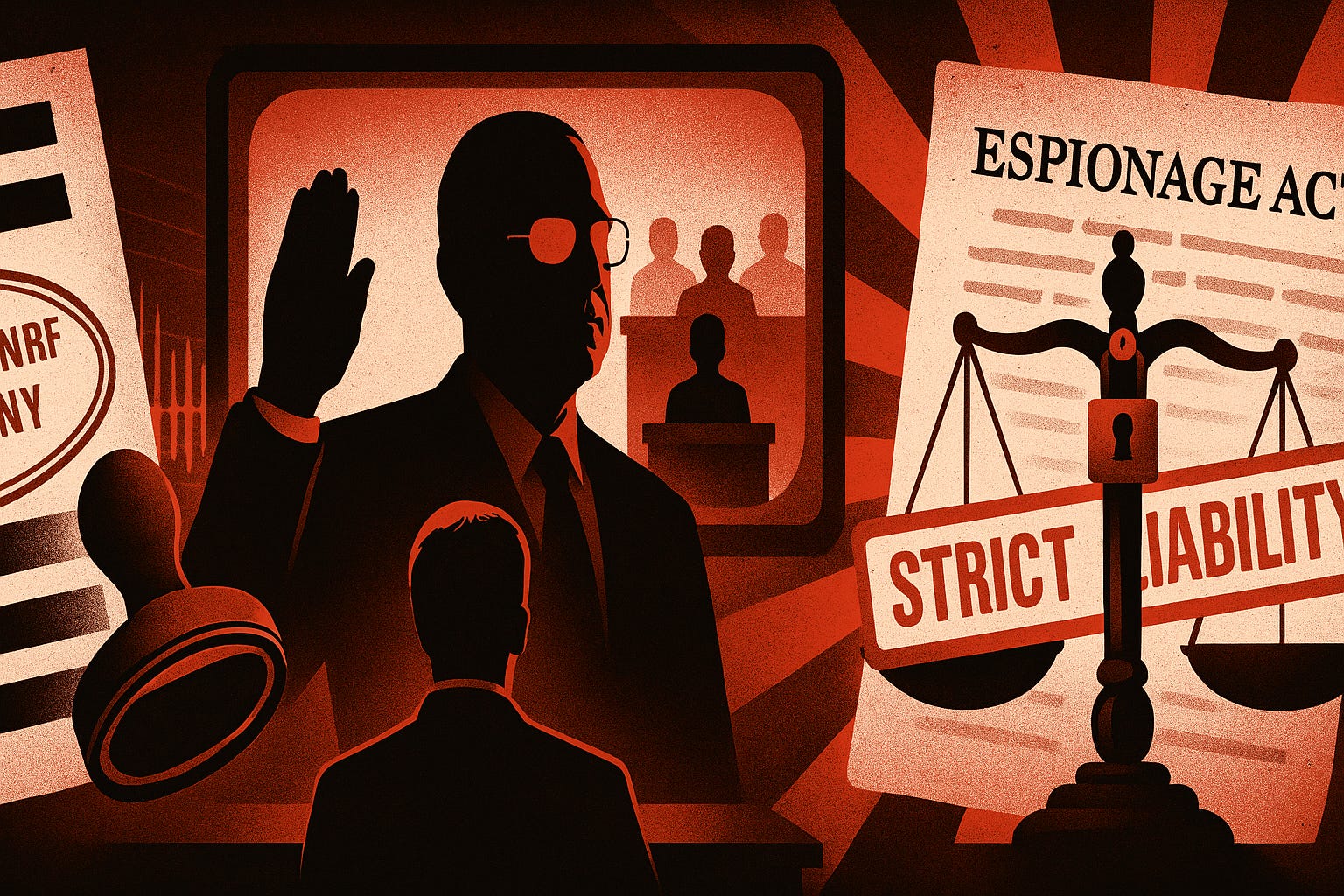
State Secrets → Glomar: Citizens and rights groups (ACLU, Amnesty, EFF) challenged surveillance—but were told they couldn’t prove programs existed because the evidence was classified. Government answer: we can neither confirm nor deny. Case dismissed.
Result: A catch-22: courts can’t review the programs until proof exists; producing proof is a felony under the Espionage Act.
2) When Open Courts Finally Looked
After Snowden’s disclosures, ordinary federal courts (not the secret FISC) reviewed bulk collection and found it unlawful and likely unconstitutional—even noting the NSA had violated its own rules thousands of times in a single year.
Translation: daylight from “leaks” restored the minimal conditions for law to operate.
3) Lying as a Governance Model
The canonical moment: Sen. Ron Wyden asks DNI James Clapper, under oath, if the NSA collects “any type of data at all on millions of Americans.”
Clapper: “No, sir… Not wittingly.”
He later admitted it was the “least untruthful” answer he could give.
Lesson: If Congress is misled on camera, and members are gagged by classification from correcting the record, oversight is theater.
4) Why Whistleblowers Are the Only Working Circuit Breaker
Prior IC insiders—Thomas Drake, Bill Binney, Kirk Wiebe, Ed Loomis—were raided or charged, signaling the system’s response: punish truth to protect programs.
Snowden’s criterion for disclosure: create a public, verifiable record large enough to overcome corporate media’s access dependence and partisan self-censorship.
5) The Espionage Act: Gag Order by Design
Strict liability: motives are inadmissible. In “national security” cases, juries may judge only whether the defendant told secrets—not why or to whom.
Net effect: telling the truth to the American public via journalists is treated as a crime worse than murder—because intent and public benefit cannot be argued.
Snowden’s standing offer: return for trial if a public-interest defense is allowed. The government’s answer across administrations: No.
6) Presidents, Power, and the Perpetual Briefing
New presidents are “feared-up” by career security officials (the real deep state = career bureaucracy), handed a menu of nightmares, then nudged toward secret, unreviewable powers that no one will ever know about.
Even reform-minded leaders (Obama campaigned against warrantless wiretapping) inherit, embrace, and often expand the toolset—then promise they “were going to fix it” later.
7) Exile and Ordinary Life
Snowden describes initial high-OPSEC paranoia, then a gradual return to a mostly normal public life in Russia—rarely recognized, living openly, still advocating privacy and due process.
On returning to the U.S.: without a public-interest defense, a fair trial is structurally impossible.
Pull-Quotes (Front-Page Ready)
“Leaks are daylight. Without them, the courts stay blind by design.”
“Glomar isn’t an answer; it’s a fire blanket smothering the Constitution.”
“The only thing on trial in an Espionage Act case is the fact that you told the truth.”
🩸RBJ Takeaways (Part III)
Oversight broke exactly where secrecy was thickest. The fix arrived only after disclosures.
Classification is power, not safety. It blocks courts first, then voters.
The deep state isn’t mystic; it’s managerial. Longevity + fear-briefings = policy inertia.
If motives are banned from court, justice is performative. Restore a public-interest defense or admit the system prefers darkness.
Practical Literacy
Demand standing rules that pierce Glomar when credible public evidence exists.
Codify a public-interest defense for sources of journalism.
Sunset authorities and require adversarial advocates in any secret court setting.
Next in the Series (Part IV Preview)
Remedies & Resistance: How to de-weaponize secrecy—statutory fixes, technical countermeasures, financial censorship choke-points, and a blueprint for civil society resilience in the age of the permanent record.
Deck:Glomar answers, gag laws, and on-the-record lies kept the dragnet alive—until whistleblowers made the courts look.