


🩸 🇮🇳 🇵🇰 🇮🇷 🇨🇳 ♟️ 💰 🌍 ⛓️ 🌊❤️✨ — THE WEDGE THAT MUST REMAIN
Who Benefits From Keeping India and Pakistan Apart, and What Role Does Iran Play? The Colonial Partition, Nuclear Deterrence, Strategic Corridors, and the Economics of Permanent Division
RED BLOOD JOURNAL — INVESTIGATIVE TRANSMISSION
October 26, 2026 | Geopolitics / Historical Power / Strategic Infrastructure / Nuclear Proliferation / Economic Dependency
PROLOGUE — WHAT IF THE DIVISION IS MORE VALUABLE THAN THE PEACE?
In 1947, the British Empire withdrew from the Indian subcontinent, leaving behind two independent countries, India and Pakistan, and a partition whose human consequences would extend across generations. Nearly eight decades later, the two nations remain divided by territorial disputes, military confrontation, competing national narratives, and nuclear deterrence.
The original division was rooted in the political struggles surrounding the end of British colonial rule, religious and communal tensions, competing demands for political representation, and disagreements over the future structure of the subcontinent. Its consequences included massive population displacement, communal violence, and the beginning of a conflict over Kashmir that remains unresolved.
Yet an important question emerges when history is examined through the actions and incentives of those exercising power.
What happens when a division becomes economically and strategically useful to interests beyond the populations directly involved?
A rivalry that persists for generations can create demand for military equipment, security assistance, diplomatic mediation, alternative trade routes, and infrastructure designed to bypass an adversary. Financial relationships develop around the continuing confrontation, and institutions begin operating under the assumption that the division will remain.
The original causes of the conflict may gradually become less important to some beneficiaries than the advantages created by its continuation.
This investigation asks whether the persistent wedge between India and Pakistan has become a source of geopolitical leverage for outside powers, whether Iran plays an important role in sustaining or exploiting the division, and who would gain or lose if the two countries established lasting peaceful cooperation.
It also examines a more controversial possibility: that powerful international financial and political interests might prefer the rivalry to continue because economic division creates opportunities for influence and profit.
That possibility is an investigative hypothesis, not an established conspiracy.
The objective is to identify the people, institutions, agreements, decisions, and money flows that could substantiate or disprove it.
I. THE ORIGINAL WEDGE — 1947 AND THE LEGACY OF PARTITION
The modern India–Pakistan conflict cannot be understood without the partition of British India in August 1947. As British colonial authority ended, independence resulted in the creation of India and Pakistan amid competing political visions, religious tensions, territorial disputes, and widespread communal violence.
The partition was not simply a geographical exercise. Millions of people crossed newly established borders, often under dangerous conditions. Communities that had shared regions for generations became separated through political decisions, fear, violence, and the collapse of established social arrangements.
The British government played a central role in determining the timetable and legal framework of withdrawal. Yet the division also reflected demands and decisions by major South Asian political organizations and leaders. Attributing the entire outcome to a single outside actor would erase the complex political conflicts already present within the subcontinent.
Nevertheless, the rapid transfer of power left severe unresolved problems, including the status of princely states and the future of Kashmir.
The dispute over Kashmir became one of the most enduring sources of hostility between India and Pakistan. Subsequent wars and crises reinforced security institutions and national narratives organized around the expectation of continuing confrontation.
The investigative question is not whether colonial policy alone explains every later conflict.
It is whether the institutional and strategic consequences of partition created a structure that outside powers could subsequently exploit.
When a dispute becomes permanent, the organizations built around managing or confronting it can acquire interests in its continuation.
This does not prove that they created the original conflict. It raises the question of how those interests influence later decisions.
II. FROM TERRITORIAL DISPUTE TO NUCLEAR STANDOFF
The rivalry acquired another dimension when India and Pakistan developed nuclear-weapons capabilities.
India conducted its first nuclear test in 1974 and additional tests in May 1998. Pakistan followed with public nuclear tests later that month, establishing an overt nuclear deterrence relationship between the two countries.
Nuclear weapons fundamentally changed the military calculations surrounding their rivalry.
Both countries had to consider the possibility that a conventional confrontation could escalate into a nuclear crisis. Deterrence was intended to discourage major aggression, but the existence of nuclear capabilities did not eliminate border incidents, militant attacks, limited military operations, or diplomatic confrontation.
The nuclear dimension also increased the international significance of every major crisis.
External governments gained opportunities to engage in diplomacy, intelligence cooperation, military assistance, and crisis management. Regional instability consequently became a concern not only for India and Pakistan but also for China, the United States, and other countries.
For a weapons supplier, military rivalry may generate commercial opportunities. For a government seeking influence, security assistance may strengthen diplomatic relationships. For international investors, instability may create risks that redirect investment or increase demand for alternative infrastructure.
But these effects must be distinguished from deliberate attempts to perpetuate the rivalry.
Nuclear deterrence may be understood by governments as necessary protection against military threats. Evidence that defense companies profit from procurement does not establish that they created those threats.
The investigation must therefore follow specific defense transactions, political lobbying, military assistance arrangements, and strategic decisions before making claims about intentional manipulation.
III. THE PAKISTANI NUCLEAR NETWORK AND THE IRANIAN CONNECTION
Iran enters the investigation through a historical connection that is documented independently of contemporary competition over transportation corridors.
During the 1980s and 1990s, Iran acquired centrifuge-related technology through an international proliferation network associated with Pakistani nuclear scientist Abdul Qadeer Khan.
Research involving International Atomic Energy Agency investigations establishes that Iran received an offer of sensitive nuclear technology in 1987 and subsequently obtained components and technical information linked to the Khan network.
This history demonstrates that Iranian nuclear procurement was connected with Pakistani-based suppliers at a time when Pakistan was developing its own nuclear capabilities.
It does not demonstrate that Pakistan transferred an assembled nuclear weapon to Iran, nor does it establish that the Pakistani government authorized every transaction undertaken through the network.
A separate Persian-language interview, previously examined by Red Blood Journal in THE FINAL JOKER CARD, includes allegations that Iranian officials made additional financial or territorial concessions to obtain nuclear expertise.
Those allegations remain unverified.
Their significance for the present investigation lies in the historical relationship between Iran and Pakistan, not in any proven exchange of sovereign territory.
Iran was not simply an outside observer of Pakistan’s nuclear development. It was involved in procurement activities connected to Pakistani technical networks.
Yet Iran also developed commercial relationships with India, including cooperation centered on Chabahar.
That combination deserves attention.
It shows that Iran’s relationships with India and Pakistan do not fit neatly into a simple division between opposing geopolitical blocs.
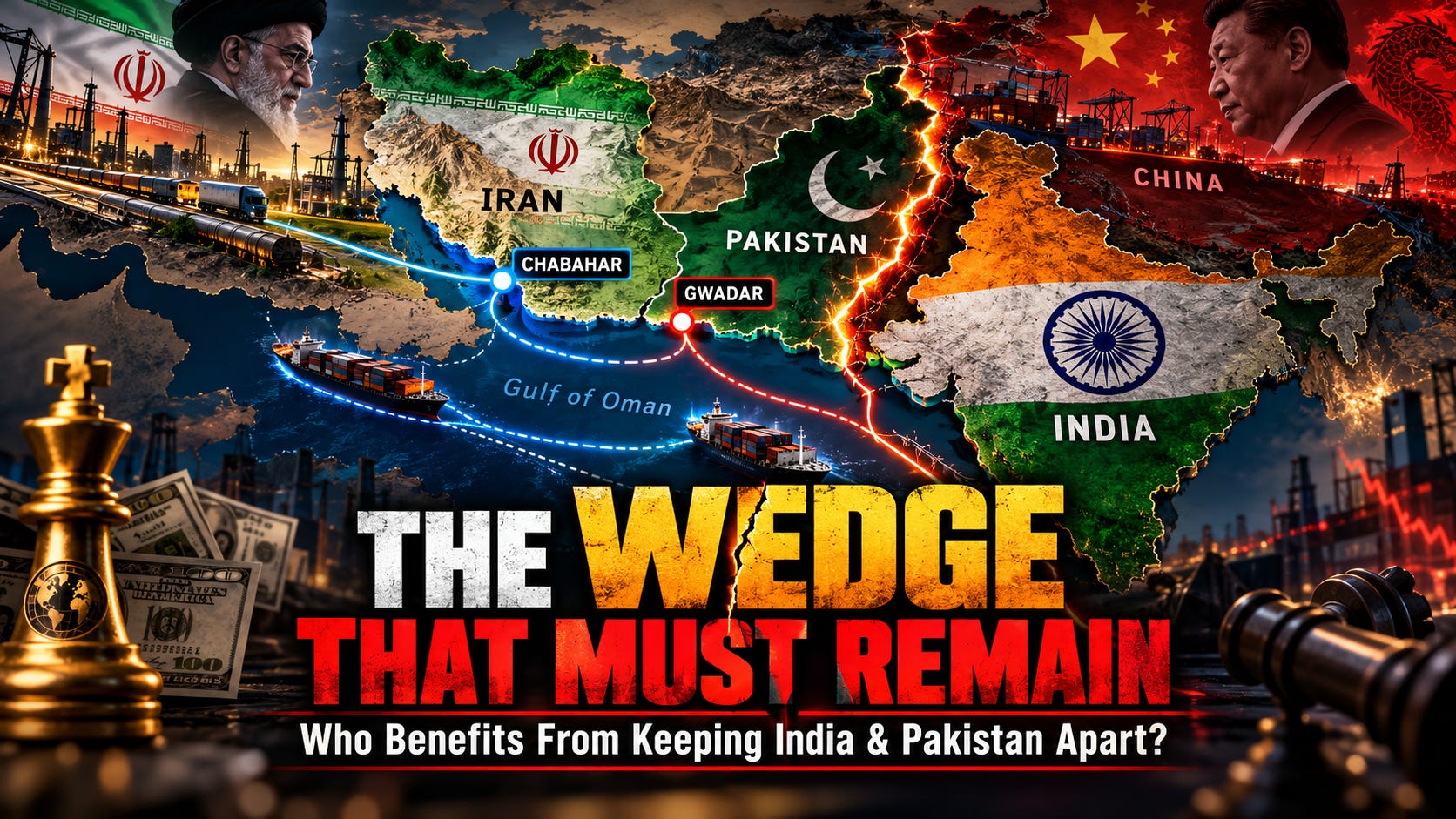
IV. THE TWO PORTS — GWADAR AND CHABAHAR
The most visible economic connection between the three countries lies along the Gulf of Oman.
Pakistan’s Gwadar port and Iran’s Chabahar port occupy strategically significant positions in regional maritime trade.
Gwadar is associated with the China–Pakistan Economic Corridor, commonly known as CPEC, a collection of infrastructure and economic initiatives intended to strengthen commercial connections between China and Pakistan.
Chabahar has become a major focus of India’s effort to establish commercial access to Afghanistan and Central Asia without relying on transportation routes through Pakistan.
India and Iran signed a long-term agreement concerning the Shahid Beheshti terminal at Chabahar in May 2024. The arrangement provided for a ten-year operational and development relationship involving India Ports Global Limited and Iran’s Ports and Maritime Organization.
These arrangements establish important facts about the regional competition.
China has invested in Pakistan’s infrastructure and commercial connectivity, while India has supported an alternative route through Iran.
But alternative commercial corridors do not automatically constitute evidence of a coordinated operation to keep India and Pakistan divided.
India has practical reasons to seek routes that do not depend on a country with which it has experienced repeated military and diplomatic disputes. Pakistan has practical reasons to expand infrastructure linked to China. Iran has incentives to attract investment and develop its own transportation potential.
The existence of these incentives does not require a hidden director.
Nevertheless, the structure of the competition creates an important economic consequence.
Every additional project developed primarily to bypass an adversary can reinforce commercial separation, even when the project also offers genuine economic benefits.
That is the wedge worth examining.
V. WHO FINANCES THE WEDGE?
Transportation corridors involve more than maps and diplomatic announcements. They involve construction contracts, operating concessions, loans, equipment purchases, financial guarantees, and long-term commercial commitments.
A major port development may create opportunities for engineering companies, shipping operators, logistics businesses, construction firms, lenders, and governments collecting commercial revenues.
Some projects may strengthen public infrastructure and regional development. Others may create debt burdens, unequal operating arrangements, or commercial dependencies that last for decades.
The relevant investigation must distinguish these outcomes by examining each project’s actual financial structure.
Who financed construction? Which companies received contracts? Who owns the terminal equipment? Who controls operations? What fees are collected? How are revenues distributed? What financial obligations remain if projected commercial activity does not materialize?
The same questions apply to military procurement.
Who supplies aircraft, missiles, surveillance systems, naval equipment, and other military capabilities to India and Pakistan? What are the financing terms? Which companies receive revenue? What political relationships accompany those transactions?
A persistent rivalry may create repeated demand for military modernization and associated services.
But identifying companies that receive contracts is only the beginning.
To establish deliberate efforts to sustain the rivalry for profit, investigators would need evidence connecting those companies or their representatives to decisions intended to obstruct peaceful relations or encourage unnecessary confrontation.
The distinction between beneficiaries and organizers remains indispensable.
VI. THE ECONOMIC PRICE OF KEEPING TWO NEIGHBORS APART
The consequences of India–Pakistan hostility can be observed in trade.
Before the deterioration of bilateral commercial relations in 2019, official trade between the countries represented a limited but meaningful channel of economic exchange. Restrictions following political crises reduced that activity substantially.
After renewed tensions in April 2025, further measures affected border crossings, trade, transportation, and airspace access.
These restrictions create costs that extend beyond the immediate political dispute.
Businesses may be forced to use longer routes, transportation costs may increase, supply relationships may be interrupted, and consumers may encounter higher prices or reduced availability of certain goods.
Some trade may be redirected through intermediary countries, creating additional costs while offering commercial opportunities to businesses capable of managing indirect transactions.
That dynamic illustrates a central feature of permanent economic division.
When neighboring countries cannot trade efficiently with one another, alternative routes may become profitable even though the overall economic system becomes less efficient.
The financial advantages of certain intermediaries do not establish that they arranged the political dispute.
But the continued existence of such intermediaries can create economic constituencies whose interests differ from those of ordinary consumers and businesses seeking normalized relations.
The question is whether these interests have measurable influence over policy.
Without that evidence, the theory remains an interpretation rather than a demonstrated coordinated strategy.
VII. THE ROLE OF CHINA — STRATEGIC PARTNERSHIP OR STRUCTURAL DEPENDENCE?
China’s relationship with Pakistan introduces another dimension.
Pakistan’s location provides opportunities for connectivity between western China and the Arabian Sea. Chinese investment in infrastructure can support Pakistan’s development while advancing China’s commercial and strategic interests.
This relationship does not necessarily depend on permanent hostility between India and Pakistan.
However, India’s own relationship with China includes border disputes, strategic competition, and concerns regarding Chinese influence in surrounding regions.
As a result, infrastructure investment can acquire significance beyond its immediate commercial value.
A transportation corridor may be understood simultaneously as an economic project, a diplomatic partnership, and a potential strategic asset.
This does not mean every Chinese-financed road or port is primarily military in purpose.
Nor does it establish that China seeks to prevent India–Pakistan peace.
The more productive question is how Beijing’s strategic relationships might change if New Delhi and Islamabad developed a stable commercial partnership.
Would reduced regional hostility weaken particular forms of diplomatic leverage? Would expanded South Asian commerce create new opportunities for Chinese investment? Could peaceful connectivity serve Chinese interests as effectively as separate national partnerships?
These possibilities challenge the assumption that any major outside power necessarily benefits from continued conflict.
VIII. IRAN’S ROLE — BRIDGE, BYPASS, OR BARGAINING INSTRUMENT?
Iran’s position is especially complicated because it occupies the geography between competing commercial systems while maintaining relationships with several regional powers.
Iran can seek investment from India, commercial cooperation with China, economic relationships with Pakistan, and transportation access to Central Asia and the Caucasus.
These partnerships may overlap rather than follow rigid geopolitical boundaries.
The existence of India’s Chabahar arrangement demonstrates that Iran can provide commercial alternatives to routes passing through Pakistan.
The historical nuclear relationship demonstrates that Iranian procurement networks also maintained connections involving Pakistani expertise.
But these two facts do not establish that Iran is deliberately being used to keep India and Pakistan apart.
A more precise hypothesis is that Iran’s geography allows different governments to pursue economic and strategic interests that can reinforce existing regional divisions, even without direct coordination.
If policymakers or financial institutions deliberately favored arrangements intended to obstruct India–Pakistan normalization, documentary evidence would be needed to establish those intentions.
The investigation should therefore examine whether Iranian transport agreements contain exclusivity provisions, whether foreign financing restricts access by particular trading partners, and whether commercial or diplomatic decisions have directly limited opportunities for regional cooperation.
Until those connections are demonstrated, Iran is better understood as an important participant in competing regional systems rather than a proven instrument controlled by an unidentified global organization.
IX. THE SANCTIONS PARADOX — WHEN ISOLATION CREATES INTERMEDIARIES
Iran’s international sanctions history adds another layer to the investigation.
Restrictions on ordinary financial transactions, energy sales, shipping, and commercial investment can create complicated channels for international trade.
When direct commerce becomes difficult, businesses may seek intermediaries, alternate transportation routes, or arrangements involving third countries.
These methods can increase costs and create opportunities for organizations capable of operating in difficult commercial environments.
The resulting profits may be concentrated among relatively small groups while ordinary consumers and legitimate businesses face greater economic burdens.
But the purpose of sanctions must be distinguished from every consequence they produce.
Governments imposing sanctions commonly cite security, proliferation, human rights, or other foreign-policy objectives.
A claim that sanctions were deliberately designed to enrich selected intermediaries requires evidence linking policy decisions to those beneficiaries.
The stronger investigative question is whether the continued use of restrictive policies produces measurable incentives that discourage normalization.
Who earns fees from indirect transactions? Which businesses gain market share when Iranian products or infrastructure become less accessible? Who benefits when regional trade must follow longer or more expensive routes?
This approach examines the economics of isolation without assuming that every policy is directed by the same hidden organization.
X. THE GLOBALIST HYPOTHESIS — WHO EXACTLY IS BEING ACCUSED?
The term globalists is often used to describe very different groups: multinational corporations, financial institutions, international political organizations, strategic-policy networks, or individuals supporting extensive international economic integration.
These entities do not necessarily share the same interests.
A shipping company may benefit from peaceful open trade. A defense supplier may gain revenue from military procurement. A development bank may support cross-border infrastructure. A government may seek diplomatic leverage through security partnerships.
Treating all these actors as one coordinated organization risks hiding the very financial relationships that an investigation is supposed to uncover.
The investigative hypothesis can be expressed more precisely.
Have identifiable political, military, or financial interests supported decisions that prolong India–Pakistan separation because those decisions protect particular revenues, investments, or forms of strategic influence?
That question can be tested.
Researchers could examine company ownership, lobbying activities, government contracts, political donations where disclosed, procurement records, infrastructure financing, diplomatic correspondence, and policies directly affecting bilateral normalization.
The evidence must establish more than the existence of profit.
It must connect the alleged actors to decisions or activities that intentionally sustain the divide.
No evidence reviewed for this report establishes a unified international command structure directing Iran to keep India and Pakistan apart.
The possibility of narrower arrangements among identifiable actors remains an appropriate subject for investigation.
XI. THE CRISES OF 2025 AND 2026 — THE WEDGE REMAINS ACTIVE
The India–Pakistan divide is not merely a historical subject.
Following an April 2025 attack that killed twenty-six tourists in Indian-administered Kashmir, India and Pakistan experienced a severe military confrontation in May.
The crisis produced new restrictions involving trade, travel, transportation, and diplomatic relationships.
The dispute over the Indus Waters Treaty introduced additional concerns involving water security, a subject with enormous economic and humanitarian significance.
Tensions also continued during 2026.
These events demonstrate that the rivalry remains capable of disrupting economic activity and creating broader regional security risks.
They do not establish that any foreign power secretly ordered the confrontation.
Each event requires examination through its own evidence, including the actions of the parties involved, disputed claims regarding responsibility, and the documented sequence of decisions.
Yet the recurrence of crises creates a predictable economic environment.
Governments plan for continued security competition. Military expenditures remain politically significant. Businesses face uncertainty about cross-border access. Alternative trade routes become attractive because direct cooperation remains unreliable.
The structure can reinforce itself without requiring a single hidden director.
That is an important possibility to distinguish from deliberate external orchestration.
XII. WHAT IF INDIA AND PAKISTAN MADE PEACE?
The most revealing way to examine an entrenched rivalry may be to consider what would change if it ended.
Imagine a sustained normalization of diplomatic relations accompanied by reliable border access, reduced security threats, and expanding commercial cooperation.
Businesses could potentially develop more direct supply chains. Transportation costs might fall. Regional infrastructure could serve wider markets. Investment decisions might become less dependent on expectations of military disruption.
Pakistan could gain new commercial opportunities through access to Indian markets. India could benefit from more reliable access to neighboring routes and markets farther west. Iran could participate in wider regional commerce rather than serve primarily as a bypass for existing political barriers.
China’s investments in Pakistan could remain economically valuable under peaceful conditions. Chabahar and Gwadar could compete commercially while also supporting complementary trade networks.
Peace would not eliminate strategic competition, national interests, or difficult historical disputes.
It would, however, change the financial incentives surrounding those disputes.
The central investigative question becomes especially clear.
Which institutions would lose revenue, influence, or strategic leverage if India and Pakistan normalized their relations?
And equally important, which populations and businesses would gain?
The answers should be determined by documented financial relationships, commercial flows, and political decisions rather than presumed in advance.
XIII. THE HUMAN COST OF A PERMANENT WEDGE
Geopolitical investigations often concentrate on governments, ports, military equipment, financial institutions, and international alliances.
But the costs of prolonged rivalry are distributed through ordinary lives.
Families may be separated by difficult border arrangements. Businesses may lose access to nearby markets. Transportation restrictions can affect prices and travel. Public resources devoted to military expenditure cannot simultaneously be used for every other national priority.
Communities affected by violence may experience displacement, interrupted education, damage to infrastructure, and lasting insecurity.
These consequences are not identical in India, Pakistan, Iran, or Balochistan.
Each population faces different political, economic, and social circumstances.
Yet a common principle emerges.
The individuals deciding geopolitical strategies are not always those who bear their greatest costs.
That imbalance deserves investigation independently of any broader theory about outside coordination.
A national rivalry can generate powerful institutions dedicated to defense and security while leaving ordinary people with relatively limited opportunities to influence the direction of policy.
Meaningful peace therefore requires more than diplomatic declarations.
It requires political accountability, public trust, respect for legitimate security concerns, and economic arrangements that provide visible benefits to the people involved.
XIV. FOLLOW THE MONEY — THE INVESTIGATION THAT REMAINS
The available evidence supports several conclusions.
The original India–Pakistan divide developed through the political circumstances of partition in 1947 and subsequent territorial and security conflicts.
The nuclear rivalry is documented.
China’s infrastructure relationship with Pakistan is documented.
India’s development relationship with Iran’s Chabahar port is documented.
Iran’s historical nuclear procurement through the A.Q. Khan network is documented.
The economic costs of restricted India–Pakistan trade are measurable, and particular companies, intermediaries, and institutions may benefit from specific conditions of rivalry.
But these established facts do not collectively prove that an identifiable group directs Iran to maintain the division.
To substantiate that stronger claim, an investigation would need to connect named decision-makers and organizations to deliberate actions intended to preserve the rivalry.
Financial beneficiaries must be distinguished from political organizers. Strategic intentions must be supported by reliable evidence. Historical relationships must not automatically be treated as present-day agreements.
The most important unresolved questions concern the relationship between commercial incentives and political decisions.
Have particular actors obstructed normalization? Did any decision protect identifiable financial interests? Were commercial agreements structured to exclude cooperation? Did external governments use security relationships to discourage diplomatic settlements?
Answers require transaction-level evidence.
The investigation remains open where such evidence is absent.
🩸 The Red Blood Perspective
The original division of British India, the continuing Kashmir dispute, nuclear competition, and the development of competing trade routes have created an enduring structure of geopolitical and economic separation.
The existence of that structure is documented. So are commercial and strategic relationships involving China, Pakistan, India, and Iran.
The question of deliberate manipulation requires another level of proof.
The investigation must identify who made the decisions, who financed them, which contracts were awarded, how money moved, who obtained political leverage, and what measurable consequences followed.
A company profiting from military procurement is not automatically responsible for creating the threat that justified the purchase. A country benefiting from a disrupted trade route has not necessarily organized the disruption. And Iran’s participation in competing regional partnerships does not establish that it is controlled by an international network intent on dividing South Asia.
But the absence of proof of one coordinated conspiracy does not mean that concentrated interests cannot influence policy.
Specific arrangements can be investigated through documents, financial records, ownership structures, and the conduct of identifiable individuals and institutions.
The central Red Blood question is therefore not simply whether the wedge exists. It does.
The question is who actively works to preserve it, which incentives encourage its continuation, and whether the public can see the evidence linking those incentives to real decisions.
🌊❤️✨ The Ocean of Love and Positivity Perspective
India, Pakistan, and Iran possess extraordinary cultural histories, human talent, economic potential, and geographical opportunities.
Their future need not be defined solely by military competition, territorial disputes, religious separation, or rival infrastructure systems.
A border can become a place of confrontation, but it can also become a place of exchange. A port can serve geopolitical leverage, but it can also create employment and connect communities. Scientific and industrial development can support military competition, but it can also advance education, healthcare, transportation, and human well-being.
The economic possibility of greater regional cooperation deserves to be considered alongside the familiar calculations of strategic rivalry.
That does not require ignoring historical grievances or legitimate security concerns. Reconciliation cannot be built by pretending difficult disputes do not exist.
It requires institutions and relationships capable of addressing those disputes without allowing fear and hostility to permanently determine every commercial and human connection.
The deeper lesson concerns the difference between the value of separation to institutions and its cost to human beings.
If an industry, political organization, or government benefits from rivalry, it may have little incentive to prioritize reconciliation. But societies are more than the institutions operating within them.
Ordinary people deserve the opportunity to imagine a future not permanently limited by conflicts inherited from previous generations.
A divided region creates boundaries around possibility. A cooperative region can create opportunities that none of its countries could achieve alone.
The purpose of investigation is not to manufacture a new enemy called the globalists. It is to understand how material incentives can influence political decisions, identify where accountability is missing, and encourage arrangements that protect human dignity.
The greatest achievement would not be for one power to control the corridors while another loses.
It would be for the people of the region to gain the freedom, security, and prosperity necessary to use their geography as a bridge rather than a permanent battlefield.
SOURCES AND HISTORICAL RECORD
Council on Foreign Relations — Global Conflict Tracker. Conflict Between India and Pakistan, updated October 23, 2026. Historical background on partition, Kashmir, the 2025 confrontation, and subsequent developments.
Government of India, Ministry of Ports, Shipping and Waterways. Long-term Main Contract for Development of Shahid Beheshti Port Terminal, Chabahar, May 13, 2024.
Government of India, Press Information Bureau. Development of Chabahar Port, July 26, 2024.
Iran Watch. A History of Iran’s Nuclear Program. Historical documentation concerning Iran’s procurement relationships and the A.Q. Khan network.
Carnegie Endowment for International Peace. A.Q. Khan Nuclear Chronology. Historical chronology of nuclear technology transfers involving Iran and other countries.
Reuters. India–Pakistan Trade Faces New Blow After Kashmir Attack, Diplomatic Rift, April 25, 2025. Reporting on trade restrictions, intermediary routes, and economic consequences.
European Union Agency for Asylum. Pakistan Country Focus: Relations with India, June 2026.
The documented evidence establishes historical rivalry, nuclear procurement, infrastructure agreements, and economic consequences. It does not establish the existence of a single international organization deliberately controlling Iran to maintain India–Pakistan hostility.
🩸🌊❤️✨ — Ocean of Love and Positivity
Blood connects us. The ocean unites us. Love guides us. Positivity illuminates our path.
♟️
South Asian Geopolitics and the Permanent Division
Oct 26, 2026
The historical division of the Indian subcontinent and subsequent nuclear competition have established a permanent rivalry that continues to disrupt regional trade and diplomacy. Outside powers and commercial entities often profit from this hostility, utilizing competing infrastructure projects like Pakistan’s Gwadar port and India’s Chabahar port in Iran to navigate severed bilateral ties. While historical ties such as Iran’s past nuclear procurement through Pakistani networks are well-documented, there is no concrete evidence of a single international conspiracy deliberately orchestrating the ongoing conflict. Ultimately, while certain institutions and intermediaries gain financial and strategic leverage from the division, the true burden falls on ordinary citizens, highlighting the need to examine material incentives and pursue meaningful regional reconciliation.