


RED BLOOD JOURNAL — PHILOSOPHY, SOCIETY & HUMAN CONSCIOUSNESS
🩸 🌉 💰 ⚖️ 🧠 🌊❤️✨ — THE TWO ENDS OF THE BRIDGE
Visible Trash, Invisible Corruption, and the Spiritual Consequences of Human Desire
Two extremes of society. Two different kinds of destruction. One humanity left to live with the consequences.
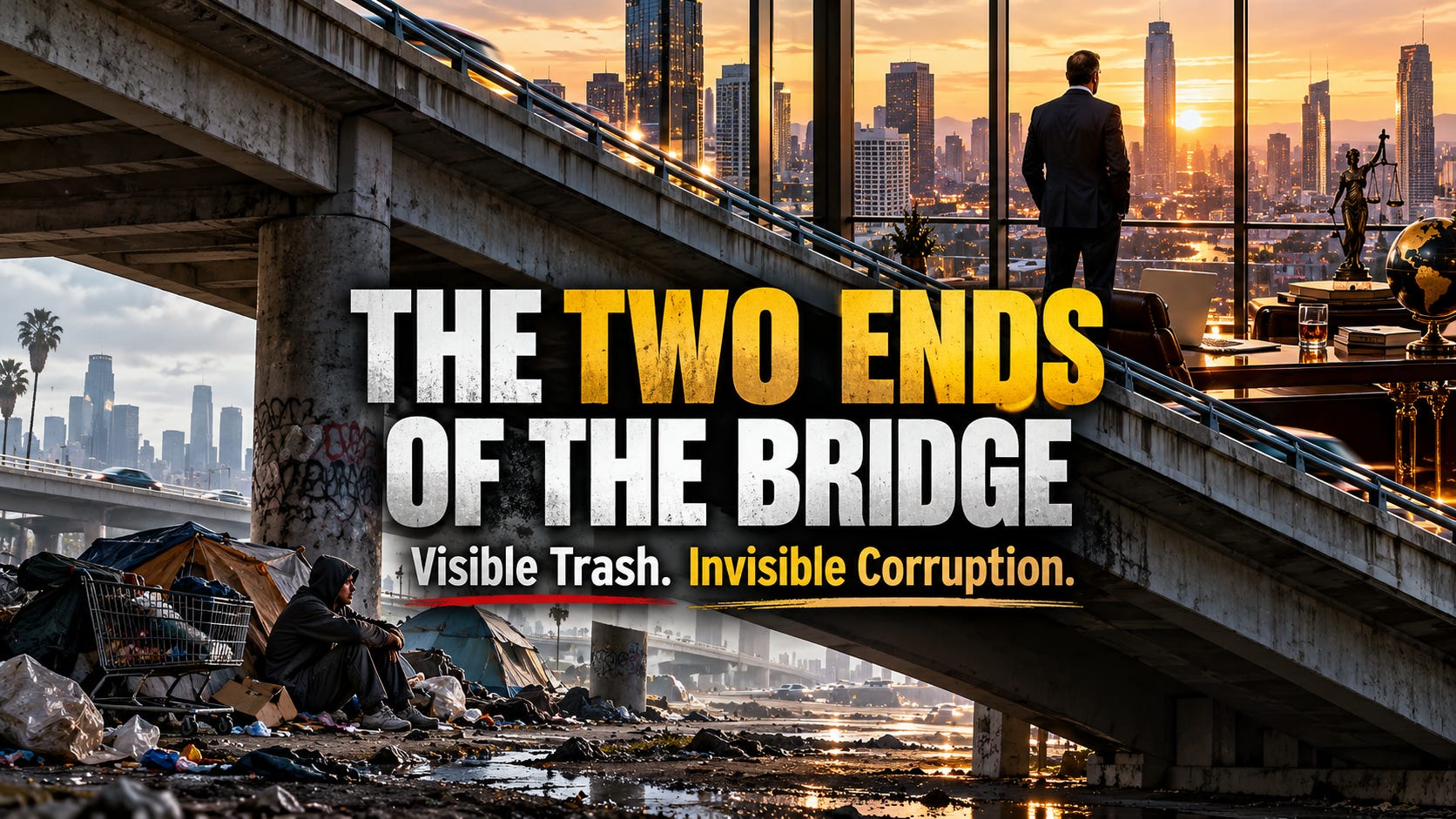
THE CONTRAST WE SEE BUT SELDOM EXAMINE
Beneath the freeway bridges of California, human beings live surrounded by discarded belongings, broken furniture, decomposing garbage, and the visible consequences of addiction, poverty, abandonment, and personal neglect. Some have gone months or years without the ordinary comforts of a home, a shower, or a safe place to sleep. Their suffering is exposed to the public, and the consequences of their circumstances often extend beyond their encampments into the surrounding community.
High above this reality, another world exists. Behind guarded entrances, polished marble floors, executive offices, and private estates live individuals whose wealth and influence can shape governments, industries, financial systems, and the lives of millions. Their clothing is immaculate, their surroundings carefully maintained, and their public images professionally managed. They may appear to represent the very opposite of the people living beneath the bridges.
Yet appearances reveal remarkably little about the consequences of human behavior.
A person beneath a freeway bridge may leave behind a pile of garbage that becomes visible within hours. A powerful executive or political leader who engages in corruption may leave behind environmental destruction, economic hardship, institutional decay, or the consequences of war that take decades to become fully understood.
One kind of damage can be collected in garbage bags. The other may require generations of investigation, rebuilding, and human sacrifice to repair.
Society has become highly skilled at recognizing physical filth. It remains far less consistent at recognizing the moral and institutional damage that can originate from its most prestigious addresses.
This is not an argument that poverty and corruption are morally equivalent. They are not. Nor is it an argument that homelessness demonstrates moral failure or that wealth demonstrates corruption. It is an examination of a deeper contradiction: why human beings judge one another so readily by visible conditions while remaining comparatively unaware of the long-term consequences of power, desire, and self-interest.
THE DIFFERENCE BETWEEN VISIBLE AND INVISIBLE CONSEQUENCES
Physical waste follows a relatively simple process. Something is consumed, discarded, and left behind. If it is not collected or properly managed, it accumulates. Eventually, the consequences become impossible to ignore.
Human decisions can follow a similar pattern, although their consequences are often far more difficult to trace.
A company may pursue greater profits by shifting environmental costs onto surrounding communities. A financial institution may encourage transactions that generate immediate revenue while transferring substantial risks to others. A public official may protect political relationships at the expense of accountability. A government may justify a military intervention through promises of security while leaving future generations to endure the economic and human consequences.
These are different situations requiring different standards of evidence and responsibility. Yet they illustrate a common ethical problem: the individual or institution receiving the immediate benefit may not be the one paying the eventual price.
This is sometimes described in economics as an externality: a cost imposed on others rather than fully borne by the decision-maker.
THE TWO TIMESCALES OF CONSEQUENCE
Immediate consequences
Garbage, sanitation hazards, public disorder, visible suffering, and neighborhood disruption.
Often measured in hours, days, or months.
Delayed consequences
Corruption, financial instability, depleted resources, institutional mistrust, and damage from conflict.
Sometimes measured in years or generations.
The difference in visibility influences public judgment. A visibly deteriorating encampment produces an immediate emotional reaction. Its presence is difficult to disguise. Institutional misconduct, by contrast, may remain hidden behind legal complexity, financial reporting, government classification, or layers of organizational responsibility.
The result is a striking imbalance. Society may react quickly to the person whose garbage is visible but take considerably longer to investigate a powerful institution whose decisions have harmed thousands.
This does not mean that every person experiencing homelessness is irresponsible or every wealthy person is predatory. The meaningful comparison concerns harmful conduct, not social class. It is possible for someone living in poverty to demonstrate extraordinary integrity and for someone possessing immense wealth to demonstrate extraordinary generosity. The reverse is also possible.
Human character cannot be measured by a bank balance, a residential address, or the cleanliness of someone’s clothing.
It must be examined through conduct, circumstances, knowledge, intentions, and consequences.
THE ILLUSION OF CLEAN HANDS
Modern civilization has developed countless ways to separate people from the consequences of their own actions.
A consumer may purchase a product without seeing the conditions under which it was manufactured. An investor may receive financial returns without understanding the practices generating them. A politician may authorize policies whose long-term effects emerge after leaving office. An executive may collect substantial compensation while risks accumulate elsewhere in the organization.
Distance creates psychological comfort.
When harm takes place far away, affects unfamiliar people, or develops slowly, it becomes easier to regard the consequences as someone else’s responsibility. The individual receives the benefit immediately while the suffering is distributed across society.
The person who drops garbage on the sidewalk can see what has been left behind. The person whose profitable decision contributes to contamination, exploitation, or financial destruction may never personally encounter those affected.
This distance can create the appearance of innocence without establishing its reality.
Clean clothing does not guarantee clean conduct. A luxurious environment does not establish a clear conscience. And social prestige does not erase responsibility for the consequences of deliberate choices.
Nevertheless, serious judgment requires evidence. A harmful outcome does not automatically establish malicious intent, and profit does not automatically establish exploitation. Responsibility must be evaluated through what was known, what could reasonably have been anticipated, what alternatives existed, and who actually made the decisions.
Without that distinction, criticism of corruption becomes another form of prejudice rather than a genuine search for truth.
MATERIALISM AND THE BELIEF THAT NOTHING FOLLOWS DEATH
Beneath the contrast between physical neglect and institutional corruption lies a philosophical question about human motivation.
What happens when a person becomes convinced that physical existence is the entirety of life, that consciousness disappears completely at death, and that nothing of personal experience continues afterward?
For some, this belief may encourage a greater appreciation of the brief opportunity to live, love, create, and serve humanity. The knowledge that life is finite can deepen responsibility rather than diminish it.
For others, however, the same belief may become part of a justification for self-indulgence. If life is understood exclusively as an opportunity to acquire pleasure, status, possessions, or power, then the temptation arises to maximize personal gain while disregarding costs imposed on others.
Why sacrifice immediate pleasure for a stranger’s future? Why refuse an opportunity to become wealthy through exploitation if punishment appears unlikely? Why preserve resources for generations one will never meet?
These questions reveal the moral danger not of disbelief itself, but of material desire becoming detached from responsibility.
Religious belief offers no automatic protection from this danger. History contains examples of people professing faith while participating in violence, exploitation, and corruption. Likewise, many people who do not believe in an afterlife conduct themselves according to deeply held principles of compassion, justice, and service.
The problem cannot therefore be reduced to a simple division between believers and nonbelievers.
A more meaningful distinction concerns the relationship between desire and conscience.
One person may believe in divine judgment yet rationalize every selfish action. Another may believe that death ends consciousness yet devote an entire lifetime to protecting people who cannot repay the kindness.
The question is not merely what someone says happens after death.
The question is whether the possibility of personal gain can persuade that person to abandon what they recognize as morally right.
THE HUMAN BODY, THE DESIRE FOR MORE, AND THE QUIET VOICE WITHIN
Human beings possess physical needs and psychological desires. Food, shelter, comfort, security, recognition, intimacy, and belonging are natural components of existence. Without these necessities, survival itself becomes difficult.
But desire does not always stop when a need has been satisfied.
Security can become accumulation. Accumulation can become competition. Competition can become domination. What begins as the natural wish to survive may eventually become the determination to control resources far beyond anything required for a meaningful life.
This transformation can occur at every economic level, although its consequences differ dramatically according to the power available to the individual.
A person struggling with addiction may become trapped in an immediate cycle of craving, temporary relief, and renewed suffering. An individual possessing enormous financial or political influence may become trapped in a different cycle: acquisition, competition, status, and the relentless pursuit of greater control.
These patterns are not identical. Addiction can involve profound changes in brain function, trauma, mental illness, and diminished control over behavior. Wealth accumulation may involve deliberate decisions, institutional incentives, or legitimate productive activity. They should never be treated as interchangeable conditions.
The philosophical connection is narrower and more important.
Both circumstances invite examination of what occurs when the pursuit of an immediate reward overwhelms consideration of broader consequences.
The body’s desires demand attention. The conscience asks questions.
The desire says, I want more.
The conscience asks, At whose expense?
The desire asks, Can I get away with it?
The conscience asks, Should I do it at all?
A spiritually conscious life, in this interpretation, does not require denying the body or rejecting material necessities. It requires preventing material desires from becoming the sole authority governing human conduct.
Material things are instruments of living. They become dangerous when they replace the purpose of living.
WAR: WHEN THE CONSEQUENCES OF DESIRE BECOME GENERATIONAL
Few human activities illustrate the distance between decisions and consequences more clearly than war.
Military conflicts involve complex causes, including security concerns, territorial disputes, ideological differences, historical grievances, and genuine threats. Not every war can responsibly be explained as a pursuit of money, and the existence of financial beneficiaries does not by itself prove that those beneficiaries caused the conflict.
Nevertheless, war creates economic incentives that deserve serious examination.
Weapons manufacturers may receive contracts. Logistics providers may secure substantial business. Reconstruction companies may obtain opportunities after infrastructure has been destroyed. Political and institutional actors may acquire influence, budgets, or strategic advantages.
Meanwhile, civilians may lose their homes, livelihoods, health, loved ones, and the stability required to build a future.
A decision made in a government office can become a child’s lifelong disability, a family’s displacement, or a community’s destruction.
Some consequences begin immediately. Others continue long after political leaders have retired and the conflict has disappeared from the headlines.
The moral issue is not whether money changes hands during war; economic activity is inevitable. The issue is whether incentives to profit influence decisions that should be governed by necessity, proportionality, evidence, and the protection of human life.
Investigating these incentives means examining procurement records, lobbying relationships, contracts, political decisions, and documented beneficiaries rather than assuming that every profitable outcome proves a conspiracy.
The greatest danger arises when the people empowered to make destructive decisions become insulated from the suffering those decisions produce.
At that point, society faces a problem extending far beyond individual greed. It faces a system in which consequences and accountability have become separated.
WHY SOCIETY JUDGES THE BOTTOM MORE QUICKLY THAN THE TOP
Human beings respond strongly to what they can directly observe.
An encampment beneath a freeway bridge may produce fear, discomfort, concern, or anger. Residents may face genuine sanitation hazards, obstructed public spaces, or other disruptions. Those effects should not be dismissed, and communities have legitimate interests in maintaining safe and accessible public environments.
But people living in encampments may themselves endure violence, illness, exposure, exploitation, and severe insecurity. They are not simply the producers of a public problem; they are also human beings living inside it.
Visible suffering often makes it easier for society to identify someone to blame than to identify the full chain of causes.
In contrast, large-scale institutional harm is frequently dispersed. A financial crisis may involve hundreds of decisions. Environmental damage may result from decades of conduct. Political corruption may be concealed through intermediaries, complicated transactions, or weak oversight.
The more diffuse the responsibility, the more difficult accountability becomes.
This creates an uncomfortable possibility: public outrage may sometimes be directed toward those who are easiest to see rather than toward those whose decisions caused the greatest harm.
The appropriate response is not to excuse neglect at one end of society or presume wrongdoing at the other. It is to apply consistent standards of accountability while recognizing differences in vulnerability and power.
Someone struggling to survive beneath a bridge should not be treated as though they possess the same freedom of choice or capacity to cause harm as someone commanding a major institution.
And someone commanding a major institution should not escape scrutiny because their consequences are less visible.
THE AFTERLIFE AS A QUESTION OF ACCOUNTABILITY
The belief that human existence continues beyond physical death has shaped philosophical and spiritual traditions for thousands of years.
Some traditions describe divine judgment. Others describe karma, rebirth, spiritual development, or consciousness continuing beyond the physical body. These explanations differ considerably, and none should be presented as scientifically established merely because it offers a compelling moral framework.
Yet they share an important philosophical possibility: that human existence may carry significance beyond material acquisition and immediate pleasure.
If consciousness survives death, the individual may eventually confront a dimension of responsibility that cannot be escaped through wealth, legal protection, social status, or physical death.
From that perspective, the powerful executive and the person beneath the freeway bridge ultimately face the same essential question.
What did you do with the life you were given?
Did you knowingly cause suffering when you possessed the ability to avoid it? Did you help when help was possible? Did you pursue pleasure at the expense of others? Did you use your influence to protect life or exploit it?
These questions do not require anyone to prove an afterlife before taking them seriously.
Even if physical death marks the end of individual experience, consequences continue among the living. Children inherit the world their predecessors created. Communities inherit the institutions previous generations established. Human decisions become part of history whether or not the decision-makers remain conscious of them.
In this sense, nobody simply disappears without leaving something behind.
Their bodies may return to nature, but the effects of their actions continue through relationships, institutions, memories, damage, and acts of kindness.
We may disagree about what awaits us after death, but we cannot reasonably deny that our actions help shape the world that survives us.
THE UNEXPECTED TEACHERS AT BOTH ENDS OF SOCIETY
There is another way to understand the people and circumstances we encounter throughout life.
What if society is not merely a collection of individuals competing for survival, but also a living environment in which consciousness develops through observation, experience, and choice?
A person living beneath a freeway bridge may teach an observer about vulnerability, addiction, neglected suffering, gratitude, or the fragility of material security. The lesson may concern the circumstances that brought the person there, the behavior that followed, or society’s response to that human being.
A powerful individual whose documented conduct reveals corruption may teach a different lesson about greed, rationalization, institutional incentives, and the dangers of separating authority from accountability.
In both cases, the observer has a choice.
One response is contempt. Another is indifference. A third is curiosity accompanied by compassion and moral judgment.
The first two responses may preserve the observer’s existing assumptions. The third creates the possibility of growth.
This does not mean that vulnerable people exist for the educational benefit of others. Their dignity and well-being matter independently of any lessons observers may draw. Nor does it mean that wrongdoing should be tolerated because it provides a spiritual example.
The purpose of learning from injustice is to become better equipped to prevent it.
If life is understood as a school, every encounter can become an examination of consciousness. But passing that examination requires more than recognizing another person’s mistakes.
It requires identifying the same tendencies within ourselves.
Where do we ignore suffering because it is inconvenient? Where do we rationalize selfish behavior? Where do we choose immediate comfort over responsibility? Where do we condemn visible wrongdoing while benefiting from systems we prefer not to examine?
These questions transform the metaphor of the school from an explanation of other people’s conduct into a demand for personal accountability.
The person who learns only to recognize darkness in others has completed only part of the lesson. The deeper education begins when that person recognizes the capacity for darkness and light within themselves.
THE REAL MEASURE OF CIVILIZATION
Modern societies often evaluate progress through economic production, technological advancement, military capability, infrastructure, and accumulated wealth.
These measures are useful. They reveal important dimensions of material development.
But they cannot independently establish whether a civilization is becoming more compassionate, responsible, or just.
A society can possess extraordinary technological capabilities while failing to provide adequate treatment for people suffering from addiction. It can produce immense wealth while permitting preventable environmental damage. It can celebrate financial success while allowing powerful institutions to transfer the consequences of their decisions onto people who had no role in making them.
Material development and moral development are not necessarily the same achievement.
Consider a civilization capable of constructing skyscrapers, developing artificial intelligence, exploring space, and conducting sophisticated medical procedures. If that civilization remains unable to reconcile the pursuit of individual advantage with responsibility for collective well-being, its technological sophistication has outpaced an important dimension of its ethical maturity.
The problem is not money itself. Nor is it ambition, comfort, success, or the enjoyment of life.
The problem emerges when these things become detached from a sense of responsibility toward others.
A healthy society should be capable of addressing public disorder without dehumanizing people experiencing homelessness. It should be capable of creating wealth without allowing preventable harm to be treated as somebody else’s expense. It should be capable of exercising political and military power while subjecting consequential decisions to meaningful scrutiny.
Civilization should not be measured only by the cleanliness of its streets or the prosperity of its financial districts.
It should also be evaluated by how it treats vulnerable people, how effectively it prevents exploitation, and how seriously it holds powerful institutions accountable.
🩸 The Red Blood Perspective
The visible waste accumulating beneath a freeway bridge and the less visible damage arising from institutional corruption are not equivalent harms, but their contrast exposes an important weakness in public perception.
Society recognizes what is immediately observable more easily than what is concealed, distributed, or delayed. Physical garbage can be photographed and removed. Financial misconduct, environmental damage, and destructive political decisions may require years of documentation before responsibility can be reliably established.
The standard must be actions, evidence, and consequences rather than appearances, social class, declared beliefs, or public reputation.
Who made the decision? What did they know? Who received the benefit? Who paid the cost? Was the harm foreseeable? Who had the power to prevent it? What mechanisms of accountability existed, and were they actually used?
These questions are equally relevant to individual conduct, corporate behavior, and government decision-making, although the legal and ethical standards applicable to each will differ.
The spiritual hypothesis that belief in personal extinction after death can encourage selfish behavior may offer one interpretation of human motivation. It is not a proven explanation of corruption, and it cannot justify assumptions about the religious beliefs of people experiencing homelessness or those occupying positions of power.
What can be established is that human beings and institutions sometimes pursue benefits while transferring significant costs to others. The resulting harm should be investigated without prejudice, and responsibility should increase with the knowledge, freedom, and power available to the decision-maker.
The central failure is not that humanity produces waste. It is that humanity too often permits those who benefit from harmful decisions to separate themselves from the consequences.
🌊❤️✨ The Ocean of Love and Positivity Perspective
Imagine approaching the freeway bridge without disgust and the mansion without envy.
Beneath the bridge is a human being whose life contains experiences we may not understand. Behind the walls of the mansion is another human being whose possessions cannot reveal the condition of their conscience. Both are participants in the same human existence, subject to desire, fear, suffering, and the possibility of transformation.
If consciousness is more than the physical body, then neither poverty nor wealth defines the spiritual worth of the individual. If life is a school, the opportunities to learn are not reserved for the fortunate, the educated, or the powerful.
Every human being can learn to recognize the difference between need and greed, pleasure and fulfillment, power and responsibility, judgment and understanding.
Compassion does not mean approving destructive behavior. Love does not require abandoning accountability. Forgiveness does not erase consequences, and spiritual growth does not excuse harm.
It means understanding that the purpose of recognizing suffering and wrongdoing should ultimately be to reduce them rather than multiply them.
The person struggling with addiction may need shelter, treatment, human connection, and an opportunity to recover. The person who knowingly exploits others may need meaningful accountability, restitution, and a fundamental reconsideration of the values guiding their decisions.
One requires help without humiliation. The other requires accountability without hatred. Both remain human.
Perhaps the greatest spiritual advancement would be a civilization in which individuals no longer require the fear of punishment after death to behave responsibly during life.
A civilization in which compassion is not merely a religious instruction, morality is not merely a legal obligation, and generosity is not merely a public performance.
A civilization in which people understand that another person’s suffering is not entirely separate from their own existence.
Whether consciousness survives the physical body remains an open philosophical and spiritual question. But we do not need to resolve it before deciding how to live.
We can choose not to exploit. We can choose not to abandon. We can choose to use our resources responsibly, question our own desires, and recognize the humanity of people whose circumstances differ profoundly from ours.
And perhaps that is the lesson waiting at both ends of the bridge.
The world does not become cleaner merely because we remove what offends our eyes. It becomes healthier when we also confront the harmful conduct that our eyes cannot immediately see.
The highest form of human progress may not be learning how to accumulate more, but learning how to leave less suffering behind.
🩸🌊❤️✨ — Ocean of Love and Positivity
Blood connects us. The ocean unites us. Love guides us. Positivity illuminates our path.
⚖️
Visible Waste and Invisible Corruption
Oct 24, 2026
The provided text examines the moral disparities between visible poverty and concealed institutional corruption, arguing that society too readily judges physical mess while overlooking systemic harm. It contrasts the immediate struggles of homelessness with the long-term, devastating consequences of unrestrained wealth and power, where decision-makers often distance themselves from the suffering they create. Furthermore, the selection explores how material desires can eclipse individual conscience and responsibility, regardless of one’s religious beliefs or views on an afterlife. Ultimately, the writing calls for consistent accountability across all social classes, urging humanity to measure true civilization not by technological or material advancement, but by its commitment to compassion and the reduction of suffering.