


🩸 🇮🇷 🇺🇸 ⏳ ⚖️ 🔒 🌊❤️✨ — THE TIME TRAVELER: Is Iran a Warning From America’s Future?
From the Iranian Revolution to the COVID-19 Emergency: Government Control, the Manufacturing of Consent, and the Constitutional Crossroads Facing America
RED BLOOD JOURNAL — INVESTIGATIVE ANALYSIS
Published: October 29, 2026
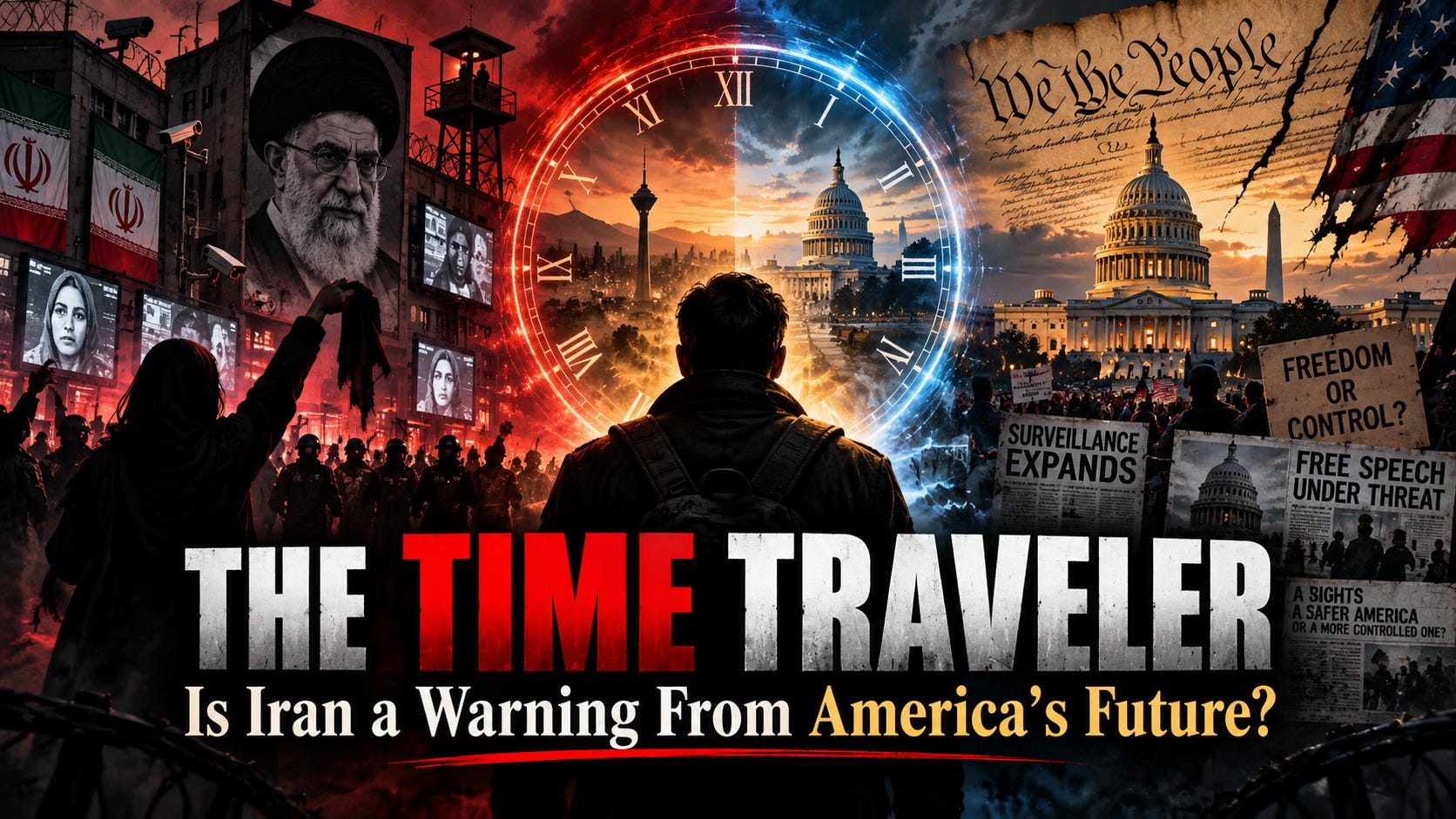
PROLOGUE — I FEEL LIKE A TIME TRAVELER
Sometimes, observing the United States from the perspective of someone who grew up in Iran during the 1960s and witnessed the country’s transformation produces an unsettling sensation. It is almost like traveling through time, watching a society encounter political and institutional patterns that another society experienced decades earlier. The countries are different, their histories are different, and their political systems remain profoundly different, yet certain mechanisms of power appear disturbingly familiar.
For someone who remembers Iran before the Islamic Revolution of 1979 and has witnessed what followed, the danger of authoritarian government is not merely a concept found in history books. It is an experience connected to the transformation of institutions, public behavior, individual freedom, and the relationship between citizens and the state. It raises a question that many Americans have never had reason to consider seriously: What happens when the institutions established to protect the population gradually acquire the power to control it?
The question is not whether the United States has already become Iran. It has not. The question is whether Americans are observing the early stages of institutional developments whose ultimate consequences they have not yet fully considered. If constitutional safeguards weaken gradually enough, could a society surrender freedoms through a series of decisions that appear individually justified, only to discover later that those decisions have fundamentally transformed the balance of power?
And perhaps the most troubling question concerns the COVID-19 pandemic. Was the emergency response simply a collection of extraordinary measures undertaken during an unprecedented public-health crisis, or did it also establish institutional precedents that could be exploited for purposes far beyond public health? Was the expansion of authority an unintended consequence, a political opportunity, or part of a deliberately coordinated design?
These are different hypotheses requiring different evidence. Yet all deserve examination because the consequences of excessive government power depend not only on the intentions of those who first acquire it, but also on how that authority may be used by their successors.
I. IRAN BEFORE AND AFTER 1979 — WHEN THE PROMISE OF FREEDOM BECOMES THE STRUCTURE OF CONTROL
The Iranian Revolution of 1979 was presented by its diverse supporters through promises of independence, justice, political participation, religious dignity, and an end to authoritarian monarchy. Many participants envisioned a future in which the concentration of power under the Shah would be replaced by a more accountable political order. What emerged, however, was a system in which ultimate authority became concentrated in institutions operating above ordinary democratic accountability.
The Islamic Republic gradually consolidated political power through clerical institutions, security organizations, revolutionary courts, ideological supervision, and restrictions on public expression. Elections remained part of the political structure, but the range of permissible political competition became constrained by institutions empowered to determine which candidates and movements could participate. Opposition increasingly carried risks extending beyond electoral defeat, including imprisonment, prosecution, professional exclusion, and violent repression.
The important historical lesson is not that every revolution inevitably produces another dictatorship. It is that political movements promising liberation can construct institutions that reproduce the very concentration of authority they originally condemned. The slogans may change, the uniforms may change, and the people occupying government offices may change, while the fundamental relationship between ruler and citizen remains largely unchanged.
By 2026, the institutional consequences of that transformation were extensively documented. Freedom House classified Iran as Not Free, awarding it 10 points out of 100 for political rights and civil liberties. The organization’s assessment identified the dominance of unelected institutions, the restrictions imposed on political competition, and the central role of security organizations and the judiciary in suppressing dissent.
The United Nations Independent International Fact-Finding Mission also documented severe human-rights violations connected to the repression of protests beginning in December 2025. Its September 2026 findings included violations involving unlawful killings, imprisonment, torture, and other serious abuses, with some conduct assessed as crimes against humanity.
Iran therefore provides more than a speculative warning about state power. It offers an extensively documented example of what happens when institutions capable of enforcing government decisions become insufficiently accountable to the population whose rights they are supposed to protect.
The essential lesson is that concentrated political power becomes especially dangerous when it can determine not only what citizens may do, but also what they may say, whom they may support, what information they may receive, and which legal remedies remain available when the government itself violates the law.
II. AMERICA’S CONSTITUTIONAL PROMISE — A DIFFERENT FOUNDATION
The United States was established around a different constitutional framework. Its founding structure divided authority among branches of government, reserved powers to the states and the people, and recognized limits on what government could lawfully demand from individuals. The Constitution did not eliminate the possibility of authoritarian behavior, but it created institutional mechanisms through which such behavior could be challenged.
The First Amendment protects freedom of speech, religion, the press, peaceful assembly, and the right to petition government. The Fourth Amendment restricts unreasonable searches and seizures, while the Fifth and Fourteenth Amendments establish essential protections relating to due process. The separation of powers and the federal structure create additional opportunities to contest unlawful exercises of authority.
These protections distinguish the United States from Iran in substantial and measurable ways. In its 2026 assessment, Freedom House classified the United States as Free, with a score of 81 out of 100. Americans retained competitive national elections, an active independent press, extensive civil-society organizations, and access to courts capable of restricting unlawful executive action.
Nevertheless, that same assessment documented deterioration in aspects of American democratic governance. It identified concerns involving expanding executive authority, weakening institutional oversight, political retaliation, pressure on expression, and shortcomings in anti-corruption safeguards.
These developments do not establish that American institutions are equivalent to Iranian institutions. They do establish that constitutional democracies can experience erosion without undergoing an immediate revolution, military takeover, or formal suspension of their constitutions.
A constitution may remain written exactly as it was while the practical relationship between government and governed changes around it. Whether constitutional guarantees retain their meaning depends on the willingness and capacity of courts, legislators, public officials, journalists, and citizens to enforce them.
The danger is not necessarily the sudden disappearance of constitutional language. It is the possibility that constitutional protections gradually become less effective in everyday life.
III. THE PANDEMIC — WHEN EMERGENCY AUTHORITY ENTERED ORDINARY LIFE
The arrival of COVID-19 in 2020 created an extraordinary public-health emergency. Governments faced a rapidly spreading infectious disease, major uncertainty about its consequences, and considerable pressure to act before reliable scientific knowledge had fully developed. Emergency measures were adopted across the political spectrum, often with the stated intention of reducing transmission, protecting hospitals, and preserving public health.
Those objectives deserve recognition in evaluating the decisions made at the time. However, acknowledging a legitimate public-health purpose does not eliminate the need to investigate the legality, proportionality, duration, economic consequences, and institutional precedents associated with emergency measures.
Across the United States, the pandemic brought restrictions on business operations, public gatherings, travel, schools, and some employment activities. Vaccine requirements, testing policies, and disputes over workplace obligations created substantial controversy concerning the boundaries between collective safety and individual autonomy. The specific legal authority, exemptions, and duration of these measures varied considerably by jurisdiction and policy.
One of the most significant developments was the normalization of decisions that might previously have been regarded as extraordinary intrusions into ordinary life. Government officials and administrative agencies made decisions affecting employment, movement, business continuity, and participation in public institutions. Some Americans supported these actions as necessary responses to an exceptional threat, while others regarded particular restrictions as excessive, insufficiently justified, or incompatible with constitutional principles.
The key institutional question extends beyond whether a particular pandemic measure was justified. It concerns the precedent established when governments demonstrate their ability to reorganize large portions of civilian life through emergency authority.
If a government can temporarily restrict ordinary freedoms during a genuine emergency, what prevents future officials from defining additional circumstances as emergencies? Who determines when those circumstances have ended, and what happens to the authority, infrastructure, regulations, and expectations established during the crisis?
Emergency government becomes especially concerning when temporary measures are normalized, renewed without adequate scrutiny, or repurposed for unrelated objectives. The lasting political consequence of a crisis may therefore be found not only in the restrictions imposed during the emergency, but also in the institutional capabilities that survive afterward.
IV. CENSORSHIP, INFORMATION CONTROL, AND THE POWER TO DEFINE ACCEPTABLE REALITY
One of the defining characteristics of authoritarian political systems is the ability to control public information and punish unauthorized narratives. In Iran, state restrictions on independent media, internet access, political speech, and public dissent have long formed an important component of the government’s control structure.
The American situation is different, but debates over government influence on information platforms became particularly visible during the pandemic.
In Murthy v. Missouri, decided on June 26, 2024, the United States Supreme Court examined litigation arising from communications between federal officials and social-media platforms concerning COVID-19 information and election-related claims. The record described extensive interactions involving government agencies and private technology companies, while the plaintiffs alleged unconstitutional pressure to suppress protected speech.
The Supreme Court ruled that the plaintiffs lacked standing to obtain the requested injunction. It did not issue a final merits determination establishing that every challenged communication was constitutional. The litigation consequently left important constitutional questions concerning government encouragement, private moderation decisions, and coercive pressure subject to further legal distinction and debate.
This distinction matters because direct government censorship and private editorial decisions are not legally interchangeable. Platforms may independently decide what content to carry, and government officials may communicate legitimate public concerns. A constitutional problem arises when official conduct crosses the boundary into coercion or sufficiently significant encouragement of suppression attributable to the state.
From the Red Blood perspective, the investigative question should therefore focus on actual communications, identifiable decision-makers, institutional leverage, and documented consequences. Who requested that particular content be restricted, what authority was invoked, how did platform operators respond, and were the resulting decisions independently justified?
The broader danger is a political environment in which the authority to determine acceptable public discussion becomes concentrated among government officials and a relatively small number of powerful private intermediaries.
A healthy society must retain the ability to challenge official conclusions, including conclusions eventually demonstrated to be correct. Scientific disagreement must be evaluated through evidence, while unlawful threats and genuinely harmful conduct remain subject to established legal standards. The distinction between correcting misinformation and suppressing lawful dissent cannot be decided merely by attaching a disapproving label to an opposing viewpoint.
A society loses a meaningful safeguard when those responsible for public decisions also gain excessive influence over which criticisms of those decisions can reach the public.
V. THE ECONOMICS OF COMPLIANCE — WHEN SURVIVAL AND OBEDIENCE INTERSECT
Political control does not always depend exclusively on police forces, prisons, or overt censorship. Economic dependency can also influence the extent to which individuals feel able to challenge institutions that govern important aspects of their lives.
During the pandemic, restrictions and economic disruption affected businesses, employees, independent contractors, families, and entire industries. Many businesses temporarily closed, some permanently failed, and millions of workers experienced changes in employment or income. Meanwhile, public assistance programs, employer policies, financial institutions, and digital platforms became significant intermediaries in determining how people could continue participating in economic life.
These developments were not uniform. Emergency assistance prevented serious hardship for many households, while particular restrictions and administrative failures imposed substantial costs on others. An accurate investigation must account for both outcomes rather than presenting the entire response as either humanitarian protection or intentional economic coercion.
Nevertheless, an important question remains: How independent can a citizen be when essential access to employment, communication, financial services, healthcare, or mobility becomes conditional on complying with requirements established by powerful institutions?
That question is not an argument against all reasonable conditions attached to public or private services. It is an argument for examining whether such conditions are lawful, proportionate, transparent, appealable, and consistent with fundamental rights.
Economic incentives can alter behavior without requiring explicit threats. When disagreement carries the possible cost of losing employment, professional standing, financial services, or access to important institutions, individuals may choose silence even when no government officer directly orders them to remain quiet.
This creates a broader area for investigation into the relationship between material dependency and political autonomy. Concentrated control over essential resources may increase the practical costs of resistance, even in societies that formally recognize freedom of expression.
The challenge is to identify actual examples, establish who imposed the conditions, examine the benefits and harms, and distinguish legitimate regulation from arbitrary or coercive exclusion.
VI. WAS COVID-19 THE BEGINNING OF A DELIBERATE DESIGN?
The hypothesis that pandemic-era policies formed part of a deliberate project to expand long-term control deserves careful investigation, but it cannot responsibly be treated as an established conclusion without evidence of coordination, intent, and implementation.
At least three explanations must be considered.
The first is institutional expansion during an emergency. Governments confronting extraordinary circumstances may adopt powers that extend beyond their ordinary practices. Those powers can produce lasting consequences even when the original intention was limited to addressing a genuine crisis.
The second is opportunistic exploitation. Political leaders, government agencies, businesses, or other organizations may recognize that an emergency creates opportunities to expand authority, acquire resources, reduce oversight, or influence public behavior. Such exploitation does not require every participant to belong to a centralized organization or to share a secret long-term plan.
The third is deliberate advance coordination. Under this hypothesis, influential participants intentionally prepared or directed policies to establish systems of control that would survive the public-health emergency. Demonstrating this would require credible evidence such as planning records, communications, financial arrangements, coordinated operational decisions, or testimony capable of withstanding independent scrutiny.
The existence of beneficiaries is not, by itself, proof of intentional design. Likewise, the absence of a publicly available document establishing a coordinated plan does not eliminate the possibility that particular actors pursued concealed objectives.
The proper investigative approach is to follow documented actions, resources, institutional authority, and outcomes, while carefully distinguishing between established facts, plausible inferences, and allegations that remain unverified.
The more immediate finding is that the pandemic demonstrated how rapidly extraordinary government authority can affect everyday life. Whether that demonstrated capability becomes a permanent instrument of political control depends on subsequent institutional decisions, legal safeguards, public accountability, and the willingness of citizens to scrutinize new emergencies before consenting to additional powers.
VII. THE EMERGENCY THAT NEVER ENDS
America’s legal framework contains unusually broad emergency authorities. The Brennan Center for Justice has identified 137 statutory powers that may become available to a president upon declaration of a national emergency, along with 13 additional authorities associated with emergencies declared by Congress.
These authorities serve different purposes and are subject to different legal conditions. Their existence does not mean that every authority may be exercised arbitrarily or that every president possesses unlimited power. Nevertheless, the scope of available emergency mechanisms demonstrates why legislative oversight and judicial review remain essential.
The National Emergencies Act allows presidents to declare and renew national emergencies, while Congress possesses procedures for terminating them. In practice, the presidential veto and other institutional obstacles can complicate congressional efforts to end an emergency over executive opposition.
This creates a recurring constitutional tension. Temporary authority may be necessary during a genuine crisis, but temporary authority becomes difficult to distinguish from ordinary government power when emergencies continue indefinitely or when similar justifications are repeatedly invoked for different purposes.
The danger is cumulative rather than necessarily immediate. Each emergency may introduce another justification for extending surveillance, concentrating decisions, limiting public participation, or reducing normal procedural requirements. Even when the emergency ends, some related institutional practices may survive.
The critical question is therefore not simply whether government should possess emergency powers. It is whether those powers remain genuinely exceptional, subject to meaningful oversight, and reversible when their original justification expires.
A constitutional society should be able to demonstrate not only how emergency authority is granted, but also how it is withdrawn.
VIII. THE SUPREME COURT — A CONSTITUTIONAL BARRIER OR A DELAYED RESPONSE?
The American judiciary provides an institutional safeguard that does not have an equivalent level of independence within Iran’s political system. Federal courts can review executive actions, evaluate statutory authority, and invalidate government conduct that violates constitutional requirements.
During the pandemic, the Supreme Court provided an important example of this power in National Federation of Independent Business v. OSHA. On January 13, 2022, the Court blocked the implementation of a broad federal workplace vaccination-or-testing requirement affecting employers with at least 100 employees. The majority concluded that OSHA had exceeded the authority Congress had delegated to the agency.
The decision demonstrated that emergency conditions did not eliminate the requirement for federal agencies to act within lawful boundaries. It also revealed the practical limitations of litigation as a protective mechanism, because restrictions may already have affected individuals and institutions before courts resolve the relevant disputes.
This leads to a difficult but legitimate question: Is a constitutional safeguard fully effective if unlawful or excessive policies impose substantial consequences before judicial review can provide relief?
There is no simple answer. Courts operate under rules governing jurisdiction, standing, evidence, remedies, and the timing of legal challenges. These procedural requirements protect important principles of judicial independence and prevent courts from exercising unlimited political authority. At the same time, delays can create circumstances in which individuals experience consequences that later legal decisions cannot entirely reverse.
A meaningful evaluation must therefore examine not only whether courts eventually reject unlawful actions, but also whether accessible and timely remedies exist for those harmed by government overreach.
The strength of constitutional government cannot be measured solely by the number of judicial decisions issued. It must also be measured by whether those decisions are respected and whether citizens can realistically obtain relief when their rights are violated.
IX. THE UPSIDE-DOWN POLITICAL NARRATIVE
One of the most disturbing features of prolonged authoritarian control is the possibility that official narratives become increasingly disconnected from the experiences of ordinary people.
A government may describe restrictions as protection, surveillance as security, conformity as responsibility, and opposition as a threat. Some policies genuinely serve legitimate public purposes, while others may employ these descriptions to conceal excessive power or institutional self-interest.
The distinction can only be established through evidence.
In Iran, the contradiction between official claims of political legitimacy and documented repression is visible in the treatment of protesters, political prisoners, journalists, and dissenters. An institution may claim to defend national independence while restricting the political independence of its own citizens.
In the United States, the existence of competing parties, independent media, constitutional litigation, and investigative organizations creates more opportunities to expose inconsistencies between official claims and observable conduct. Yet those opportunities are meaningful only when institutions remain independent enough to perform their functions.
The Red Blood investigative method begins with actions rather than political branding. A policy described as public safety must be examined through its actual effects on safety, individual rights, and institutional power. A measure described as economic protection must be examined through the distribution of its costs and benefits. A restriction justified as necessary must be evaluated against its legal basis, available alternatives, and documented results.
The important question is not whether an institution claims to act for the public good. Nearly every government makes that claim. The important question is whether its actions can withstand independent examination.
When reality and official explanation diverge, citizens must retain the practical ability to investigate and discuss that divergence without fear of unlawful retaliation.
X. WHY AMERICA IS NOT IRAN — AND WHY THE COMPARISON STILL MATTERS
Any responsible comparison must recognize that the United States and Iran currently differ in essential characteristics.
The United States retains competitive elections, legally protected political opposition, constitutionally independent courts, federalism, a diverse media environment, and civil-society organizations capable of publicly challenging government actions. Iranian political institutions place much more extensive restrictions on electoral competition, expression, association, and dissent.
The available evidence does not justify asserting that American citizens presently face the same systematic forms of political imprisonment, torture, and state repression documented in Iran.
However, recognizing these differences should not become an argument for ignoring institutional warning signs. Political systems are not static, and constitutional structures do not remain effective through language alone.
Democratic erosion can occur incrementally through changes in executive authority, the weakening of legislative oversight, selective enforcement of laws, pressure on independent institutions, or the normalization of retaliation against lawful political opposition.
Some changes may be reversible. Others may create long-lasting precedents that make additional concentrations of power easier to accomplish.
The Iranian experience therefore offers a warning about the destination of unchecked authority, not a predetermined timetable for the United States.
America’s future cannot be derived mechanically from Iran’s past. Its trajectory depends on the decisions of institutions and citizens, the distribution of political authority, and the continued enforceability of constitutional rights.
XI. THE NEXT FEW YEARS — THE TEST OF THE CONSTITUTION
There is no reliable basis for declaring that the United States will become an Iranian-style authoritarian system within a few years. History does not provide such a countdown, and political outcomes depend on many changing factors.
The more useful approach is to identify the institutional developments that would indicate whether constitutional safeguards are becoming stronger or weaker.
Americans can examine whether lawful criticism of government officials remains protected, whether journalists can investigate public institutions without unlawful retaliation, whether courts can enforce decisions against executive agencies, and whether legislative bodies retain meaningful control over spending and emergency authority.
They can also examine whether elections provide genuine opportunities for political competition, whether government surveillance is subject to effective oversight, whether emergency policies have clear expiration mechanisms, and whether individuals can challenge restrictions without facing disproportionate consequences.
These are not exclusively Democratic or Republican concerns. They involve the constitutional limits that apply regardless of which political party controls the presidency, Congress, state governments, or administrative agencies.
A constitutional principle that protects only one’s preferred political movement is not a reliable constitutional principle. Its significance becomes evident when it also protects critics, opponents, minorities, and unpopular speakers.
That is where the experience of Iran becomes especially relevant. Once political authority is sufficiently concentrated, changing the identity of the individuals governing the country may no longer restore the independence of the institutions themselves.
The fundamental safeguard is therefore not merely replacing one leadership group with another. It is preserving a political structure in which no leadership group can lawfully place itself beyond accountability.
XII. THE TIME TRAVELER’S WARNING — WHAT SHOULD AMERICANS LEARN BEFORE IT IS TOO LATE?
Someone who has lived through the transformation of a political system may recognize similarities that others initially dismiss because their own society still appears fundamentally secure.
Such recognition does not guarantee that the observed similarities lead to the same outcome. Historical experience can illuminate patterns, but it can also create understandable expectations that require careful testing against present evidence.
The value of the time-traveler perspective lies in recognizing how extraordinary authority can become familiar through repetition. People adapt to changing conditions, sometimes without noticing how much the relationship between themselves and their institutions has changed.
A restriction that initially appears exceptional may become routine. An emergency procedure may become a standard administrative practice. A disputed exercise of authority may establish a precedent for subsequent officials. A political narrative may be repeated so frequently that questioning it comes to be regarded as irresponsible rather than a normal exercise of citizenship.
Yet none of these processes is irreversible merely because it has begun.
The American Constitution establishes mechanisms through which citizens, courts, legislators, states, journalists, and civil organizations can challenge government action. Those mechanisms are not guaranteed to succeed in every dispute, but their continued existence creates possibilities that remain severely restricted within Iran.
The question is whether those mechanisms will continue to operate effectively when officials invoke national security, public health, economic emergencies, public order, or other powerful justifications for expanding authority.
Constitutional limits are most consequential when enforcing them is inconvenient to those exercising power.
For someone who remembers the promises of freedom surrounding Iran’s revolution and the political system that ultimately emerged, this is perhaps the central warning: Never assume that a government remains accountable merely because it continues to speak in the language of liberty, security, democracy, or public welfare.
Those claims must be tested against its actions.
🩸 THE RED BLOOD PERSPECTIVE — FOLLOW THE POWER, NOT THE PROMISE
The Iranian experience demonstrates the dangers of political institutions that concentrate authority while restricting the population’s ability to challenge those who exercise it. The United States retains stronger legal and institutional safeguards, but documented concerns about executive expansion, emergency authority, and pressure on civic freedoms make continued scrutiny necessary.
COVID-19 exposed the extraordinary reach of modern government during a national emergency. It also revealed the importance of administrative accountability, independent courts, private institutions, and public access to contested information. Some interventions had legitimate protective purposes, some generated substantial economic and social costs, and particular measures raised constitutional questions that required judicial intervention.
Whether these developments reflect a centrally coordinated long-term design remains unproven. What does not require speculation is that governments and institutions acquire practical capabilities through their actions, and those capabilities may remain available after the original emergency has passed.
Red Blood Journal therefore places the investigation where evidence can establish responsibility: official decisions, statutory authority, documented communications, financial incentives, institutional beneficiaries, judicial rulings, and measurable consequences.
The question is not simply who occupied the White House during the pandemic, or who occupies it today. It is which powers were claimed, which were lawfully authorized, which exceeded legal limits, which survived, and whether future officials can use them against a population that has become accustomed to their existence.
The Constitution is not protected by political slogans, and the population is not protected merely by changing the party controlling government. Constitutional protection depends on enforceable limits that apply to every administration.
The time traveler does not claim to know America’s future. The warning is that history offers repeated examples of societies discovering the value of institutional independence only after that independence has been severely weakened.
🌊❤️✨ THE OCEAN OF LOVE AND POSITIVITY PERSPECTIVE — THE FREEDOM THAT BEGINS WITHIN
Beyond the political structures of Iran and the United States lies another question concerning the nature of the human being. Why do individuals seek power over others, and why do societies sometimes become willing to exchange conscience, independence, or dignity for promises of material security?
Fear and desire can influence both sides of that relationship. Those who govern may become attached to authority, wealth, prestige, or the ability to determine the behavior of others. Those who are governed may become willing to surrender responsibility for their own judgment when uncertainty, hardship, or insecurity makes obedience appear more comfortable than independent thought.
This is not an accusation against people struggling to survive. Human beings need food, shelter, healthcare, security, and meaningful opportunities to participate in society. A compassionate civilization should strive to make these necessities accessible without turning dependence into an instrument of humiliation or political submission.
The spiritual challenge is to recognize that freedom requires more than the absence of physical restraints. It also requires an inner capacity to distinguish conscience from fear, integrity from material temptation, and genuine responsibility from obedience motivated solely by self-preservation.
A society cannot preserve human dignity by cultivating hatred toward those who disagree. It cannot overcome censorship by demanding censorship of its opponents, nor can it overcome coercion by adopting coercion as its own preferred instrument.
The Ocean of Love and Positivity offers a different foundation: compassion without surrendering discernment, forgiveness without abandoning accountability, and peaceful courage without dehumanizing those who exercise power.
Perhaps the most important lesson from Iran is not simply the danger of an authoritarian government. It is the enduring human responsibility to protect one another’s dignity before institutions make that responsibility difficult to fulfill.
The purpose of recognizing a warning from history should not be to live in fear of tomorrow. It should be to act with greater awareness today, preserving the capacity for independent judgment while respecting the same freedom in others.
A person who chooses love over hatred, evidence over manipulation, and conscience over the pursuit of power contributes to a society in which authoritarian control becomes harder to normalize.
The future is not a destination already written for us. It is shaped, in part, by the choices we make while the opportunity to choose remains.
🩸🌊❤️✨ — Ocean of Love and Positivity
Blood connects us. The ocean unites us. Love guides us. Positivity illuminates our path.
SOURCES AND DOCUMENTATION
Freedom House, Freedom in the World 2026 — Iran. Assessment of political rights, electoral restrictions, civil liberties, and institutional control.
Freedom House, Freedom in the World 2026 — United States. Assessment of constitutional protections, political competition, executive authority, and institutional accountability.
United Nations Independent International Fact-Finding Mission on the Islamic Republic of Iran, report dated September 21, 2026. Findings concerning the suppression of nationwide protests and serious human-rights violations.
Supreme Court of the United States, Murthy v. Missouri, No. 23-411, June 26, 2024. Government communication with online platforms, allegations of suppression of speech, and standing requirements.
Supreme Court of the United States, National Federation of Independent Business v. Department of Labor, Occupational Safety and Health Administration, January 13, 2022. Limits on administrative authority regarding workplace vaccination-or-testing requirements.
Brennan Center for Justice, A Guide to Emergency Powers and Their Use, updated July 1, 2025. Statutory emergency authorities and the legal framework governing presidential emergency powers.
Editorial note: This report combines documented historical and legal findings with comparative political analysis. The suggestion that pandemic policies formed part of a coordinated long-term authoritarian plan is presented as a hypothesis for investigation, not as an established fact. Historical parallels do not constitute a prediction that the United States will reproduce Iran’s political system.
⚖️
Echoes of 1979: Is Iran America’s Future?
Oct 29, 2026
Drawing upon lessons from Iran’s 1979 revolution and subsequent authoritarian transformation, the provided texts examine the fragile nature of constitutional democracies and the potential risks of unchecked governmental power. The sources evaluate how emergency measures enacted during the COVID-19 pandemic—including expanded administrative authority, economic dependencies, and information control—may establish dangerous precedents that normalize intrusion into everyday life. While acknowledging that the United States maintains robust democratic safeguards and independent courts that distinguish it from Iran, the analysis warns that civic freedoms can gradually erode through incremental institutional changes rather than sudden overthrows. Ultimately, the material urges citizens to maintain eternal vigilance, demanding strict accountability and enforceable legal limits on executive power regardless of which political party holds office.